
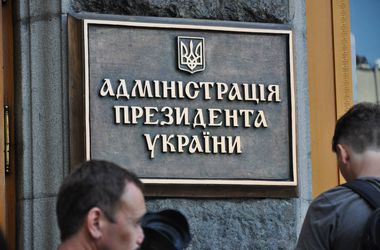
Administration of the President
The Presidential Administration, through Poroshenko: Who's Who Among the Top Officials
The main reformer, the main European integrationist, the authorized representative in Donbass and the “sister of mercy” – who are the main speakers of the Bankova
During Petro Poroshenko's nearly six months in office, his administration has managed to assemble a very stable and, it should be noted, quite extensive team. Heads of departments, divisions, main departments, and the presidential service are oddly coexisting on Bankova Street with deputy heads of the Presidential Administration (there are already five of them), two first deputies, the first assistant to the president, and the head of the administration himself. And that's not counting the press secretary and five advisers, who, according to Decree No. 870 of November 12, "are appointed for the term of the president's term and are civil servants."
Potentially, every third person on the list could, in theory, represent the president's position to society and the media. However, at the moment, the list of Poroshenko's "heralds" is limited to nine names. Segodnya.ua analyzed their key statements.
Dmitry SHIMKIV — Chief of Reforms
Since his July official presentation as Deputy Head of the Presidential Administration of Ukraine and chief expert on administrative, social, and economic reforms, Dmytro Shymkiv has already managed to change several roles.
Having started out as the chief reformer of the Presidential Administration of Ukraine and the ideologist of the rapid launch of 3G in Ukraine, the former head of the Microsoft representative office (from 2009 until joining the Presidential Administration of Ukraine) became the chief promoter of Poroshenko's National Reform Strategy, dubbed "Strategy 2020." Today, he is the most cited figure among the entire "presidential ranks." His recent offer by Prime Minister Arseniy Yatsenyuk to head the Ministry of Economic Development and Trade in the future Cabinet of Ministers has also added to his profile.
"By 2020, Ukraine should be in the top twenty in the ease of doing business rankings," Shymkiv promised in one of his speeches. "To become an EU member, Ukraine must meet 35 specific criteria," which it can achieve "over the next five to six years" thanks to the Association Agreement. We can also expect increased life expectancy, more sporting victories, and, yes, EU accession by 20.
However, he did talk about "Strategy 2020" at length; but Ukrainian society certainly has someone to hold accountable, if necessary.
ZUBKO Gennady - constitutionalist
Gennady Zubko, the first deputy head of the Presidential Administration of Ukraine, can safely be considered Bankova's key expert on legal issues. Despite the complete failure of Poroshenko's constitutional amendment initiatives, for which Zubko was the main speaker, he remained in the public eye.
And it was he who was entrusted with commenting on such a sensitive issue as official Kyiv's refusal to provide social benefits to Ukrainian citizens remaining in militant-controlled territory, which had effectively pushed some to the brink of death. However, despite the fact that Zubko was one of the president's five personnel appointments following the constitutional fiasco, his visibility in the media has diminished, and judging by the fact that his biography has disappeared from the Presidential Administration of Ukraine's website, we will likely see him in a different capacity in the near future. And it's far from certain that he will remain the herald of the ideas and plans of the guarantor of the Constitution.
Gennady Zubko believes that "in order to receive social security and pension benefits, it is necessary to register in the territory controlled by the Ukrainian government and receive a pension there," while "such people must re-register themselves and their businesses," since "the state must fulfill its obligations to these Ukrainian citizens and Ukrainian businesses."
He didn’t talk about how those who can’t leave, who have nowhere to go, or nothing to leave with, can survive…
Valery CHALY – European integrationist
Valeriy Chaly has become the President's chief ambassador for understanding the international situation. During the most challenging and tense moments, it was he, who came to the Presidential Administration of Ukraine from his position as Director General of the Razumkov Center and one of the ideologists of the Anti-Crisis Center, who bore the brunt of the fire related to both the Minsk agreements and the ceasefire and resumption of hostilities, including the law on special status and all victories and setbacks on the diplomatic front. Like Zubko, his biography is no longer listed on the Presidential Administration of Ukraine's website. However, unlike the latter, Chaly is tipped for a new position – the position of chief European integrationist, and, as a consequence, work on the further implementation of the Association Agreement with the EU in the future Yatsenyuk Cabinet.
Chaly believes the key objective is "avoiding a full-scale war in central Europe," which is why "strikebacks (against columns of Russian military equipment)—ed.), as military experts have repeatedly called for—shelling them before they enter cities—in his view, "is the beginning of a war using air power." And, as a consequence, there is a risk of further escalation, "and then it will be a different story."
At the same time, he acknowledges that "events in Ukraine have demonstrated that the European security architecture based on the Paris and Helsinki Charters no longer exists," and that "the annexation of Crimea and the hybrid war waged by Russia against Ukraine have completely changed Ukrainian realities," and that now "principles such as sovereignty, territorial integrity, and non-interference in sovereign affairs are now under threat." He concludes that the only thing that can guarantee Ukraine's security "is internal unity," and while "we rely on our partners," we must "recognize that the security guaranteed to us by the Budapest Memorandum no longer works."
Irina Gerashchenko – Listen to Donbass
The very appointment of Yushchenko's former press secretary, and later a UDAR MP, to the position of presidential envoy for the settlement of the situation in the east initially seemed, to put it mildly, dubious. Her unfamiliarity with the region's specifics and her lack of diplomatic and negotiating experience—all of this generated considerable skepticism among experts. However, as time has shown, Gerashchenko focused exclusively on civilian and humanitarian issues, without addressing the issue of warfare methods.
Gerashchenko is convinced that "the liberation of the occupied territories is possible not only thanks to a strong army, but also by creating a strong civic position in society in these territories, and this requires a serious information policy." According to her, "the list of hostages and missing persons currently numbers 2,800 people," and "implementation of the second point of the Minsk Protocol on the mandatory release of all hostages has indeed slowed down." Overall, "over the entire duration of the ATO, 1300 people have been freed, 722 of them recently."
Yuriy Biryukov – the ATO “phoenix”
The decision to appoint volunteer Yuriy Biryukov, who had organized an entire movement to support the Ukrainian army called the "Phoenix Wings Army Assistance Fund," as presidential adviser was virtually unanimous. After the Ilovaisk tragedy, Bankova desperately needed someone who could comment on the events from the front and possess sufficient authority, especially given the widespread criticism. Moreover, Biryukov was quickly promoted from adviser to the head of the Ministry of Defense for army procurement less than two months later.
Biryukov estimates that the war with Russia has already cost Ukraine "around 12 billion hryvnias," and although "warring countries spend tens, hundreds of times more, such sums are unaffordable for our economy." According to his calculations, "in recent years, the Ministry of Defense has allocated 60 million hryvnias for uniforms, equipment, footwear, soap, and bedding (this year, the clothing department received approximately 700 million). "The equipment of one soldier, inexpensive and not of the best quality, costs around 5 hryvnias. We have 5 soldiers. That means we need 200 billion hryvnias," Biryukov concludes.
He is convinced, however, that if not for the "information hysteria," the Ukrainian army would have suffered its worst defeat since the conflict in the east at Ilovaisk. "The 72nd and 79th Brigades were encircled in Sector D in July. This includes Maryinka, Dmytrivka, and Saur-Mohyla. There were significantly more of them than in Ilovaisk – 4,5 fighters. But no one made a fuss about it, and the guys were able to break through the encirclement and escape. They lost five men. And at Ilovaisk, the enemy decided it was a safari and a matter of honor to destroy the groups that all of Ukraine was trumpeting," he states.
DZHEMILEV Mustafa - leader of Crimea
Crimean Tatar leader and former head of the Crimean Tatar Mejlis, Mustafa Dzhemilev, was also accepted into Poroshenko's team, receiving the post of Presidential Commissioner for Crimean Tatar Affairs. However, it appears Dzhemilev will soon return to the Verkhovna Rada, where he may head the new parliamentary committee on occupied territories.
Dzhemilev remains optimistic and believes Crimea will return to Ukraine, but believes this will only be possible "if Crimean Tatars and Ukrainians stand together." Moreover, he recently admitted that a Crimean Tatar battalion could be created in the near future. "The President and I discussed the creation of a Crimean Tatar military unit for the southern direction, because the situation in the Kherson region is quite alarming. This is still under discussion, and then we'll see," Dzhemilev emphasized recently, admitting that "approximately 450 Crimean Tatars are participating in various military battalions in the anti-terrorist operation (ATO), including on the front lines," emphasizing that "the relatives of these servicemen are particularly at risk in the territory of Crimea annexed by Russia and are being held hostage by local authorities, and therefore the names of such servicemen must be kept confidential."
KNYAZEVICH Ruslan – envoy to the Rada
But someone who effectively disappeared from the news cycle was Ruslan Kniazevych, the Presidential Representative in the Verkhovna Rada, a member of parliament from the Batkivshchyna faction when he assumed the post. After the elections (although he commented quite actively on the parliamentary campaign, serving as the Petro Poroshenko Bloc's representative on the Central Election Commission), he disappeared not only from television screens but from the media landscape altogether.
Despite the fact that coalition negotiations are in full swing, he, as the current representative of the President in parliament, has made no public comments.
For now, Knyazevich's most high-profile statement remains his public call to "recognize the 'DPR' and 'LPR' as terrorist organizations." "Separatists are actively shelling residential areas in front of Russian television cameras... And I would like to appeal to parliament to now appeal to international organizations, as the president has done, to recognize the 'DPR' and 'LPR' and their accomplices as terrorist organizations. This will enable a truly effective response," Knyazevich told deputies in the session hall in July of this year.
PLAYONET Olga – Sister of Mercy
An Honored Doctor of Ukraine, a well-known public figure, and a Maidan volunteer, Olga Bogomolets joined the presidential team in the fall and immediately became a sort of "Sister of Mercy" for Bankova.
Bogomolets is convinced that "every doctor, teacher, and law enforcement officer must undergo military medical training and be prepared to competently provide first aid, and every doctor must be prepared to become a military doctor." Regarding Donbas, Bogomolets says, "besides militants and Russian troops, there are Ukrainians who need to be protected, and there are civilians in those territories who don't know where to go," because "no one is waiting for them in Kyiv, no one is offering them jobs, no one is offering them housing," and there are people "who can't move, children without parents, and there are large families." Furthermore, "in Donbas, there are many divorced women raising children."
But the heir to a distinguished family doesn't forget about healthcare either. According to her, "we need to determine Ukraine's actual annual vaccine needs, analyze the existing market, primarily among Ukrainian manufacturers of immunization products, and develop a program that will eliminate situations like today's, where the Ministry of Health is unable to procure and administer vaccinations because 'someone is holding up sales.' We have the will to break these corrupt schemes," she states regarding the immunization situation in Ukraine.
TSEGOLKO Svyatoslav - network press secretary
Svyatoslav Tsegolko, the press secretary of Ukraine's fifth president, could arguably be called the quietest in history. He's a press secretary, not a head of information like Gromnitskaya, Gerashchenko, Vannikova, or Herman. After all, Poroshenko's longtime aide, Iryna Friz , essentially runs the entire media process, while Tsegolko merely serves as a media relations assistant. This likely explains why it's sometimes difficult to contact Tsegolko, and once contacted, the best one can hope for is a simple yes or no. However, Tsegolko has much to say, and when the opportunity arises, it will be very interesting to learn the details of President Poroshenko's most crucial negotiations during his first year in office, including visits to Minsk, Washington, Brussels, and Milan.
For now, his comments are mostly limited to social media, where Tsegolko regularly reports on the president's actions. For example, one recent post vividly and succinctly describes the situation in the gas market.
"Intensive negotiations in Bratislava. Slovakia guarantees compliance [with supply conditions – ed.] with the reverse gas flow. Ukraine wants to create a gas hub so that gas is not used as a means of political pressure. Meetings of the Visegrad Four are coming up. Poroshenko will also meet separately with the presidents of Poland and Germany. The Slovak side has already assured that it will continue the reverse gas flow despite the reduction in supplies from Russia. Europe must be united, and as President Kosicka stated, Ukrainian soldiers are fighting not only for Ukraine, but for all of Europe and its values," the President's press secretary wrote on his Facebook page in a post on November 16.
IN THE SHADOW. This exhausts the list of presidential spokesmen. But it could be expanded in the very near future. After all, the Presidential Administration's personnel list includes not only the immediate head of the Administration, successful media manager Borys Lozhkin, but also the deputy head of the Presidential Administration of Ukraine, the owner of one of the most successful businesses in the agricultural sector, and the country's chief "birdman," Yuriy Kosyuk, who was introduced to the public at the same time as Shymkiv.
Moreover, long-time associate and chief political strategist of the BPP, Ihor Hryniv (although apparently also leaving Bankova for the "dominion" of the Rada), and acting Prosecutor General Oleh Makhnitsky , who has moved into the role of advisor to the President after leaving his post, can speak excellently about ideas and strategy, as can another advisor who recently joined the presidential team, Volodymyr Horbulin, who at the dawn of independence headed both the National Space Agency and the National Security Council under the President of Ukraine (now the NSDC).
Poroshenko's team also includes Ihor Smeshko, the former head of the Security Service of Ukraine (SBU) (in the last year before and the first two years after the Orange Revolution) and three-time head of the Presidential Intelligence Committee, who returned to head it after the Ilovaisk tragedy. Unfortunately, after a sparkling inauguration briefing, he has so far kept a low profile.
The same can be said for now about Yuriy Ruban, one of the most prominent, albeit somewhat radical, spokespersons of the Yushchenko era, who headed the National Institute for Strategic Studies for five years from 2005 to 2010. In September 2014, he became head of the Presidential Administration's Main Department for Humanitarian Policy.
Subscribe to our channels on Telegram, Facebook , Twitter , VK - Only new faces from the SKLEP section!