

Alexander Loifenfeld
Alexander Yakovlevich Loifenfeld (according to SKELET-info , nicknamed "Louis" among his criminal friends) keeps a low profile in the media, makes no sweeping or "incriminating" statements, doesn't "attach" himself to the Maidan, and doesn't assist the Anti-Terrorist Operation (ATO). He's quietly and purposefully amassing wealth even during the crisis, as befits a true Jew.
Loifenfeld's most notorious high-profile cases involve the collapse of Sintez Bank, the purchase of shares in the Paton Plant, the acquisition and sale of the Globus shopping and entertainment center and luxury real estate in central Kyiv—the so-called Baron's Castle—and money laundering by the Babyn Yar Memorial Foundation, which he headed.
We tell the success story of Kyiv's most secretive millionaire, featuring the flamboyant schemes.
Life in the slums
Alexander Yakovlevich Loifenfeld was born in 1957 in Kyiv, the third child in a large Jewish family. The family, with five children, lived in extreme poverty—they lacked money for food and clothing. So, at the age of two, Alexander's mother gave him to his grandmother in Petrozavodsk, Karelia, to be raised. A few years later, his parents took their son back to the capital, and gave their daughter to a relative. During this time, Alexander was sent to a boarding school in Kyiv. He spent two years there, and then returned to his grandmother in the north. The Loifenfelds finally took their son back to the Ukrainian capital when he turned 15. But the family's financial situation remained dire: the three sons shared a room and took turns sleeping on the floor because the apartment lacked beds and there was no room for a folding bed.
At 16, to help support his family, Alexander Loifenfeld took a job as an electrician at a medical equipment factory in Kyiv. Five years later, his career took off, and he became a foreman. In those years, Alexander Yakovlevich could be called a Stakhanovite; his brigade participated in all-Union competitions and won first place. He worked at the factory until the onset of perestroika. With its onset, Loifenfeld wanted to join the "fashionable" trend of creating a cooperative out of his factory brigade. At the time, such organizations skimmed the cream of the crop: workers traveled on business trips, worked abroad, and the paperwork indicated that everything was handled by intermediaries—cooperatives. Alexander Yakovlevich wanted his brigade to become a cooperative and work for itself. The idea failed miserably, and the innovator was fired from the factory.
In 1989, Loifenfeld got a job as a salesman at the Moscow Regional Food Trade Department, but lasted only six months before quitting. His next job was at the Sever Association of Zovnishinform JSC, where he served as chief engineer.
While Alexander Yakovlevich was changing jobs, the technology boom was beginning. So he fell in line and went into business, selling computers. His connections at the factory helped. At the same time, Loifenfeld decided to pursue higher education and enrolled in the law department of the Institute of Internal Affairs. Before perestroika, no university accepted the young man's applications, due to the "fifth column"—his nationality. A legal education was vital at this stage for Alexander Yakovlevich, as he had a plan in mind: to pursue investment projects.
Little is known about the next three years of Mr. Loifenfeld's life, as is the case with many of the businessmen who made their fortunes in the early 1990s.
The Synthesis Scam
It's 1993. In a country engulfed in buy-and-sell operations, a new bank is founded. Its name is "Sintez." Its founder is unknown to the general public, and few care. It won't be long before the bank's director emerges from the shadows, building where it's not allowed and seizing state-owned land. He turns out to be Alexander Loifenfeld. However, in reality, the bank was created jointly with the Tabachnik brothers, Dmitry and Mikhail (Dmitry Tabachnik would later become the Minister of Education and Science of Ukraine ( read more about him in the article " Dmitry and Mikhail Tabachnik: Brother for Brother ") , and Mikhail would become a businessman, heading Graal LLC, a real estate developer). This information is kept under wraps until the very end. Essentially, Alexander Loifenfeld is the brothers' capital broker, and his position was needed solely to oversee their shadow banking operations.
For 7 years after its establishment, Sintez Bank dealt exclusively with issuing small loans and did not carry out large transactions.
Everything changed in 2000. Tatyana Shatskikh came to work at Sintez Bank. She found a job as an economist. It's unclear exactly how Shatskikh and Loifenfeld came up with the idea to create a financial pyramid (similar to MMM), but they began implementing it systematically. Tatyana Shatskikh's mother, Natalya Sergeevna, and her brothers were recruited to help with the scheme. The gist of the scheme was this: the Shatskikhs collected money at high interest rates from people greedy for profit, tired of everyday life, and simply gullible, ostensibly for the international sale and purchase of rare stamps. They had a ton of receipts. Natalya Sergeevna brought the money to her daughter at Sintez Bank, who then gave it to Loifenfeld. Incidentally, at this time, interesting facts began to emerge: it turned out that at that time, Alexander Yakovlevich had the best collection of rare stamps in Ukraine, if not in Europe. This was a childhood hobby of a poor Jewish boy.

The fraudulent scheme operated successfully for five years. Then, Tatyana Shatskikh transferred to the Ukrainian Financial Group bank, founded in 2004 and liquidated in 2010. It belonged to the chairman of the Supervisory Board, Valeriy Babich, a businessman and politician, owner of the Bukovyna oil and gas company, which in 2004 received special permits for gas production in the Chernivtsi region. Natalya Sergeyevna completely disappeared into the vastness of Ukraine. And all would have been well, had not the victim, Irina Krikunova, appeared out of nowhere. She began filing complaints with every district police station. Criminal cases were opened, but no one could be held accountable – Tatyana was not involved in the schemes, and Natalya Sergeyevna was nowhere to be found.
The victim, Irina Krikunova, decides to conduct her own investigation and discovers that the bank's owner, Loifenfeld, is quite the character – he's engaged in corporate raiding, illegal construction in Kyiv, VAT refunds, and has offshore accounts in Cyprus. Perhaps Krikunova and the investigator would have raised public awareness, but then MP Dmitry Kryuchkov appeared in their path . He files a request with the Prosecutor General's Office regarding interference in Alexander Loifenfeld's private life.
Incidentally, Dmitry Kryuchkov himself has a rather strange biography: non-partisan, officially unemployed at the time of the inquiry, and previously deputy chairman of the Rivne Regional State Administration, dismissed amid scandal, accused of accepting a bribe of 13 registered shares of the Rivne Nuclear Power Plant Construction Management JSC. Kryuchkov and his brother, Leonid, also managed the Kyivrekonstruktsiya enterprise and were involved in corporate raiding and construction scams.
Of course, after this statement, the investigator was removed from the case, and Krikunova was gently warned not to interfere. Loifenfeld's case was closed.
The victim tried to appeal the case's closure for about a year, but everything stalled at the Prosecutor General's Office or the Main Directorate of the Ministry of Internal Affairs in Kyiv. And why? Viktor Kudryavtsev, Deputy Prosecutor General, and Vitaly Yarema, the former Prosecutor General of Ukraine ( read more about him in the article "Vitaliy Yarema: An "Honest Cop" and Serhiy Dumchev's Godfather" ), then simply the head of the Kyiv police headquarters and a city council member, stood up for Oleksandr Yakovlevich.
The matter even reached the Presidential Secretariat. Irina Krikunova was supposed to be received by Igor Gelyarovich Pukhin, Deputy Head of the Presidential Secretariat of Ukraine, but three aides showed up instead. Even this didn't help; the matter was hushed up.
Problems at Sintez began in 2008. The bank issued large loans and stopped paying deposits, citing a lack of funds. The reason for the problems was attributed to the institution having two large borrowers who owed it hundreds of millions of hryvnias and stopped paying. In the summer of 2010, the situation reached its climax: the National Bank placed Sintez under temporary administration, which meant its imminent closure. By late autumn, the National Bank revoked the bank's license and initiated liquidation proceedings. Loifenfeld wasn't particularly concerned about this, despite the fact that he, with a 74,92% stake, and Premium Plus LLC, with 24,96%, were the largest shareholders.
We can assume the "Synthesis" scam has served its purpose. It's time to move on.
Proper investments and corporate raids
Loifenfeld puts money to work in another way – through capital investments. This path has been linked to several high-profile scandals.

The Babi Yar Memorial Foundation . A stunning scam by Loifenfeld. So, in 2006, Alexander Yakovlevich became the Chairman of the Supervisory Board of the Babi Yar Memorial Foundation and worked on the creation of a museum-memorial at Babi Yar, while the Chairman of the Board was Vadim Rabinovich ( read more about him in the article "Vadim Rabinovich: Secrets of an Underground Billionaire "). Loifenfeld allegedly used his own money to purchase an unfinished construction project located on the very site of the mass shootings and transferred it to the foundation. He also wanted to lease land from the state to create a park near the memorial. His intentions were good. Only in 2008 did a strange incident occur. The Babi Yar Memorial Foundation was seized; more precisely, a certain company appropriated the building and the unfinished monument. The SBU uncovered the case. It turned out that citizen O. Shcherban, working with a shell company, Lukskom LLC, used forged documents to steal property through the Central Commodity Exchange. A criminal case was opened, but it was later dropped because the mysterious O. Shcherban disappeared. The case was hushed up. However, knowing the capabilities and methods of Alexander Loifenfeld, one can guess who is behind this scam.
The next incident occurred in 2009, when Ihor Kolomoisky assumed control of the Babi Yar ravine. The Kyiv City Council voted on a resolution "On Approving the Placement of Hotels in Kyiv through 2020." The document approved a plan for the placement of hotels in the capital. And then a truly blatant blasphemy emerged: it turned out that the deputies had decided to allocate almost two hectares of land in the Babi Yar ravine for the construction of one of the hotels! The resolution was fully supported by the Chernovetsky Bloc and the Kyiv Civic Activists. The latter party was a member of Loifenfeld at the dawn of his political career, and it, in turn, fully supported the Kyiv Mayor's Bloc. So the connection is clear.
As early as 2010, the Kyiv City Council excluded a plot of land in the tract from the hotel development plan. Public outcry ensued. The silence didn't last long. A year later, rumors resurfaced that an unknown company was attempting to seize the land, which by this time had already been resold several times using forged documents.
It's worth noting that Alexander Loifenfeld's name never appeared in the Babi Yar case. Moreover, for his contributions, he was recognized as Philanthropist of the Year in 2007.
Saturn OJSC. In 2006, Vladimir Chmil, Chairman of the Board of Saturn Scientific and Production Enterprise OJSC (the only scientific and applied organization in Ukraine with a full production cycle for military and civilian microwave electronic devices using arsenic-helium technology, a technology possessed by only eight countries worldwide), announced plans for a corporate raid. He named the main raider as Alexander Loifenfeld and his bank, Sintez. How did this connection come about?
In 1994, as the corporatization program gained momentum, NPO Saturn was transformed into a joint-stock company. Alexander Loifenfeld acted with precision: since his bank was a partner in the company and provided loans, he bought out a portion of the shares, while the rest were purchased by the company's employees. He became the owner of 4,3% of Saturn's shares. At first glance, this may seem like a small amount, but compared to the other shares, 4,3% allowed Loifenfeld to wield considerable influence over the company.
The first conflict between a shareholder and the company arose in 1999. At that time, the plant's top management categorically refused to provide the bank with a letter of guarantee for its real estate. The second "clash" occurred in 2004. Employee shareholders with minor stakes decided to annually issue additional shares to increase the authorized capital of JSC NPP Saturn from UAH 0,4 million to UAH 3 million. However, Alexander Loifenfeld succeeded in having the additional share issue declared invalid.
By 2005, it was revealed that Saturn's main shareholders were UPTK CJSC (24,94%) and Oriyana-K, a private enterprise specializing in purchasing shares in state-owned enterprises. The founder of the latter organization was listed as Alexander Loifenfeld's common-law wife, Rozalinda Bondarskaya. That same year, another attempt to issue additional shares followed, but it was blocked by a court ruling from the Chuguevsky District Court of Kharkiv Oblast. This is truly odd: why is a Kharkiv court handling cases involving entities registered in Kyiv? Nevertheless, the court ruling granted Oriyana-K the right to purchase the entire additional share issue. This immediately increased Loifenfeld's and the company's combined stake to 42%. However, there was one miscalculation: Alexander Yakovlevich was unable to reach an agreement with the company's registrar, Okma. One of its owners and director, Vladimir Shcherban, made no secret of his loyalty to the chairman of the board of directors, Vladimir Chmil, and the family members who controlled the plant. Consequently, Loifenfeld held its own shareholder meeting and appointed its own registrar, the company "All-Ukrainian Registrar," headed by Dmitry Grantsev. His brother, Ivan Grantsev, had long worked for one of the leaders of the BYuT faction, Andriy Portnov, and his firm, "Portnov and Partners" ( more about him in the article " Andriy Portnov: A Raider's Story "). Incidentally, Portnov has a close relationship with Alexander Yakovlevich.
A logical question arises: what was it about Saturn that so interested Alexander Yakovlevich? It turns out Loifenfeld was right to be interested in the company's land in 1999. The land in question is 13 hectares of Kyiv land owned by Saturn. It could be used to build 20 houses. Each house would generate a profit of $2 million. So the competition was entirely justified.
However, in any corporate raid, there's someone who doesn't want to be seen—or, more accurately, the mastermind. In this case, according to Vladimir Chmil, it was Lev Mirimsky, a Crimean Ukrainian entrepreneur and politician, founder and leader of the Soyuz party, and a former member of the Bashmaki organized crime group.

NPP Saturn
In December 2008, a Saturn shareholders' meeting was held. Its main outcome was the admission of shareholders Alexander Loifenfeld and deputy Lev Mirimsky to all management bodies. Lev Yulievich's brother, Dmitry, who owns 4% of the shares, took one of five seats on the supervisory board, while Oriyana-K received one of two candidate positions on the supervisory board and one of three seats on the audit committee. Vladimir Berezhnoy, a delegate from Oriyana-K, also became a board member. Rumor has it that this event was preceded by lengthy negotiations over the compensation Vladimir Chmil personally sought, in cash, to avoid interfering with Mirimsky and Loifenfeld's takeover of Saturn.
Paton PlantIn 2007, Loifenfeld's wife's already well-known company, Oriyana-K
acquired a 5,9% stake in the Experimental Plant of Welding Equipment of the Paton Electric Welding Institute (OZSO). The securities were previously owned by Orgenergogaz, a subsidiary of Russia's Gazprom and the gas monopoly's leading engineering company. Gazprom was divesting non-core assets and therefore put them up for sale to Ukrainian companies. Incidentally, before the share sale, Orgenergogaz sent letters to shareholders offering a buyout. The State Property Fund, which owns 81,5% of the plant's shares, declined, and the others did not respond. Thus, Oriyana-K emerged as the only bidder at the auction for the 5,9% stake, and it purchased it. The main danger is that Loifenfeld now has the opportunity to gain complete control of the company if the State Property Fund decides to sell its shares.
Of course, Loifenfeld's area of interest is not the plant, but his land - about 10 hectares in the Pechersky district and in the area of the Stolichnoye Highway.
Only in this case did Alexander Yakovlevich encounter resistance. The new shareholder was disliked by the co-owners of Interagrotech and Explovel. The latter is considered to be within the sphere of influence of Vladimir Stepakhno, Chairman of the Board of Directors of the closed joint-stock company, who previously served as a member of the welders' supervisory board. However, they did not file a lawsuit, leaving that prerogative to the plant itself. However, the Kyiv Commercial Court dismissed the claim to invalidate the share purchase transaction.
It's worth noting that the plant and Loifenfeld had a long-standing relationship. Oriyana-K rented space at the plant for several years, and a branch of Sintez Bank was also located there.
Kyiv Experimental Plant Dnipro. In the summer of 2008, the Kyiv Experimental Plant Dnipro was liquidated. Loifenfeld had a hand in the matter. The plant had lost all its assets in 2004. A year earlier, bankruptcy proceedings had been initiated against Dnipro following a lawsuit filed by the Kyiv State Research Institute of Hydraulic Instruments over a debt of 271 hryvnias. After the lawsuit was filed, Kamerton 2004 LLC came to Dnipro's aid and offered to become an investor. This company is associated with Vladimir Bodnarov, who had served as a member of the Kyiv Regional Council since 2006, where he headed the standing committee on regional development and foreign economic relations. Alexander Loifenfeld was behind him. Vladimir Bodnarov also managed a large construction company, Majestic. Its owner, Rozaliya Bondarskaya, is the former common-law wife of Alexander Yakovlevich.
The most expensive "Globus" and FC
The purchase and sale transactions carried out by Loifenfeld are unique in both scale and value. However, they are all limited exclusively to the capital.
In 2007, Alexander Melamud and Garik Korogodsky, co-founders of the oil trader Alfa-Nafta and owners of the Aquarium fitness center, decided to sell the Globus shopping and entertainment center in Kyiv, located on Maidan Nezalezhnosti (rent per square meter is one of the highest in the capital, ranging from $50 to $200). They valued their creation at €170 million. Alexander Yakovlevich emerged as the leading contender. Why him? It's simple: the Loifenfeld-Melamud-Korogodsky trio had been connected since 2000, when the shopping center was under construction. The Melamud-Korogodsky duo approached businessman Loifenfeld for a loan from Sintez Bank. But Alexander Yakovlevich devised a clever scheme: he took out loans from Oschadbank, funneled them through his own bank, Sintez, and then never repaid them. And then came the ultimate in fraud—illegal VAT refunds. The scheme involves fraudsters submitting forged documents to tax authorities confirming construction work, claiming a VAT refund. The money is returned. However, the actual cost of the work turns out to be much lower, and it's being performed by other companies.
A year before the Globus shopping center was officially listed for sale, Loifenfeld received permission from the Antimonopoly Committee to acquire more than 25% of the shares of ACJ Holdings Limited (Nicosia, Cyprus). The company is engaged in investment activities in Ukraine and owns 50% of the shares of the Kyiv-based companies Delight LLC, Delight Plus LLC, and Delight City LLC. The primary purpose of these limited liability companies is to lease out their own retail space in Kyiv and the Kyiv region. All of them are controlled by Alexander Melamud and Garik Korogodsky. One of the companies, Delight LLC, operates the Globus shopping center on Maidan. So, without a doubt, it was no problem for Alexander Yakovlevich to acquire Globus. And it seemed like a stroke of luck. After all, by the most conservative estimates, the shopping center's net profit reaches $3 million per month. However, six months later, the businessman decided to sell the property.
100% of Globus shares were sold for $200 million to the British investment fund London & Regional Properties (L&RP). Experts have dubbed this deal the largest ever in the commercial real estate market. It was revealed that the agreement to sell the shopping center was signed in late 2006, but the deal was not completed until 2007.
It's worth noting that Globus isn't L&RP's only acquisition in Ukraine. It also owns the Podol Plaza office center and the Magellan shopping center.
Loifenfeld's second breakthrough deal was the sale of Arsenal Football Club. Until February 2008, he owned half of the club's shares, which he eventually sold to Vadim Rabinovich. The deal's value remains a secret, but we can assume it was in the millions.
Illegal construction
Alexander Loifenfeld and his family (his ex-wife and daughter) own a whole host of companies with sometimes bizarre names: Zamok, Magus, Septada, Impex, Harbo, Tiv, Libra, Podilbud, Centrobud-205, Tekna, Kozak, Buildinvest, and River Town. This list is incomplete; many of the companies are registered to other people but have a direct connection to Loifenfeld. Their main activity is construction and the acquisition of land for it. It's worth noting that the Loifenfelds select prime land for their developments.
The Pobeda Sanatorium Land . In 2006, Kyiv Mayor Leonid Chernovetskyi allocated 18 hectares of land in the Svyatoshinsky district to the Pobeda Clinical Sanatorium, but changed his mind a year later and decided to transfer it to the River Town company. One of the company's founders is Rozaliya Bondarskaya.
Land on Andriyivskyy Descent. In 2013, a land scandal erupted in Podil. The land in question concerned several buildings on Andriyivskyy Descent, where artists exhibit their paintings. The company "Aviantbud" wanted to demolish the structures. However, the developer and the artists reached an amicable agreement: the company promised to restore some buildings, while others would be rebuilt and converted into cafes and restaurants. The owners of "Aviantbud" turned out to be Alexander Loifenfeld and Rozaliya Bondarskaya.
Land in Pushcha-Vodytsia . In 2013, the Kyiv City Council allocated 10 acres of land on the territory of a health resort in Pushcha-Vodytsia to Loifenfeld's daughter. The land's designated use was changed so that construction of an entertainment complex could begin in the protected area. However, the deal was annulled later that year.
Land on Yaroslaviv Val . In late 2014, a Kyiv court invalidated and overturned the 2007 Kyiv City Council decision to transfer a 0,66-hectare land plot at 40 Yaroslaviv Val Street to Konika LLC. The land was intended for the construction of classrooms, a theater studio, and an office and residential complex. As it turned out, the plot is designated for historical and cultural purposes and is part of the protected area of the St. Sophia Cathedral in Kyiv. The land lease violated the UNESCO Convention. Moreover, it was discovered that construction had already begun on the site, and an unfinished project exists. It is currently frozen. You must admit, it's quite brazen to build illegally in central Kyiv. Who could be behind this? An interesting fact has come to light: in the mid-2000s, Alexander Loifenfeld was one of the founders of Konika LLC. In addition, the company has a common telephone number with Centrobud-2005 LLC, Septada LLC, and Habro LLC, one of the founders of which is Alexander Loifenfeld.
Land on Anri Barbussa Street . At the end of 2014, a company associated with Loifenfeld collapsed again. The court refused to renew the lease agreement for a 3-hectare plot of land at 9 Anri Barbussa Street between the Kyiv City Council and Budalyansindustriya-2006 LLC. In 2007, the Kyiv City Council transferred the land to the company for the construction of a residential and office complex. The lease agreement was for five years. Since 2013, the company has been seeking an extension, but was denied because it had not provided a complete set of documents. Furthermore, the facility was supposed to be commissioned in 2011, but construction had not even begun at the time of the case. The founders of Budalyansindustriya-2006 LLC are Avtopromkhim LLC and the Cypriot company I.E.S. Infoserv Ltd. However, since 2007, the company has shared a contact phone number with L Kvadrat LLC, founded by Alexander Loifenfeld and Alexander Lutsky, a former Kyiv City Council member. Incidentally, the same phone number is also listed for Magus LLC, co-founded by Loifenfeld.
Land on Trukhanov Island . In 2015, the Kyiv City Council, with Klitschko's signature, terminated the lease for 2 hectares of land on Trukhanov Island at 42 Trukhanivska Street. He leased it for 15 years to the public organization "Desenka." It would seem like a good deed, everything for the people, if not for a few nuances. First, Desenka's phone number matches that of a private company, Zenit-Service, which specializes in real estate rentals and is quite wealthy. Second, one of the company's founders is listed as Inessa Loifenfeld, the daughter of Alexander Yakovlevich, born in 1990. Third, Desenka's director, Tatyana Imas, has a stake in Zenit-Service and was appointed Chair of the Audit Commission.
Land in the center of Kyiv. Another high-profile story erupted in 2016. In May, Impex-Project, a private joint-stock company, renewed its lease agreement for 1,69 hectares at 6 Staronavodnytska Street through the courts. This plot had been transferred to the company by the Kyiv City Council in 2009 for five years. The plan was to build a residential and office complex with underground parking there. After the lease expired, Impex-Project applied to the Kyiv City Council for an extension, but received no response. It soon emerged that the plot had been seized as part of a criminal case back in 2012, but the seizure was miraculously lifted by the Prosecutor's Office in 2015, and by the Security Service of Ukraine (SBU) in 2016. Interestingly, information about this plot is absent from the property registry, and the grounds for the seizure and the names of the investigators are unknown. Despite this, the lease was renewed.
Inna Loifenfeld is the sole owner of Impex-Proekt PJSC shares. And the most important detail is that at the time the company was allocated land, Loifenfeld was a member of the Kyiv Civic Activists parliamentary faction, which consistently voted in unison with the Leonid Chernovetskyi Bloc.
Destruction of an architectural monumentThe most egregious scandal of 2016 is unfolding in the center of the capital. Not far from the Verkhovna Rada and the Cabinet of Ministers, the Graal company, linked to former Education Minister Dmytro Tabachnyk (the owner is the politician's brother, Mykhailo) and his partner, former City Council deputy and oligarch Oleksandr Loifenfeld, is renovating a building at 4B Grushevsky Street. MP Ihor Lutsenko wrote about this on his Facebook page and published photographs. The MP noted that Tabachnyk-Loifenfeld's development company is attempting to remove the building from the register of architectural monuments in order to build a luxury hotel in its place.More: Tabachnik-Loifenfeld's Grail firm is destroying an architectural monument in Kyiv.).
Failed policy
What Alexander Yakovlevich had to work hard for was to obtain the coveted deputy's card.
Loifenfeld first ran for the Verkhovna Rada in 2006, as the 16th candidate on the list of the For the Union party's electoral bloc. The bloc was led by the controversial Volodymyr Goshovsky and Lev Mirimsky. The bloc garnered only 0,2% of the vote and failed to gain entry into parliament. At the same time, the millionaire ran for the Kyiv City Council and was number two on the list of the Kyiv city branch of the All-Ukrainian Patriotic Union political party. Kateryna Okhendovsky, wife of Central Election Commission member Mykhailo Okhendovsky, topped the list.
In 2007, Loifenfeld ran in the snap parliamentary elections as part of the "Kuchma" bloc ("Constitution-Ukraine-Honor-Peace-Anti-Fascism"). This was a political project that united the interests of longtime friends: Oleksandr Volkov, Oleksandr Zadorozhny, Vadym Rabinovich, and Oleksandr Loifenfeld. Oleksandr Yakovlevich was number 11 on the party list. Incidentally, he reserved the next step in the party for Oksana Tsyganenko, an employee of the firm "L.Kvadrat."
The millionaire made another attempt to become a member of parliament in 2008. This time, he won a seat on the Kyiv City Council with a faction called the Kyiv Civic Activist Committee (HAK) led by Oleksandr Pabat. Before the elections, it was dubbed "black," as it included a who's who of corrupt officials at all levels, as well as millionaires—Igor Bakalenko, founder of the Furshet retail chain; Dmitry Kazakov, a member of the land commission and the main promoter of illegal construction projects; Galina Gerega, owner of the Epicenter construction hypermarkets ( read more about her in the article "How the Gerega Family Successfully Rip Off Kyivites" ), and others.
It's worth noting that the State Joint Stock Company was the brainchild of the renowned magnate Vasyl Khmelnytsky (former owner of the Zaporizhstal plant). He, combining his business and political efforts with Andriy Ivanov, successfully established a new force in the Kyiv City Council.
In 2014, Loifenfeld ran for the Kyiv City Council again. He was number three on the list of the little-known but active party "Rights of Will Ukraine."
In 2015, he represented Oleksandr Omelchenko's Unity party ( read more about him in Oleksandr Omelchenko: Secrets of the Past of Klitschko's Main Competitor in the Kyiv Elections ).
Weaknesses of a Millionaire
Beloved women. Today, millionaire Loifenfeld has two: a daughter and a mistress. His former common-law wife, a private figure, provides for herself entirely, with some help from her husband, of course. So, Alexander Yakovlevich is left to care for his daughter and mistress, who, incidentally, are practically the same age. And he does so successfully.

Innesa Loifenfeld
For example, in 2013, the Kyiv City Council gifted Innesa's daughter a 1-hectare plot of land for the construction of a dacha at 9 Kurortna Street in the Obolonskyi District. She built a cottage there with a total area of 511,9 square meters. Incidentally, no regulatory appraisal of the plot was conducted, and there is no information on land use fees.

In 2015, the millionaire's girlfriend, 28-year-old Yulia Yurchuk, also received a "gift." She was appointed deputy director of Kyivtransparkservice, which brings in 4 million hryvnias monthly. And that's only according to official statistics. According to unofficial statistics, the company brings in 26 million hryvnias monthly. After graduating from university, Yulia worked for a while as an accountant at the private company Dobro-Plast, and then immediately moved up to the deputy director's chair. However, before that, she spent time entertaining Oleksandr Yakovlevich.
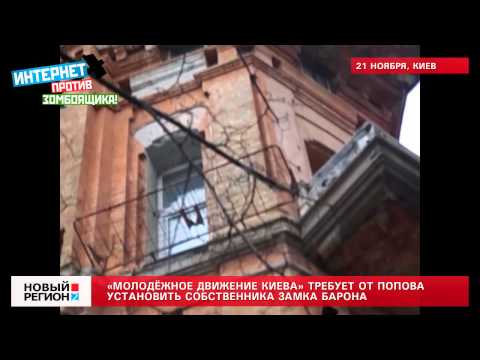
Baron Steingel's Castle . In 2012, Loifenfeld began formalizing the rights to the building in central Kyiv at 1 Yaroslaviv Val Street, known as Steingel's Castle. Many experts believed that selling such a property would be difficult, as it required complete restoration and major renovations. But millionaire Loifenfeld is capable of anything. Moreover, he began buying apartments in this building back in 1998 and completed the acquisition in 2006.
Alexander Loifenfeld is purposefully and methodically building his empire by acquiring real estate in Kyiv. By the way, who owns your house?
Arina Dmitrieva, for SKELET-info
Subscribe to our channels on Telegram, Facebook , Twitter , VK - Only new faces from the SKLEP section!