
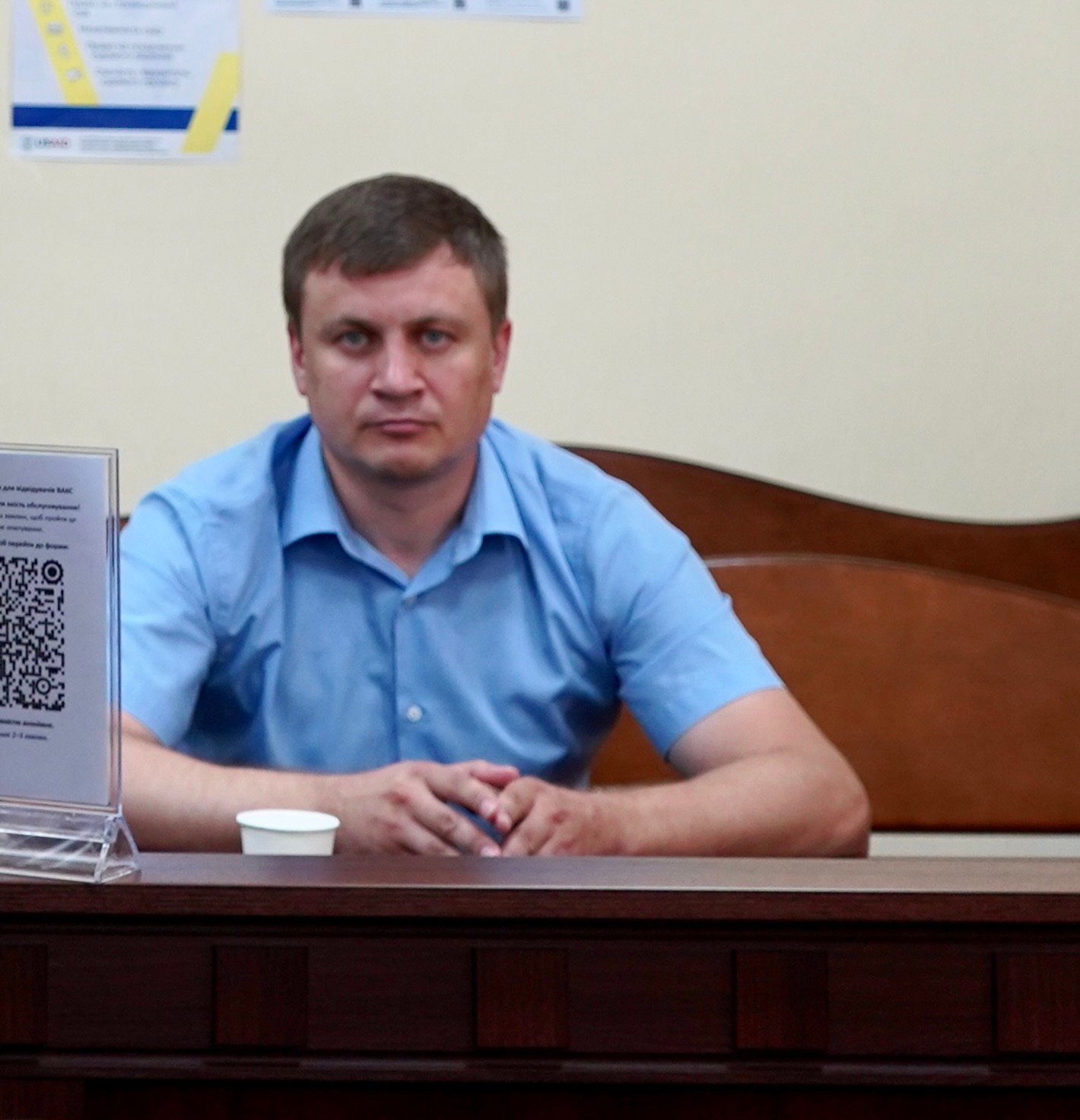
Former head of the State Judicial Administration Alexei Salnikov was found guilty of influence peddling, writes the Court Reporter.
He was notified of the suspicion two years ago, a couple of months after the high-profile exposure of the then Chairman of the Supreme Court, Vsevolod Knyazev.
According to the prosecution, the head of the State Security Service received $7,5 in exchange for promising to help with the Supreme Court's decision in the case of the company "Fowarter Plus," which was suing for a permit to mine sand.
NABU documented a meeting on March 5, 2023, at the Prague restaurant. The official accepted the money, saying, "We can do all this for five rubles..." The interlocutor asked if Alexey Salnikov himself was included in the sum, and when he realized he wasn't, he added another 2,5 rubles, joking about dumping the funds, as the prices for the Supreme Court were low.
Alexey Salnikov. One small matter.
The official complaint against Salnikov was filed with the NABU by serviceman Oleksiy Gonchar on March 1, 2023.
"I learned from lawyer friends of mine about a trial in the Cassation Administrative Court of the Supreme Court regarding a claim by Forvater Plus LLC against the State Service of Geology and Subsoil of Ukraine... Knowing that I knew Salnikov, they asked me to inquire about the case. In November 2022, during a meeting with Salnikov, I informed him of the case and asked if he knew anything about it... Later, during our conversation, he informed me that he had spoken with the head of the Cassation Administrative Court of the Supreme Court about the case, and on February 27, 2023, [during a meeting] that took place in a restaurant, the Supreme Court ruled to send the case back for a new trial at the second instance and that a payment of $5000 was required for this. However, he did not provide details about who he intended to provide and how much of this amount..." the criminal complaint stated.
The NABU registered a criminal case alleging that Supreme Court judges, through an intermediary, requested an undue benefit for making a decision (Part 4 of Article 368 of the Criminal Code). Undercover investigative actions simply could not have been conducted under a weaker statute.
The first meeting under NABU supervision took place on March 5 at a restaurant, where Oleksiy Salnikov took the money. All subsequent meetings were filled with Gonchar's constant reminders of the "small matter" and Salnikov's justification for why the case was taking so long.
On March 8, Gonchar met with someone he'd seen near the administrative building of the State Judicial Administration of Ukraine. Oleksiy Salnikov told him that the money had been transferred ( That's all for that matter. I'll tell you, they gave it to him... ) and also said he would be meeting with Supreme Court Chairman Knyazev.
On the evening of March 14, 2023, Gonchar met with Salnikov outside the La Fontana restaurant in Pechersk. He asked if the delay in resolving the case was related to the amount of funds transferred, to which Alexey Salnikov replied that he could offer more: "I don't know. I think if I offer more, if he leaves, he'll offer, maybe she'll bite, persuade her ." Gonchar, for his part, agreed with the need for an increased sum: "Good information. We'll double it now... We'll beat him with a jackpot, as they say ." Gonchar then inquired about "comrade" (in the context of the conversation, this was Supreme Court Chairman Knyazev). Salnikov replied that he had spoken with him and perhaps he would have time for a meeting.

At the end of the meeting, Gonchar reiterated that he needed to meet with their "comrade" and saw no problem finding a few minutes to discuss the urgent matter (" It's really very important [the matter] "). Gonchar specifically mentioned both the decision and their "small matter" several times, so that Alexey Salnikov wouldn't forget to discuss it. Gonchar also warned that he would change his phone number to avoid wiretapping. Later, during questioning, Gonchar said he didn't remember what was meant by the "small matter/matter/story," but assumed it might have specifically concerned the Forvarter Plus LLC case.
On March 26, 2023, at a restaurant, Gonchar once again inquired about the resolution of their "little case." Alexey Salnikov, in turn, replied that everything would be done the following week, as he had already spoken with a "comrade" who would resolve the matter: "We'll do it next week. I already spoke with a friend... I kind of approached him about this... I said that I'll resolve this matter next week." When asked how the matter would be resolved, Alexey Salnikov explained that "downward," meaning sending the case back to a lower court for retrial.
Subscribe to our X channel , Telegram channel and Facebook page!
Stay informed about who is doing business, in politics, and supporting corruption in Ukraine!
On March 30, 2023, Salnikov informed Gonchar that a minor matter "would be resolved at the end of the week, since a judge from the panel had been absent until then. Therefore, when a panel of three judges is present, a court hearing will be scheduled and the case will be heard."
On March 31, Alexey Salnikov sent his deputy, Maxim Pampura, to meet with Gonchar. He got into Gonchar's car and drove around the courthouse. A phone conversation ensued in the car, which Salnikov joined via speakerphone. Salnikov informed them that Knyazev's assistant, who was aware of the situation, was waiting at the courthouse: "The assistant to the director... And he's waiting. You should approach him and tell him about this situation. Tell him you wanted feedback. That's all . "
After this, Pampura entered the Cassation Administrative Court, while Gonchar waited in the car. An hour later, Pampura returned and confirmed to Gonchar that they needed to wait for a panel member to arrive to refer the case to the appellate court. "The discussion was about sending it down to the second instance... That's it. He confirms that. They're looking for a side judge, but whatever, it will be ," Pampura said.
On April 7, 2023, outside the State Administrative Court building, Alexey Salnikov told Gonchar that he had reminded Knyazev of a "personal matter" that had already been resolved. Upon hearing this, Knyazev allegedly scheduled a meeting for Monday morning with the Chairman of the Cassation Administrative Court, Mikhail Smokovich.
On April 10, Salnikov told Gonchar that he'd been to Knyazev's and seen Smokovich. The latter promised to make a positive decision within a month to return the Forvater Plus case to the appellate court. Smokovich said, "I promise we'll send it within a month ." I don't know how else to say. He said, "We'll draft it and now we'll see what grounds we can find, and then we'll send it down." "Well, that's it," he said, "I hope they do it quickly ." He asked, "What's the problem? What can't you say?" They said, "We need time to figure it out and find what grounds to send it down ." I said, "Okay ," Alexey Salnikov recounted.
The head of the State Administrative Court then reported increased activity by law enforcement agencies, whose representatives had visited the Supreme Court, and that Supreme Court Chief Justice Knyazev was aware of Gonchar's phone being tapped. "Moreover, our meeting with you was recorded and photographed while we were in this..." "He told me today. He said, 'They've become more active. They've started running. What are they running for? Your phones are listening, it seems. They've obtained permission to access your phone ,'" says Alexey Salnikov.
There is then a pause in the case file of almost three months—during this period, no meetings, telephone conversations, or correspondence are documented.
That is, either they were absent for more than three months, which is unlikely after the previous, fairly intensive communication, or the individuals involved, including Gonchar, who cooperated with NABU, were so secretive that they were not recorded, or the detectives decided not to show what they recorded.
It was during this period that the arrest of the head of the Supreme Court, Knyazev, took place.
The next recorded meeting between Gonchar and Salnikov was on July 14. Gonchar is outraged that so much time has passed, and this small issue remains unresolved.
"So, on March 5th, they kind of shook hands... Right?... On the 6th... you say: 'Everything's fine, everything's been handed out, everything's good, everything's going to be great.' Four months... They're getting ready, on Monday they'll go, fucking, to the troika, the troika will tell them no one gave them any shit, you understand? No one carried anything in, no one brought anything in... There'll be a fucking, huge scandal . "
Alexey Salnikov replied that he tried to resolve the matter, but was unsuccessful.
"I say, 'I can't help here.' That is, they approached them, talked once, talked a second time, talked a third time. I can't help here, because they're not responding ," the head of the State Security Service responded.
After some argument, Gonchar says the money needs to be returned. Alexey Salnikov replies that he already gave the money to Gonchar's friend two months ago.
Salnikov: “I drove up, a comrade drove up in this car, introduced himself, and said, ‘To the ZSU’.”
Potter: “Well, when, a month ago, two months ago, three months ago?”
Salnikov: "When we were talking, you said they got together and said they urgently needed all of this."
Gonchar: "Wait. Was it a month, two, three ago, or even roughly the exact date?"
Salnikov : "It was two months ago. You came to work, we talked..."
The men argue. Gonchar is indignant, wondering why he didn't know about this before, and reminds Salnikov of a conversation at the end of June that's not recorded in the case file ( "So we were sitting here, you fucking... Lyokha, what are you doing again? When was that? It was at the end of June" ).
In Gonchar's presence, Salnikov calls his assistant, puts her on speakerphone, and confirms that she personally gave the money to Gonchar's security guard.
Finally, Alexey Salnikov advises Gonchar to contact law enforcement.

On July 26, 2023, the head of the State Security Service was notified of suspicion of fraud and incitement to a completed attempt to provide an improper benefit.
On August 21, 2023, Assistant to the Chairperson of the State Administrative Court, Tatyana Dobrenko, filed a report with the National Police alleging fraudulent activity against her. However, the police records of her report were not preserved. At the court hearing, she testified that on May 24, 2023, Oleksiy Salnikov was on a business trip to Dnipro and was unable to hand over the money himself, so she asked him to do so.
"He said I should get a little emotional, he'd talk about purchasing a vehicle for the Ukrainian Armed Forces, and he'd agree on a time for me to hand over the funds ," Dobrovenko testified in court.
Salnikov's lawyers learned the name and phone number of Gonchar's then-security guard. According to mobile phone operators, there were indeed three phone calls between the assistant to the head of the State Security Service and Gonchar's security guard on May 24, 2023. Their phones were located within the coverage area of a base station in the Darnytskyi district of the capital.
A man who worked as a security guard for Gonchar initially refused to appear in court when summoned. He rudely called the court secretary and told him not to call again. The witness was only finally questioned after the court applied grounds for questioning. The husband confirmed that he once went to pick up a package on Gonchar's instructions. They don't remember the day or month. Some woman delivered it. "Tell them the package is for the Ukrainian Armed Forces, and they'll understand," he recalled Gonchar's instructions. He then allegedly brought the package home and left it on the nightstand.
The court found the return of the money proven, although Gonchar denies receiving it. The missing funds belonged to NABU. However, Gonchar was deemed a victim. The court noted that, logically, if the matter was being resolved in the interests of Forvater Plus LLC, the transferred funds should have belonged to that company. Therefore, it is unclear why Gonchar was specifically targeted.
Who is Gonchar and what does Alexey Salnikov have to do with it?
Oleksiy Salnikov met Oleksiy Honchar back in late 2015 – early 2016. At the time, he was the head of the State Property Fund in the Kherson and Mykolaiv regions. Salnikov testified in court that he attended a meeting with two members of parliament, where Honchar was also present with a large number of security guards. His new acquaintance claimed to be in business and owned his own law firms. When asked about Honchar, the members of parliament responded, "He's our colleague." Initially, Salnikov listed Honchar's contact information in his mobile phone as "Oleksiy, deputy." Upon closer inspection, Honchar clarified that he wasn't a member of parliament, but a businessman: "He seems to be an oligarch, but not a public figure."
Alexey Salnikov subsequently met with Gonchar in his office and there, according to him, he first saw the future Chairman of the Supreme Court, Knyazev, then still just a judge of the Nikolaev District Administrative Court.

Gonchar claims to have discussed many commercial matters with Salnikov, and the head of the regional state property fund allegedly helped him rent a cultural center in Nikolaev, which then housed the administrative court.
Today, Gonchar claims that Salnikov owes his career advancement in the judicial administration to him because he vouched for him with Knyazev. He introduced Salnikov to Knyazev and then allegedly convinced Knyazev to appoint Salnikov as head of the State Administrative Court, so they could earn a living. When questioned as a witness, Knyazev, of course, denied the voucher or the earnings. However, he admitted that Gonchar recommended Salnikov to him as a good specialist for the position of head of the territorial office of the State Administrative Court in Mykolaiv Oblast. In 2019, as a Supreme Court judge, Knyazev was not yet in a position to appoint him.
"Salnikov was appointed through a competition. As Gonchar later said, he was instrumental in this appointment. This is according to Gonchar... By that time, Gonchar was communicating with members of the High Council of Justice, and this was under the High Council of Justice's jurisdiction. Gonchar believed he had helped Salnikov advance his career ," Knyazev recounted from the witness stand.
Gonchar says that after Alexey Salnikov became head of the State Administrative Court, he sought legal advice from him on behalf of various individuals and acted as an intermediary in these cases. These commercial matters were allegedly resolved for a fee.
Before the full-scale invasion, Gonchar recounted, he, Salnikov, and Knyazev allegedly met frequently, the three of them, about once every two weeks. The topics of these meetings were commercial—how to make money with the GSA, specifically from employee insurance, repair work, construction, and so on.
Salnikov and Knyazev didn't deny having known this man for a long time, although not in the light Gonchar himself presented.

They apparently had no clear idea of what Gonchar actually did. But their testimony makes it clear that Gonchar impressed them with his ostentatious wealth and influence.
"Gonchar, it seemed to me, was a very rich man. He was constantly bragging about it, living in a luxurious house in Koncha Zaspa, where he invited people to visit. He had Maybachs, a Rolls-Royce, and so on. The house there was so big you couldn't even imagine... He used to say, 'I'm like an oligarch, but I don't show it off,'" Knyazev recounted.
"I visited him (Gonchar – ed.) at home. He also made me very happy, because, as he says in the NSRD materials, his house was worth millions of dollars ," Alexey Salnikov said, not hiding his delight.
Gonchar himself testified in court that he provided "consulting services" and received inside information, for which he could receive compensation. He also liked to talk about his influential connections, as a marketing strategy to increase awareness of his ability to resolve issues.
Yuriy Babenko, co-founder of Forwater Plus, had known Gonchar since 2016. Gonchar had two lawyers working in his office, and Forwater Plus consulted with them. Babenko met Gonchar in the offices of three MPs. One of the MPs, Oleksandr from the Mykolaiv region, later accused Goretsky of fraudulently embezzling his funds (referring to Zholobetsky, MP of the 8th convocation).
Babenko did indeed complain to Gonchar once that his case was stalling in the Supreme Court, and Gonchar promised to investigate. However, Gonchar apparently wasn't offered compensation for this, as he had previously received favors from them, and this would have been improper.
Babenko said he had never heard of Gonchar bribing judges. Then he read about his company in the media and was shocked. In December 2023, the Supreme Court finally reached the decision Forvater Plus desired. Gosgeologiya was ordered to re-examine the license application. But the company refused to continue operations.
It was through Gonchar's mediation that Knyazev and Salnikov apparently met lawyer Oleg Goretsky. Gonchar testified in court that he introduced Salnikov to Goretsky specifically because of the prospect of making money.
A few years later, it was Goretsky who would become one of the key figures in the corruption scandal in the Supreme Court and enter into a plea agreement.
Earlier, in 2021, Goretsky had the misfortune of lending Gonchar a quarter of a million dollars. The "successful businessman" never repaid him. Then the lawyer discovered that his acquaintance was a former Russian citizen who had served almost five years in prison for fraud and moved to Ukraine when he faced the risk of being reincarcerated. After receiving Ukrainian citizenship, the foreigner changed his last name three times.
In October 2021, Gonchar was detained by the Security Service of Ukraine on suspicion of fraudulent resale of land plots by a group of individuals.
Knyazev and Salnikov began hearing news about their mutual friend. And not only from the media, but also from their mutual friend, lawyer Goretsky, who now called Gonchar nothing less than a fraud.
Knyazev claims he stopped communicating with Gonchar back in December 2021, when he became Chief Justice of the Supreme Court. Alexey Salnikov, however, did not sever ties, a decision he later deeply regretted.
In November 2022, Gonchar was informed of one suspicion of fraudulent appropriation of funds—$210,000 from Haretsky and $295,000 from former MP Zholobetsky. On November 1, 2022, the court ordered Gonchar to be placed on bail. The suspect failed to post the money, and on December 13, the bail was changed to 24-hour house arrest with an electronic bracelet.
To understand, it was in November 2022, according to Gonchar, that he first told Salnikov about the Forwater Plus case.
On February 10, 2023, the court extended Gonchar's 24-hour house arrest for another two months. However, it was clear that the measure of restraint was not observed. According to Gonchar, it was at a meeting on February 27, 2023, that Salnikov told him that he needed to pay money for the court's decision. On March 1, 2023, the NABU registered a criminal case. And on March 5, at the Praga restaurant, under NABU supervision, Gonchar handed over $7,500 to Salnikov.
Alexey Gonchar wanted gratitude
Salnikov admitted taking the money but denied it was a bribe. He said Gonchar did indeed constantly remind him of his assistance and tried to make him feel guilty about his position.
Alexey Salnikov confirmed that Gonchar had a conversation with him about the Forwater Plus court case.
"He started saying he had some specific comrades, some powerful enterprises, and started offering to provide tens of thousands of dollars to resolve the matter. But he wouldn't tell me how."

Salnikov claims he refused to help Gonchar, but the latter continued to visit and offer funds for both Forwater Plus and other matters. Salnikov says he advised him to seek legal advice. Gonchar, however, began to talk about the criminal cases pending against him, claiming Salnikov was unwilling to help him even here, even though he had come to his aid in his hour of need. Gonchar mused aloud about mobilization to suspend his criminal proceedings. He repeatedly complained about Goretsky as someone who was causing him a ton of problems and asked for his intervention, possibly through law enforcement.
One day, Alexey Gonchar apparently saw on social media that Salnikov, as head of the State Security Service, had donated a car to the Femida military battalion. He suggested that Salnikov buy him a car for the front line. Salnikov declined, saying he didn't have the money. Then Gonchar asked how much a similar car would cost. Salnikov replied $5 plus $2 in equipment.
The former owner of Maybachs and Rolls-Royce said he would seek philanthropists to finance a car for him to take to the front lines.
Salnikov allegedly approached the commander of the Femida Battalion and asked him to find a car for his fellow soldier fighting. And on March 5, he believed he was borrowing money specifically for the car.
Salnikov: What is this?
Potter: These are the 5 you said.
Salnikov: Uh-huh.
Gonchar: The only thing I didn’t understand is, are you already there or not?
Salnikov: No, but nothing, they'll just close everything down.
Potter: If not, then somehow
Salnikov: We were saying something like... I went to tell him, even though my brother is not here, we can do all this for five bucks, if so, what will happen there?
Salnikov allegedly referred to the leader of the Femida Battalion as "brother," addressing him as "brother" or "comrade." Eduard Leonov, the Femida Battalion commander, was called to court as a defense witness. He confirmed that Alexey Salnikov asked for help buying a car for a serviceman he knew, and that in their correspondence they referred to each other as "brother," "friend," or "brother."

After examining all the evidence during the court hearing, prosecutor Oleh Makar stated that the NABU detective had incorrectly recorded Salnikov's statement in the NSRD report. Initially, the detective wrote, "There's no brother." The case was then transferred to another detective, who replayed the video recording and discovered that it contained a different statement. But they didn't revise the NSRD report for the sake of one word. In fact, according to the prosecutor, Salnikov said, "There's no ker apparatus." In other words, he was referring to the chief of staff of the Cassation Administrative Court.
It's difficult to say who's telling the truth: the prosecutor or the lawyers. But on March 5, immediately after the funds were transferred, Gonchar continued his conversation with Salnikov specifically about the court case.
— Look at the questions the guys ask right away. First, deadlines. They say, "Well, we'd like the issue resolved by the end of the month." Because we've already wasted a ton of time. That's the first thing. So, if you ask for a date, let them do it by the end of the month... Second, can we help with the second deadline and back again, because it'll come back anyway, it won't be there by the end of the deadline... Well, there's no need to guarantee anything, we just need to talk and understand whether we can or can't. How can you guarantee something that's beyond our control? Well, he should know, maybe he can from the apparatus itself... the apparatus. "Can we resolve the application there?" So that they can come back with the answer: "Yes, we can."
Gonchar's testimony states that Alexei Salnikov inquired about the prospects of the Forvater Plus case directly from the head of the Cassation Administrative Court's office, claiming to be in contact with the head of the office, who in turn was in contact with the judges.
The Supreme Court judges who heard the Forwater Plus case were questioned as witnesses and, of course, confirmed that no one had offered them anything. For some reason, neither the prosecutor nor the defense asked the court's chief of staff to be questioned.
Hidden motives
Initially, Gonchar allegedly lobbied Salnikov for the position of head of the State Investigative Service, as he himself claimed, not for purely selfless reasons—to make money together. But then he reported him to the NABU, effectively destroying his career and reputation.
Whether by chance or not, Oleksiy Gonchar became an anti-corruption activist when he ran into serious problems with law enforcement – the police and the Security Service of Ukraine.
Gonchar later explained that after mobilizing into the Ukrainian Armed Forces, he began to view corruption differently. Another trigger for Gonchar was Salnikov's friendship with his enemy, Goretsky. However, he still cites his current intolerance of corruption as the primary reason for filing his resignation.
Lawyers believe Gonchar had several motives for harming Salnikov: resentment for his interactions with Goretsky and ingratitude for his position as head of the State Investigative Service. Furthermore, by assisting NABU, Gonchar likely hoped to avoid criminal liability for his own actions.
"When he started working with law enforcement, I understand he had no other choice but to come and provoke... ," Salnikov believes.
Defense attorney Ivan Kostyuk said Salnikov's interactions with Gonchar were like those between the weak and the strong. And Salnikov is the weak one here, his answers uncertain. In his defense, Alexey Salnikov claimed that Gonchar was a "subtle psychologist" who was difficult to refuse openly. He was also afraid of him. Because whenever he tried to avoid him, Gonchar would furiously arrive and sort things out.
Salnikov even read a text message from Goretsky to the court: "Just met a scammer (Gonchar – ed.) at a gas station. He threatened me. He threatened to hit me ." Later in the message, Gonchar allegedly sends Salnikov his regards and says he's already dealt with him.
From the conversations with Gonchar, it becomes clear that in addition to the "small issue" (the Forvater Plus case), there was also a "big issue" (the Poltava Mining and Processing Plant case), which Gonchar wanted to discuss personally with Knyazev. However, the Supreme Court Chief Justice clearly avoided contact with him. Gonchar attempted to resume communication through Salnikov, but to no avail.
The lawyers asked whether the applicant had gone beyond the limits of control over the commission of the crime when he started talking to Salnikov about the “big question.”
It's known that former Supreme Court Chief Justice Knyazev's defense team is also pursuing a theory that their client was provoked. They petitioned for access to the NSRD materials in the Salnikov case. They argued that Knyazev was questioned by the NABU as a witness in this case. They also provided conversations in which Gonchar attempted to secure a personal meeting with Knyazev through Salnikov.
The investigating judge rejected the former Supreme Court chief justice's lawyers. The defense's case was that Gonchar was initially supposed to provoke Knyazev into accepting a bribe in the Poltava Mining and Processing Plant case. However, since communication between Knyazev and Gonchar failed to establish, the NABU brought in notary Kirill Gorburov, whom Knyazev had known for over 20 years, to assist.
Incidentally, Gonchar later became a whistleblower in another NABU case. Under the guise of "Torop," he, as a representative of a private company, negotiated the provision of $200 in improper benefits to the deputy head of the Dnipropetrovsk Regional State Administration for the long-term allocation of a plot of land.
Persistence without provocation
The prosecutor requested a seven-year prison sentence for Salnikov for the combined crimes. The court sentenced him to three. The charge of incitement to attempted improper benefit was found unproven.
"Since Salnikov's involvement in the crime was not documented until he received the funds, there is no evidence that he was the instigator," the court's verdict explains. The instigation theory was based solely on Gonchar's testimony. Consequently, the court reclassified Salnikov's actions as abuse of influence. Recorded conversations reveal that the Chairman of the State Administrative Court declared his connections to individuals who could influence the trial, promised to pass on information on the case to third parties, and mentioned the Chairman of the Supreme Court, his assistant, the Chairman of the Cassation Administrative Court, and the chief of staff. Salnikov repeatedly promised to "talk," "pass on," and "report" to the "suitable" Gonchar, while simultaneously failing to provide clear guarantees of results, avoiding commitments and maintaining uncertainty.
The head of the State Administrative Court's mandate did not extend to participation in the judicial process. However, he cited informal connections within the judicial system. Alexey Salnikov told Gonchar about meetings with the Chief Justice of the Supreme Court and representatives of the Cassation Administrative Court. Recordings of Salnikov's conversations with Supreme Court Chief Justice Knyazev, the Chief Justice of the Cassation Administrative Court Smokovich, and other officials are missing from the case files. Therefore, the court was unable to verify that these meetings actually took place. There is no evidence of the transfer of Salnikov's funds to other individuals. The head of the State Administrative Court explained that attempts to resolve the case were unsuccessful for reasons beyond his control: " I say, 'I can't help here.' That is, they approached them, talked once, talked a second time, talked a third time. I can't help here, well, they don't respond. 'No, yes, let's say, on my part, I didn't cheat them anywhere. Nothing happened.' We went and had an honest conversation (…) I came, I came once and they looked, I came a second time, I came a third time… Well, you saw how the situation turned out.”
Salnikov's contacts with the judges he was supposed to influence were not documented. There were virtually no working or personal relationships between him and the judges, making any influence impossible.
But the head of the State Administrative Court could have exerted such influence through other individuals, since in conversations with Gonchar, he referred to communications with Supreme Court Chairman Knyazev and the Chairman of the Cassation Administrative Court. Gonchar attempted to establish contact with "comrade" (Knyazev) through Salnikov, as confirmed by the complainant Gonchar, the witness Knyazev, and the accused Salnikov. Therefore, Gonchar believed that Salnikov's relationship with Supreme Court Chairman Knyazev extended beyond purely official matters. Subsequently, it was Knyazev's assistant to the Supreme Court Chairman who advised Salnikov's deputy on the further progress of the Forwater Plus case and its referral to the appellate court.
The court found it established that the head of the State Judicial Administration received money from Gonchar for influencing the decision-making of judges of the Cassation Administrative Court (Part 2 of Article 369-2 of the Criminal Code of Ukraine).
The court's opinion does not preclude the existence of this crime and the return of the money, since Oleksiy Salnikov committed this crime solely because he was unable to fulfill his obligations. At the same time, the crime under Part 2 of Article 369-2 of the Criminal Code of Ukraine is formal in nature, meaning it is considered complete from the moment the undue benefit is actually received, not from the moment the influence is achieved or not achieved.
The case materials suggest that Salnikov was attempting to do something about a "minor matter." Undercover investigative actions revealed that he instructed his deputy to visit the Cassation Administrative Court and inquire about the Forvater Plus case. Combined with the fact that the money was later returned, the court found this sufficient to exonerate Salnikov of fraud—that he had no intention of doing anything, only of embezzling the money.
The court agreed with the defense that Gonchar was persistent. Certain fragments of the conversations demonstrate a high level of emotional tension on Gonchar's part, creating a sense of urgency, and attempting to influence Salnikov's behavior through emotional pressure and promises. However, such persistence occurred after Salnikov had voluntarily accepted the money. Therefore, the court does not consider this as evidence of provocation. After all, Gonchar pressured Salnikov solely to ensure he complied with their preliminary agreements to influence the judges' decisions, and did not force him to accept payment for this influence. There is no evidence that the complainant or the NABU detectives created artificial conditions or incited Salnikov to commit the crime.
The information gathered by the defense raised doubts about Gonchar's absolute integrity. But not to the extent that all his testimony was deemed unreliable and his actions provocative. In examining the circumstances and reconstructing the events, the court considered only Gonchar's testimony, which was consistent with other evidence.
"The Chairman of the State Judicial Administration is an unusual official. He is a key figure in the judicial system's infrastructure, heading the entire judicial administration system and effectively managing court budgets, influencing the selection and promotion of court staff, having access to sensitive management and personnel information, and maintaining contact with judges, court chairpersons, and the heads of agencies that ensure the functioning of the judiciary. The effectiveness, transparency, and impartiality of the judiciary depend on his actions. His commission of a crime related to corruption is particularly dangerous, as it creates the impression of tolerance for violations at the highest levels ," the court's verdict reads.
By accepting funds to influence the decision-making of Supreme Court judges, Salnikov not only ignored the established legal order himself, but was also inclined to influence its violation by others.
In cases of influence peddling, the law allows for a fine as punishment. However, the High Anti-Corruption Court ruled that Salnikov's crime directly discredited the entire justice system. A fine would be unfair and would create the impression of a formal punishment and permissiveness. A real prison sentence would be the only way to guarantee the inevitability of punishment and prevent a recurrence. Therefore, Salnikov was sentenced to three years in prison.
The verdict has not yet entered into legal force and it is unknown whether it will be appealed.
Skelet.Org
On the topic : Salnikov's deputy, Maxim Pampura, a defendant in the Supreme Court case over the "five" award, continues to oversee judicial affairs.
Former Supreme Court Chairman Knyazev and his former friend were questioned
Subscribe to our channels on Telegram, Facebook , Twitter , VK - Only new faces from the SKLEP section!