
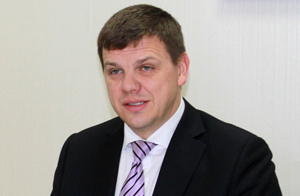
Andrey Kamuz
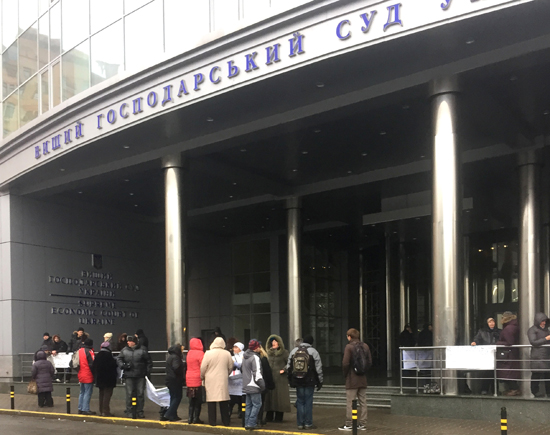
On December 16, people appeared under the windows of the State Mortgage Institution in the center of Kyiv with posters reading "Kamuz and Zots are taking our money" and "Hands off our apartments."
There were also titushki strolling around here.
A television camera was stationed nearby. Soon, the Inter TV channel aired a story about "Kyiv residents demanding lustration of the insatiable Azarov-Yanukovych officials."
This phenomenon is more than common these days, but there are nuances.
Firstly, few people even know about the existence of the State Institution of Higher Professional Institutions (GIU), unlike the Deposit Guarantee Fund (DIF). This is a highly specialized financial institution, the nature of which initially resembled the American Fannie Mae and Freddie Mac.
It doesn't interact with ordinary citizens, except perhaps when dealing with problem loans. In 2009, apartments were purchased with State Housing Institution funds, but they were distributed by government officials.
Secondly, the State Inspectorate is engaged in a court battle with Nadra Bank. The financial institution, owned by oligarch Dmytro Firtash, owes the state institution a large sum of money—over 200 million hryvnias.
As if by chance, a wave of identical publications appeared on third-rate websites online claiming that the State Inspectorate issued large advances to the banks of Oleksandr Yanukovych and Vadym Novinsky, and that more than 5 billion hryvnias were being managed completely unchecked by the state.
These are clear signs of a black PR campaign against the institution, although this does not mean that the theses voiced are plucked out of thin air.
There are indeed many questions for the State Housing Institution's leadership. Even during Yulia Tymoshenko's tenure, the EP wrote that the procurement and distribution of apartments was not a function appropriate for a state institution. The same goes for pouring money into completing residential buildings, where apartments are then distributed among employees.
The head of the State Mortgage Institution, Andrey Kamuz, contacted EP himself and offered to comment on all the accusations leveled against the mortgage institution and himself personally. The conversation lasted over two hours, during which he answered every question.
Kamuz links both the arrival of people with posters and the online publications to the lawsuit against Nadra Bank.
* * *
Why is there an online campaign against you? Who is fighting for redistribution, and what's going on?
In 2008, we issued a 700 million UAH loan to Nadra Bank—a considerable sum at the time. In 2009, the bank defaulted on its obligations and did not repay the loan.
I had just started work, and it so happened that Valentina Zhukovskaya (who had joined Nadra Bank as an interim administrator) and I found ourselves on opposite sides of the barricades. Legal proceedings began.
The court of first instance ruled that Nadra Bank owed us nothing: the contract had expired. But we won the right to claim what we considered rightfully ours.
This dispute went through all the courts over the course of four years: we won in the Kyiv Commercial Court, then in the Court of Appeal, twice reached the Supreme Court, and twice returned to the first instance.

In the summer of 2013, Nadra Bank went on the offensive and won against us first at first instance, then on appeal, then on cassation, and finally in the Supreme Court. There, they ruled that they shouldn't have to pay us any interest at all.
Ultimately, we reached an agreement—not with Valentina Borisovna, but with Dmitry Zinkov, the bank's chairman of the board. In early 2013, after four years, we were finally repaid the principal, but the interest for using the money was never paid.
We had to reverse (from the word "storno", write-off. - EP) the interest accrual, because of this it was very difficult to "close" 2013.
After rethinking everything we'd gone through, we filed a lawsuit jointly with the prosecutor's office. This time, we took a different tack, insisting that we had incurred interest costs and asking the bank to compensate us for them. We're talking about 228 million.
We won this case at first instance, then on appeal, and tomorrow (December 17, the day after the titushki and Inter TV camera appeared. - EP) we have a cassation appeal.
However, this isn't all the money we wanted from Nadra Bank. According to the court's ruling, we cannot demand interest payments for the six months the bank was under temporary administration. In total, we would have received 320 million from Nadra Bank.
The results are already visible: journalists from the Inter TV channel, along with the titushki, are standing outside our office demanding lustration, and our photographs are pasted onto trash cans.
We understand that the key pressure is placed, first and foremost, on the court.
To more fully examine all the nuances of the case, we requested that the panel be expanded at the previous hearing. At the first hearing of the cassation court, it was alleged that Nadra Bank had already paid everything. "Everything" being 150 million in interest for the use of 700 million over four years.
— "Nadra" has long been on the brink of introducing a temporary administration. Is this due to your efforts?
"That's not our goal. Our goal is to prove that Nadra Bank must pay interest to the State Mortgage Institution for the use of the funds. That's all. We have no other demands."
We need this because since 2014 we have switched to international accounting requirements.
While we were able to somehow explain our situation to the auditors in 2013, and the auditor wrote a conclusion with the notation "conditional," now we can't explain anything. We simply won't be able to transition to the international system; we'll have to reverse the capital.
In simple terms, the interest that the bank did not return to us was paid from the capital that the state contributed to our company's authorized capital.
At the same time, the company has state guarantees for which it is responsible. This means that the state would ultimately bear the losses. We are fighting to prevent this from happening.

— What's the crux of the matter? Why does Nadra Bank think they shouldn't pay you anything more?
— The main argument in court was: "Guys, you paid the market interest. You haven't suffered any losses. So what's the problem?"
— What do you mean? You paid interest, and now you're in the red. It's essentially a loss.
"In court, you can demand compensation for damages, but we don't have any damages. We have lost profits. What we paid for interest is an expense."
This is a purely procedural dispute. Economically, the company paid all the costs associated with acquiring this money. Nadra Bank used this money for its own operations, made money on it, and never paid for it. That's the whole paradigm.
Inter and the tracksuit-clad thugs outside our windows are yet another tool to pressure the GIU leadership, who have taken a principled stand. We're defending our interests.
We don't ask Nadra for anything more than what they owe us, based on the contract and the civil code. Nadra, however, is using very dirty tricks against the State Institution of Higher Professional Education, which have nothing to do with banking ethics.
We don't feel guilty. We have detractors—that's understandable. But no bank can accuse us of being opaque in our dealings with them. Apart from Nadra Bank, we have no conflicts with anyone.
* * *
— The State Institution of Ukraine manages assets worth over UAH 5 billion. How much of this is operational? Taking into account Crimea, the ATO, and the "collapsed" banks?
— Overwhelming. The overall degree of "problem" has increased to only 8% of the State Mortgage Institution's loan portfolio, which amounts to approximately UAH 1,3 billion (the average rate of problem loans at banks during the 2009 crisis was 20-30%. — EP).
We work with everyone. The State Institution of Ukraine (GIU) has created a secure online acquiring system so that people living in Crimea can pay their loans directly with their credit cards (dollar or ruble), as traveling to the mainland for this is very difficult.
According to our statistics, the average loan life is six years, and the average loan amount is 300 hryvnias. These are mostly small loans that families take out to secure housing. Our philosophy is to provide citizens with everything they need to simply move in and start living.
— Yanukovych's presidential program offered housing at 3%. What kind of fantasy is this, paying 24% on deposits and asking 27% on loans?
The downside of this program was this: The client signed a contract not for 3%, but for the actual interest rate offered by the bank, and the state was supposed to compensate for the difference of up to 3%.

The most flawed aspect of this program was that people were buying an apartment in a building that wasn't yet finished. In other words, they were buying property rights. They were renting somewhere else and were already paying off the loan—essentially paying two rates at once.
We proposed our own program. Initially, it was simply called "three-percent rent." We would issue our own bonds, which would be purchased by strategic investors represented by state-owned banks, and then refinanced by the National Bank. This would create a low-cost resource, which would allow us to launch the rental program.
People would immediately move into their apartment and sign a contract for 3%, and the state housing authority, not the people, would be responsible for the cost of resources. We proposed this.
We believed and continue to believe that a product offered to a specific individual must be completely understandable to him.
According to our project, a person pays the same amount as they would for rented housing—we compared this in Kyiv. Moreover, part of this money goes toward paying off the apartment. What else do you need? Pay your utilities and live!
Yes, it won't be top-class, it will be "social" housing, but you can live here tomorrow. This is the main problem the state must solve for its people—provide them with housing!
The biggest mistake is giving away housing for free. Housing should have a value. It doesn't have to be high, but it should be present—people should understand they're paying for it, that they earned it. Then the attitude toward property changes completely.
* * *
— The media has been flooded with reports that the State Inspectorate for Ukraine (SVIU) has handed out a slew of advances, in particular to the banks of Oleksandr Yanukovych, Anton Klymenko, and Vadym Novinsky. They're trying to prove that this was a negotiated allocation of funds, similar to refinancing the National Bank. They're hinting that this money was stolen. Where did the idea for these advances come from, and what exactly are they?
Our company was created as an institution specializing in mortgage refinancing. The concept of these advances was copied from the American and European markets and evolved into standards approved by a Cabinet of Ministers resolution.
These standards defined the conditions under which the State Mortgage Institution could refinance commercial banks. These conditions included a 25% down payment, OTI, PTI (that is, the total family loan servicing costs), and a non-retirement age (that is, the person must repay the loan before reaching retirement age).
We currently service approximately 5 loans. We managed to survive 2008-2009 and the collapse of Ukrprombank largely thanks to the strict standards that were built into the company's operating philosophy from the outset.
The fact that the State Mortgage Institution only works with the hryvnia also helped. We have always been against foreign currency mortgage lending to individuals. Otherwise, consumers take on unjustified and uncontrollable exchange rate risks.
We work with more than 100 banks that provide mortgages in Ukraine.
Advances are refinancing loans for replenishing working capital for issuing mortgages according to our standards. The loan is issued for 180 days. The State Mortgage Institution issues these funds against collateral in the form of government bonds, bonds issued by the State Mortgage Institution itself, or property rights to mortgages issued to individuals.
We evaluate these loans based on their servicing, meaning they cannot be loans with delinquencies. They must be classified as "well-performing" according to the National Bank's terms.
Only in this case does our credit committee make a decision on issuing a loan. We also consider the bank's experience in the mortgage lending market. We do not work with banks that do not offer mortgages.
Furthermore, our standards include a risk-relief clause: if a refinanced loan deteriorates within 90 days (if the funds are not received on time), the bank undertakes to repurchase the loan or replace it with a similar product. This means that the risks associated with the deterioration of a specific borrower's financial situation are borne by the bank.
To understand which counterparty we are dealing with, we have introduced a system similar to that used in the banking world.
Every month, we collect financial statements from banks; we have a separate department that deals with risk management. We assess each bank and set a limit for them. Previously, it was quarterly; now it's monthly.
For some banks, we can check their reports as often as weekly. There are many issues that we address ourselves. We don't receive any budgetary subsidies.
The only way the state helps is by providing a state guarantee, which gives us the right to issue a bond. This is a "quasi-sovereign" (analogous to government debt – EP), which has more guaranteed collateral for the end investor.
We have diversified loans for 5 families. If we look at the characteristics of our loan portfolio for individual loans, the volume of overdue loans is 3,8%, and the quantitative indicator is less than 3%. This figure is unmatched in the banking system.
— Over the past year, several dozen banks have gone bankrupt. Many of them probably worked with you. What's happening to the loans issued to these banks?
— One of the main principles when establishing the company was to transfer all risk to the bank. As I already mentioned, the bank undertakes to buy back the deteriorating loan or replace it with a similar one.
No one ever considered the possibility that a bank would disappear on its own. We first encountered such a situation in 2009—it was Ukrprombank. This was a serious challenge for us, as the bank held over 200 million hryvnias in retail loans across Ukraine.
At that time, the company employed 85 people. We couldn't physically call each of them and explain the situation. We had to service the entire loan volume directly. We had no choice but to become the lender of first resort. Essentially, we became a bank.
We were so unprepared for what happened that we realized we needed to find a partner bank. We found several that bought our loan portfolio.
— What was the discount?
"There was no discount—we sold at par. We said, 'Guys, buy a portfolio of 50 million from us, and we'll give you upfront financing, which you can use to issue loans.' All requirements will be met, but we're already prepared to accommodate you."
The largest number of advances – although it would be more correct to call them financial loans – were issued in 2008.
Returning to your first question, we haven't had a single financial loan from VBR Bank, Unison Bank, Expobank, or any of the other institutions mentioned in the press.
Only one bank, Unex (associated with Vadim Novinsky – EP), issues loans under our program, and we buy them.
— How many banks have issued such loans?
— We have only three advance loans: at Finance and Credit Bank, Agrokombank, and Radical Bank, each of which is an active participant in our mortgage lending program.
— Have there been cases where banks issued loans under your program, but the State Mortgage Institution didn't buy them?
— All loans submitted to our portal and meeting the criteria are accepted. The only exception is loans that raise questions about the property's appraised value.
Sometimes, for example, one apartment in Zaporizhzhia costs twice as much as another apartment on the same street. Then, our risk manager makes an additional request to clarify the valuation.
— What do you do with loans from banks that recently went bankrupt?
"After Ukrprombank, we learned how to handle such situations. As soon as a bank goes down, our specialists arrive and collect the documents (loan files) that are in the bank's custody for the duration of the agreement. These loans are then transferred and serviced at another bank."
Now we have a different problem. We have issued 606 loans totaling approximately 75 million in the ATO zone and Crimea. Since we don't work directly with individuals, but with banks, they have taken on this issue. PrivatBank, for example, services these loans. The state is not yet ready to shoulder these costs.

How many loans were issued under the program in 2014?
— 355. Since the end of September, people have been actively taking out loans due to fluctuating exchange rates. People understand that the money they've saved needs to be converted into a hard asset to preserve its value.
This summer, we developed and offered a financial leasing program. This is a program that minimizes risks. Leasing eliminates the 25% down payment requirement. We offered to pay only 3% of the apartment's purchase price to cover utility costs.
The program is designed for ten years (until the tenant transfers ownership. — EP). The main requirements for the borrower are Ukrainian citizenship and the ability to cover one payment with a single "official" salary.
Under our program, people would simply pack their suitcases and move right into the apartment. No down payment required, and an annual interest rate of 12,5%. This is no more than what they would pay rent in someone else's home.
— Where can I find a cheap resource for this? Taking into account maintenance costs, it's a maximum of 10% per annum on entry plus the cost of purchasing the property.
"The Ministry of Finance's ideology is to attract money—it doesn't matter from America or China—and to boost core industries by channeling liquidity there. This is the best way to combat the exchange rate. We, the State Institution of Higher Education, position ourselves solely as an instrument that handles loans."
China built a city in Africa for tens of thousands of people, but it's located in the desert, there's no one to sell the apartments to, and China ultimately switched to financial leasing. Ukraine is a much richer country in terms of its working population—demand for this is sure to emerge.
We looked at the statistics: the higher the standard of living in a country, the more housing is rented rather than purchased. People understand that it's a long-term investment. People aren't tied to a specific location: someone changes jobs, moves, and enjoys life. In Germany, for example, 60% of housing is rented.
Subscribe to our channels on Telegram, Facebook , Twitter , VK - Only new faces from the SKLEP section!