
"Servant of the People" David Arakhamia has decided to enrich domestic science and will defend his dissertation for a PhD at the Taras Shevchenko National University of Kyiv, ZN.UA reports.
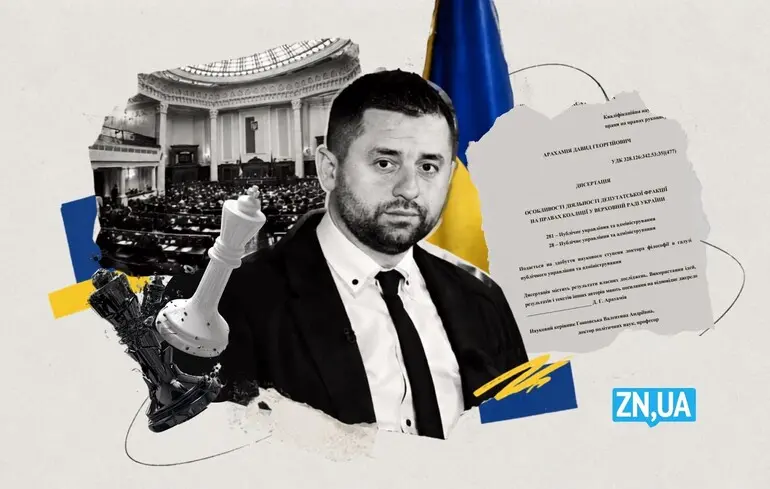
© Collage ZN.UA (contains AI elements)
Academic degrees are like honey for officials. Why do they do it—for prestige, to satisfy their ambitions, or to supplement their meager salaries? President Kuchma's Chief of Staff, Dmytro Tabachnyk, defended his doctoral dissertation on the so-called body of work—that's acceptable, but it must be a body of academic work, not interviews or collections of various authors, which Tabachnyk wrote down as monographs. Then there was Volodymyr Lytvyn , who rose to become Speaker of the Verkhovna Rada and Vice President of the National Academy of Sciences of Ukraine, but was repeatedly caught blatantly plagiarizing. The list goes on and on. Apofigei, a doctor of economics, is better known as "Proffesor" Yanukovych.
Of course, news of the academic ambitions of the head of the largest parliamentary faction prompted scholars to scrutinize his dissertation for plagiarism. But no direct borrowings were found—after all, the academic work was likely written by an intelligent person, well-versed in the examples cited.
True, there were some plagiarisms involved—a scandal occurred with the reviewer of a highly respected doctoral candidate. Scholars claim that her doctoral dissertation contains overlaps with five Russian sources.
But let's leave the reviewers aside, as well as the eternal rhetorical question: where do government members and MPs find the time to write dissertations, especially in the midst of a war of attrition (Arakhamia began publishing on his dissertation topic in 2024)? Let's also leave aside the subtle nuance that David Georgievich chairs the supervisory board of the Kyiv University of Intellectual Property and Law—the same university where President Serhiy Kivalov , the former head of the Central Election Commission, earned the nickname "Pidrakhuy" (Faggot) after the 2004 presidential election for rigging the election in favor of Viktor Yanukovych, is serving. Their photos sit comfortably side by side on the university's website.
But the most interesting thing about David Arakhamia's dissertation is the topic and how the author explores it. The MP examines "the specifics of the activities of a parliamentary faction acting as a coalition in the Verkhovna Rada of Ukraine," or, more simply, the so-called mono-majority. This is interesting. Who could know more about the Ukrainian mono-majority than the man who has led it from the very beginning? And not only does he know, but he also recommends a mono-majority for Ukraine, citing the British experience (the so-called Westminster model):
“ It has been substantiated that the Westminster model, as an example of European experience in the operation of a parliamentary majority based on one political party (mono-majority), may have the greatest potential for adaptability to Ukrainian realities” (p. 175) (emphasis added).
What Arakhamia saw in his dissertation—and what he didn't see
The problem isn't the very existence of a mono-majority. Such practices exist in democratic countries as well. The problem lies elsewhere: academic research must explore reality. That is, not only how a given political structure is supposed to function according to laws and regulations, but also how it works in real life. Especially when this real-life experience is right before the researcher's eyes.
David Arakhamia's dissertation lists legal acts, regulations, procedures, instructions, and so on. But there's not a word about what was happening around them. And although the section conclusions outline what specifically needs improvement, and even vaguely mention that the executive branch sometimes dominates the legislative branch, the dissertation itself doesn't elaborate on this at all. One gets the impression that this dissertation is a complete abstraction. It's divorced from the practices carried out under Zelenskyy, including by faction leader Arakhamia.
The First Government of Arakhamia? Why is Bankova Recalibrating the Levers of Power?
The reality is this: the Ukrainian mono-majority was formed by populist Volodymyr Zelenskyy out of thin air, from random people, and, as some say, allegedly with money paid in "envelopes" (perhaps this is the "greatest potential for adaptability to Ukrainian realities"?). And not at all based on the principles that David Georgievich describes in quasi-arbitrary terms (such as, for example, the "resilience matrix"). In fact, the mono-majority turned into a conveyor belt that turbo-charged dubious decisions, ignoring even the most basic parliamentary procedures for their adoption.
Now this mono-majority has effectively collapsed—the parliament is littered with petitions from people's servants to leave it. They're simply not allowed into the floor for the vote. Bankova is trying to hold the mono-majority together and make it manageable through persuasion, persuasion, pressure from security forces, and money (as evidenced by NABU investigations). But this is no longer working: the once-largest faction in parliament can no longer secure the passage of either presidential or cabinet bills with its votes alone, and is failing to pass important legislation.
It is losing its monopoly and public support, a process that began even before the full-scale invasion. A KIIS poll in January 2022 showed that if elections had been held then, the "Servants of the People" party would have received only 14% of those who had made up their minds. This is a threefold (!) reduction compared to the 43% of the party list votes in the 2019 elections. The "Servant of the People" brand may not exist at all in the next elections.
It would seem that this should have been one of the main subjects of research for someone who has been immersed in the process the entire time. Especially since Arakhamia himself writes about the "potential for adaptability to Ukrainian realities," a seemingly positive experience. But these very realities remain almost entirely off-screen in the dissertation. After all, so far it feels very much like a cargo dissertation: all the trappings of a scholarly work are present, but the reality it should explore and explain has vanished. Is this really scientific research?
Westminster, which will not exist in Ukraine
Now about the Westminster model, which David Arakhamia recommends for Ukraine and which we discuss with our first-year students. It's a classic British model (Westminster is the seat of parliament). Its logic is simple: winner takes all. Two major parties alternate in power. The winning party forms single-party governments and, with a majority in parliament, can pursue its policies. The opposition has no significant influence on its decisions. This is what's known as majoritarian democracy. In contrast, consensus democracy involves seeking compromises between various political forces.
However, this structure doesn't operate in a vacuum. In the United Kingdom, it relies not only on a parliamentary majority but also on established political traditions. There's no practice of eliminating the opposition: everyone understands that in the next election, the current opposition could win and become the government.
However, Britain itself is now moving away from the Westminster model because the political situation is changing. In the 21st century, it already has two (not one, as Arakhamia writes) examples of coalition governments. Scotland, Wales, and Northern Ireland have gained significant political autonomy, and their electoral systems are no longer purely majoritarian. Unitarianism, an integral part of the Westminster model, is eroding.
Another important component of the Westminster model is the majoritarian electoral system. It favors the winner: a party can win a significantly higher share of seats in parliament than the vote it received in the election. However, third-party parties are discriminated against: under such a system, it is much more difficult to convert their voters' votes into parliamentary seats.
In Ukraine, the single-member system favored the government or business interests. That's why one of the demands of the Euromaidan was a proportional electoral system with open lists, which is envisioned by the current Electoral Code. Does Arakhamia remember this? Or perhaps he already knows something about the mono-majority's plans to change everything?
And, overall, comparing the parliamentary model in the UK with the mixed model in Ukraine is, to put it mildly, not entirely accurate. It seems as if whoever wrote their dissertation about the Westminster model doesn't quite understand what that actually means.
While Britain has seen two major parties alternate in power for decades, other European countries are accustomed to multi-party systems and coalition governments. Ukraine also operates by this logic. It's hard to imagine two parties alternating in power here: our country is too diverse for such a structure.
Incidentally, Arakhamia's dissertation mentions two other instances of mono-majority in Ukraine. It's unclear where this information comes from or what it's based on. This didn't even happen under Yanukovych—the Party of Regions needed the "add-on" of the Communist Party.
And the "Group 239"—the communist majority formed after the 1990 elections—existed back in the Ukrainian SSR. That is, in independent Ukraine, a true mono-majority emerged only after the 2019 parliamentary elections.
Subscribe to our X channel and Telegram channel!
Stay informed about who is doing business, in politics, and supporting corruption in Ukraine!
Davidka Arakhamia. So, is it a mono-majority again?
So, we're faced with a paradox: the current Ukrainian phenomenon of a mono-majority has proven a failure and is unlikely to be implemented in future parliamentary structures. Yet this is precisely the model Arakhamia presents as the result of his "scientific research," and one that has already been implemented.
However, in the context of a war to destroy Ukraine, the pseudo-monopoly should be replaced by a coalition/government of national unity. But David Georgievich's boss stubbornly refuses this. And Arakhamia himself doesn't recommend it in his dissertation either, preferring a monopoly majority and the imposition of unilateral decisions from the very top of the government.
But let's return to the work of the future PhD candidate. The value of any scientific research lies precisely in the fact that it explores and explains reality, rather than forcing it to fit a predetermined picture. Especially when real facts shatter that picture. Otherwise, it's no longer science, but an imitation of it. A cargo dissertation.
Skelet.Org
On the topic : Is David Arakhamia and Daniil Getmantsev protecting Andrei Biba, a fan of the "Russian world"?
What did Dmitry Vatsner and David Arakhamia discuss at Suto Mamoyan's reception?
Subscribe to our channels on Telegram, Facebook , Twitter , VK - Only new faces from the SKLEP section!