
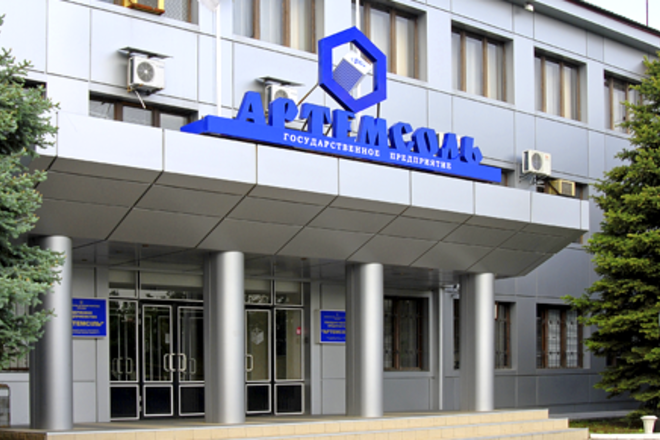
 Corruption, corporate raiding, kickbacks, and causing losses to the state—these aren't just terms found in the Criminal Code. This is the current state of affairs at the state-owned enterprise "Artemsol," which is rapidly sliding toward bankruptcy with the complete connivance of its central government patrons.
Concentration Camp "Artemsol"
In mid-January, Artemsol's acting CEO, Denis Fomenko, convened a general meeting of the company. He had little to brag about in 2014: compared to 2013, salt production and sales had declined by more than 30%, or 1.06 million tons. Meanwhile, everyone at Artemsol knows there are no objective reasons for such a sharp sales decline – salt consumption hasn't declined in Ukraine or in the countries to which the company exports, and operations had remained virtually uninterrupted throughout the previous year, despite its close proximity to the front lines.
It would have been logical to assume that, under these circumstances, Artemsol's management would at least let the team know what they intended to do to improve the situation. But that wasn't the goal of Fomenko and his associates. According to company employees, they were given an ultimatum: anyone who attempted to express dissatisfaction with what was happening at Artemsol would be fired, along with their relatives. This threat was accompanied by an assurance that everything was under control in Kyiv, and the Ministry of Agrarian Policy (which houses the state-owned enterprise) was on the side of Artemsol's management. And not without compensation.
For the small Donbas town of Soledar, where Artemsol is the city's main employer, such a threat is practically tantamount to losing their jobs altogether. And the threat of dismissal isn't the only danger. Since Fomenko's rise to the top, he's been constantly accompanied by six security guards of the appropriate appearance, along with a brigade of what most closely resembles the term "titushki." So the workers are afraid to talk about what's happening at Artemsol, even in private. Although they have plenty to say.
"PROFESSIONALS"
Until the spring of 2014, Artemsol was a successful enterprise. 2013 brought in net income of over 1 billion hryvnias, despite the fact that the state-owned company was the source of income for numerous shell companies associated with Andriy Klyuyev, former head of the Presidential Administration under Yanukovych. And when, at the request of Soledar activists, the issue of leadership changes and the fight against Yanukovych-era corruption was raised, there was every reason to expect that the state's profits from Artemsol would increase.
Instead, the company experienced a decline in production. The situation didn't improve after Deputy Public Relations Officer Alexander Stepanenko became Artemsol's CEO in June 2014. The former director of the Soledar sports complex, who had never been involved in salt production or sales, was unable to restore production to its previous levels. Furthermore, he proved to be a very poor personnel manager, for which he paid the price.
One of Stepanenko's first decisions as CEO was to appoint Denis Fomenko to the newly created position of executive director. Unknown in Soledar, the manager of a Donetsk car dealership received an unprecedented vote of confidence from the CEO, which he took advantage of by bringing his own team to the company. The principles by which this team was formed are unknown, but they share two characteristics: everyone Fomenko brought in had a residence permit and permanent place of residence in territory controlled by the "DPR" (usually Donetsk or Horlivka), and they had never been involved in such a specialized industry as salt mining. For example, Andrey Vronsky, a former car wash manager from the same dealership where Fomenko worked, became Artemsol's commercial director.
This team's "achievements" are impressive. Production and sales declined sharply, and revenues plummeted accordingly. The Voldarsky mine was closed down completely. Furthermore, concerns about product quality emerged: in mid-January, Rospotrebnadzor (the Federal Service for Surveillance on Consumer Rights Protection and Human Wellbeing) declared that Ukrainian salt did not meet food safety standards for various impurities and recommended its removal from the market. For the company, which controlled a quarter of the Russian salt market, this was yet another significant blow.
ACCORDING TO THE REPORT FROM THE CLEANING LADY
None of this is a coincidence. After all, Fomenko's main accomplishment at the company, and one that continues to do so, is to purge the old staff—those who previously ensured production volumes, high sales, and product quality. Back in the summer, Artemsol's technical director, Anatoly Biryukov, was fired. He ensured salt shipments even when Soledar was in a war zone and communications were destroyed by militants. Following his dismissal, several other specialists were forced to resign. A few days ago, Fomenko offered the CFO, the head of sales, and his deputy the opportunity to resign. The dismissed employees share a common "problem": they were attempting to counter the company's growing collapse by expressing disagreement with management policy. And how could they possibly agree to it, when Fomenko proposes compensating for lost ground in the Russian market by conquering the markets of Turkey and Iran—apparently unaware that they produce their own salt there and that its price is $5 per ton.
The turn finally came for the "godfather" of Fomenko's team, Alexander Stepanenko. On January 12 of this year, he received an order, signed on December 29, terminating his own employment for... a one-day absence. The basis for his dismissal was a report written by a cleaning lady and a security guard.
Stepanenko, however, is still trying to resist, but resistance is futile—the order was signed in Kyiv, at the Ministry of Agrarian Policy, and Fomenko personally went to pick it up. He was then appointed acting CEO, also by order from Kyiv. And rumor has it that at the celebration of his appointment, Fomenko said that it had already been agreed with the ministry that either he or his ally Vronsky would become CEO.
DOES KYIV PROTECT YOU RELIABLY?
Unlike establishing production, Fomenko is proficient at cultivating relations with the Kyiv authorities. Back in the summer, despite numerous signals from activists, he received the support of the previous Minister of Agrarian Policy, Ihor Shvaika. This support was so strong that Shvaika personally visited the plant to demonstrate his favor to Artemsol's management. The cost of this support can only be guessed at.
In December, Shvaika was replaced by Oleksiy Pavlenko, but the Ministry of Agrarian Policy's position hasn't changed. It's impossible to discern what motivates the new leadership. However, it certainly isn't the current management team's professionalism—we've already discussed their "successes" in 2014, and there's no reason to hope for anything better in 2015. And it's certainly not patriotism—on January 14, the body of Ivan Reznicenko, a Soledar activist who fought corruption at Artemsol, was found. Mykhailo Volynets, chairman of the Independent Miners' Trade Union, made it clear that he links the murder to Artemsol: "This man held an active position in life, which is why he was killed by workers at the same enterprise, outspoken separatists... The current leadership is close to Yanukovych's team. They live peacefully in Donetsk and Horlivka."
If, despite all these facts and repeated signals from the company's employees and city residents, the new minister continues Shvaika's line of support for Fomenko and his team, only one conclusion can be drawn: such support comes at a price. Again, no one knows the price of this support, but one can assume it's considerable—otherwise, it's difficult to explain why the Ministry of Agrarian Policy still hasn't implemented the Cabinet's November order transferring Artemsol to the Ministry of Infrastructure. Meanwhile, the situation in Soledar is escalating, people are becoming increasingly aggressive, but officials, it seems, haven't learned anything from the Maidan experience.
HOW IS TRIBUTE COLLECTED?
Another thing Fomenko and his team are good at is lining their own pockets. According to sources close to the company, the kickback per ton of salt sold within Ukraine amounts to 10% of the selling price, while for international sales, it ranges from $5 to $15 per ton. Moreover, kickbacks are often combined with sales at reduced prices, which causes losses for both Artemsol and the state through lost tax revenue.
This "private enterprise," unlike the official company "Artemsol," is operating smoothly and on a grand scale. "Trading houses" have been established in Kyiv, Moscow, and Warsaw, which, according to sources, collect the aforementioned tribute from intermediary firms for transfer to the "founders." According to the latest reports, Fomenko and Vronsky are planning a trip to Moscow at the end of January. Apparently, the tribute has already been collected. Furthermore, the Moscow-based "Artemsol" trading house, whose director is V. Kiselev, is successfully establishing salt supplies to Crimea. And the Ministry of Agrarian Policy, of course, sees no politics in this.
Subscribe to our channels on Telegram, Facebook , Twitter , VK - Only new faces from the SKLEP section!