
In 2016, the collapse of Mykhailovsky Bank was perhaps the most high-profile event in the Ukrainian financial market. The media also wrote extensively about the role of then-Deputy Governor of the National Bank of Ukraine (NBU), Kateryna Rozhkova, in this process. So, about Mykhailovsky Bank.
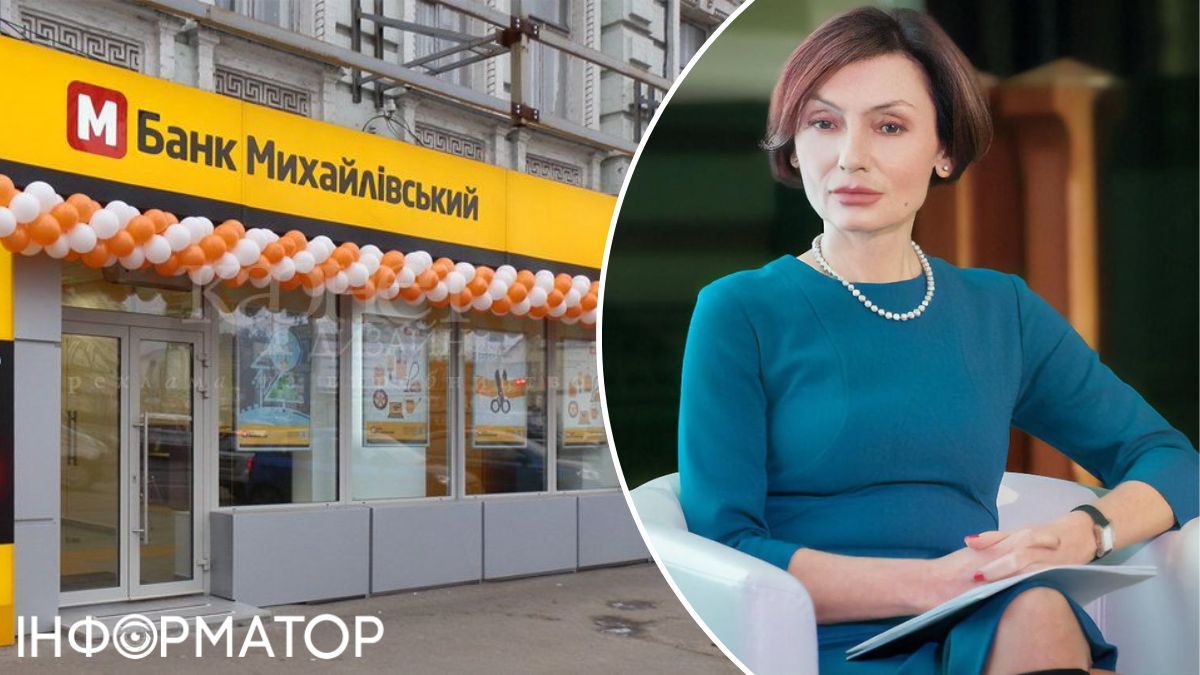
In 2016, NBU Governor Valeria Gontareva estimated the damage caused by the actions of the former owner of Mykhailovskiy Bank at 23 billion hryvnias. The home of then-Deputy Governor of the NBU, Kateryna Rozhkova, was even searched in connection with the case , resulting in the seizure of her mobile phone. The question of Rozhkova's involvement in the fate of this bank, which caused billions in damages to the state and its clients, remains controversial, writes Informator.
On May 23, 2016, the NBU declared Mykhailovsky Bank insolvent after a series of problems. On May 24, a temporary administration was appointed. The bank's owner and managers had pulled off an interesting scheme, which, for some reason, the NBU ignored. Furthermore, the bank offered deposits of up to 37% per annum in hryvnia, compared to a market average of 19%.
Clients were offered deposits 0,5-1% higher, but only if they opened them not at the bank, but at similar credit institutions – the KIC (Credit and Investment Center) and the IRC (Investment and Settlement Center), which were not members of the Deposit Guarantee Fund, in the event of the collapse of the KIC and IRC, respectively.
After the bank's closure, this is precisely what happened. To return funds to a significant number of defrauded clients, President Poroshenko had to lobby a special law in the Verkhovna Rada, which added to the budget burden. According to the Deposit Guarantee Fund, of the 1,4 billion hryvnias, approximately 870 million hryvnias were returned to people after the adoption of the special law. Many remember the protests of abandoned Mykhailivske depositors across the country—it was precisely to these that Poroshenko responded , and the state lost an extra billion to compensate for what the fraudsters had stolen.
On May 18, 2016, Ihor Doroshenko, Chairman of the Board of Mykhailovskiy Bank, resigned. On the same day, he was appointed Chief Executive Officer (CEO) of the Cypriot company PT Platinum Public Ltd, which owned Platinum Bank—the institution where Rozhkova worked before joining the NBU in the summer of 2015. Rozhkova's son also continued to work at Platinum Bank after her transfer to the National Bank. Even before Doroshenko's dismissal, rumors circulated that the bank could be declared insolvent. Doroshenko, however, assumed the helm of the Cypriot company, allegedly without the NBU's consent.
Also, in March 2015, Igor Doroshenko, along with his colleagues who were part of the credit committee of Mykhailovskiy Bank, issued loans worth 200 million hryvnias in one day to companies associated with the bank, which the bank lost.
On May 20, the bank experienced difficulties processing transactions: a technical glitch occurred during the Mykhailovskiy Bank's ODB (operating day). The following day, restrictions came into effect: clients could only make card transactions of up to 5000 hryvnias. Later, people were unable to withdraw funds, pay by card, or even top up their mobile phone accounts.
After the ODB resumed operations, the NBU supervisor discovered that during the outage, the bank had transferred client deposits opened with the Information and Credit Centers (ICCs) and the Credit and Credit Centers (with third-party companies) to deposit accounts with the bank—a total of UAH 1,6 billion. Of this, UAH 1,1 billion—up to UAH 200—was the amount guaranteed for repayment in the event of the bank's collapse. Moreover, this was done automatically according to pre-written scripts. This increased the burden on the state-owned Deposit Guarantee Fund (DGF) from UAH 1,6 billion to UAH 2,6 billion. The bank also refused to provide the NBU supervisor with access to information. During the outage, the NBU blocked Mykhailivske's correspondent account to prevent funds from being withdrawn from the bank.
Subscribe to our X channel , Telegram channel and Facebook page!
Stay informed about who is doing business, in politics, and supporting corruption in Ukraine!
On May 23, after 9 p.m., the bank sent out a press release. It announced that the bank's owner (92,5%), Viktor Polishchuk, had sold his stake through Ecosipan LLC to third parties—investors. This agreement did not require approval from the NBU, as none of the investors received a significant stake.
The Deposit Guarantee Fund was unable to cover its expenses for payments to individuals and the management of the liquidated bank. The bank's assets were overvalued dozens of times. Mykhailovskiy Bank lost 2,6 billion hryvnias worth of collateral, including real estate and land, due to its management's dealings with shell companies.
Specifically, the Guarantee Fund sold Mykhailivske's loans worth UAH 1,5 billion, issued by the bank to several companies, to collectors from DG Finance. The loans were sold for UAH 25,9 million. The loans were issued in 2015-2016, but payments on them had not been made since the bank was declared insolvent. The collateral included 257 hectares of land in the Kyiv region.
The Deposit Guarantee Fund called Mykhailovsky Bank a Ponzi scheme . They noted that the bank's assets, while listed at UAH 5.113 billion on paper, were actually worth UAH 138,6 million. Furthermore, more than UAH 2,6 billion was illegally siphoned off from the bank before it was declared bankrupt.
Mikhailovsky Bank. What does Ekaterina Rozhkova have to do with it?
In recorded phone conversations, Kateryna Rozhkova, then deputy head of the NBU and responsible for banking supervision, discusses lifting restrictions on Mykhailovsky Bank on her "word of honor" so that it could resolve its problems. This later became one of the reasons for the withdrawal of astronomical sums from the bank.
Mykhailovsky Bank was established in 2013. Its owner was Viktor Polishchuk , the owner of the Eldorado electronics chain. A sharp increase in clientele was fueled by consumer loans for electronics. The NBU first classified Mykhailovsky as a problem bank in April 2015—it still had just over a year left in business. In December 2015, the NBU appointed a supervisor and imposed a number of restrictions (later relaxed by Rozhkova). The NBU asked Mykhailovsky to recapitalize the bank with cash.
On April 27, 2016, the NBU lifted some restrictions on Mykhailivske, allowing transactions with client funds in excess of the amount guaranteed by the Deposit Guarantee Fund. The NBU explained that it had taken this step deliberately to help the bank "recover."
"We expected the owner to repay the loans of related parties and declare the banking group. That's all we demanded of them," Katerina Rozhkova commented. She also said they had heard calls to pull Mikhailovsky from the market before, but "believed" the owner and management.
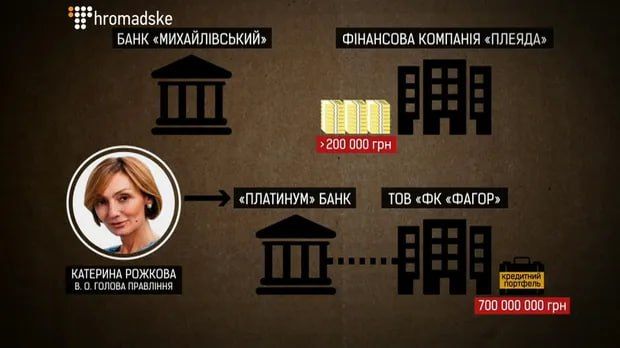
This also allowed for the attraction of client funds into the accounts of the financial company Pleyada, which subsequently acquired the bank's retail loan portfolio worth UAH 682 million and, the very next day, transferred it to another company, FC Fagor LLC, which was associated with Platinum Bank. Before joining the NBU, Rozhkova worked at Platinum Bank.
"Of course, he sold it without any money. But the loans were reassigned. The bank was in trouble and had no right to sell anything without the NBU's approval. And it was prohibited from not only dividing up individual deposits but also transferring deposits from legal entity accounts to individual accounts. This is what they effectively did ," Rozhkova commented.
Rozhkova did not rule out the possibility that Viktor Polishchuk used the resources of Mykhailovsky Bank to service his debts at other banks. This refers to the state-owned Oschadbank and Ukreximbank, where Polishchuk's companies borrowed over $770 million during Yanukovych's presidency.
Former bank owner Viktor Polishchuk claimed that businessman Boris Kaufman (then the unofficial owner of Platinum Bank) approached him through the bank's chairman of the board and wanted to acquire Mykhailovsky. Polishchuk sold his fortune to 12 individuals to expedite the process (since the NBU's approval was no longer required). Polishchuk claimed that the NBU and Rozhkova pressured him to sell the bank to Kaufman and drive it into insolvency. Specifically, the NBU interfered with Polishchuk's bank's operations with its own audits (there were 11 of them in a year).
He allegedly received 200 million hryvnias from Kaufman for the bank, which he used to repay part of his companies' loans to the bank. According to Polischuk, by May 19, 2016, Mykhailovsky's entire team was already working for Platinum Bank, so any fraudulent activity during that time was no longer his responsibility. Kaufman himself denied ever wanting to buy Mykhailovsky or even having any negotiations about it. Polischuk suggested that the three of them take a lie detector test.
"Regarding the accusations, I can only say that Mikhailovsky Bank needed significant capitalization, so it was definitely not attractive to outside investment ," Rozhkova told Polischuk. She blamed Polischuk and Doroshenko for the bank's bankruptcy.
This is interesting. Google is complaining about Skelet.Org for this :
- Ibox Bank owner Alena Shevtsova has been placed on an international wanted list.
- Sanctions against Andriy Matyukha, or why FAVBET is untouchable
- Ivan Rudy, head of KRAIL, ignores the Russian origins of Igor Zotko's Pin-Up casino.
- Roosh IG owner Sergey Tokayev and his ties to Russia
- Yakov Finkelstein's Slots City: The Russian Connection
- Anatoly Shkriblyak: A Small Giant of Big Corruption. Part 1
- Vadim Ermolaev: Dnepropetrovsk's King of Thieves, Cognacs, and Smuggling. Part 1
- Auto scammers from Odessa have opened a new used car business in Moldova.
- Activist Gusakov received funds through "drops" and withdrew them through casinos, sources say.
- The Khimprom drug cartel's major showdown
- Scandal in Ukraine: Soft2Bet's legal problems reveal the true value of MEGA
- Untouchable FAVBET: When will Zelenskyy impose sanctions against Andriy Matyukha?
Driving a bank into bankruptcy is a crime (Article 218-1 of the Criminal Code). In Ukraine, it is punishable by 1-5 years in prison, a fine of up to 170,000 UAH, and disqualification from holding certain positions for up to 3 years. Of course, if it had been proven in court that Rozhkova drove Mykhailovsky Bank into bankruptcy, she would have been fired from the NBU earlier. But she had a positive track record. And according to the law, without a court verdict, there is no guilt.
There are reports online that Rozhkova allegedly discussed his dismissal with Ihor Doroshenko, the chairman of the board of Mykhailovsky Bank, several months before the bankruptcy. Although he officially resigned on May 18, and was still at the NBU as the bank's head on May 19, his dismissal was "revealed in the media" on May 20. Rozhkova is also reported to have discussed two options for Mykhailovsky Bank with Doroshenko: the sale of Platinum Bank or the introduction of a temporary administration by the NBU.
On October 27, 2016, Rozhkova's home was searched in connection with the Mykhailovskiy Bank case. However, the search resulted only in the confiscation of her mobile phone. At that time, Ukrainian MP Ihor Lutsenko wrote about Kateryna Rozhkova's possible involvement in the looting of the bank's assets.
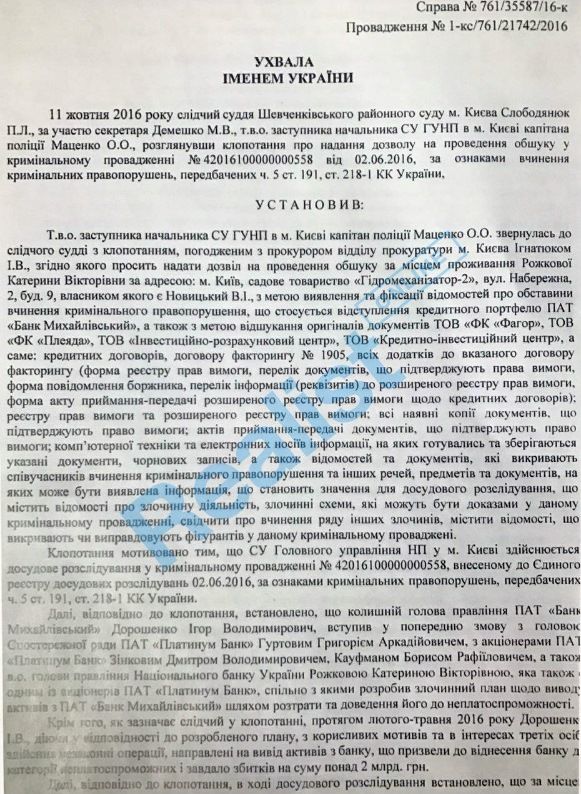
The investigation believed that Igor Doroshenko, Chairman of the Board of Mykhailovsky Bank, "entered into a preliminary conspiracy with Grigory Gurtov, Chairman of the Supervisory Board of Platinum Bank; with bank shareholders Dmitry Zinkov and Boris Kaufman ; and with Acting Chairperson of the Board of the National Bank of Ukraine (NBU), Kateryna Rozhkova, who is also one of the following. Doroshenko, together with the aforementioned individuals, "developed a criminal plan to strip Mykhailovsky Bank of its assets through embezzlement and drive it into insolvency." Rozhkova's case ended in insolvency, but Doroshenko faced a lengthy legal battle.
Misappropriation, embezzlement, or taking possession of property (Article 191 of the Criminal Code of Ukraine), as mentioned in the court's ruling, is punishable by 7-12 years in prison, up to 3 years of deprivation of the right to engage in certain activities, and confiscation of property. A rhetorical question: who took possession of the property of Mykhailovsky Bank and benefited from it?
Media outlets published messages between Rozhkova and her then-boss, NBU Governor Valeria Gontareva. Gontareva allegedly traveled to a meeting with Prosecutor General Yuriy Lutsenko and President Petro Poroshenko on the case. The messages allegedly fell into the hands of bloggers after Rozhkova's phone was confiscated.
The bank had problems with loans to related companies (insiders) . In late 2015, the bank issued preferential loans totaling UAH 756 million to six dubious companies. Although Rozhkova claimed that the NBU was working on this at Mykhailivske, no real steps were taken to settle these debts. And the outstanding insider loans later became one of the reasons for the bank's bankruptcy.
It cannot be claimed that Rozhkova's work led to the bank's bankruptcy (especially since her guilt was not proven in the criminal conspiracy case). However, her failure to take certain actions and weak response to violations led to the liquidation of Mykhailivske and over 2,5 billion hryvnias in damages to the state.
Of course, Article 367 of the Criminal Code on official negligence cannot be ignored here. NBU employees could be held accountable for their prolonged failure to detect fraud at Mykhailovsky Bank, which resulted in billions in economic losses. This carries a penalty of up to 2-5 years in prison, a fine of 12,750 UAH, and a ban on certain activities for up to 3 years. As a reminder, Kateryna Rozhkova was responsible for banking supervision, and her lifting of restrictions on the bank made some of the fraud possible.
On the topic : Oschadbank and Ukreximbank received ownership of the Gulliver shopping center.
Mikhailovsky Bank. Is Gontareva's company buying up banks for Klimenko?
Mikhailovsky Bankruptcy: Court Rejects Deposit Guarantee Fund's 743 Million Claim Against Polischuk
Subscribe to our channels on Telegram, Facebook , Twitter , VK - Only new faces from the SKLEP section!