
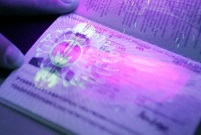
 Ukraine's mass transition to biometric passports is a gold mine
A brief introduction: Ukraine is one of the largest countries in Europe. Our culture has a thousand-year history. When Princess Anna Yaroslavna of Kyiv came to France in the 10th century to marry the king, the aged Henry I signed his name with a cross. At that time, most French people were illiterate. Anna Yaroslavna brought a sizable library from Kyiv and began to educate that then-dark and wild land. So, why this historical excursion, and what I mean to say? In fact, several centuries of Muscovite enslavement, and even worse, 70 years of communist oppression, have thrown Ukraine far back to the other side of the civilizational divide. And after more than 20 years of independence, it has yet to shake off the stigma of being a post-Soviet country.
Promises and reality
Ukrainians remain unwelcome in economically developed and successful countries. Doors are only opened to those who can afford a luxurious life in Ukraine. The issue of simplifying, or even completely abolishing, visa regulations has always been a lucrative source of political speculation. If you want a little extra favor from the electorate, promise to open the borders.
The current "kamikaze" government could use some extra credit from its citizens. Now, the visa-free regime has become a particularly vocal topic. They've even set a date: January 1, 2015. If you ignore everything that goes beyond this announcement, the news is truly remarkable. But it's a equation with many unknowns.
As is well known, visa-free travel will only apply to holders of biometric passports—this is a requirement of the European Union. This is where they made a mistake when they promised a borderless world starting in the new year. After all, the new documents will only be issued starting January 1st, so it's too early to talk about visa-free travel.
But obtaining a visa for the average Ukrainian was quite lengthy and complicated. A huge package of documents, long lines at the consulate, service fees, and other expenses were required. And all this without any guarantee of actually receiving the desired document. Often, you had to start over from scratch. This meant a considerable outlay.
Biometric profit
The mass transition to biometric passports is also a gold mine. Ukraine's prospects for such a transition became known back in 2008, when it approved an action plan with the EU to simplify visa procedures. Since then, nearly 40 laws and over 50 resolutions and orders have been adopted in accordance with the plan. Relevant international agreements and conventions have been concluded and ratified.
As is well known, when biometric documents were first discussed, the EDAPS (Unified State Automated Passport System) consortium was the sole producer of passports in Ukraine. This same company was also required to create biometric documents, according to the Law "On the State Register" adopted in 2012. The author of this bill was Vasyl Hrytsak, a member of parliament of the sixth convocation from the Party of Regions. This is not surprising, as he is the founder of EDAPS and its ardent lobbyist.
Even during the time of Leonid Kuchma, EDAPS received a monopoly on the production of a number of documents, in particular, international passports.
Moreover, its de facto director, Yuriy Sidorenko, has patented almost all state symbols depicted on documents, the design of passports, and even the word "UKRAINE" itself. This means that only EDAPS has the exclusive right to use them.
This monopoly position of EDAPS naturally led to numerous abuses. First and foremost, this involved unjustifiably inflating the cost of documents for citizens. Clearly, the creators of EDAPS couldn't afford to lose such a coveted prize as a biometric passport. Yanukovych and his "family" had to be swayed considerably, as all key positions involved in overseeing the production of the new passports depended on Yanukovych. Apparently, Gritsak succeeded. He was soon appointed Deputy Chairman of the State Migration Service, despite the fact that Gritsak had never had any connection with the migration service.
An impossible dream
The next step was a tender for the procurement of biometric passports. Naturally, the EDAPS consortium won. And just when everything seemed to be in order, something went wrong. The Cabinet of Ministers invalidated the tender, and passport production was transferred to the state-owned printing plant "Ukraine." As it turned out, EDAPS was rapidly slipping out of the "family's" control.
A scheme was being developed in which only this consortium would dictate its prices again, and the authorities would have no leverage over this process.
Ultimately, the hopes pinned on the production of biometric passports failed to materialize. The Yanukovych regime came to an end. However, the well-established scheme remained. In order to finally dismantle the once-powerful EDAPS, the Ministry of Internal Affairs took on the former monopoly. As Deputy Minister of Internal Affairs Serhiy Chebotar stated , materials concerning hundreds of millions of hryvnias embezzled have already been handed over to the investigation. And there is already evidence of EDAPS's illegal activities.
Furthermore, former MP Vasyl Hrytsak is being investigated for involvement in illegal activities. Serhiy Chebotar noted that the Ministry of Internal Affairs no longer has any dealings with EDAPS, and all orders are now being fulfilled by the Ukraina Printing Plant, which in turn reports to the National Bank.
Vicious connections
Of course, the Ministry of Internal Affairs is disavowing EDAPS and everything associated with it. After all, being suspected of ties to such notorious corrupt officials today means ruining the entire process of producing new biometric passports.
However, not everything is so simple with the "Ukraine" printing plant. The National Bank, to which it reports, does not have the necessary equipment to produce this type of passport. Therefore, the biometric passport standards previously developed by the State Medical Insurance Agency will have to be revised. To bypass the patented EDAPS, the passport's appearance will have to be modified.
A Delay of Hope
Insufficient capacity to produce biometric passports could lead to a real collapse. Ukraine has 10 million citizens holding international passports, but an average of 1,5 million passports are issued annually. And if citizens want to exchange their passports for biometric ones, it will take up to five years.
If the European Union introduces visa-free travel for Ukrainian citizens tomorrow, there will be no one to use it. This is how Alexander Sushko, Research Director of the Institute of Euro-Atlantic Cooperation, commented on the situation.
One can only hope that this time the Ukraina plant will not turn into another corruption monster, while the door to the world remains closed to Ukrainians.
Subscribe to our channels on Telegram, Facebook , Twitter , VK - Only new faces from the SKLEP section!