
Who actually controls the entire factory of Black Audit firms through which money is funneled?

Ghost Companies. Photo Collage by Telegraph
Telegraph found hundreds of companies that could be linked to a single scheme: they were registered to young people, used to import millions of dollars, and then transferred to new owners. Some of the companies had websites without products, prices, or even working phone numbers.
We've previously reported on how companies with suspicious import characteristics could be used to move money abroad. This concerns Black Audit, a network of companies that provide conversion center services and facilitate the movement of funds across borders.
Media reports have claimed that former tax and customs officials Vasily Sandul and Yevhen Kulibaba may be behind Black Audit . Telegraf has been able to establish the full picture. This may not be a few shell companies, but an entire factory of companies created using a similar template.
The main thing:
- In 2024, dozens of companies with identical authorized capital were registered en masse to young men (18-20 years old), through which hundreds of millions in imports were carried out, after which they were transferred to foreigners (including citizens of Uzbekistan).
- All companies have primitive one-page websites with domain data hidden for privacy reasons, completely lacking catalogs, product lists, prices, contact numbers, and supplier information.
- Using the example of the company "Khvilyaopt", it was recorded that they attempted to import branded clothing (Gucci, Louis Vuitton, etc.) and expensive AirPods worth hundreds of millions of hryvnias under the guise of ordinary household goods (for example, steam cleaners).
- This cluster of companies may be connected to a large-scale scheme to funnel money abroad through Black Audit, whose likely organizational core, according to media reports, includes former tax and customs officials Vasily Sandul and Yevgeny Kulibaba.
- Telegraph is calling on the Bureau of Economic Security, the Security Service of Ukraine, the SAP, and the Prosecutor General's Office to investigate the activities of this network and has asked the defendants to comment on the disclosed facts.
How a Factory of Suspicious Companies Was Created
In 2024, several dozen companies were registered in Ukraine to three 18- to 20-year-old men. The firms received authorized capital of approximately 200 hryvnias each, declared wholesale trade, began importing goods worth hundreds of millions, and then changed names and owners.
Sometimes the chain didn't end there. The first hero of this story is Ilya Gritsenko.
In 2024, when he was just 18 years old, ten companies were officially registered in his name. Five in March. Another five in June. The names varied: Entoblaun, Panska Moda, Kvadrosfera, Fauzeropt, Tradelot, Lauder Torg, Modna Khvilya, Gatesvit, Priamtrai Optimal, and Distributibkontakt.
But the structure is almost identical. The companies were engaged in wholesale trade, had small staffs, authorized capital typically in the range of 200-220 UAH, and carried out import operations.
This scheme is similar to how Black Audit operates. Moreover, some of the companies registered to the men also appeared in reports to law enforcement regarding Black Audit's activities. Specifically, Planeta Rechey LLC was previously owned by Yuriy Yarosh. Read more about this here.
According to YouControl, the total declared import volume for these companies exceeds one billion hryvnias. This raises a simple question: what exactly were these firms selling?
Some of them have websites where you can inspect their product range... And that's where things get interesting. These aren't fully functional online stores. There's no catalog, no specific products, no prices, no product photos, no supplier information. Some don't even have a working phone number.
For example, one of Gritsenko's companies, Modna Khvilya LLC, imported goods worth approximately 400 million hryvnias over two years, according to YouControl.
The documents indicate that knitted fabric and textile materials were imported from China. The supplier was Soltera Trade Limited (remember that name).
Customs clearance took place through the Odesa customs office. The Chinese supplier also has a website, created in March 2025. The website is essentially a mock-up of a business card, lacking a proper product listing, prices, and other information expected from a company positioning itself as an international supplier.

Website of the Chinese supplier Soltera Trade Limited
Domain owner data is hidden using Withheld for Privacy.
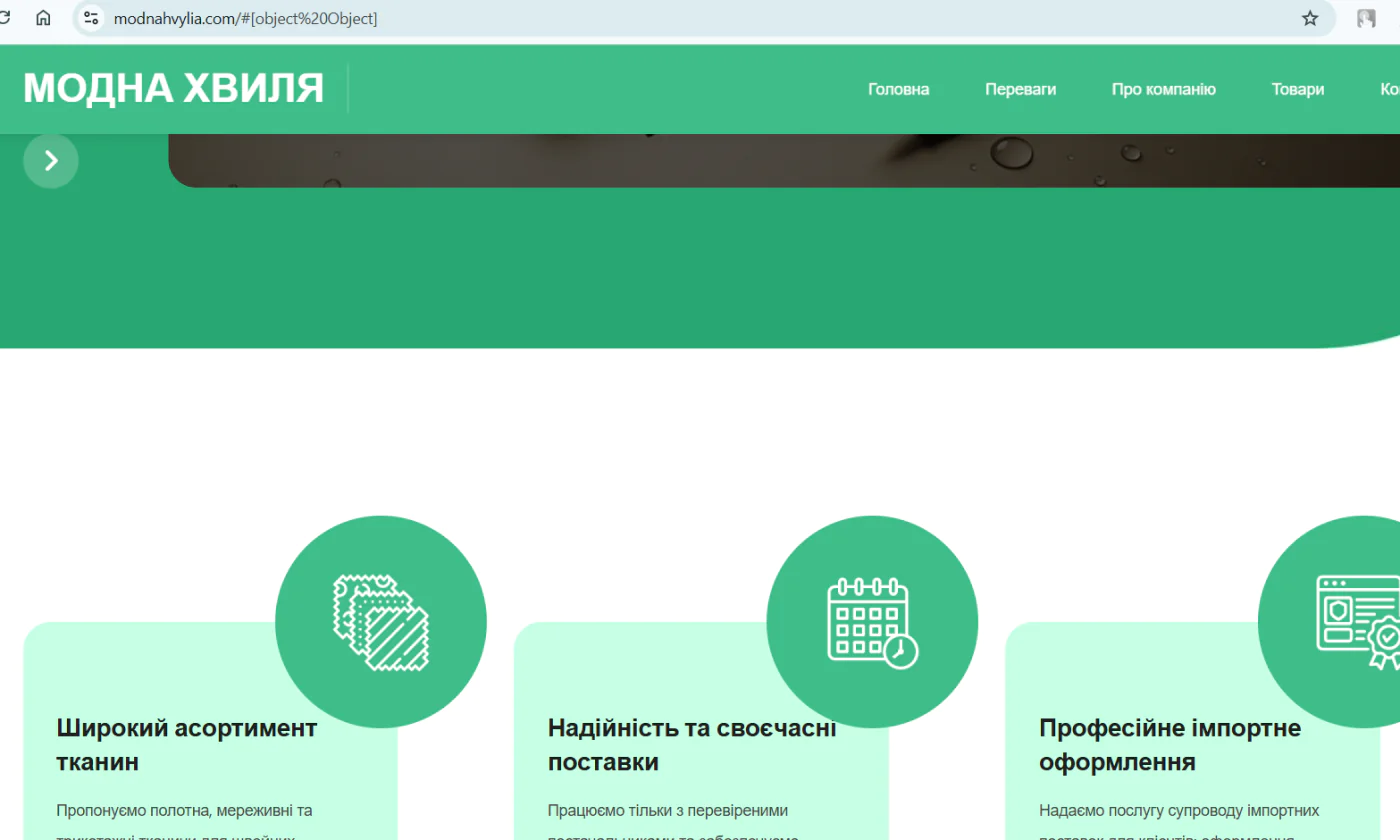
Domain owner information is hidden
And the website “Fashionable Khvili” has a similar concept.
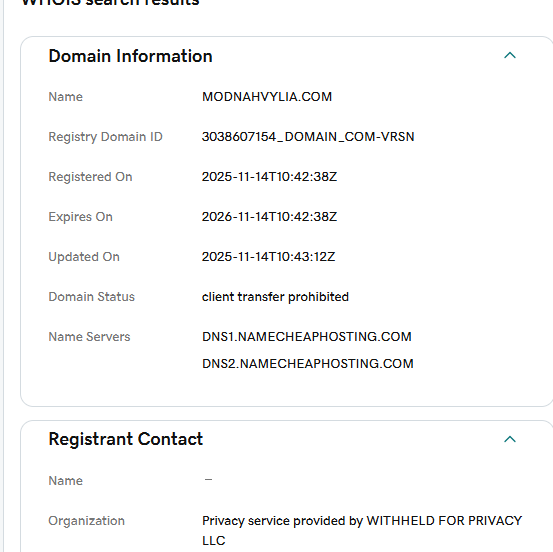
Modnaya hvilya website
It was created in November 2025. And here again, Withheld for Privacy was used.
So, we have a Ukrainian importer, a foreign supplier, hundreds of millions of hryvnias of trade transactions—and two extremely unsightly websites that make it virtually impossible for potential clients to understand what exactly these companies are selling.
But even more interesting is what happened to the companies themselves.
Today, the companies that were “hung” on 18-year-old Gritsenko no longer exist.
They were transferred to other people. Among the new owners is Uzbek citizen Muhammadjon Egamberdi Ogly Usarov, who, according to public records, owns more than 40 companies. This scenario is repeating itself in another group of companies.
Black Audit. A 21-year-old from the village and 16 other companies.
Yuriy Yarosh is a resident of the village of Stara Chortoryia in the Zhytomyr region. In 2024, when he was 21, companies began to be registered in his name. In total, there were 16.
"Khvilyaaopt", "Sinteksred", "Linderio", "Ekobudiya", "Kingstaropt", "Visionprom", "Denisopt", "Torgstock", "Origent Sweet", "Torgrukh", "Torgimpakt", "Globavers", "Khatniy Smak", "Tovarniy Shlyakh", "Asortitreyd" and others.
We see a familiar set again:
- Wholesale.
- Small staff.
- The authorized capital of some companies is approximately 200 thousand UAH.
- Imports.
- And then - a change of names and owners.
Some of the companies were subsequently transferred to Uzbek citizen Abduraufkhon Bokhodirkhon Ogly Tursunkhodzhiev. According to company registers, he owns over 70 companies.
The most illustrative company in this story is the one that is now called Khvilyaopt.
Initially, it was called "Khozportal." Yuriy Yarosh founded it on March 7, 2024. The company then became "Purchasing Center," and later, "Khvilyaopt."
The owners also changed: first Yarosh, then Vasily Tsalko, and later that same Uzbek citizen, Muhammadjon Egamberdi Ogly Usarov.
According to YouControl, the company imported goods worth approximately 400 million hryvnias. What happened next is far more complex than just the registry statistics.
Last August, the company's cargo was stopped at the Mostyska customs post in the Lviv region. The customs declaration listed more than 1,7 steam cleaners.
But upon inspection, customs officials saw something else. The cargo contained items labeled Gucci, Hermès, Louis Vuitton, Dior, Montblanc, Boss, Tommy Hilfiger, Prada, Loro Piana, Yves Saint Laurent, and Celine. And 398 Apple AirPods Pro.
Customs officials filed a report for an administrative offense for transporting goods across the border while concealing them from customs control. However, according to information obtained by Telegraf, this incident did not escalate into criminal proceedings against the company.
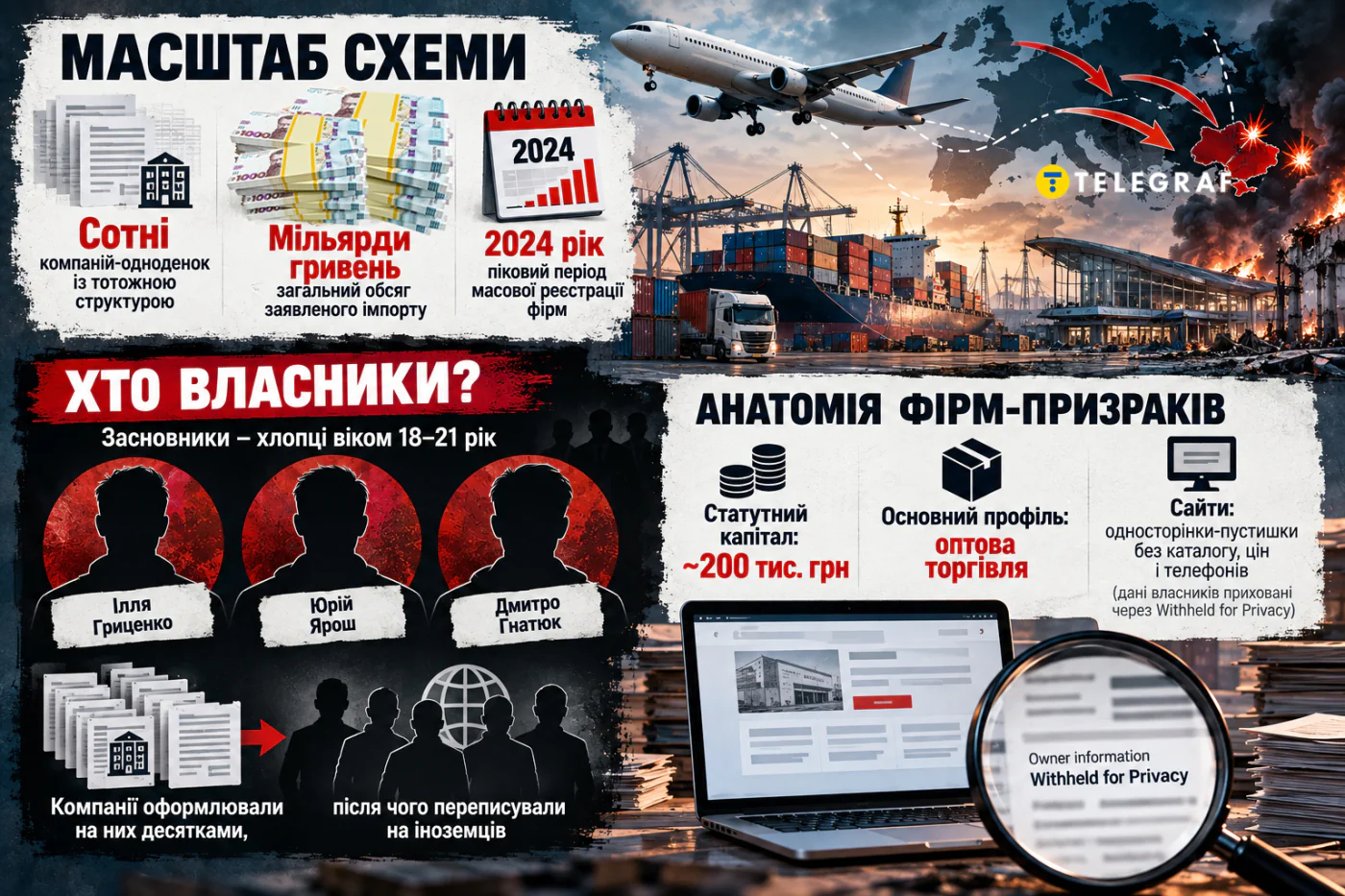
The Anatomy of Ghost Companies. Infographics from Telegraph
Why would a million-dollar importer need a website where you can't buy anything?
Let's return to Khvilyaopt. The company has a website created on November 18, 2025.
The domain owner's details were hidden using Withheld for Privacy. It, like other companies' websites, looks very much like a cover site. For example:
- The site itself consists of essentially one page.
- There is no normal catalog.
- There is no specific list of products.
- No prices.
- No product photos available.
- No information about suppliers.
- There is no information about the founder and director.
The third subject of the publication is 20-year-old Dmitry Gnatyuk from Bila Tserkva. In 2024, about a dozen companies were registered in his name. And again, it's a familiar scenario.
Companies were established over the course of several months, declared wholesale trade, carried out significant import operations, and then changed hands. One of them was Maiden Sale.
Her website has a different look, but the principle is the same. Instead of a full-fledged catalog, there are icons. Instead of specific products, there are general categories.
There are no prices, proper descriptions, supplier information or management.
Telegraph tried calling the numbers listed on these companies' websites. Almost none of the mobile numbers worked.
And again - Withheld for Privacy to hide data about the domain registrant.
If we look at each company individually, all of these details can be attributed to sloppy marketing, a young business, or a poor website.
The foreign supplier "Modnoi Khvili" also has a similar website. This is important, because if the company is truly purchasing goods from China worth hundreds of millions of hryvnias, its supplier must be a genuine commercial entity with a corresponding scale of operations.
And here we see a website that contains practically no information about the products.
The question is: who creates these companies, why are dozens of them registered to young people, and who actually controls them after they are re-registered?
The Telegraph does not claim that each of these companies is part of Black Audit. Only investigators can prove this. But the sheer number of identical details raises the question: are we dealing with a single network churning out companies using the same template?
Black Audit. Here's what's most alarming:
- Dozens of companies opened in a very short time;
- The founders are very young people who are unlikely to be representatives of a real business;
- All of them have almost the same size of authorized capital and the same types of activities;
- Millions of imports are made through primitive websites that were hastily created in one period;
- There are no contact phone numbers, normal product catalogs or prices, and information about the website owners is hidden;
- Companies are constantly changing their names and are re-registered to people who are also responsible for a dozen other similar companies.
The shipments themselves also raise questions: they clear one shipment at customs, only to find designer clothing or expensive AirPods inside. When this happens to a single company, it's surprising. But when it involves an entire system, law enforcement should investigate. And that's where we come back to Black Audit.
Telegraf reported on companies that appeared to be used to funnel money abroad via fake imports (at the time, the NBU fined Ukrainian Capital Bank 42,5 million hryvnias). Media outlets linked Black Audit to former tax and customs officials Vasyl Sandul and Yevhen Kulibaba (although we have no direct evidence of their guilt).
Subscribe to our X channel and Telegram channel!
Stay informed about who is doing business, in politics, and supporting corruption in Ukraine!
Now, a new array of data is added to this picture. If this is a regular business, it's very easy to prove legally. But if it's a single, massive scheme that siphoned off billions of hryvnias, the scale is staggering.
Telegraf publicly appeals to law enforcement officials to launch an investigation into the facts reported in the publication. We also once again ask Vasily Sandul and Yevgeny Kulibaba to comment on their connection to Black Audit. To be continued...
Skelet.Org
Black Audit has moved into scams involving the "gray" import of automobiles.
Takeaway Economy: How the "Black Audit" Scheme Is Destroying Ukraine's Financial System
The NBU and the prosecutor's office opened a case against the bank instead of investigating.
Black Audit
Subscribe to our channels on Telegram, Facebook , Twitter , VK - Only new faces from the SKLEP section!