
Ruslan Kravchenko's resignation as Prosecutor General was decided even before the Verkhovna Rada vote. It's not even because Volodymyr Zelenskyy decided it. Kravchenko himself turned his own end into a farce. Serhiy Lyamets writes about this in his UNIAN column . So, the ICU case.

Valeria Gontareva
At any other time, a case against the NABU director would have been possible and even appropriate. But after NABU released recordings of his subordinates, bringing charges against the Bureau's head was like playing a meaningless chord to demobilize. In its cynicism, this prank was reminiscent of a dictator's attempt to mobilize children when all battles have already been lost, but he still wants to hang on for five more minutes. Under these circumstances, the Verkhovna Rada simply had to shed its ballast and save face for itself and the president.
But there's another side to the process, and now is the opportunity to examine it. Note how intensely various opinion leaders and activists pushed for the Prosecutor General's resignation. Social media was flooded with angry posts and videos about the Prosecutor General's arrest in Paris. And, of course, the most wonderful thing—the incendiary comments.
What's going on? You'll be told these people were concerned about law and order. But that's certainly not true. Just a month ago, all these activists might not have known that Ukraine had a prosecutor general. But over the past week, they've been mercilessly denouncing him. Most likely, the cause and effect is different. A campaign was launched to "whip up" not only Kravchenko, but also the entire influential group that had controlled the Prosecutor General's Office for the past year. Incidentally, this is how they once "brought down" Mindich's group.
I'm not defending either Kravchenko or Mindich. I'm not interested in whether they're guilty or not. My question is different: why? Why now? Why are they being shot down? What are the interests of those behind this campaign?
The logic here is more or less clear. If they're targeting the head of Energoatom, it means they're interested in overseeing tenders and electricity sales. But the Prosecutor General's Office is responsible for overseeing high-profile investigations. The Prosecutor General is capable of stalling some of them (Kravchenko's team was suspected of this), while accelerating others (they were also suspected of this). My sources in the Prosecutor General's Office told me that, since Kravchenko's appointment, there's been talk of how the Prosecutor General's Office leadership stalled some cases for unclear reasons, while deliberately accelerating others so they could stall them later. I can't verify whether these rumors are true. But such rumors were circulating—that's 100%. If such a course of action existed, it certainly generated a lot of dissatisfaction.
In this regard, it's particularly interesting to see whose cases the Prosecutor General's Office has been handling recently. Were such investigations one of the factors that ultimately created problems for Kravchenko?
To illustrate this point, I'll remind you of one of the episodes I wrote about in July of this year. The defendants in this case are classic interested parties in the scandal surrounding the dismissal of the Prosecutor General.
The ICU case
In January 2026, the Office of the Prosecutor General sent requests for international legal assistance to the Prosecutor General's Offices of the Netherlands, Cyprus, and the British Virgin Islands to obtain information about the Investment Capital Ukraine group (also known as "Investment Capital Ukraine" or ICU).
But already in July 2026, it became known that the Prosecutor General's Office had withdrawn its requests. Why?
Let's start by saying that this case is completely unfeasible. You may know the Investment Capital Ukraine group from the names of its current (Makar Pasenyuk, Kostyantyn Stetsenko) and former co-owners (former National Bank Governor Valeriya Gontarev, former Energy Minister Volodymyr Demchyshyn , and Galina Ulyutina, the wife of Yuri Solovyov, deputy head of the Russian state-owned bank VTB). They owned and currently own what is arguably Ukraine's largest and most influential investment bank, which served, among others, the circles of Viktor Yanukovych and Petro Poroshenko.
Therefore, the criminal case against this group is not just about billions. It's about access to information about the wealth of Ukraine's most influential people.
It's no surprise that for many years, the ICU group remained virtually invisible to law enforcement. Any cases involving it were quickly closed. The current investigation defied this pattern, and it began after Kravchenko. This doesn't mean Kravchenko is a saint or a complete idiot. It does mean that for the first time, the ICU has become involved in a major case.
A new Prosecutor General was appointed in June 2025, and the investigation into case No. 62025000000000954, which involves the ICU, was opened in September 2025. The scale of the investigation was quite significant. Instead of the typical one or two investigators, the case was handled by 13 SBI officers and five prosecutors of various levels, including senior prosecutors from various departments. This can be considered a sign of a serious case.
The scale of the information examined was also significant. Official documents featured Pasenyuk, Stetsenko, Gontareva, and numerous companies in Ukraine, Cyprus, and the British Virgin Islands (BVI) that are part of the Investment Capital Ukraine (ICU) group. For example, among the most prominent of these are ICU Trading, ICU Holdings, ICU Investment Management, CIS Opportunities Fund, and JSC Bank Avangard (more than a dozen entities in total). Prosecutors and investigators analyzed not only the Ukrainian "facade" but also the group's offshore core.
To prevent you from thinking that the queries are fake, I am publishing screenshots of the first pages of all three queries.
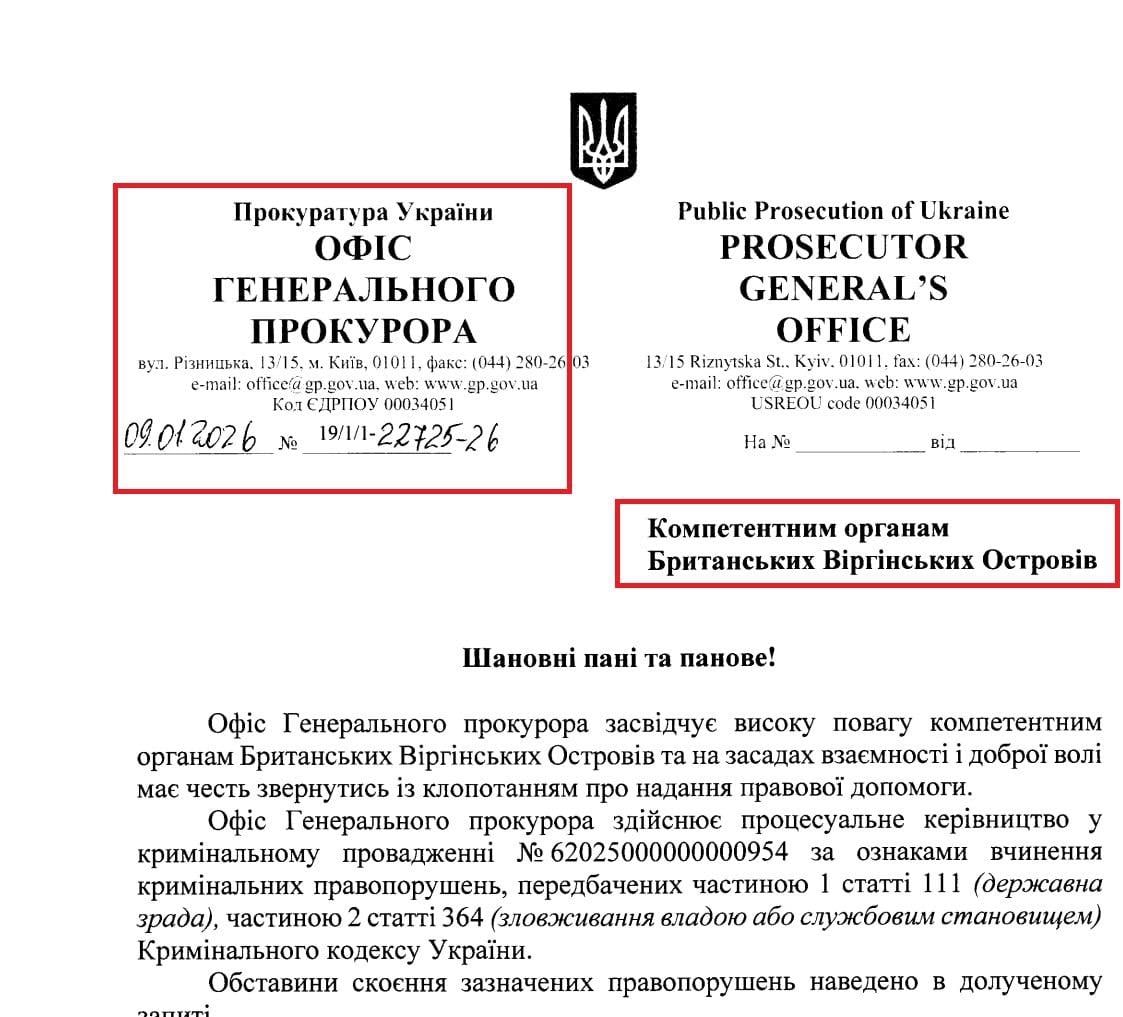
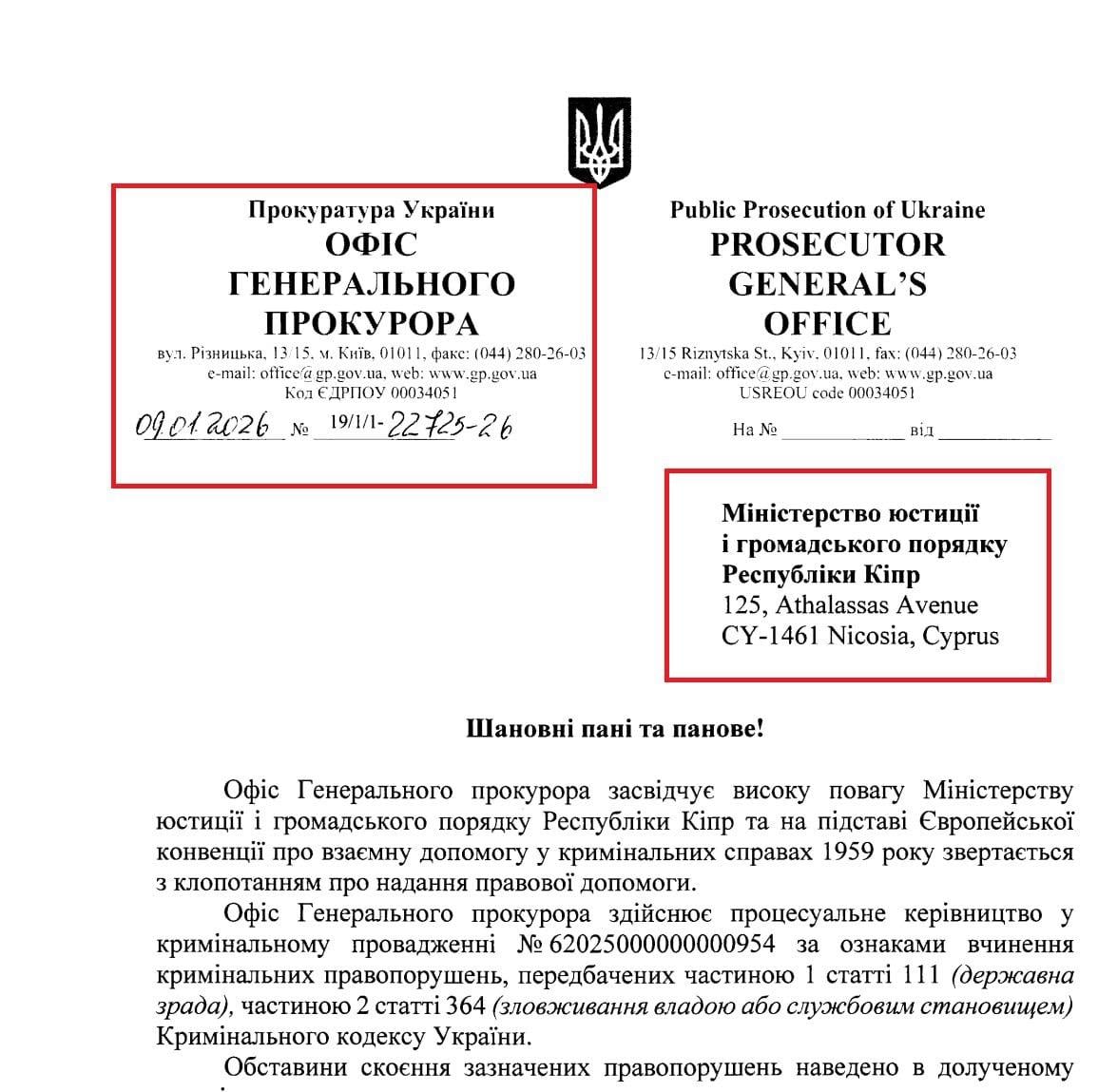
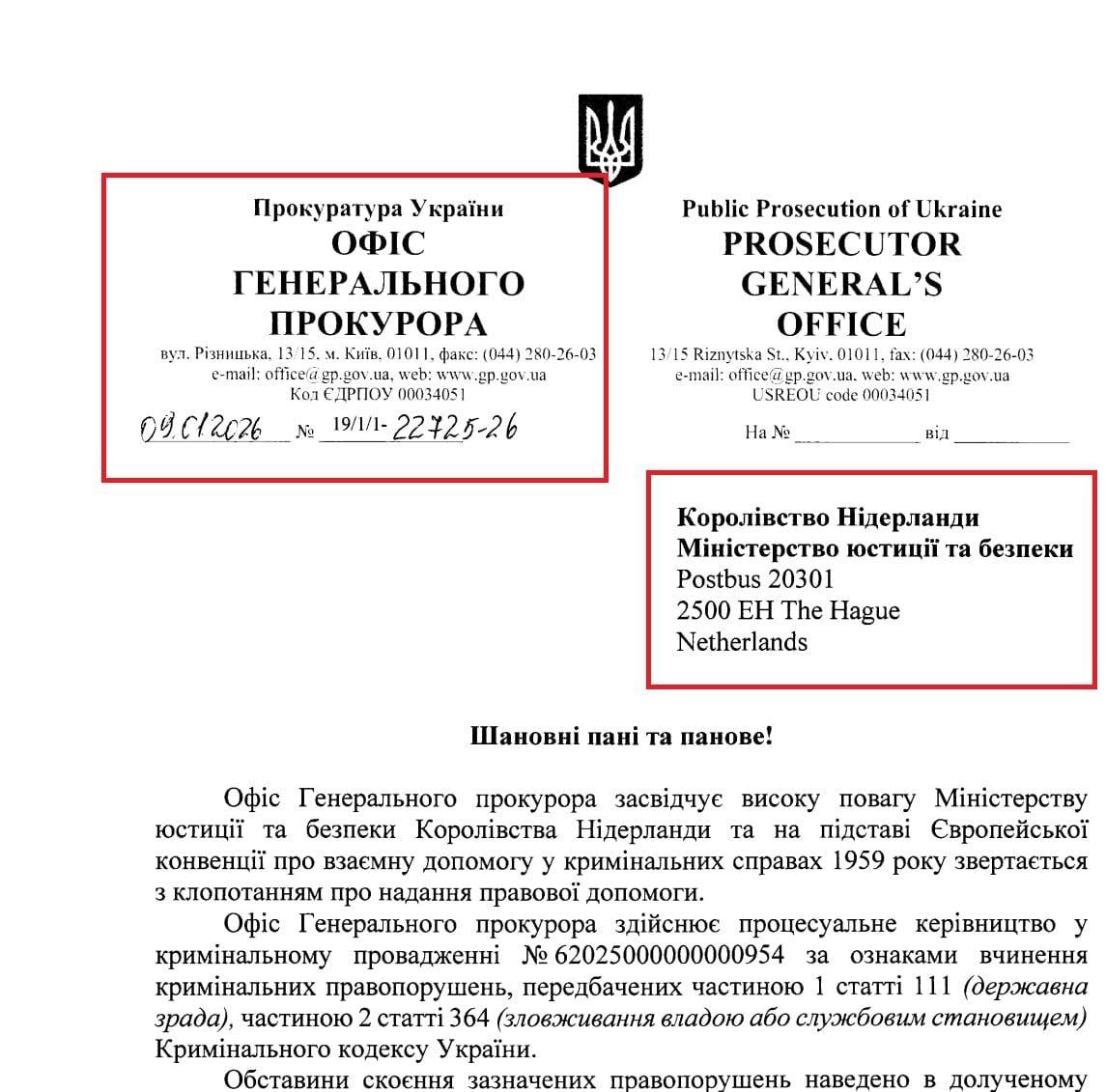
Investigators were looking into their possible involvement in financial relationships with representatives of the Russian Federation, as well as abuse of power for profit. Prosecutors from the Netherlands, Cyprus, and the British Virgin Islands requested that Ukraine provide financial statements and other necessary data, and that their foreign counterparts maintain confidentiality. Among other things, the Prosecutor's Office assured that the case was not politically motivated. This is an important point, as defense attorneys often exploit the idea of political persecution to block international investigations.
In July 2026, it became known that the international requests might have been withdrawn. Apparently, the ICU learned of the investigation and made efforts to "bury" it. How this agreement was reached, I don't know. According to my sources, as early as February 2026, the Prosecutor General, with the support of Aidin Khudiyev, Head of the Department for Enforcement of the Prosecutor General's Powers in Criminal Proceedings, ordered the removal of the entire team of prosecutors, specifically those handling international requests, from the investigation. And by June 2026, it became known that the international requests might have been partially withdrawn. After this, the case was put on hold. Ukraine, represented by the Prosecutor General's Office, lost interest in such a high-profile case.
Incidentally, back in the winter of 2026, rumors surfaced that someone had offered the leadership of the Prosecutor General's Office $500 to make the ICU case disappear. This allegedly explained why overzealous prosecutors were removed from the investigation, and requests for international legal assistance became irrelevant. The story seemed classic: first, they created a need by initiating criminal proceedings, then "ticketed the client" and shut it all down. Of course, I couldn't verify this information then, and I still can't. Therefore, I believe it should be treated as nothing more than rumors that require verification.
However, as my sources noted, the case wasn't closed. It was simply put on hold.
It's quite possible that this was the only thing they could agree on. Why? Perhaps because of ICU's close ties to Poroshenko. They literally hold the secrets of "Sivochologic," and these secrets would be very useful on the eve of the elections. It would be a sin to close the case and let ICU's owners off the hook.
Be that as it may, we have a fact. Most likely, in the spring or summer of 2026, ICU managed to negotiate a freeze on the investigation in which they figured. These were my conclusions in July. I decided to return to the ICU case later to verify whether the Prosecutor General's Office had indeed halted the investigation. As of mid-September, it appeared as if there was indeed no activity in the case.
Taking advantage of this lull, ICU is attempting to defeat the NBU's sanctions in court for recognizing Pasenyuk and Stetsenko's less-than-perfect reputations. As far as I understand, the group can only win such cases if the authorities have no further complaints against it.
Everything went too far
However, the investigation is still not closed. It continues to hang like a sword of Damocles over the heads of the financiers.
And here one might ask: has the investigation against ICU gone so far as to pose a real threat to Gontareva, Poroshenko, and the group they created to serve the needs of government officials, known as ICU, now formally registered to Makar Paseniuk and Kostyantyn Stetsenko? Could this, in turn, have been one of the reasons why the pressure at some point began to shift to Kravchenko himself?
Yes, that's speculation. But the logic here is absolutely ironclad. If the current prosecutor general doesn't close the case, another prosecutor general can.
Let me reiterate, I don't believe the ICU is powerful enough to bring down Kravchenko by involving the NABU and activists. They are certainly among many similar figures in investigations overseen by the Prosecutor General's Office. However, I would like to remind you that Valeria Gontareva has historically had a good relationship with the NABU. The bureau consistently ignored the activities of the NBU head, even though simple logic dictated that in her case, there were ample grounds to wiretap her and examine her documents.
ICU is also a long-established service provider for senior government officials in Ukraine. Therefore, the group has the best contacts in the country.
There's another compelling reason to close the case by any means necessary. ICU Group still maintains its status as the number one investment bank in Ukraine. The group operates not only in Ukraine, but also in the UK, Switzerland, Cyprus, and the Emirates. For Makar Paseniuk and Kostyantyn Stetsenko, the investigation against ICU has gone too far. The criminal case threatens their future projects.
Furthermore, according to my sources, Valeria Gontareva is opening a family office in Cyprus. Her partner in the new project may be former First Deputy Governor of the National Bank of Ukraine Kateryna Rozhkova, who has also been spotted in Cyprus and is rumored to own property there. Rozhkova is a longtime friend and confidant of the former National Bank governor; for many years, she handled behind-the-scenes matters with bankers on behalf of the National Bank of Ukraine (as evidenced by Rozhkova's recordings, which, strangely, were not included in the National Anti-Corruption Bureau's investigation).
A family office is a closed structure that professionally manages the finances of one or more families. The office provides services in investment, tax, and money management. The names of the beneficiaries are usually kept confidential. The choice of Cyprus is clear. The country is a convenient location because it offers tax benefits and is convenient for working in the EU; the island also has a large community of lawyers, auditors, financiers, and consultants. One more thing: the ICU Group has always actively used Cyprus and other offshore jurisdictions (including the British Virgin Islands), so the country is convenient for this reason as well.
Is Gontareva connected to the case in question? Officially, she sold her stake in the ICU group upon her appointment as head of the National Bank in 2014. However, Gontareva was implicated in an investigation by the Prosecutor General's Office and the State Bureau of Investigation (SBI), which included requests for international legal assistance. A probe into her and other ICU co-owners' connections to Russian officials and possible abuse of office does not constitute charges. However, their status may change during the investigation. Furthermore, Gontareva has been the subject of other criminal cases at various times, as she has crossed many influential people in Ukraine. Her "cleansing" of the banking system resulted in the loss of a significant portion of Ukraine's GDP for many years to come.
I am convinced that Valeria Gontareva and the people in whose interests she is opening a family office in Cyprus are absolutely not interested in the successful completion of the investigation by the State Bureau of Investigation and the Office of the Prosecutor General.
They must be confident that Ukraine's claims against Gontareva have been dropped. The same applies to Rozhkova, whom the Supreme Court ordered to pay a large sum in the Platinum Bank case.
This is why I conclude that the ICU group may be among those ardently supporting "Kravchenkogate" and the Prosecutor General's resignation. This doesn't exonerate the disgraced prosecutors, but it does provide a more sober perspective on the recent proceedings surrounding the Prosecutor General's Office.
Why is ICU so important?
ICU's value to the investigation is unique. The group's uniqueness lies in its knowledge of the secrets of Viktor Yanukovych and Petro Poroshenko's inner circle. Since the 2010s, the financial group has professionally handled the financial flows of the previous and previous governments. It's possible that the current government has also resorted to its services, as the Investment Capital Ukraine group's expertise is undoubtedly high.
Among other things, after Euromaidan, ICU represented Poroshenko in several major agreements, including the creation of a blind trust managed by Rothschild, the settlement of the Lipetsk factory case, negotiations for the purchase of television channels, energy agreements, and many others. And this is just what is known, and why Makar Paseniuk was considered "Poroshenko's financial shadow . "
ICU has always managed to be at the epicenter of business dealings with power, large financial flows, and sanctioned individuals. This means the group's owners hold many keys to unlocking clients' personal closets, complete with skeletons inside.
For some time, ICU was interested in the assets of nationalized Russian state-owned banks and, quite possibly, used administrative resources to resolve these issues. The conflict with the NBU surrounding Avangard Bank is an echo of that interest. As a reminder, we're talking about a billion embezzled through Avangard Bank. Paseniuk and Stetsenko pocketed 949 million hryvnias in interest earned by circulating the frozen assets of Sberbank Ukraine, a liquidated subsidiary of the Russian bank Sber. Paseniuk and Stetsenko decided not to return this interest to the state, but to divide it between themselves (like Matroskin's cat from Prostokvashino: the cow is state-owned, the milk is ours).
Apparently, they ignored the division table, which would have been quite useful in this situation. Their actions were noted, but they were given the chance to resolve the dispute amicably. The Cabinet of Ministers and the National Bank of Ukraine (NBU) offered to transfer all the embezzled funds to United24 accounts. Paseniuk and Stetsenko refused, paying themselves almost a billion hryvnias in dividends. In response, the NBU imposed harsh sanctions on them, including removal from the management of Avangard Bank and declaring their reputation impeccable. ICU lost the lawsuits and has been trying for months to sell their bank to save it from liquidation (with no progress). Furthermore, the Cabinet of Ministers filed a lawsuit against them and is seeking to compel them to return approximately $47,5 million. Only recently, according to court records, have they gained any hope of clearing their reputation (which is crucial for financiers).
I don't rule out that the group continues to manage the property of someone from Poroshenko's circle, but no longer advertises it.
There's a reason for this. "Sevochelyi" has been under National Security and Defense Council sanctions for several years and is still considered a genuine opposition to current President Volodymyr Zelenskyy. Any indication that ICU is still serving Poroshenko could cost the group its business not only in Ukraine but also globally. However, I would still admit that there are ways to anonymize capital so that it's no longer the money of a sanctioned person, but simply capital.
Obtaining classified documents and financial statements from the Netherlands, the British Virgin Islands, and Cyprus could have revealed facts unfavorable to ICU. Therefore, I am certain that the financiers weren't sitting idle but were trying to find ways to thwart the investigation.
"Investment Capital of Ukraine" is associated not only with Yanukovych and Poroshenko. ICU has, in some instances, intersected with Viktor Polishchuk (the former owner of Gulliver, whose wife was said to be a relative of former Russian President Dmitry Medvedev) and Dmitry Firtash's entities.
As we can see, many incidents involving the group would be of interest to investigators. I admit that obtaining classified documents and financial statements from the Netherlands, the BVI, and Cyprus could reveal new facts that are not in favor of ICU.
Therefore, the case, which was opened under Prosecutor General Kravchenko but unexpectedly melted away, may well be revived again.
Contacts from Russia
There is extensive evidence of contacts between ICU co-owners and Russians. This can be found, in particular, in documents accompanying the joint investigation by the State Bureau of Investigation and the Prosecutor General's Office.
"The Investment Capital Ukraine group of companies has had stable financial ties with financial companies in the aggressor country, the Russian Federation, since its inception and continues to do so despite the full-scale armed aggression against Ukraine and the national and international sanctions imposed," states the Pechersk Court's ruling of December 11, 2012.
Specifically, the investigation highlights Gontareva, Pasenyuk, and Stetsenko's collaboration with representatives of Vneshtorgbank of Russia (VTB). After the events of 2014, the group acquired a 35,02% stake in Burger King Russia (Cyprus) Ltd., purchasing the stake from sanctioned VTB. The family of a top VTB executive was once a co-owner of ICU.
ICU is also known to have collaborated with sanctioned Russian oligarch Konstantin Grigorishin . Specifically, in January 2015, ICU purchased a 25% stake in Vinnytsiaoblenergo. By that time, the Russian already owned a 72% stake in Vinnytsiaoblenergo. It was believed that the 25% stake in Vinnytsiaoblenergo went to Konstantin Grigorishin . However, there was another version, claiming that the stake went to Petro Poroshenko in exchange for immunity from prosecution of Grigorishin's other businesses.
Grigorishin is not just a story of the Poroshenko era. After the full-scale invasion, the National Security and Defense Council (NSDC) seized Zaporizhzhiatransformator and Turboatom from Grigorishin, but, strangely, left his stakes in six regional energy companies untouched. The NSDC imposed personal sanctions against Grigorishin only on January 19, 2025. In fact, there is no asset freeze. Vinnytsiaoblenergo is not subject to sanctions, nor has it been seized or confiscated. The reason is quite interesting.
The ICU Case: Gontareva's Personal Risks
Investigators suspected that the former NBU governor may have retained control over the operations of ICU Group companies after officially relinquishing her ownership. Furthermore, she may have been suspected of causing damage to Ukraine on an especially large scale.
The investigation also examined personal incidents related to Gontareva. Specifically, the former head of ICU may have been involved in issuing stabilization loans to banks during the "bank collapse." It's fairly easy to draw a line from these stabilization loans to charges of causing damage to the state on an especially large scale, as approximately half of Ukraine's banks (several dozen) were subject to liquidation during the "bank collapse."
Quote from court documents:
"There are reasonable grounds to believe that V.A. Gontareva, in her position as Chairman of the Board of the National Bank of Ukraine, abused her official position and acted contrary to the interests of the service in order to obtain undue benefits for herself and other individuals and legal entities during 2014-2018, facilitated the illegal issuance of stabilization bonds."
Gontareva's name also came up in connection with her possible involvement in money laundering and embezzlement of budget funds, although without details.
Quote from court documents:
"A pre-trial investigation is being conducted against the board of the National Bank of Ukraine, which, under the leadership of V.A. Gontareva, during 2014-2018, by prior conspiracy with officials of the Investment Capital Ukraine (ICU) group of companies, used their official position contrary to the interests of the service, in order to obtain conditions for facilitating illegal schemes for the theft of budget funds and the laundering of proceeds from crime."
Both of these formulations are general. They may or may not evolve into suspicion. Apparently, this transformation did not occur under Kravchenko. However, it could very well happen after the appointment of a more independent prosecutor general.
Even if the case does not reach a court verdict, the facts are very convenient for the authors of the National Security and Defense Council sanctions.
I think that such risks are not compatible with managing a family office in Cyprus.
What do LPN bonds have to do with this?
Another episode in the history of the Investment Capital Ukraine group could lead to the unexpected resumption of a joint investigation by the State Bureau of Investigation and the Prosecutor General's Office. This concerns the relationship with the owners of the so-called Loan Participation Notes (LPNs), which the group has taken hostage.
This episode became a key element of the court decision that prompted the UCP's request to the Dutch authorities. Following a request from the Prosecutor General's Office, in December 2025, the Pechersky District Court partially seized the ICU-compliant Loan Participation Notes (LPNs) issued by the Dutch company EMIS Finance BV.
The requests are aimed at collecting evidence of corporate documents, transactions, voting, restructuring, and other matters. Specifically, the request concerns two issues: Series 26 Notes ($42,628 million) and Series 31 Notes ($49,023 million). Before the war, the bonds were sold to VIP clients of Sens Bank Ukraine. They were in demand because they offered higher foreign currency yields than deposits. After the full-scale invasion, Sens Bank Ukraine was nationalized, and the bonds were left in limbo. Their income was generated by repaying Sens' loans, and the state refused to pay the debts of the former owners. However, EMIS Finance BV promised to repay the debts. All but two tranches were successfully restructured. ICU is located in these two tranches.
The group holds a majority stake in series 26 and 31 securities, which the Pechersky District Court has seized. ICU has refused to restructure. Because of these seizures, holders of smaller stakes in tranches 26 and 31 cannot restructure their securities. Minority shareholders are now held hostage. They cannot expect to receive payments, and their securities are worthless.
I admit that ICU wanted to first squeeze out the unwitting partners by buying their bonds at a steep discount, and only then carry out a restructuring and recoup the entire $91 million. This would have been a fairly typical practice for ICU. But so far, the minority shareholders haven't sold their shares. I suspect they've begun to put pressure on the group in return.
According to my information, ICU lawyers learned of the OGP's inquiries and attempted to undermine the decisions of the Pechersk Court on which they were based. This tactic is quite reasonable, as accurate information from the Netherlands would have revealed a great deal of sensitive information. They were somewhat successful. In March 2026, the Kyiv Court of Appeal upheld ICU Trading LTD's appeal and overturned the "minor" decision of the Pechersk District Court of December 11, 2025. The court denied the prosecutor's request to seize bonds LPN-26, LPN-29, and LPN-31 of issuer EMIS Finance BV. Thus, the initial seizure of the securities imposed by the "minor" decision was completely lifted. Having received this decision, ICU lawyers attempted to undermine the international inquiries from the Prosecutor General's Office.
Subscribe to our X channel and Telegram channel!
Stay informed about who is doing business, in politics, and supporting corruption in Ukraine!
However, they were unsuccessful. Firstly, the Pechersk Court's "major" ruling of December 12 was upheld on appeal. The Kyiv Court of Appeal rejected ICU Trading LTD's appeal. The bond seizure was confirmed (including the ban on participation in restructuring and corporate events). According to one theory, the Prosecutor General's Office realized that the "minor" ruling was, in a certain sense, "defective," and therefore appealed to the Pechersk Court for a second ruling, which is standard practice for protecting state interests. This is precisely why the Prosecutor General's Office did not support the "minor" ruling on appeal, but upheld the "major" ruling. Most importantly, the court recognized, and the appellate court confirmed, that the LPN bonds meet the criteria of Article 170 of the Russian Criminal Procedure Code as property related to a crime. Furthermore, the court deemed the connection to the crime sufficient even at the stage when no one had yet been served with a notice of suspicion.
"The panel of judges finds that the prosecutor's arguments for the seizure of the securities—bonds—were reviewed by the trial court, the court materials were examined, and circumstances relevant to the seizure of the property were clarified. The panel of judges concludes that the evidence provided is sufficient to justify the seizure of the property , " the judges acknowledged.
Therefore, the bond seizure was unsuccessful, and the UCP's international requests continued to be processed. However, rumors then surfaced that one or more requests had been withdrawn.
So, even in open sources, one can find a lot of facts that could create difficulties for former and current ICU owners.
In my opinion, this automatically creates their motivation to seek the closure of the investigation, even if this requires the resignation of Prosecutor General Kravchenko.
Perhaps the ICU owners seriously expect the new attorney general to provide them with a valuable service.
Skelet.Org
On the topic : Pasenyuk, Gontareva, ICU, and treason: how the Prosecutor General's Office began and then abruptly terminated an investigation
How the former energy minister, who was beaten in Cyprus, is connected to ICU and DTEK
Subscribe to our channels on Telegram, Facebook , Twitter , VK - Only new faces from the SKLEP section!