
The Ukrainian army still uses civilian Motorola radios from Dolia i Ko. LTD. Why isn't this the best choice?
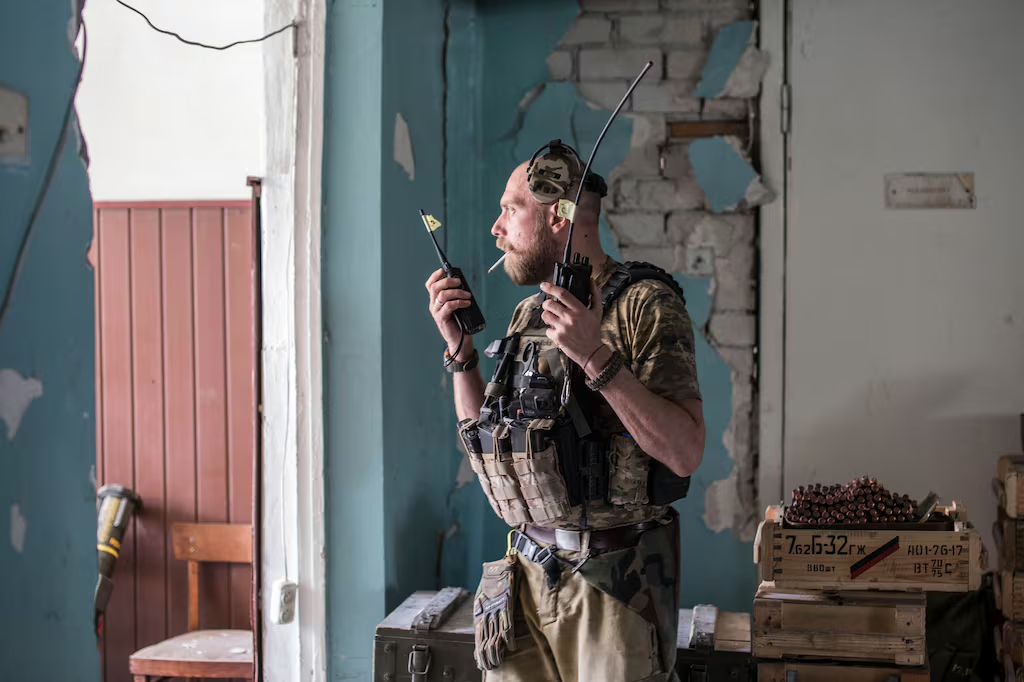
A Ukrainian soldier uses a Motorola radio during fighting in Severodonetsk, Luhansk Oblast, June 2022. (Photo by Oleksandr Ratushnyak/AP Photo)
Portable hand-held radios from the American company Motorola remain the primary means of internal communications in the Ukrainian Armed Forces. These purely civilian radios are used in the army for tactical communications—that is, during direct operations. The supplier of these radios to the Ukrainian Armed Forces is Dolia i Ko. LTD, one of Motorola Solutions' Ukrainian distributors. Repeated attempts to replace Motorola radios with more secure military communications have been unsuccessful.
"The communications market here is monopolized by one manufacturer and one supplier, and no one is going to change that now," a Ukrainian entrepreneur with many years of experience in the military told NGL.media .
Ukraine isn't the only country using commercial radios in its military. Russia, while proud of its own Azart radio, also uses civilian solutions like Motorola.
There are a number of companies in Ukraine operating in the communications sector, but no one has previously mass-produced portable radios. In 2023, the Ukrainian company Himera emerged, attempting to fill this niche, but so far with little success. In general, attempts by other manufacturers or suppliers to enter the market usually fail. For years, the Ministry of Defense has been entering into confidential agreements with Dolia i Ko. LTD, making it virtually impossible to verify prices or analyze the terms of the partnership.
NGL.media analyzed all available data and spoke with numerous experts, military communications specialists, and manufacturers to understand what led to the monopoly on the military communications market in Ukraine and what can (and should) be done about it.
We would like to emphasize that military communications is a complex, multilayered system and is not limited to portable radios. However, in this article, we will focus on these devices. For security reasons, we are also not publishing the names of some of the interviewees and sources who provided the information. We typically do not base our articles on anonymous testimony, but since this topic is so important, we have decided to include their comments. All interviewees and sources have been verified by the NGL.media editorial team.
Dolya i Ko. LTD. In the right place at the right time
During the first Russian invasion in 2014, the Ukrainian army faced numerous problems, including communications. The military relied on Soviet-era radio systems and mobile phones , which were easily detected by enemy intelligence. Volunteers donated whatever they could find on the commercial market to the army—Japanese Kenwoods, Chinese Baofengs, and other radios that lacked sufficient protection against eavesdropping and geolocation. Using them regularly was simply unsafe.
Dolia i Ko. LTD quickly entered the arena. At that time, it had been in business for over 20 years and, among other things, imported Motorola Solutions products to Ukraine. During a critical communications shortage in the Ukrainian army, Dolia i Ko. LTD was able to address this urgent need. Both the Ministry of Defense and other security agencies began signing contracts with the company. At the time, Motorola radios were an optimal, albeit temporary, solution, as they used the international DMR digital communications standard, which, unlike analog, was encrypted, though still not very secure.
Subscribe to our X channel , Telegram channel and Facebook page!
Stay informed about who is doing business, in politics, and supporting corruption in Ukraine!
"Getting professional military communications equipment from allies isn't easy. It takes time, which you didn't have. It was even quicker to say, 'Look, we can buy 10 Motorola radios now.' Essentially, it's a way out of a hopeless situation where you know these radios won't be secure and will be vulnerable to electronic warfare. But, in contrast, you get the radios right away, you can buy them and deliver them to soldiers very quickly ," explains Thomas Whittington, a research fellow at the UK's Royal Institution (RU), in an interview with NGL.media.
Soon, other suppliers of DMR radios, competitors to Motorola, attempted to enter the communications market , which met with resistance. The main argument in favor of Motorola and Dolya i Ko. LTD radios was the supplier's security clearance. Other distributors and manufacturers did not have such clearance, and it was impossible to obtain it quickly. The Ministry of Defense and other security agencies continued to work with Dolya i Ko. LTD, accepting the terms and prices offered by the sole supplier at the time.
In 2016, NABU detectives opened a criminal case, suspecting that officials from several defense agencies had conspired with Dolia i Ko. LTD to embezzle budget funds through the purchase of radios. NABU investigated the hypothesis that the radio procurements were initially tailored to Dolia i Ko. LTD, while proposals from other market participants were rejected for technical reasons.
"It was established that the procurement of radio stations using state funds was actually tailored to the products of the company [Dolya i Ko. LTD]. Tender committees amended the tender documentation six times and rejected, for formal reasons, bids from other bidders that could have been more advantageous. Furthermore, when importing the said radio equipment and software, officials [of Dolya i Ko. LTD] used official documents: correspondence, supply contracts, and invoices, which showed signs of forgery ," stated one of the court rulings in the case.
The plaintiff in this case was Alexander Doroshenko, director of a competing company, Kenwood Service Center LLC. He declined to speak with NGL.media.
The case materials state that the Ministry of Defense and other security agencies paid Dolia i Ko. LTD a total of almost 811 million hryvnias between 2014 and 2015. However, the investigation into this case remains ongoing—NABU closed it twice due to insufficient evidence, reopened it by court order, and then transferred it to the Kyiv Specialized Defense Prosecutor's Office. This case remains open.
Therefore, Dolya i Ko. LTD remained the only company in the tactical military radio market and continued to supply Motorola radios. However, discussions about switching to more professional military communications were ongoing.
Attempts to replace Motorola from Dolya i Ko. LTD
So what is professional military communications and is it different from the solutions offered by Dolya i Ko. LTD?
"Professional military communications equipment uses frequency hopping (FH), meaning the ability to quickly change frequencies. This is necessary to protect radio communications from interception, jamming, and interference. Civilian radios lack this ," explains Yevgeny Kuchuka, deputy commander of the communications battalion of the 39th Coastal Defense Brigade, in a conversation with NGL.media. " Furthermore, the DMR encryption protocol used by Motorola radios broadcasts too much information, and military communications should not broadcast anything unnecessary. Professional military radios often support multiple bands and different protocols . "
Modern Motorola Solutions radio models use 256-bit encryption, which is considered highly secure. However, incidents still occur due to operational errors or system vulnerabilities.
"Ukrainian officers recalled an instance in which Russian headquarters warned their units of an artillery strike, relying on a call from Ukrainian troops for a fire mission. Ukrainian troops communicated using Motorola radios with 256-bit encryption, but it appears the Russians were able to intercept and decrypt these transmissions in near real time ," according to a report by the Royal United Services Institute for Defence and Security Studies, published in May 2023.
One Ukrainian soldier, speaking with NGL.media, also mentioned a recent incident in which the enemy managed to infiltrate the communications system and access the communications of one of the units. "When we learned of this, we had to make urgent decisions and change the encryption. I can't disclose the details, but there was a fairly large-scale information leak," said a signalman from one of the brigades holding the line in the southern direction.
What kind of radios do the military use in other countries?
Before the full-scale invasion, the Ukrainian army attempted to equip itself with tactical military radios. Among the options was products from the Turkish company Aselsan, with which have signed supply agreement, and the Israeli company Elbit. In 2021, Get in touchThe key supplier of tactical radios for the Ukrainian Armed Forces will be the American L3Harris, considered the benchmark in this niche, and the purchased Turkish Aselsan radios will be distributed to territorial defense units. The US government has supplied and continues to supply
L3Harris radios are available as technical assistance, but in limited quantities, so only select special forces units of the Defense Forces use them. The Ministry of Defense does not purchase these rights. One of the reasons is likely the high price—depending on the model, an L3Harris radio costs between $5000 and $20000.
"The situation in 2021 and 2025 is completely different, and what was planned for 2021 requires a complete rethink. The current situation is largely determined by the position of Ukraine's partners, including the United States, and the dynamic changes in their political establishment, funding availability, and the capabilities of the Ukrainian Ministry of Defense," Yuriy Servetnik, head of the training and service center at Radio Satcom Group, the official representative of L3Harris, told NGL.media.
Even during the full-scale war, Ukrainian troops began using satellite communications, primarily Starlink, but when performing missions on the front lines, portable radios remain the primary means of communication.
"Starlink has truly become an alternative for most communications equipment located just beyond ground zero. Ground zero, of course, also has some, but it's used less frequently and is more vulnerable to enemy detection. After all, a stationary radio antenna can at least be successfully camouflaged, whereas camouflage can be a hindrance for Starlink ," a signalman from one of the Ukrainian Armed Forces brigades operating in the Kharkiv sector explained in a conversation with NGL.media.
The cart is still here
After the Russian invasion in 2022, the Ukrainian Armed Forces' numbers nearly tripled in a matter of weeks. At that point, no one considered switching to any other military communications system, because objectively, there was no time. Besides, a well-established system had been in place for years. Motorolas were almost everywhere, and we're not just talking about portable radios. And military communications specialists knew these rights inside and out and could pass this knowledge on.
"You had a situation in February 2022, where you were facing a major attack from Russia. You needed to deploy as many troops as possible to push back the Russians. There was simply no time to waste waiting to buy other radios ," explains military analyst Thomas Whittington. " By the way, the Russians were in a similar position back then. They were buying not only Motorola radios but also Chinese Baofeng radios, which are far inferior. But finally, having a commercial civilian radio is better than nothing at all."
Today, in the fourth year of full-scale war, Ukrainian troops continue to use Motorola radios. This represents 80%, perhaps 90%, of all radios in the Ukrainian Armed Forces. Only a few units are equipped with American L3Harris radios, while a few others use Kenwood, Hytera, Aselsan, Elbit, and other radios.
What specific Motorola radios are used by the Ukrainian Armed Forces?
Radios reach the Ukrainian Armed Forces in various ways. Some are purchased centrally by the Ministry of Defense through its subdivisions and supplied to military units. They are also purchased decentrally through military unit budgets. Finally, military personnel can purchase radios at their own expense or receive them as donations from volunteers.
Since 2015, centralized procurement of communications equipment has been conducted through a negotiated process. This is an alternative to open bidding, whereby the customer directly contacts potential suppliers and invites them to submit proposals, from which the best one is selected. Since the full-scale invasion, when the demand for communications equipment increased exponentially, Dolia i Ko. LTD has remained the main player in this market. NGL.media also learned this from other Motorola Solutions distributors operating in Ukraine. The company has a total of seven dealers , but the Ministry of Defense works only with Dolia i Ko. LTD.
The Ministry of Defense does not publish communications equipment procurement reports, and the ministry rejected NGL.media's request for information on suppliers and contract amounts . The Main Directorate of Communications and Cybersecurity of the General Staff of the Armed Forces of Ukraine claims that it purchases equipment from sources other than Dolia i Ko. LTD, but has not provided any confirmation.
In response to a request from MP Yaroslav Yurchyshyn, NGL.media learned that between 2024 and 2025, the Defense Procurement Agency (DPA), a division of the Ministry of Defense, signed five contracts with Dolia i Ko. LTD for the supply of portable radios worth 3 hryvnias. Prior to 2024, these purchases were handled by other Ministry of Defense agencies.
Dolia i Ko. LTD not only sells communications equipment from Motorola and other manufacturers but also manufactures its own products: radio antennas, headsets, repeaters, and radios, which it also sells to military personnel. According to YouControl , from 2014 to 2021, Dolia i Ko. LTD reported total annual revenue of UAH 300-500 million. However, in 2022, revenue sharply increased to UAH 3,2 billion, and the following year to UAH 4,8 billion. By the end of 2024, the company's annual revenue will have returned to its 2022 level of UAH 3,2 billion.
The owners of Dolya i Ko. LTDD are Kyiv-based spouses Larisa and Andriy Tatarintseva and their son Yaroslav. Larisa Tatarintseva also heads the Ukrainian Agency for Institutional Development and is a board member of the League of Defense Enterprises of Ukraine. Yaroslav Tatarintsev is a co-owner of Longevity Solutions, a healthcare services company founded in September 2025. He also owns Art-T LLC, an electrical equipment retailer.
Larisa Tatarintseva declined to answer NGL.media's question about the company's monopoly in the market for radio supplies to Ukrainian Armed Forces personnel.
What about Ukrainian producers?
Today, the domestic military communications market in Ukraine is represented by only one company, Himera. It was founded after the full-scale invasion of Ukraine in 2022. Other companies specializing in military communications equipment, such as Telecard, also operate in the Ukrainian market, but they do not produce portable radios.
Himera radios aren't in widespread use, but they are being tested by select units. The manufacturer claims these licenses offer features specifically relevant to military communications, including frequency hopping (FH), AES-256 encryption, and MANET network configuration support. Currently, the Himera G1 Pro license can be purchased for 15 UAH. This is cheaper than Motorola or, especially, L3Harris, and cheaper than any other global manufacturer of military communications equipment. Himera explains the low price by using more readily available and less expensive components for production than other tactical communications equipment manufacturers.
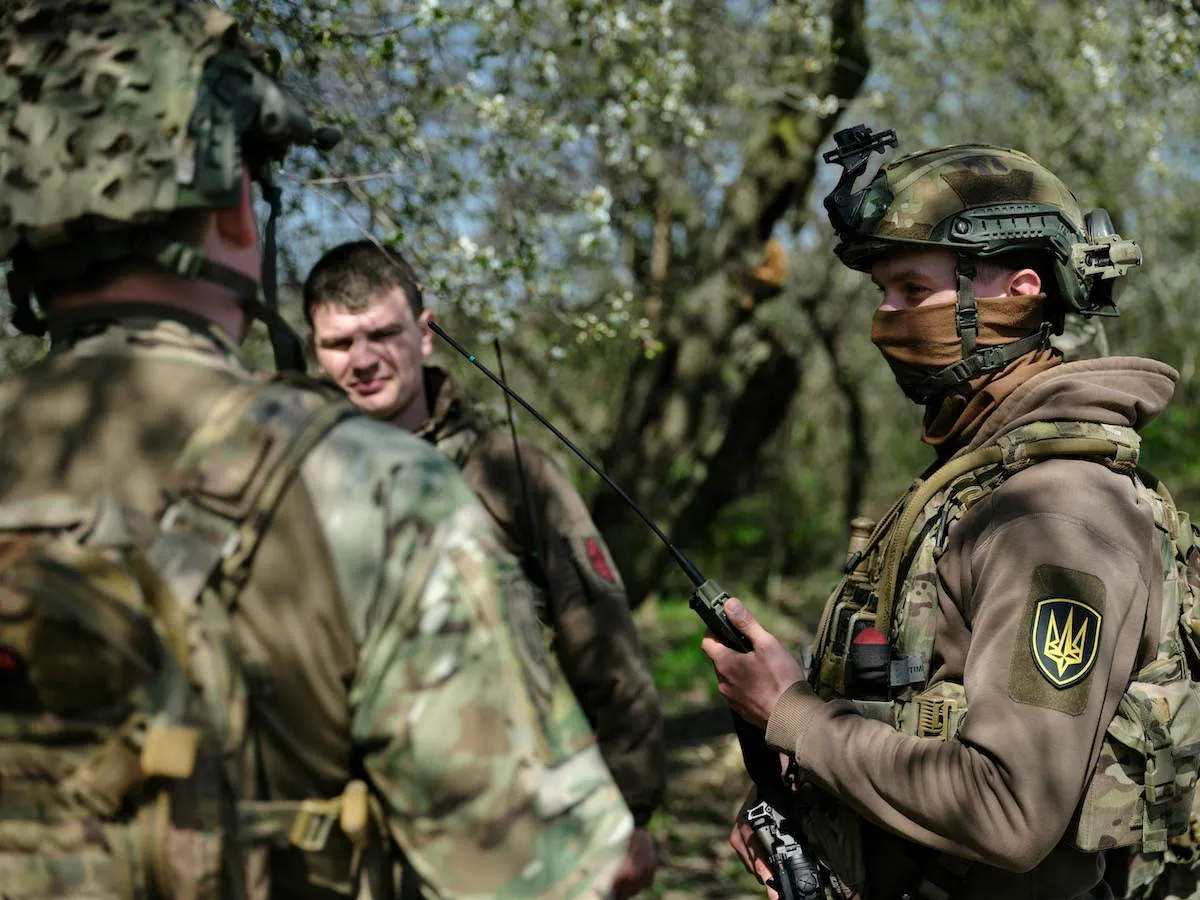
Ukrainian soldiers test Himera radios in a combat zone, summer 2025 (photo by Alexey Berezovsky / Monocle)
Yevhen Kuchuk, deputy commander of the communications battalion of the 39th Coastal Defense Brigade, is testing radios from a Ukrainian manufacturer in his unit. However, they haven't abandoned Motorola radios: they use them as the primary communications device, while Himera radios, purchased at their own expense, serve as backup.
"Motorola is a good communications system; they have excellent sound quality and work well with the protocol they're designed for. Overall, Motorola is fighting the war, but they lack some essential military features, " explains Evgeny Kuchuk. " So, fundamentally, Motorola is a good professional communications system. But it was designed for special services, airports, and civilian institutions, not for military use. Therefore, I believe we should consider other options and develop our communications technology."
His fellow communications officers from other brigades, who spoke to NGL.media, also don't yet see any options for completely switching from Motorola radios to other manufacturers.
"Unfortunately, there are no fully protected radios. Our troops periodically update the radio firmware for security, but this is always a temporary measure. The enemy, for example, doesn't care, and they've often been found with Baofeng radios or similar ones, which cost 800 hryvnias on the market [and are unprotected]. Motorolas, on the other hand, cost an average of 25–30 hryvnias. But we're assured that at least they offer more reliable communications security ," communications specialist Alexey B. told NGL.media.
Recently, the Ukrainian company Himera granted tactical testing licenses to the US Air Force. According to the manufacturer, testing was also conducted in Ukraine, and the company received all necessary certifications. The company has already ambitiously stated its readiness to produce 100 devices per year, should the demand arise.
"Our company is already registered with the Association of Industrialists and Entrepreneurs as a potential contractor for government contracts. We have completed the necessary codification and received all the required certifications for our type of product ," says Mikhail Rudominsky, CEO of Himera.
Skelet.Org
On the topic : Radios worth more than a million hryvnias: Kyiv officials made a new scandalous purchase
A TV presenter in the Ivano-Frankivsk region was convicted of fraud involving humanitarian aid.
Subscribe to our channels on Telegram, Facebook , Twitter , VK - Only new faces from the SKLEP section!