
The summoning of two deputy heads of the Dnipropetrovsk Regional State Administration, Svyatoslav Oliynyk and Gennady Korban, to the Prosecutor General's Office was a clear warning to their boss, Ihor Kolomoisky.

Gennady Korban
Vice Governor of Dnipropetrovsk Oblast Gennady Korban will be held accountable for the deaths of thousands of Ukrainian volunteers near Ilovaisk.
The summoning of two deputy heads of the Dnipropetrovsk Regional State Administration, Svyatoslav Oliynyk and Gennady Korban, to the Prosecutor General's Office was, if not a black mark, then a very clear warning for their boss, Igor Kolomoisky.
Kyiv no longer intends to tolerate the lawlessness of local officials, who, under the guise of patriotic statements, are building their own model of Ukraine for it, in comparison to which the defeated Yanukovych regime looks like a hotbed of law and democracy.
For now, Prosecutor General's Office investigators want to question Korban and Oliynyk about the persecution of regional prosecutor Roman Fedyk and the kidnapping of State Land Committee head Serhiy Rudyk, which was carried out by local activists at the direct instigation of Kolomoisky's deputies.

Viktor Yanukovych
While this is unpleasant in itself, it's not fatal, given the Dnipropetrovsk governor's political and business clout. However, the Prosecutor General's Office's intention to investigate Gennady Korban's role in the Ilovaisk tragedy could end much more tragically for him, given the public outcry and the serious consequences of this failed operation.

Svyatoslav Oliynyk
As a reminder, the decision to launch a frontal assault on Ilovaisk, a heavily fortified town occupied by militants, by Ukrainian volunteers without adequate support from army units, was made following a meeting in the office of Deputy Chairman of the Dnipropetrovsk Regional State Administration Gennady Korban, at which he ordered volunteer battalions to attack the town captured by the enemy.
"During the meeting, some of the commanders present received monetary compensation for participating in the upcoming Ilovaisk operation. Korban informed the battalion commanders of the absence of any fortifications or military equipment in the city. General Khomchak arrived at Korban's meeting much later, in a Lexus belonging to Kolomoisky's group, and fully confirmed everything Korban had said so far. Thus, in the office of Gennady Korban, a completely civilian and subordinate of oligarch Ihor Kolomoisky, the decision to march on Ilovaisk was made," former Azov Battalion deputy commander and MP Ihor Mosiychuk wrote on Facebook following the meeting of the Verkhovna Rada's Temporary Investigative Commission.

Igor Mosiychuk
In turn, the commander of the Shakhtarsk battalion, Andrei Filonenko, who testified before the VSK, stated that on August 7, he had intelligence data on a significant increase in the number of terrorists in Ilovaisk, which he provided to Korban, the leadership of the Azov and Dnipro-1 battalions. According to
Filonenko, they ignored this data and insisted on the small number of the enemy and the possibility of taking the city by the forces of the Shakhtarsk, Azov and Dnepr-1 battalions.

Subsequently, in a comment to Ukrainska Pravda, Gennady Korban denied his involvement in developing the plan to capture Ilovaisk, adding that he didn't know any battalion commander like Filonenko and wouldn't comment on the statements of "imposters." After Andriy Filonenko harshly criticized Ihor Kolomoisky at a commission meeting, Shakhtarsk itself was hastily disbanded.
Korban's "modesty" is understandable. After all, according to Andriy Senchenko, head of the Temporary Investigative Commission, the total number of Ukrainians killed (including from wounds) in the Ilovaisk Cauldron is around a thousand. And this, according to many military experts, is still a very optimistic figure. Kolomoisky's armchair strategist, who cut his teeth raiding enterprises for Privat and therefore, apparently, fancies himself a great military leader, clearly does not want to bear responsibility for this.

Igor Kolomoisky and Gennady Korban
A whole entourage came to greet Gennady Korban at the Prosecutor General's Office: two other of Kolomoisky's deputies, Boris Filatov and Svyatoslav Oliynyk, the commander of the Dnipro-1 battalion, Yuriy Bereza (who, incidentally, fled Ilovaisk, abandoning his subordinates to certain death), journalists, activists, and volunteers, who have been accompanying Korban lately.
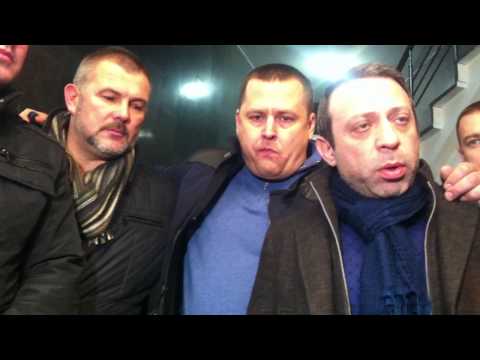
The delegation's size and aggressive demeanor (visitors even attempted to break down the turnstile in the lobby) were unlikely to have been motivated by fears that Gennady Korban's visit to the Prosecutor General's Office that day could have resulted in his arrest. Rather, it was a deliberate show of force—similar to the September rallies of the Donbas and Aidar battalions outside the Presidential Administration building, or the more recent December protests, with balaclava-wearing, bat-wielding youths blocking Khreshchatyk Street demanding the resignation of Prosecutor General Vitaliy Yarema.

Vitaly Yarema
The fact is that the next high-ranking Dnipropetrovsk official invited to Reznitskaya could quite logically be the immediate superior of the failed Napoleon-Korban, the head of the Dnipropetrovsk Regional State Administration, Ihor Kolomoisky. And not for the sins of his subordinate, but rather for his own victories in the difficult task of plundering Ukraine.

Igor Kolomoisky
For example, Prosecutor General's Office investigators may be curious to know why PrivatBank, which received the largest refinancing from the state treasury this year among commercial banks (over $1 billion), used these funds not to pay off deposits but to buy and sell foreign currency. As a result, Kolomoisky reaped excess profits, and the hryvnia's value almost halved.
It's possible that prosecutors will also want to inquire into the reasons why former NBU head Stepan Kubiv issued such a gigantic sum to a bank that had pledged 10 billion hryvnias worth of Crimean property as collateral (even though it was clear in the spring that these assets had essentially been lost).

The Prosecutor General's Office also has an unclosed criminal case on the siphoning of 600,000 tons of industrial oil from Ukrnafta pipelines, ordered by Kolomoisky, under the pretext of saving it from separatists. The "extracted" oil was initially sold for refining to the Kremenchuk Oil Refinery, owned by the Privat Group, at a price 14 times lower than expected, and then supplied to the army as fuel (under contracts again monopolized by Privat, and at exorbitant prices). The profit from the scam amounted to approximately half a billion dollars.
Furthermore, the Prosecutor General's Office also got its hands on Kolomoisky's private army. According to the evidence collected, some of the volunteer battalions he created, instead of fighting separatists, were seizing the businesses of Privat's competitors and abusing civilians in the Donetsk and Luhansk regions (murder, kidnapping, rape, and looting). Thus, after the publication of Amnesty International's report on the atrocities committed by Aidar militants, the Prosecutor General's Office opened criminal proceedings against some of the unit's fighters.

But, beyond his criminal troubles, the Dnipropetrovsk oligarch-governor is also facing more than his share of financial problems. The war in the east of the country, on which Kolomoisky had pinned so much hope, is failing to deliver the expected profits. Privat's agricultural business has virtually collapsed due to restrictions imposed by Russia. And his "pocket" battalions, demanding ever-increasing amounts of money for their loyalty, couldn't even hold onto Mariupol, strategically important to his business, fleeing at the first rumors of "DPR" scouts appearing on the outskirts. And now the city is under the control of regular forces under the control of the Ukrainian president.

According to a memo from NBU Governor Valeria Gonareva, PrivatBank is effectively bankrupt given its losses in Crimea and Donbas. A new refinancing (provided, of course, that it is used for its intended purpose) could delay its collapse, but Gonareva, unlike Kubiv, is in no rush to hand over billions of hryvnias of state funds secured by dubious assets.

The People's Front's investment in the election campaign also failed to pay off, and after a grueling coalition, it failed to secure the desired number of key government positions. Furthermore, even the generous payments Prime Minister Yatsenyuk had been generously making to Kolomoisky over the preceding months began to slip through his fingers.
Thus, the Ministry of Justice recently suspended a controversial decree issued by the State Aviation Service, which effectively allowed only PrivatBank's UIA airline to open new routes (in particular, for this reason, Wizzair, the largest Eastern European low-cost airline, is planning to leave Ukraine).

In turn, Naftogaz of Ukraine proposed that the Ministry of Energy and Coal Industry remove Ukrnafta representative Andriy Kushch, considered close to the company's minority shareholder, Ihor Kolomoisky, from the auction committee. Having his own man on the auction committee gave the oligarch the ability to control the bidding process and block unnecessary decisions. Thus, the oil refiner, affiliated with him, purchased oil from the state-owned company at discounted prices for several years, damaging the state budget.
Just recently, the head of the State Fiscal Service of Ukraine, Ihor Bilous, informed the press that the Sumy Oblast prosecutor's office had opened a criminal case regarding Ukrnafta's failure to pay royalties for gas and oil production: "We currently have the largest debt in the Sumy Oblast – 1,1 billion hryvnias in unpaid taxes, and that's where tax enforcement actions have just taken place, and they're continuing. We're seizing property. We're not arresting people; they're simply receiving summonses as part of the criminal proceedings."

In short, the range of opportunities is inexorably narrowing, and the volume of troubles is snowballing. Apparently deciding to play a preemptive role, Kolomoisky (not yet directly, but with the help of his henchmen) has begun sending clear signals to Bankova that he is prepared for tough resistance.
Meanwhile, the effectiveness of such blackmail against the central government through discrediting GPU head Yarema and the demonstratively rattling sabres of the territorial battalions with their periodic threats to march on Kyiv appears dubious. It's unlikely that Poroshenko, who has also undergone a harsh school of survival in business and government, will agree to give in. He understands perfectly well that if he shows weakness even once, he will doom himself to inevitable defeat.

Petro Poroshenko
And things aren't so smooth with the battalions either. Firstly, their commanders, given the extraordinary nature of the situation, may demand excessive fees for their services (even a share in the enterprises they've "seized"). Secondly, some of the battalion commanders (like Semyon Semenchenko), having barely made it into the Rada, have already begun to play their own game, increasingly disregarding their former master. And thirdly, many of the fighters simply won't want to defend Korban, the same man who sent them into the Ilovaisk "meat grinder."

Gennady Korban
Moreover, some of them might have a perfectly reasonable desire to personally speak with the man responsible for the deaths of hundreds of their comrades. After that, the current visits to the Prosecutor General's Office will seem like a walk in the park to this newly minted "victim of political repression," and the prospect of spending a certain number of years behind bars for the crimes they committed will seem like a gift from fate.
Subscribe to our channels on Telegram, Facebook , Twitter , VK - Only new faces from the SKLEP section!