
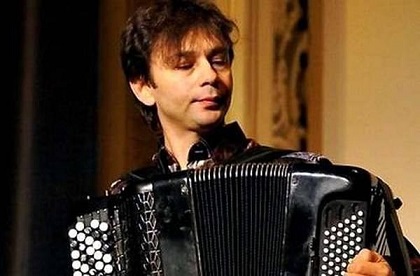
Igor Zavadsky
Musician Igor Zavadsky was jailed by Kivalov's son-in-law at the behest of Yan Tabachnik.
The falsifiers of the high-profile criminal case have received Russian citizenship, promotions, and favors from the new government.
The Zavadsky case is a disgrace to Ukraine and a public slap in the face of civil society. The world's best accordionist, Igor Zavadsky, the pride of our country, was sentenced to 13 years in prison on fabricated charges of pedophilia.
The person who ordered this crime is known: Yan Tabachnyk, a former deputy of the Party of Regions, a “signatory” of the dictatorial “January 16 laws,” a corrupt official, and a friend of V. Yanukovych (currently hiding in Moscow).
The falsifiers of this contract criminal case are known:
— Morozov M.V., former investigator of the Main Investigative Department of Ukraine in Kyiv, major of the Ministry of Internal Affairs (fled to Russia, having received Russian citizenship) — the main executor of the “technical part” of the fabrication of criminal case materials;
— S.I. Nechiporenko, the son-in-law of MP Kivalov, was the prosecutor of the Shevchenkivskyi district of Kyiv at the time when the criminal case against Igor Zavadsky was illegally initiated by employees of the Shevchenkivskyi district department. As soon as the criminal case against I. Zavadsky was transferred to the Podolsky District Court of Kyiv, S.I. Nechiporenko became the prosecutor of the Podolskyi district of Kyiv and simultaneously became the lead prosecutor in this trial;
— expert Elkin I.I. — at the time of the fabrication of "video evidence" of I. Zavadsky's guilt, as well as the destruction of evidence of the musician's innocence, he was the chief expert on technical issues of the Shevchenko RU, and after the successful fabrication of evidence, he became the chief expert of the city of Kyiv on technical issues in criminal cases (one can only imagine what kind of criminal cases this scoundrel is fabricating today).
— former Prosecutor General of Ukraine Viktor Pshonka, who personally oversaw a criminal case fabricated by the police and prosecutor's office at the request of Yan Tabachnyk, a personal friend of V. Pshonka and V. Yanukovych.
— former Deputy Prosecutor General Renat Kuzmin ( read more about him in the article Renat Kuzmin: the family business of outlaw prosecutors ), who personally oversaw the fabrication of investigative materials and the detention of I. Zavadsky in harsh conditions without grounds.
The judge in the case, V.N. Borodiy (who delivered the verdict), served as a prosecutor for 20 years, including in the Kyiv City Prosecutor's Office; he became chairman of the Podolsk District Court under V. Yanukovych and currently holds the same position.
— V. Pidpaly, judge of the Pechersk District Court of Kyiv (this judge lifted the freeze on the accounts of former National Bank of Ukraine Chairman S. Arbuzov and his wife on November 21, 2014). On November 3, 2014, V. Pidpaly considered I. Zavadsky's complaint regarding an illegal search of his apartment against a ruling by a city prosecutor's investigator.
The judge issued an absurd decision to return I. Zavadsky's complaint, citing the rationale that he was not the original complainant or victim. It was during this illegal search, conducted without a court order and under the investigator's false pretext, that I. Zavadsky's apartment was completely ransacked by Shevchenko District Police Department officers, and he filed the complaint as a victim.
How the Zavadsky Case Was Fabricated: A List of Falsifications
1. M.V. Morozov – investigator at the Main Investigative Department of Ukraine in Kyiv, major in the Ministry of Internal Affairs. He was the one who fabricated the indictment against the defendants in the I. Zavadsky case. Several months before the verdict, he fled the country and accepted Russian citizenship.
2. S.I. Nechiporenko (son-in-law of MP Kivalov) was the prosecutor of the Shevchenkivskyi district of Kyiv at the time when the criminal case against Igor Zavadsky was illegally initiated by employees of the Shevchenkivskyi district department. This was despite the fact that the territorial principle in initiating the case was violated: I. Zavadsky lived in Podil, where he was allegedly accused of criminal acts. By a strange coincidence, as soon as the criminal case against I. Zavadsky was transferred to the Podolsky District Court of Kyiv, S.I. Nechiporenko became the prosecutor of the Podolskyi district of Kyiv and simultaneously became the lead prosecutor in this trial.
This prosecutor is the only one who was not subject to the lustration of all district prosecutors in Kyiv when the new government came to power.
The judge in the case, V.N. Borodiy (who delivered the verdict), served as a prosecutor for 20 years, including in the Kyiv City Prosecutor's Office; he became chairman of the Podolsk District Court under V. Yanukovych and currently holds the same position.
3. In criminal cases involving sexual crimes, only relevant expert examinations or "hot" video shot at the time of the crime can serve as irrefutable evidence of the suspects' guilt.
Not a single expert examination in this criminal case confirmed that any of the accused were guilty.
According to the case materials, I. Zavadskiy was under surveillance for six months, and allegedly, sexual assault against minors was repeatedly committed in his apartment. Moreover, a hidden camera was allegedly installed in the apartment. If such crimes had occurred in the apartment, it would have been easy for the police to film a "hot" video, using intelligence allegedly about another crime. In that case, the defense would have had no chance... Such a video is not and could not have been in the case materials!
4. The case materials contain videos from only two dates: allegedly March 19, 2012, and March 23, 2012, allegedly involving I. Zavadskiy, A. Brigida, and the same minor. If the investigation had indeed had a video from March 19, 2012, it would have been a simple matter for them to obtain permission from the court for a search (they had four full days to do so). But there is no such permission in the criminal case.
In other words, the time code superimposed on the video falsifies the date of March 19. And such a video did not exist at the time! Moreover, investigator S.M. Litvin issued an order to detain I. Zavadsky and A. Brigida, as well as to search I. Zavadsky's apartment, illegally, as he had no authority to do so.
The motive for the arrest and search of the apartment, stated in the warrant, was invented by the investigator, namely, to allegedly stop a serious crime. In reality, according to the police officers' own testimony in the criminal case, no one was there at the time of the break-in!
5. A video from the criminal case file from March 23, 2012 (the day of the arrest and search) has a timecode that starts at 7:35 PM and ends at 8:35 PM. Part of this video was posted online by programs on the 1+1 television channel, specifically "Taboo." This falsified video was provided to this channel by the investigation in order to discredit I. Zavadsky and turn the public against him.
In this case, the confidentiality of the investigation was violated.
In the investigator’s order to detain and conduct a search dated March 23, 2012, there are the words: “About 20:00, the information about those who I. Zavadsky and A. Brigida in Igor Zavadsky’s apartment (address given) was committed for committing mischief transfers Art. 156 KKU".
The question arises: why didn't the investigative team immediately go to the crime scene at 20:00 PM, after receiving information about the alleged crime? The distance between I. Zavadsky's house and the Shevchenkivsky District Department of Internal Affairs is approximately 3,5 km. Driving at 25-30 km/h, this distance could be covered in 6-7 minutes.
According to the case materials, I. Zavadsky was detained at 20:37 p.m. as he was leaving his building.
If such a crime had been committed, the police would have had ample time to enter the apartment, stop the crime, and capture a "hot" video. So why didn't this happen? There are two possible answers to this question:
1) police officers knowingly allowed a crime to be committed, knowing about it, that is, they became accomplices to this crime;
2) no crime was committed at all.
So where did the video come from?
For a month after March 23, 2012, investigators did not return the keys to I. Zavadskiy's apartment to his relatives. It was most likely during this time that the staged video, which is included in the case file and, in part, is available online, was filmed. It was filmed from such angles that faces were obscured and it was impossible to accurately determine who was inside.
6. The criminal case includes investigator M.V. Morozov's refusal to allow I. Zavadsky's first lawyer, E.A. Zakrevskaya, to conduct a "portrait" examination of the falsified video. In reality, there could have been two possible reasons for this refusal:
1) if it turned out that the video was true, then it would be necessary to immediately initiate a criminal case against the police officers, since the detention of I. Zavadskiy and A. Brigida did not take place on March 19, 2012 (according to the available video), and not after that, not even during the alleged commission of the crime on March 23, 2012;
2) if the video is falsified and the dates of its recording indicated on the time code do not correspond to reality.
7. In M.V. Morozov's ruling denying the "portrait" examination, he stated that it was pointless, as three witnesses, having viewed the video, confirmed that it depicted I. Zavadskiy and A. Brigida. All of these "witnesses" refuted their previous statements in court. Specifically, they stated that it was impossible to categorically identify the individuals in the video for the following reasons: the lack of faces, the poor quality, and the lack of sound (voice).
The latter confirms that the audio was edited separately from the video and later than it was shown to these witnesses. One of them, whose signature appears in the criminal case under the testimony, admitted in court that this was the first time he had ever seen A. Brigida, and that I. Zavadsky was not present.
Two other witnesses were obviously interested parties: another defendant in the case, A. Boyko, and a person "hooked" by the investigation (since his name was also initially added to the list of suspects in indecent acts). A. Boyko testified in court that his signature was obtained in exchange for the return of his car, which had been seized by the investigation, and for not being sent to pretrial detention on trumped-up charges. The other two witnesses were unable to explain why they signed what they retracted in court.
Morozov M.V. also refused I. Zavadsky’s lawyer’s request to conduct an examination of the “victims’” voices to establish the identity of any of their voices with the voice on the video (for the simple reason that this would reveal the fact that the video was fabricated).
8. Given "irrefutable evidence of the suspects' guilt," as stated in the Ministry of Internal Affairs reports in the first days after their arrest (including, according to N. Kalinovskaya, press officer of the Shevchenko District Police Department), the pre-trial investigation should have lasted no more than a month, taking into account the alleged six months of surveillance. Instead, it lasted eight months! Meanwhile, during the first month and a half of the suspects' detention, no investigative actions were taken against them at all!
9. The only statement from the “victims” at the time of the initiation of the criminal case was a statement on the day of the detention of I. Zavadsky and A. Brigida on March 23, 2012, which was allegedly filed by the director of one of the boarding schools in Kyiv, who is also the guardian of one of the “victims”.
As she later testified in court, she never filed such a statement! She couldn't explain how her signature appeared on this statement, only speculating that she could have signed either a blank sheet of paper or without reading the contents of what she was signing. Based on this statement and her client's explanation, which, according to her, was also definitely not given on that day, March 23, 2012, a criminal case was opened. In other words, these documents were fabricated!
Moreover, in this statement, falsified by the employees of the Shevchenko RU, it was stated that the crimes against her ward were allegedly committed 3 years ago, in June and August 2009 (in order to reduce the age of the “victim”), and only by Igor Zavadsky.
The report from the head of the Shevchenko District Criminal Investigation Department's Children's Affairs Unit to the head of the Shevchenko District Department requested that a criminal case be opened based on the aforementioned complaint, this time against not only I. Zavadsky but also A. Brygida, whose name had not even appeared in the fabricated complaint. The report also altered the time of the alleged crimes: not as stated in the complaint, but supposedly from the summer of 2009 until the report was filed on March 23, 2012.
This "victim," as it later turned out, was vacationing in Austria with the boarding school in the summer of 2009. Moreover, he had no right to testify at all, as he was registered at the Pavlov Hospital, the No. 1 Psychiatric Dispensary. Furthermore, he was a frequent escapee from the boarding school and had a habit of deceiving everyone, according to his guardian. The court repeatedly ordered this "victim" to be brought in by force, but he was constantly "on the run."
The case file contains a document from March 18, 2013—a report from the Obolonsky District Police Chief: "It is impossible to forcefully bring the victim to court on March 22, 2013, to give testimony, because he is currently undergoing inpatient treatment at Psychoneurological Dispensary No. 1." Despite this information, this "victim" somehow appeared at the court hearing on March 22, 2013, and stated that he confirms the testimony he signed in the criminal case.
It's not hard to guess that he was brought directly from his ward at Pavlov Hospital by police officers to give the testimony they needed. When I. Zavadsky asked him in court why three completely different testimonies in the case file bore three completely different signatures, supposedly his own, the "victim" unexpectedly replied, "My hand twitched."
The court rejected the request for a graphological examination filed by I. Zavadskiy.
To conceal the fact that this "victim" was registered with a psychiatrist, Shevchenko District Police Department investigator S. M. Litvin changed the name and address of this "victim" in his March 2012 inquiry to Psychiatric Dispensary No. 1, asking whether this person was registered with them. Naturally, the answer was no, as they were now talking about an entirely different person, a non-existent one. I. Zavadsky received a seven-year sentence for this "victim" (Part 2 of Article 156 of the Criminal Code of Ukraine, from five to eight years).
10. There are five "victims" in the indictment. Three of them also received a four-year sentence for I. Zavadsky. They signed a criminal complaint against I. Zavadsky, drawn up by the police, for the following reasons: two were given old laptops in exchange for this (these guys had tried to blackmail him a few days before his arrest, asking for his laptop in exchange for not signing the criminal complaint against him); one was helped to stay in college so that he wouldn't be expelled in exchange for incriminating I. Zavadsky. This "victim" had a failing grade in history, and the police helped him "resolve the issue."
11. Another "victim," the fifth, is the only person for whom I. Zavadsky was ultimately charged under Part 3 of Article 153 of the Criminal Code of Ukraine (10 to 15 years) and sentenced to 13 years. It was precisely for the charges related to this "victim," who allegedly appears in the video from the criminal case materials allegedly dated March 19, 2012, and March 23, 2012. The case file, however, contains not a single signature from him, not a single explanation, or interrogation by the investigator!
This article is interpreted in the indictment as the victim's "inability to resist" due to his age. Even the staged video refutes the child's "inability to resist," which is present: he plays naked and makes advances toward a naked adult with his back to him, hitting him on the buttocks, etc.
In the ruling of investigator M.V. Morozov, denying I. Zavadskiy's motion to dismiss all charges against him, the argument states, in particular: Part 3 of Article 153 of the Criminal Code of Ukraine was brought against I. Zavadskiy because the "victim" was under 12 years of age at the time of the criminal acts against him and, accordingly, due to his age, allegedly could not comprehend what was happening to him, i.e., he was in a "state of insecurity." This untruth is refuted by a copy of the "victim's" birth certificate—at the time of the indecent and violent acts against him with which I. Zavadskiy is accused, the "victim" was already 13 years old!
It is significant that the parents of this "victim" did not submit any statement indicating that their son was a victim. The case file includes statements from this "victim's" father, in which he refuses to allow investigators to interrogate or conduct a psychological examination of his son.
The criminal case includes the results of a forensic medical examination of this "victim," which confirms that no sexual acts were committed against him. He never showed up for any court hearings. Neither did his parents or other representatives. Preventing this family, with whom I. Zavadsky had developed a friendly relationship, from appearing in court was one of the investigators' primary goals.
It could have been revealed that M.V. Morozov had been exerting prolonged psychological pressure on this family, with the goal of extracting statements against I. Zavadsky and A. Brigida. Ultimately, no such statements were ever obtained. The only result of this pressure was that the parents wrote a letter to the court stating their unwillingness to appear with their son, without stating any claims against the defendants.
Later, in his verdict, Judge V.N. Borodiy decided to falsify the contents of this letter, writing that the parents of this "victim" allegedly requested that I. Zavadsky and A. Brigida be brought to criminal responsibility.
12. Initially, six victims were named in the indictment against M.V. Morozov. The very first of them testified in court on December 6, 11.12.2012, in which he described in detail how he was forced three times at the Shevchenko RU to sign a denunciation against I. Zavadsky and A. Brygida, without the presence of his parents, teacher, or doctor.
He described everything connected with this in detail: the make and color of the car of the detective who abducted him from the yard before the third "interrogation," the detective's name, and other details. He signed everything the investigation required after being threatened with imprisonment. The question arises: why did the investigation artificially create another "victim" when there were already others in the case? The answer is obvious: other "victims" in the criminal case were also artificially created.
One "victim" refused to testify in court, and another did not show up at all.
The remaining three "victims" were unable to recount a single episode contained in their signed statements in the criminal case file. However, all three (including the one registered with a psychiatrist) stated that they confirmed their statements contained in the case file, undoubtedly under pressure from police officers.
13. The operational search activity in the criminal case, using technical means, was illegal. Evidence of this is as follows: in the response from the Kyiv Court of Appeal to the Podolsk District Court of Kyiv, it was stated that the permits for the use of technical means (for what purpose and in whose names it is unknown) for this operational search activity were destroyed on April 14, 2014 (several months before the verdict was handed down!). This was done to destroy traces of the illegal actions of the Shevchenko District Police Department officers.
Other evidence of illegal police actions was destroyed in the same manner, such as the video recording of the search of I. Zavadsky's apartment on the day of his arrest. Moreover, the expert who recorded the video twice cited different reasons for the loss of the footage, as reflected in the case file:
1) the video camera allegedly turned out to be faulty and the video recording was lost on the same day;
2) supposedly everything was fine with the video camera, the video recording was transferred to the computer's memory and this computer was sent for repair three times over a certain period of time, as a result of which this video recording was accidentally lost.
An interesting detail: at the time he created the video, expert I.I. Elkin was the chief technical expert for the Shevchenko District Police Department. After the prosecutor's investigation, where he concealed the video under a false pretext, he became the chief technical expert for the city of Kyiv in criminal cases.
14. Absolutely all expert examinations and all witnesses in the courtroom confirmed the innocence of the accused in this criminal case, but this was not reflected at all in the verdict! All evidence of guilt in the case was either falsified or artificially created by the police through official forgeries or absurd interpretations of innocuous entries in I. Zavadsky's diaries and telephone conversations, which contain no hint of any criminal activity.
15. Many of the expert examinations in the case were completely pointless and absurd. They were conducted merely to simulate the "vigorous activity" of the pre-trial investigation.
For example, the verdict charges Igor Zavadsky a hefty fee for the forensic analysis of video recordings from his numerous concerts (CDs, mini DVDs, VHS), obtained during an illegal search of the artist's apartment. This analysis was conducted under the pretext of searching for pornography in Igor Zavadsky's concerts, which primarily featured classical music.
16. In his verdict, the judge made numerous falsifications in an already fabricated charge. For example, the judge pointed out that when viewing a video recording allegedly taken by police with a hidden camera from I. Zavadsky's apartment, the court immediately recognized a specific "victim." The paradox is that this victim never appeared in court, and his photograph is nowhere to be found in the case file, meaning the court could not have recognized a person it had never even seen!
17. One of the proofs that the verdict was written in advance is that all the typos from the indictment of investigator M.V. Morozov were transferred to the two amended indictments of the prosecutor's office (where a number of the most absurd episodes of the charge were removed), as well as to the court's verdict.
18. The verdict omitted virtually all (!) of the evidence proving the defendants' innocence, which had been obtained primarily during 29 court hearings in 2013. All original audio recordings of these 29 court hearings were destroyed under the false pretext of "computer memory overload." Copies of the audio CDs, some of which had been listened to by the defendants, were falsified. Furthermore, three hours and 27 minutes of audio recording from one of the court hearings was missing entirely! It contained important defense testimony.
This alone should certainly be grounds (or rather, one of many) for overturning the sentence in accordance with paragraph 10 of Article 370 of the Criminal Procedure Code of Ukraine (as amended in 1960) in the Kyiv Court of Appeal. This article, in particular, states that this violation constitutes a material breach of the requirements of the Criminal Procedure Law, and:
“... in every case, the rule must be dealt with insofar as it is at the right... the circumvention of the judicial process in cases referred to in this Code is not fixed by technical means.”
Conclusion: the court destroyed evidence of innocence! Moreover, it turned out that absolutely all (!) of the court transcripts contradict the audio recordings in significant details that attest to the innocence of the convicted. Some of the transcripts do not correspond not only to what is in the court journals, but also to the copies of the court transcripts that were bound into separate volumes and issued to I. Zavadsky and A. Brigida, who signed for them.
In other words, some court records in the criminal case file were altered, and others may be altered in the future before the case is transferred to the Kyiv Court of Appeal. This means the criminal case may continue to be falsified!
19. It's not hard to guess that the main goal of the person who ordered the murder in I. Zavadsky's criminal case was, along with destroying the artist's reputation, to separate him from his musical instrument for as long as possible. It will soon be three years since the musician was separated from his instrument, which he always called his "other half."
One of the pretrial detention center directors, on the eve of his dismissal, confessed in a private conversation with Igor Zavadskiy that there had been an unofficial order from the Prosecutor General's Office of Ukraine, then headed by V. Pshonka, not to give him the instrument. The verbatim version read: "Prosecutor's office employees, in particular Renat Kuzmin, regularly called me and told me not to give I. Zavadskiy a musical instrument.
I. Zavadskiy's last request for a musical instrument and the opportunity to practice on it, at least silently, was made on December 10, 2014, to the next pretrial detention center director. There was no response.
20. The following are indirect evidence of the involvement of I. Zavadsky, as the customer of the criminal case, former Ukrainian MP Yan Tabachnyk:
1) Investigator M.V. Morozov repeatedly stated during the pre-trial investigation, in the presence of lawyers, and during the defendants' familiarization with the case, that Ya. Tabachnik called him practically every day to inquire about the progress of the investigation. However, while testifying during the court hearing, M.V. Morozov unexpectedly stated that he had never heard the name Ya. Tabachnik, in response to Igor Zavadskiy's question about whether it was true that they regularly communicated by telephone.
2) On the eve of the debate, Judge V.N. Borodiy denied I. Zavadsky's motion to include in the case file a journalistic investigation conducted by journalists from the Ukrainian quarterly "Pedagogy of Tolerance" into the case file, regarding the possible involvement of Y. Tabachnyk in this criminal case as the mastermind behind the murder. The judge justified his refusal by saying that he had never heard the name Y. Tabachnyk, which in itself is absurd.
21. An alarming signal before the consideration of the appeals against the sentence of I. Zavadsky, A. Brygida and their lawyers was the fact that on 15.10.2014 the panel of the Kyiv City Court of Appeal (I. Palenik - A. Malinovsky - L. Bartashchuk) made a knowingly unjust decision on the fact of I. Zavadsky's appeal against the decision of the investigating judge of the Pechersk District Judge of Kyiv V. Pidpaly (this judge on 21.11.2014 lifted the arrest from the accounts of the former chairman of the National Bank of Ukraine S. Arbuzov and his wife). On 03.11.2014 V.
Pidpaly considered I. Zavadsky's complaint regarding the illegal search of his apartment, against the order of a city prosecutor's investigator. The judge issued an absurd decision to return I. Zavadsky's complaint, arguing that he was not the original complainant or victim. It was during this illegal search, conducted without a court order and under the investigator's false pretext, that I. Zavadsky's apartment was completely ransacked by officers from the Shevchenko District Police Department, and he filed a complaint as a victim.
The Kyiv Court of Appeal, while reviewing I. Zavadsky's appeal, in which he requested that V. Pidpaly's decision be overturned, went beyond the scope of the appeal under consideration and, while overturning V. Pidpaly's decision, simultaneously issued another decision—to deny I. Zavadsky's appeal, which he had filed with the Pechersky District Court of Kyiv, not with them, without even allowing the applicant to comment on it during the court hearing.
Whether we can expect a fair decision from this court in the upcoming hearing of I. Zavadsky's appeal, in which he requests that the sentence be overturned and the criminal case dismissed, is a rhetorical question...
And this is only part of the falsifications in the completely fabricated “Zavadsky case” from beginning to end.
***
Igor Zavadskiy is once again gathering friends on his birthday.
On January 20, 2015, on Igor Zavadskiy's birthday, the Actor's House will host a now-traditional concert featuring Ukraine's most talented accordionists, dedicated to Uchitel, the only person to have been recognized three times as the best accordionist on the planet by an authoritative international jury.
At the initiative of the birthday boy, proceeds from the concert will go towards purchasing medicine for Ukrainian soldiers in the ATO zone.
Before the concert, a press conference will be held by Igor Zavadsky's lawyers.
Sergei Fedorov, "Argument"
Subscribe to our channels on Telegram, Facebook , Twitter , VK - Only new faces from the SKLEP section!