

Vadim and Ilya Segal: Will the Nadra Bank thieves return to Ukraine? Part 2
BEGINNING: Ilya and Vadim Segal: Will the Nadra Bank thieves return to Ukraine? Part 1
Vadim Segal and Ilya Segal: The Big "Scam"
What happened in 2008 simply boggled the minds of those familiar with Nadra Bank's public activities. In fact, in 2006-2007, the bank was actively increasing its capital, indicators, and ratings, striving to maximize the value of its shares—which indeed rose to $19, with a par value of 10 hryvnia. The stated goal was to sell Nadra Bank to foreigners—a practice many Ukrainian bankers were pursuing at the time. In most cases, the sale price was inflated by nearly a factor of two, and some banks turned out to be completely inflated, with numerous hidden problems. According to Skelet.Org , the Segals were hoping to sell Nadra for over two billion dollars!
Among other steps, Nadra during this period placed $175 million in Eurobonds and secured $215 million in international loans, while also expanding its client base by any means necessary. This included administrative means, thanks to the bank's co-owners and managers' connections to the highest levels of government. Ukrainians still remember how many public sector employees and students were forced onto Nadra salary cards, and how corporate employees were forced to open accounts with the bank to receive their salaries. Even when the bank collapsed in the fall of 2008 and stopped paying its clients, then-Health Minister Vasyl Kniazevych prohibited medical institutions from closing salary accounts with Nadra and ordered them to continue transferring funds to them! Education Minister Ivan Vakarchuk then ordered universities to do the same. Thus, even ministers (and perhaps higher-ranking figures) worked to increase the bank’s capitalization (and then to support it), and one can only guess at the reason for their interest.

Petro Poroshenko, Igor Gilenko, Viktor Yushchenko
But although the Segals, their associates, and managers did their utmost to create the appearance of Nadra Bank's success and prospects, as early as January 2008, eight months before the crisis, the ratings company Standard & Poor's assigned it a credit rating of "B." This meant that the bank was "solvent, but unfavorable economic conditions would negatively impact its ability and willingness to repay its debts." This was essentially a death sentence: the bank's shares on the international stock exchange stopped rising, and selling such a bank to foreigners at an inflated price became impossible. No one wanted to associate with a bank whose accumulated loan liabilities equaled or exceeded its assets, which were already being covered by additional infusions such as salary accounts—the movement of funds through which began to be artificially delayed.
One of the reasons for the bank's problems were loans issued in 2007-2008 to the Segal brothers' agricultural firms: the soybean complex of Kakhovka Prom Agro CJSC (a loan of 200 million hryvnia), the Ukrainian branches of the American holding company Freedom Farm International PJSC (150 million hryvnia), Freedom Farm Terra LLC, Freedom Farm Bacon LLC (pig farming), and others. It appears that closer to 2008, Ilya Segal and his brother Vadim had already abandoned the idea of getting rich by selling the bank to foreigners and began to funnel its assets into the development of their agricultural firms. However, sources reported that the investigation into Nadra Bank has not yet been completed, and most of the information on this case is hidden from the public, and therefore the bank distributed loans in 2007-2008. Many more loans were made to their owners' companies—including shell companies—intended for the siphoning and theft of funds. The list is simply staggering, and the main recipients were the Segalovs' firms and the Continuum Group of Yeremeyev and Lagur :

list of debtors of Nadra Bank
It's worth noting that the lending to these companies involved a scheme involving the asset management companies (AMCs) Finkom and Kruar, which acted as "straw men": the bank purchased certificates from them worth 2 billion hryvnias (!), and the AMCs then invested this money in the companies of the Segals, Yeremeyev, and Lagur. Interestingly, Nadra Bank continued to work with these companies even after the change of ownership at the end of 2008, meaning the same scheme was used by its new owner, Dmytro Firtash . Moreover, interestingly, negotiations to sell the bank to Firtash began as early as the spring of 2008, and he was aware of all the machinations and embezzlement of the bank's assets – yet he nevertheless purchased the bank at the height of the 2008 crisis.
But the real robbery of the bank by its owners began in the fall of 2008, when those same "unfavorable economic conditions" took hold in Ukraine and around the world. These were no longer loans for company development, but outright embezzlement of funds from the bank under the guise of loans. Of these scams, only two episodes reached trial and public disclosure, one of which became the reason for the subsequent placement of the Segal brothers on the wanted list. This involved the issuance of loans to Ilya Segal and Vadim Segal in the amount of $12,5 million each (a total of $25 million) under an agreement dated August 29, 2008 (the crisis had already begun), which took place on October 17, 2008 (when the bank was already in its death throes). Formally, this money was to be transferred to the account of the Cypriot company "FREEDOM FARM INTERNATIONAL PLC," through which the Ukrainian branch of the American holding company was managed. But withdrawing such a sum of currency issued to individuals from Ukraine was practically impossible (the crisis was already raging), so Ilya Segal, Vadim Segal, and Igor Gilenko devised the following scheme: Nadra Bank issued an order to the Latvian bank TRASTA KOMERCBANK (through which Nadra had previously conducted shady currency transactions) to issue the Segals' money. As a result, the brothers received 25 million rubles in their foreign account, which they didn't even have to transfer out of the country, and Nadra remained indebted to TRASTA KOMERCBANK.
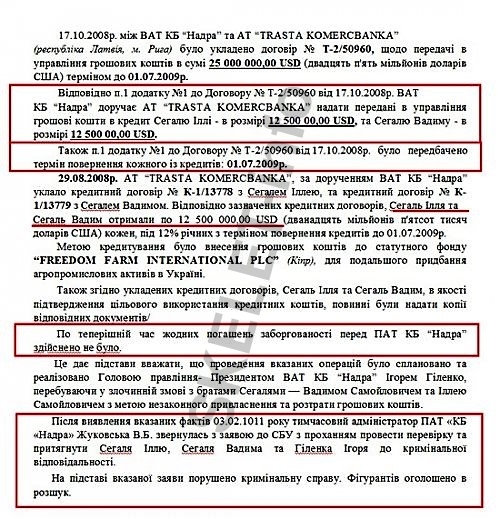
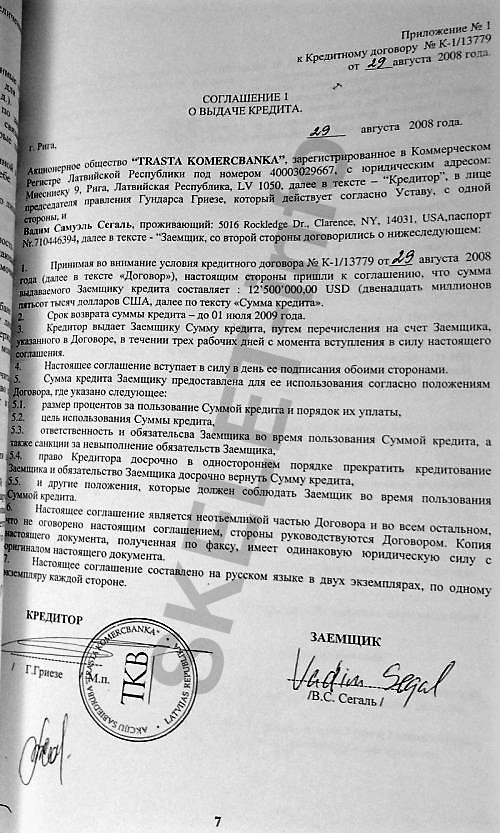
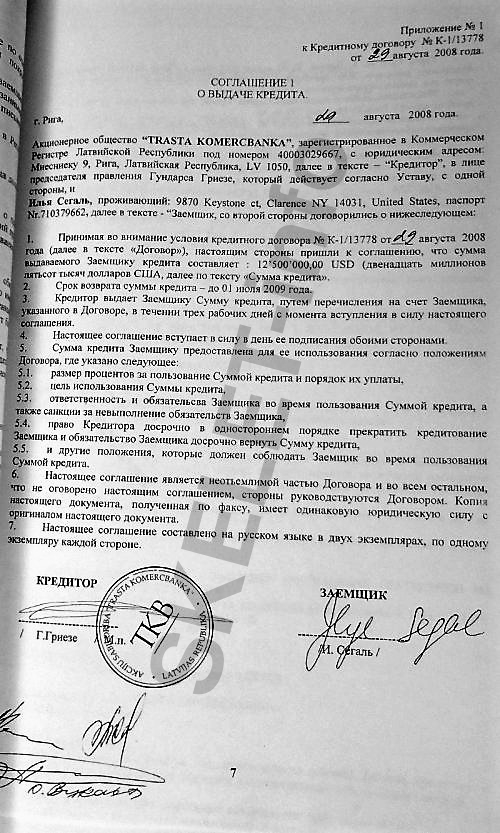
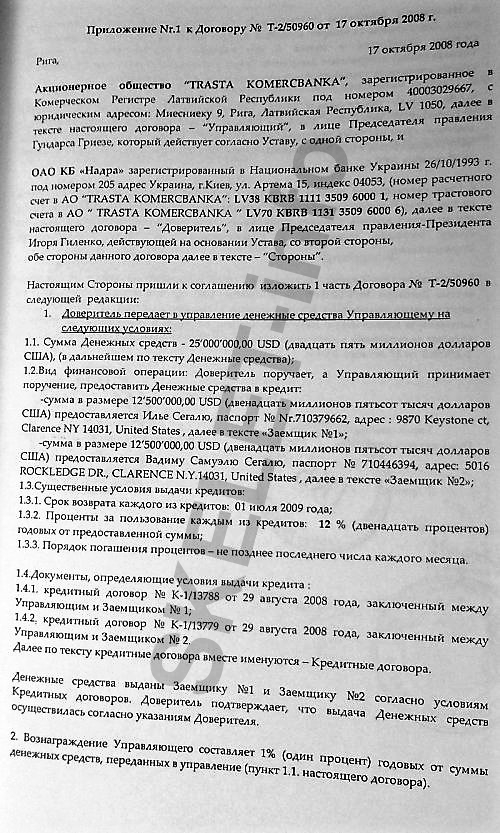
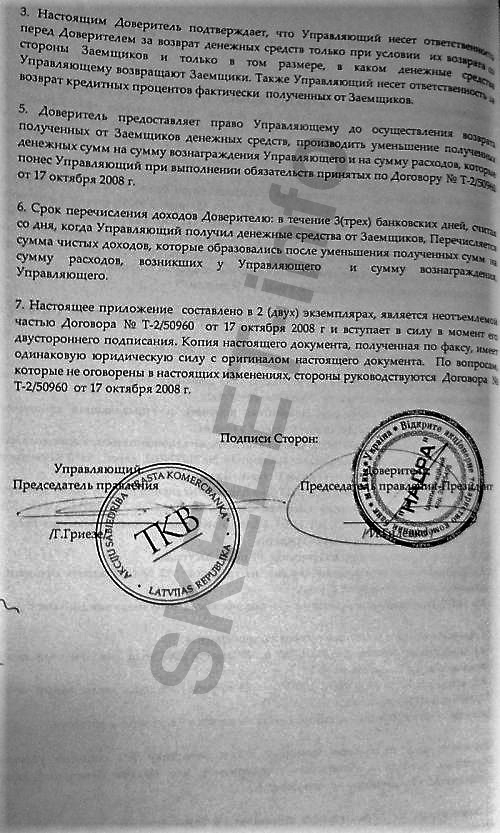
Documents for the $25 million loan
The second well-known episode in the looting of Nadra Bank involved the issuance of two loans to Dnipropetrovsk firms, Knight Private Enterprise (210 million hryvnias) and K-L-O LLC (170 million hryvnias), in November 2008, when the bank was not only in crisis but also in a transitional state (it had already been acquired by Firtash). The first firm was engaged in some kind of retail trade, while the second was registered in an apartment and was clearly a shell company. By the spring of 2009, these firms had liquidated themselves, and their debt to Nadra Bank (with interest—over 414 million hryvnias) was "written off" due to a lack of funds and assets to repay it. But here's what's interesting: both firms also owed "minor" debt (approximately 800 hryvnias) to Yeremeyev's and Lagur's companies. Numerous sources reported that Knight and K-L-O were part of Eremeev and Lagur's scheme to siphon money from Nadra Bank and other enterprises, but that this particular case was successfully hushed up. Whether this scheme was more successful, or whether Eremeev and Lagur had more extensive connections, they were not forced to flee Ukraine like the Segal brothers. However, Skelet.Org has information that Vadim and Ilya Segal fled not because of a 25 million ruble loan debt (which only became a debt in July 2009), but because of larger-scale financial fraud. These same frauds also prompted the hasty flight in February 2009 of Nadra Bank director Igor Gilenko. He also did not wait for any investigation into the loan fraud and fled to Russia, which refused to extradite Gilenko to Ukraine on the grounds that he was a Russian citizen.
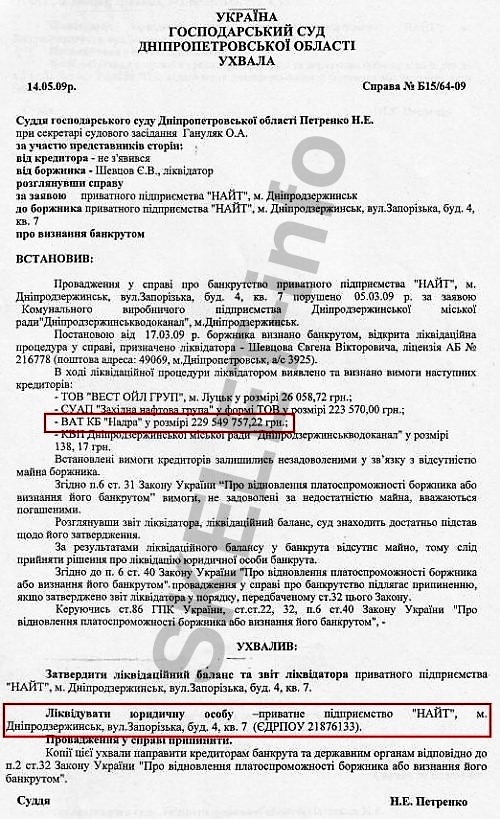
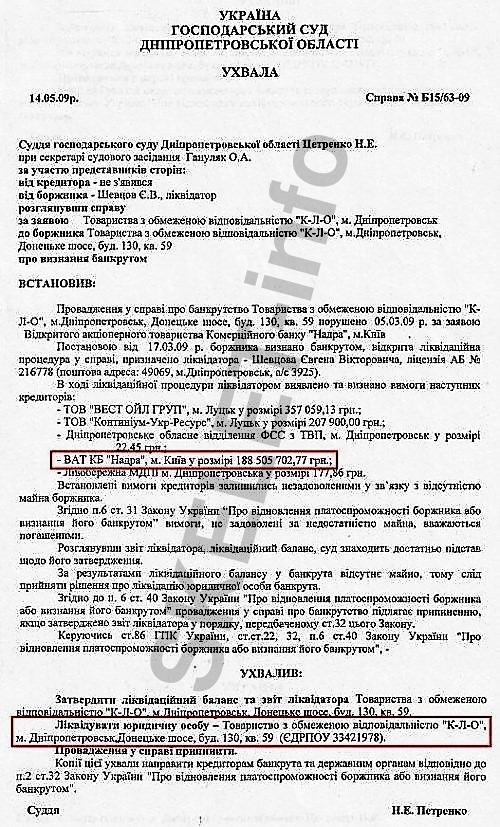
What were the Segals running from?
Indeed, it's hard to believe that people handling billions of hryvnias simply fled with $25 million (400 million hryvnias at the 2009 exchange rate) in their pockets. Especially since, throughout 2009-2010, the Segals first negotiated a debt restructuring with the new owners and managers of Nadra Bank, then sued Firtash when he began seizing their Ukrainian agricultural enterprises for debt. But one must admit that this "trifle" shouldn't have made the brothers flee so rashly from bread-rich Ukraine, where many prospects still lay before them. And they, it's worth noting, didn't return even after the change of power in 2010, although they could have blamed it on "political persecution by the previous regime."
Skelet.Org sources report that the true reason for the Segals' flight lies in the enormous, simply abnormally enormous, refinancing of Nadra Bank that it received in the fall of 2008 (not counting the state's purchase of the bank's bonds, worth 700 million hryvnias). This was carried out in several stages, the first of which was shockingly corrupt: the refinancing loan allocated by the National Bank (1,5 billion) exceeded the legally established amount (50% of the recipient bank's capital) by 206 million hryvnias, with half of this amount going toward the purchase of Nadra shares, which were then transferred to the National Bank as collateral. Then, in violation of laws and its own regulations, the National Bank issued new regulations, groundlessly increasing the credit ceiling for Nadra Bank, and in October-November 2008, it issued two more loans, amounting to 2 and 3,6 billion hryvnias, respectively! Thus, the total amount of funds received by Nadra Bank from the National Bank, including the repurchased bonds, reached 7,8 billion hryvnias! This amount could have been higher: in November 2008, Ihor Gilenko nearly reached an agreement with the National Bank to provide Nadra Bank with an additional 1,4 billion hryvnias in stabilization loans, but this agreement was terminated in December (possibly under pressure from Prime Minister Tymoshenko).
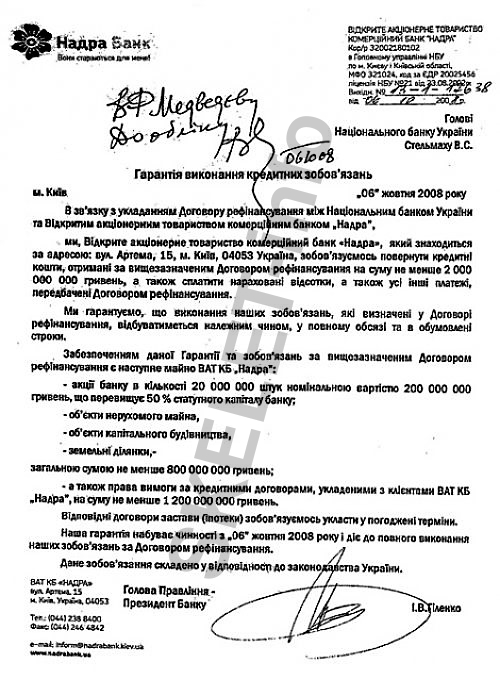
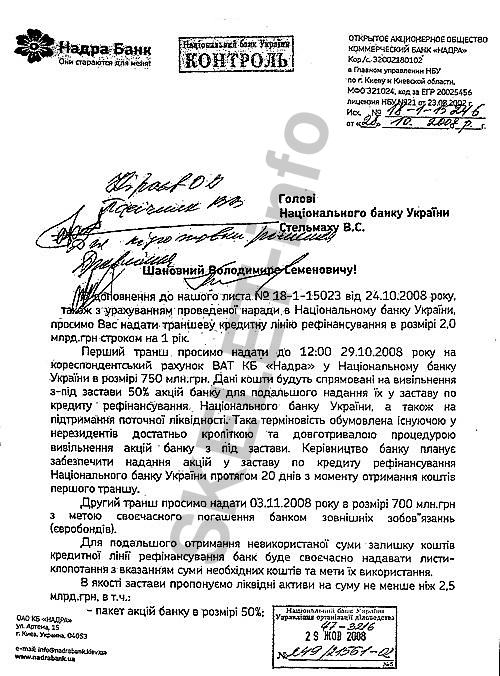
Of this amount, only 3,68 billion hryvnias were spent on liquidity support, while the remaining 4 billion hryvnias in refinancing loans, plus several hundred million hryvnias in depositors' money, were used to purchase dollars and euros from the National Bank at a preferential rate in October-December 2008. Moreover, during this period, Nadra issued new loans to individuals and legal entities totaling 2,1 billion hryvnias (including the aforementioned loans to the Segal brothers and the Yeremeyev-Lagur shell companies). This raises the question: who else was the lucky recipient of Nadra loans at the height of the financial crisis, and did they repay them? However, the fate of these financial transactions was not made public, perhaps because too many high-profile figures were involved in these scams. For example, they could not have been realized without the direct participation of the then head of the National Bank, Vladimir Stelmakh , who had been a trusted person of Viktor Yushchenko since the early 90s.
Was the then-president involved? That remains a mystery, but other people from Yushchenko's circle were also involved. Skelet.Org sources reported the involvement of Viktor Baloha, head of the Secretariat . Even Firtash's purchase of Nadra Bank seemed rather strange, a kind of incomprehensible manipulation. And yet, we mustn't forget that Firtash was also the head and co-owner of the scandalous RosUkrEnergo, which was linked to Mogilevich's structures (the company grew out of them), the secret schemes of Putin's "family," and the interests of Viktor Yushchenko and his money-hungry entourage. True, Mogilevich was imprisoned from January 2008 to July 2009, arrested in Moscow (and it was during this time that all these scandalous dealings took place at Nadra Bank), but this man could manage businesses and politicians even from a prison cell.
It's quite possible that Ilya Segal, Vadim Segal, and Igor Gilenko hastened to leave Ukraine not so much to avoid being put in the dock, which was unlikely (they would have named many names), but to avoid being eliminated as unnecessary witnesses. Moreover, they didn't believe this threat would disappear even after another change of power in Ukraine. After all, the death of Igor Yeremeyev, who allegedly fell from a horse and then died in the hospital in the summer of 2015, occurred a couple of months after Kyiv once again remembered the Segals after many years of oblivion. More precisely, they were remembered by the scandalous deputy Serhiy Leshchenko, who sent a curious appeal to the head of the Security Service of Ukraine (SBU) Valentyn Nalyvaichenko in April 2015 :
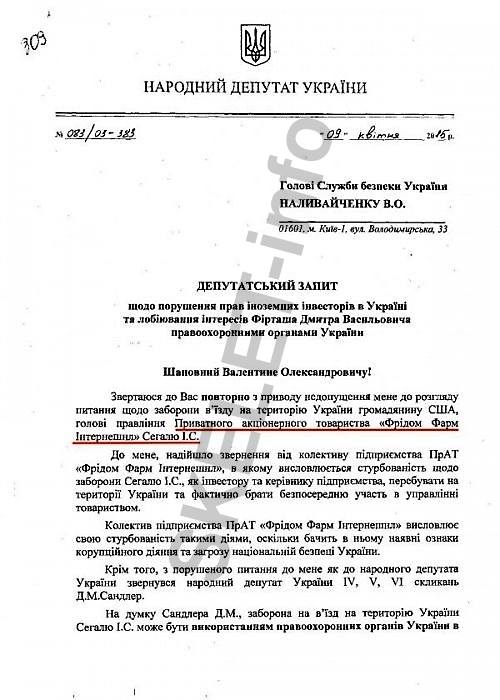
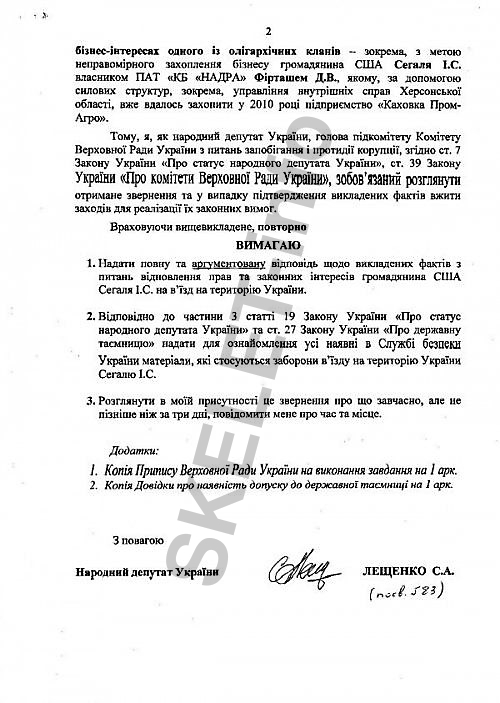
This appeal revealed that the Segal brothers, previously placed on Interpol's wanted list in 2011, were no longer welcome in Ukraine because the SBU had banned them from entering the country! This seemed simply absurd: first, they would issue an international wanted list, search for people to prosecute, and then lower the barrier in their faces. But perhaps there was some logic to it. In 2011, the brothers had only been wanted for a few months, at the height of their conflict with Firtash, who was "squeezing" their agricultural enterprises from them. And even then, this search was somewhat odd – after all, the Segals' page on Interpol didn't even have a photo! In 2012, there was no longer any talk of being wanted, and they were forgotten; no one even knew where in the world they had settled. And suddenly, for some reason, Leshchenko revives this topic, learns that the SBU has banned the Segals from returning to Ukraine, and Leshchenko asks for this ban to be lifted under the pretext of allowing justice to be restored and supposedly to reclaim Kakhovka Prom Agro.
But do the Segal brothers themselves need this? That's unknown. However, shortly afterward, Igor Yeremeyev was injured and died. Was it a coincidence? Nothing has been heard of the former CEO of Nadra Bank, Igor Gilenko, for many years, ever since Russia refused to extradite him. Is he even alive? Ilya Segal and his brother, we repeat, are in an unknown location, and even without a ban on entry to Ukraine, they have expressed no desire to return to their homeland. Thus, of the former owners of Nadra Bank, only one potential defendant and witness remains in plain sight: Sergei Lagur, who has been quietly involved in the oil business for the past three years. Perhaps he's been doing so because he knows how to keep quiet.
Sergey Varis, for Skelet.Org
Subscribe to our channels on Telegram, Facebook , Twitter , VK - Only new faces from the SKLEP section!