

The head of the Deposit Guarantee Fund receives a salary higher than that of presidents.
The head of the Deposit Guarantee Fund for Individuals receives a salary several times higher than the president, and her subordinates own luxury cars and real estate.
How much and from what do employees of the Deposit Guarantee Fund earn?
A 2,5 million-dollar electric car, luxury cars, estates in Ukraine and abroad, and exorbitant salaries that would make European presidents envious: it seems officials at the Deposit Guarantee Fund are accustomed to living lavishly. At least, this is what their declarations and property records attest to. However, it's likely that the Deposit Guarantee Fund's management is hiding some of their valuable assets from the NACP, along with... potential business in the aggressor country.
So, what do the subordinates of Svetlana Rekrut, head of the Deposit Guarantee Fund, actually own, and how did they "earn" it? What do the Fund's scandalous tenders have to do with it? And what does the NAPC think about this state of affairs? StopKor journalist Alla Legeza investigated.

Amid the scandal surrounding the Deposit Guarantee Fund's purchase of an electric car for UAH 2,5 million, the institution continues to spend considerable sums on fuel. Specifically, in January of this year, the Deposit Guarantee Fund announced a million-euro tender for the purchase of 15 liters of diesel fuel. This is despite the fact that, according to YouControl, official vehicles run exclusively on gasoline and electricity, while only officials' personal vehicles consume diesel fuel.
According to the declaration, the Managing Director of the Guarantee Fund owns a 2022 diesel Range Rover Sport, and her husband owns a diesel Mercedes GL of the same age. Svetlana Rekrut's father owns another diesel Mercedes. Natalya Rudukha, who resigned as Deputy Director of the Guarantee Fund in February of this year following corruption scandals, also owns a diesel Audi Q5. Another deputy, Elena Nuzhnenko, drives a brand-new diesel Mercedes registered to her 69-year-old mother.
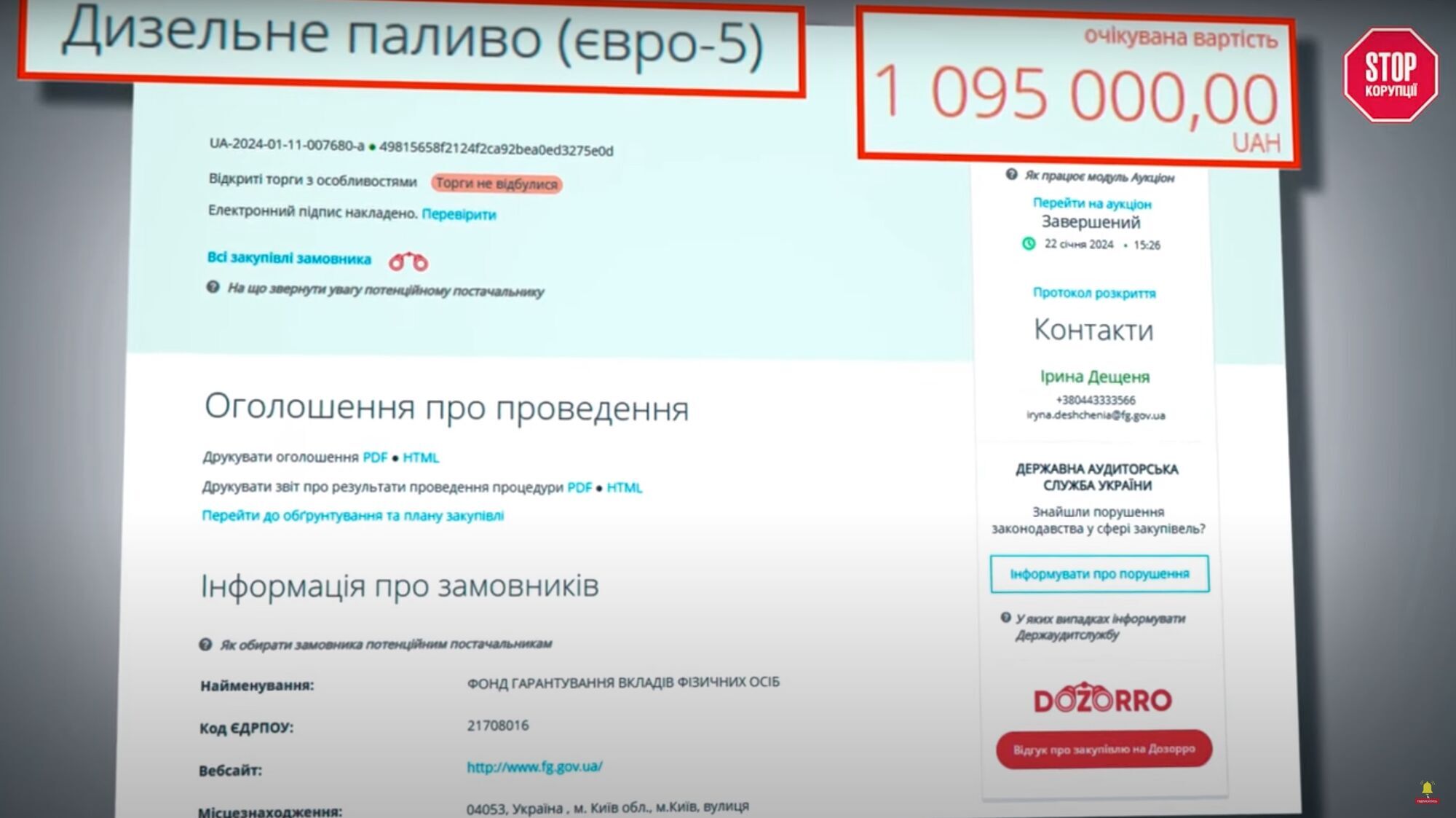
The Deposit Guarantee Fund spent millions on diesel fuel // The head of the Deposit Guarantee Fund receives a salary higher than that of presidents.
The cost of these expensive cars correlates with the high salaries of the Fund's employees.
"According to the declaration, the fund's managing director's salary in 2023 is 6,100,000 hryvnias. And the President of Ukraine's is around 300,000 hryvnias. The question is, who bears what responsibility? And this is despite the fact that the President said that all unproductive expenses should simply be eliminated. And yet, they still feel free to accept financial assistance from the same Deposit Guarantee Fund ," comments financial expert Dmytro.
By comparison, the Fund's director, Svetlana Rekrut, received a salary equivalent to $160 in 2022. This is almost twice as much as the presidents of Poland, Spain, Moldova, and Lithuania. Meanwhile, the Deposit Guarantee Fund declined to respond to StopKor's inquiry regarding the salaries of the institution's management, so we analyzed this data from declarations and open sources.
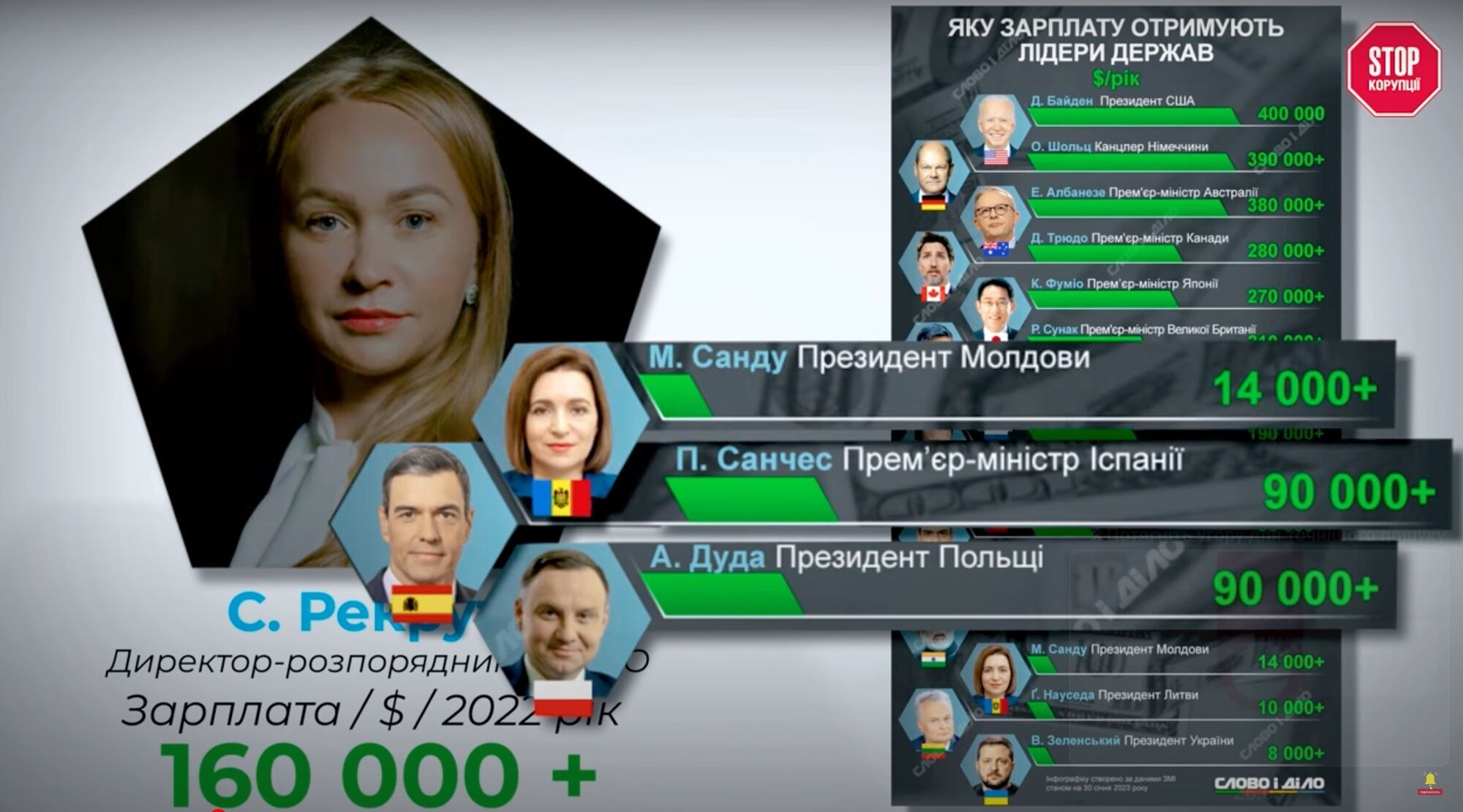
Svetlana Rekrut's salary is higher than that of heads of state.
Thus, according to 2022 data, the monthly salaries of the six members of the fund's executive board amounted to more than 2,6 million rubles. And this is only the official income, excluding bonuses and other incentives.
"We note that the salary data is outdated; it has grown significantly over the past two years, and payments continue to increase. Not to mention the executive directorate; even the employees of the fund of authorized representatives for bank liquidation receive seven-figure annual salaries. Specifically, Svetlana Groshova, the liquidator of Finance and Credit, Platinum, and other financial institutions, earned over UAH 1,3 million in net income over the past 22 years and declared UAH 800 worth of valuables, including a sable fur coat, jewelry, and a watch ," notes Alla Legeza.
But that's not all: it turns out that someone with access to Ukrainian banking data may own property, a business, and a family in Russia.
Thus, two years ago, Svetlana Groshova declared three cars, three apartments and parking spaces in Kyiv, an apartment and a house in Dnipro, a mansion and several other properties in the Dnipropetrovsk region, and an apartment and other seaside properties in occupied Crimea. She also owns a significant amount of property in Russia, acquired between 2019 and 2022 (i.e., after the war in eastern Ukraine began), including apartments and other non-residential premises.
Moreover, two weeks before the full-scale invasion in 2022, a liquidator from the Guarantee Fund made a direct investment in the aggressor country's economy, becoming a co-owner of the Russian company Kartek. Russian citizens and VALARTIS CONSULTING, the owner of RIMBORSO-RUSSIA LLC, whose primary activity is distressed asset management, also have stakes in this company.
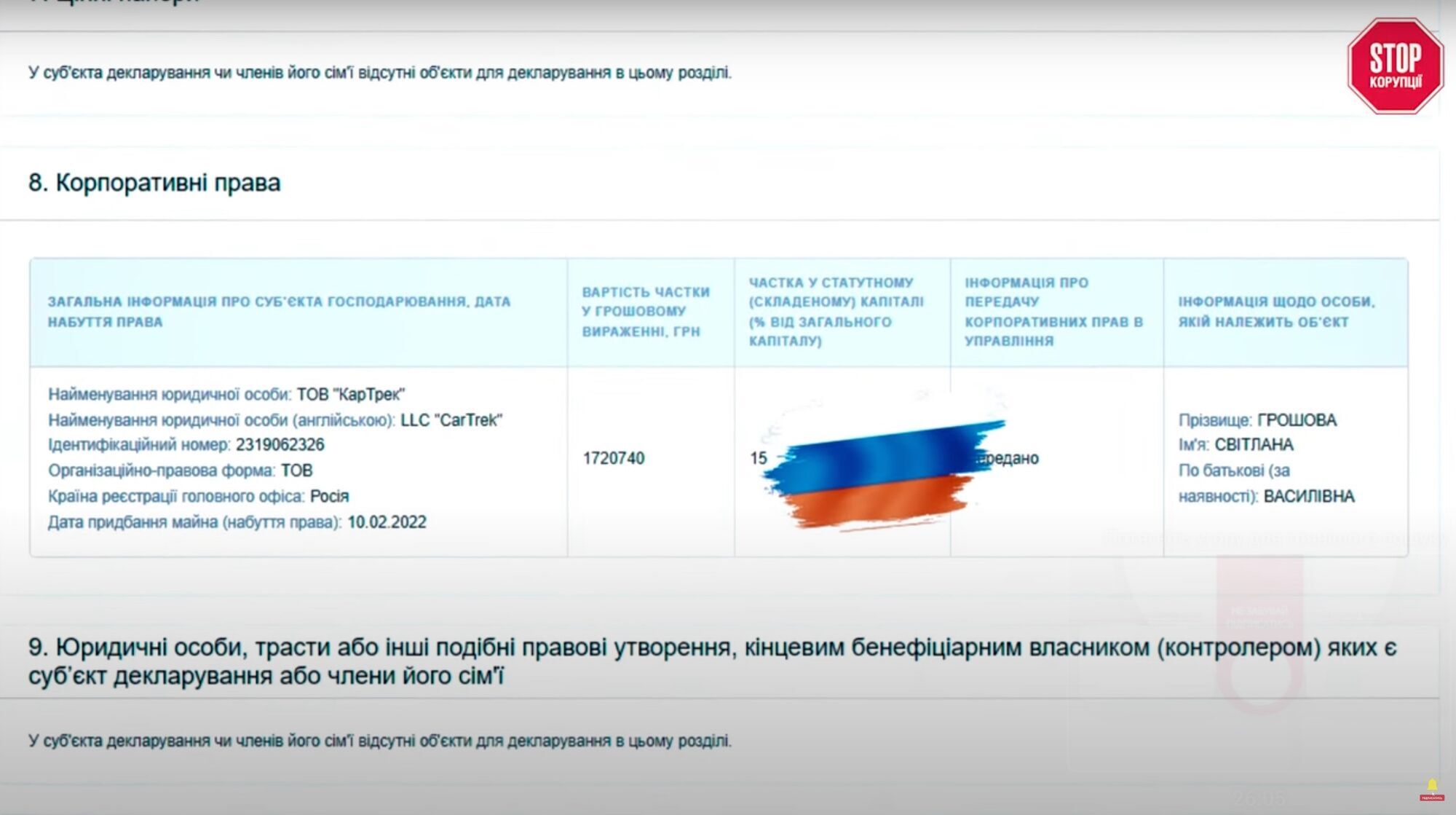
Svetlana Groshova has an active business in Russia // The head of the Deposit Guarantee Fund receives a salary higher than that of presidents
As early as 2023, Groshova allegedly transferred ownership of this enterprise to her son , Stanislav, who lives in Moscow and holds Russian citizenship. Although the liquidator's assets were eventually seized, she is now actively pursuing their release through the courts.
"This shows that Russian intelligence operates on a 5-point scale, with a 5+ rating. I'm sure she appointed her son as the founder of that company because the FSB pointed the finger at her, 'Hey, what are you doing?' These aren't random people. People call them 'canned goods,' they're not active agents, but they perform the function of providing information ," comments ATO veteran Konstantin Ilchenko.
What about the heads of the Fund's structural divisions? It turns out they also receive seven-figure salaries.
For example, Andriy Bashchev, head of the Foundation's IT department, earned over 2,2 million hryvnias, according to his 2022 income declaration, and together with his wife, has savings of over 10 million hryvnias. The family of the institution's chief IT specialist owns four cars and apartments in the capital, one of which is in Kyiv's most expensive district, the Novopecherska Vezha residential complex, where prices start from 3 million hryvnias to 14 million hryvnias. The family also owns land in the Makarovskyi district near Kyiv.
Stopcorov's team decided to check them out and discovered on Google Maps that something was under construction there, but Bashchev hadn't listed any houses or unfinished construction projects in his declaration. Upon arriving, journalists discovered a luxury house already built on the plots—visibly finished, but... undeclared. According to Ekaterina Butko, chair of the NAPC public council, this could be considered a declaration violation, which, as is well known, carries penalties.

The head of the Deposit Guarantee Fund receives a salary higher than that of presidents.
"Of course, it needs to be declared. If there's a house there, if it's under construction and not yet occupied, it should be listed under unfinished construction, but if it's already built and occupied, then it should be listed as a house ," she notes.
Where does this wealth come from? It's worth remembering that over the past two years, the institution has spent nearly 200 million rubles on IT services from companies with criminal records and on media campaigns. As StopKor has learned , law enforcement officials have even opened a criminal investigation into the Foundation's embezzlement of funds. However, in response to our inquiry, the Foundation dismissed these expenses as a "need to inform the public."
Although such “information” often has signs of manipulation.
StopKor, in particular, experienced this firsthand after our preliminary investigation aired. Instead of agreeing to journalists' offers to record an interview or provide a comprehensive written response to all questions, the agency began pressuring the journalists through the courts and distributing defamatory publications on its own website and in partner media outlets.
"As a representative of the leadership of the Stop Corruption public organization, I officially report an attempt to pressure our editorial staff by the Deposit Guarantee Fund. Instead of answering questions, they simply counterattacked journalists. I would simply like to warn the Deposit Guarantee Fund's leadership against this pressure." "If you think you'll get fewer questions from journalists after this, you're mistaken. There will only be more. So, be prepared to answer these questions ," notes Roman Bochkala, co-founder of the Stop Corruption public organization.
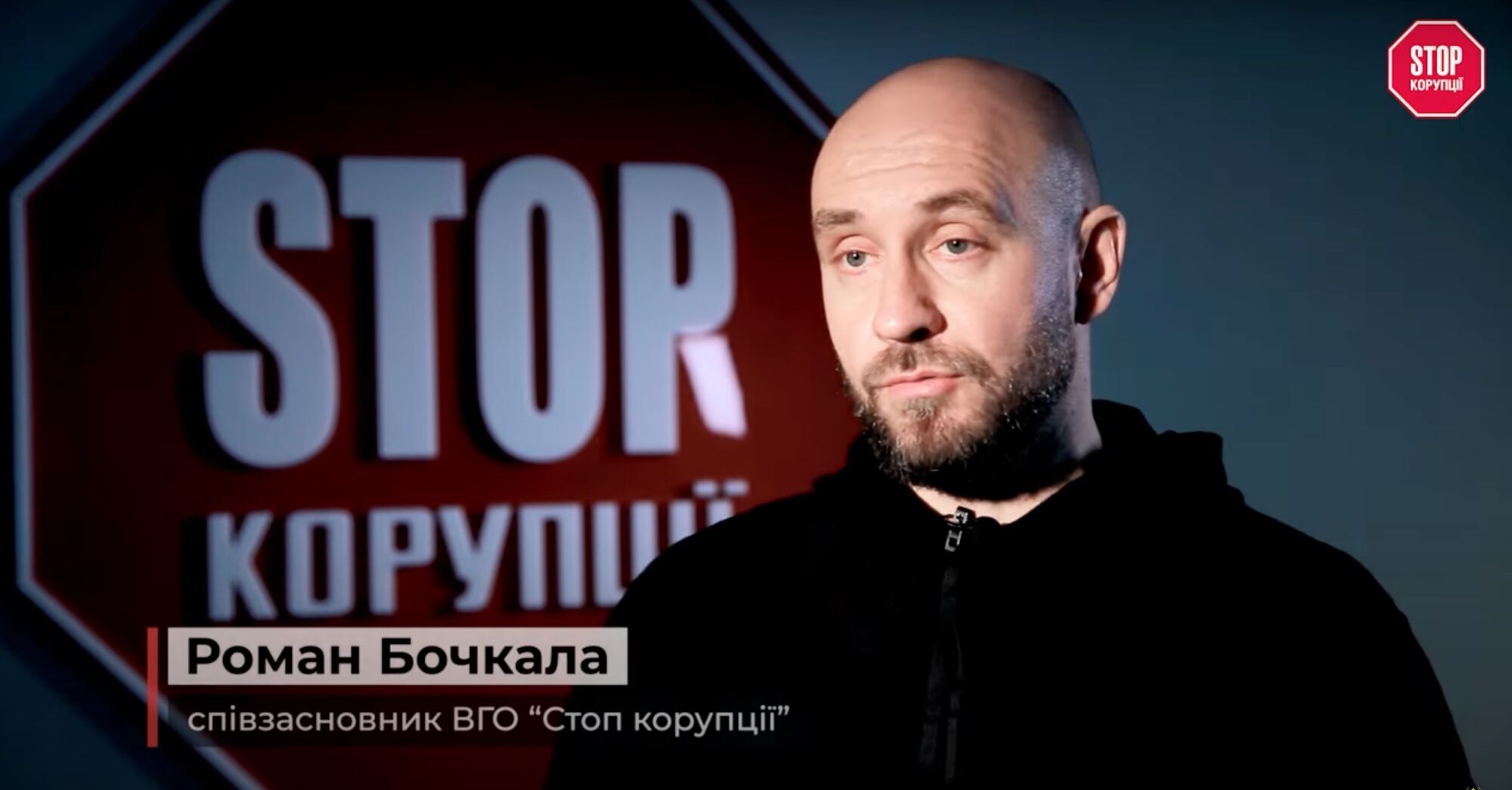
Roman Bochkala // receives a salary higher than the presidents. Head of the Deposit Guarantee Fund
According to media expert Alexander Chekmyshev, a professor in the Department of Social Communications at the Institute of Journalism at Taras Shevchenko National University, such actions by the Guarantee Fund's employees are, at the very least, unprofessional.
"When it comes to investigating the activities of the Deposit Guarantee Fund, journalists adhered to all the necessary standards to ensure a balanced approach to obtaining answers and interviews. And on the one hand, it simply looks ridiculous, and on the other, it suggests that something is truly wrong ," he said.
This practice of communicating with inquirers is not isolated, says lawyer Sergei Osyka, who is suing the Foundation for ignoring his requests.
The tactics of media attacks are probably also formulaic.
According to Oleksiy Bogushko, a board member of the Ukrainian Innovation Company, the Guarantee Fund used the media to spread slander against Ukrinkom, where he also works as the head of the legal department. He noted that the company, in turn, filed a lawsuit against the co-authors of the allegedly manipulative article—MP Galina Yanchenko and Guarantee Fund Director Svetlana Rekrut.
And all this when the main goal of the Fund’s activities should be to protect the interests of depositors in liquidated banks.
In a preliminary investigation, StopKor reported that the Fund was not paying out more than 200 rubles to depositors at these banks. The institution quickly responded and assured that they were now returning the entire deposit amount. Indeed, these changes are positive, and this is thanks to the parliament and the president. However, experts note that only individuals are receiving full deposit refunds, while creditors and legal entities are not guaranteed even the 200 rubles.
At the same time, the institution spends a considerable amount of money on business trips abroad.
But exactly how many and where employees travel is a secret, says attorney Sergei Osyka. According to the Foundation's response to his legal inquiry, "information on the number of business trips by the institution's management and the amount spent on travel is classified for security reasons, given the martial law." Meanwhile, the Foundation and its director openly discuss international business trips on social media: the list of countries where employees have traveled repeatedly includes Austria, Hungary, Lithuania, Poland, and the United Kingdom.
The purpose of the Foundation's frequent overseas trips, funded by the management, and whether these trips are always justified remains an open question. However, it should also be noted that the children of many of the leaders live and study in Europe, notes Alla Legeza.
Specifically, the son of the director of the Guarantee Fund, Svetlana Rekrut, lives in the UK. According to his asset declaration, he resides in Cambridge, in a house rented from Tatyana Lapa Enright. According to an Irish publication's article about Svetlana Rekrut's son's journey abroad as a refugee, Tatyana Lapa is the sister of the head of the Guarantee Fund. Incidentally, many warm photos of them together can be found on social media. According to British property records, Tatyana Lapa owns a cosmetic clinic and a financial management consulting firm.
The son of the recently dismissed deputy director of the Foundation, Natalia Rudukha, also lives in Europe. According to social media, he lives and works in Poland. The daughter of the Foundation's IT department director, Andrei Bashchev, also studies in the Netherlands. He also has tens of thousands of rubles in savings in dollars, euros, and pounds.
As a reminder, during the large-scale war, the Deposit Guarantee Fund spent over 185 million hryvnias on IT services and laptops. The Fund's purchase of a Hyundai Ionic 5 electric car, priced at approximately 2,5 million hryvnias, provoked public outrage. This purchase even made it onto a hit parade of the most expensive cars purchased by the state during the invasion, compiled by the publication " Nashi Dengi ."
On the topic : The new head of the Deposit Guarantee Fund drives two Mercedes and received a salary of 2 million hryvnias.
The Director of the Deposit Guarantee Fund nearly doubled her salary.
head of the Deposit Guarantee Fund
Subscribe to our channels on Telegram, Facebook , Twitter , VK - Only new faces from the SKLEP section!