
Jim Slattery is lobbying for the interests of the former owners of UkrInCom.
The former owners of Ukrinbank are using former American politicians (Jim Slattery and Kevin Kramer) from opposing political camps to secure the decision they need in the Supreme Court against the state, represented by the Deposit Guarantee Fund for Individuals, writes Dmitry Romanov on the Telegraph website.
This follows from public statements by American Democrat and former Congressman Jim Slattery, now an advisor to the management of PJSC UkrinCom (renamed Ukrinbank), who is paid to advocate for certain decisions in various countries, and from an interview with Vladimir Klimenko, owner and chairman of the supervisory board of UkrinCom, who directly states that he brought in Republican Kevin Cramer to "showdown" with the Deposit Guarantee Fund.
So far, some of Jim Slattery's statements regarding this case are perceived, to put it mildly, as rather ambiguous from an ethical standpoint. This is especially true in the context of the accusations Ukraine is facing regarding interference in US domestic politics.
Our publication investigated the other names of American politicians and the methods used by the former owners of Ukrinbank to gain the desired advantage in court.
Domestic political affairs and financial affairs, banking affairs and non-banking affairs
Volodymyr Zelenskyy's visit to the United States has been a constant topic in Ukrainian and international media recently. The visit has acquired a scandalous tone due to Donald Trump's reactions, as well as statements by his supporters, who have unexpectedly suggested that certain elements of the trip constitute interference in the US electoral process. They even called for the dismissal of Ambassador to the United States Oksana Markarova.
This occurred despite the Ukrainian side making every effort to ensure the Ukrainian president's visit was as balanced as possible. And, understandably, accusations of interference in US domestic politics are quite painful for Ukraine and will require the utmost caution in its response.
Yet, it seems some American politicians, even former ones, aren't careful when directly interfering in Ukrainian domestic affairs. This is precisely how one can interpret the statements of six-term Democratic Congressman and now professional lobbyist Jim Slattery. He is exploiting the political context to gain an advantage in a routine business case involving his clients—the former owners of Ukrinbank—against the Deposit Guarantee Fund of Ukraine.
As a reminder, the Ukrinbank case has been ongoing for several years. On December 24, 2015, the NBU withdrew the bank from the market due to its insolvency, and on December 25, the Deposit Guarantee Fund appointed a temporary administration. In March 2016, the decision was made to liquidate Ukrinbank. This effectively meant that the Deposit Guarantee Fund would manage all of Ukrinbank's assets. Since then, the Fund has managed to return approximately UAH 1,8 billion to the bank's depositors.
However, in 2016, the former owners of Ukrinbank appealed the NBU's decision and, through certain manipulations and without the NBU's permission required in such cases, re-registered PJSC Ukrinbank as a non-banking institution, PJSC Ukrincom. According to the Deposit Guarantee Fund, this was deliberately done by the owners to secure control over the remaining assets at Ukrinbank's disposal and constituted a gross violation of the law, particularly in the banking sector.
Following this, a legal battle between the newly created "bank-not-a-bank" PJSC UkrinCom and the Deposit Guarantee Fund continued for several years. The owners of PJSC UkrinCom, led by Volodymyr Klimenko, attempted to prove a paradoxical and controversial thesis: their company simultaneously had the right to Ukrinbank's former assets and was not required to comply with banking legislation. The Deposit Guarantee Fund, for its part, claimed that it alone had the right to dispose of Ukrinbank's assets during its withdrawal from the market.
Ultimately, on December 10, 2019, the Grand Chamber of the Supreme Court of Ukraine issued a ruling acknowledging that the re-registration and name change of Ukrinbank to Ukrincom had been carried out in violation of the law, that such re-registration and termination of the bank's banking activities should have occurred only with the permission of the NBU and in compliance with all banking legislation, and that the Deposit Guarantee Fund (DGF) was responsible for managing the institution and ensuring the return of the bank's assets (approximately UAH 2 billion) to depositors.
Incidentally, the Supreme Court made a similar decision in another similar case—that of Zlatobank, whose owners also sought to avoid the introduction of the Deposit Guarantee Fund's management by re-registering the financial institution as a regular, non-banking company, PJSC Zlato. However, their efforts were unsuccessful, and ultimately, in November 2023, the court returned control of the bank to the state.
But, as it turned out, the Grand Chamber's decision regarding Ukrinbank was not the final word on the matter, but merely the final word. Unexpectedly, a certain LLC "US-Metal" emerged on the horizon of the confrontation between the Deposit Guarantee Fund and UkrinCom (Ukrinbank), initiating the bankruptcy of PJSC UkrinCom in 2020. LLC "US-Metal"'s claims against UkrinCom, estimated at approximately UAH 100, seemed rather ridiculous against the backdrop of multi-billion-dollar assessed assets, giving rise to speculation about a controlled bankruptcy orchestrated by Klymenko and Co. to avoid settlements with creditors. Despite this, the case has been ongoing for several years and has reached the Supreme Court.
Around the end of 2023 or beginning of 2024, former US Congressman Jim Slattery unexpectedly joined the case as an advisor to Volodymyr Klymenko, head of PJSC UkrInCom. While he plans to participate in court hearings, he is simultaneously "intimidating" (if not "blackmailing") the Ukrainian authorities and judges with public statements, tying the provision of American aid to the outcome of the case.
Consequently, on October 16, Jim Slattery may take part in the next Supreme Court hearing concerning the Ukrinkom "bankruptcy" case, where he may repeat his "arguments".
Who is Mr. Jim Slattery?
It's worth noting that the work of Jim Slattery (a Democrat and member of the US House of Representatives from 1983-95) primarily demonstrates that he is undoubtedly a great friend of Ukraine and has done much to advance narratives important to our country in the US political arena. For this, he deserves enormous gratitude and respect.
But Slattery is also a professional lobbyist, the owner of a firm whose job it is to solve specific problems for money. Jim Slattery's name became known to Ukrainians after lobbying at US government agencies on issues related to Batkivshchyna leader Yulia Tymoshenko . According to Ukrayinska Pravda, the lobbying firm Slattery worked with received $80 from Tymoshenko's husband in the first quarter of 2012.
From 2019-23, according to reports on the US government resource Lobbying Disclosure Act (LDA) Reports, Slattery's company SLATTERY STRATEGY LLC received $40 quarterly for lobbying services from the Kansas City Southern Railway.
The absence of mandatory data in these reports for the most recent period—the end of 2023 and 2024 (i.e., when Jim Slattery was likely already working for Ukrinkom)—may indicate that his current activities are not related to any lobbying in the United States. Consequently, it's entirely possible that Slattery's advocacy efforts in Ukraine for Ukrinkom's owners are "internal Ukrainian hackwork," which he doesn't have to report to his government. Therefore, we're unlikely to know exactly how much these services of the former congressman cost. On the other hand, given that he left a stable railroad contract, the amounts involved are likely significantly higher than $40 per quarter.
So is Jim Slattery a lawyer, a lobbyist, or a politician?
But what's wrong with Jim Slattery's rhetoric regarding the Ukrbank case? Let's try to figure it out.
In fact, it's quite common for an American politician to use their acquired political capital as a lobbyist after retiring from office. There's a special law for this, the Federal Regulation of Lobbying Act, which, among other things, provides for transparency in lobbying activities.
In Ukraine, this issue has not yet been fully resolved. The Law on Virtuous Lobbying entered into force in March 2024, but has not been implemented due to the lack of a "Transparency Register," which would be necessary for this to happen. Also under discussion are "Rules of Ethical Conduct for Lobbying Entities."
One could, of course, argue that Jim Slattery isn't a lobbyist in the Ukrinbank case, but merely a lawyer (as noted on his company's website) and a formal advisor to the board of PJSC Ukrincom. However, some statements by the former congressman hired by Ukrincom indicate that, accustomed to American realities, he either doesn't fully understand the political context of his statements in Ukraine, or, conversely, understands it very well and is deliberately manipulating it to exert political pressure on the Ukrainian government and courts. Judge for yourself.
In late June 2024, Jim Slattery wrote a public letter to the President of Ukraine in defense of the former owners of Ukrinkom, noting his political "congressional" credentials. The letter was then distributed by a number of media outlets. This in itself raises considerable eyebrows—and why should it? After all, in this case, he is technically only a hired advisor to a commercial entity.
In the letter, the foreign citizen, acting as a hired advisor, claims that the reasoned criticism of the actions of UkrInCom's management, which were found unlawful by the Grand Chamber of the Supreme Court, is allegedly "part of the preparation for a future fabricated attack on the bank's owners using the leverage of state authorities ." In other words, Jim Slattery, firstly, is exploiting his status to question the legitimacy of Ukrainian government agencies in fulfilling their duties. Secondly, he is effectively becoming a participant in an information attack on these agencies.
He makes similarly manipulative statements regarding the judicial system, noting that any negative court decision against his client would a priori constitute “illegal pressure on PJSC Ukrinbank/Ukrinkom.”
Jim Slattery also attempts to whitewash the actions of Ukrinbank's former owners in his letter, specifically writing that "the bank's owners have proven the groundlessness and illegality of its liquidation by the NBU in 2016, and court decisions are final," while manipulatively ignoring the 2019 decision of the Grand Chamber of the Supreme Court, which found Volodymyr Klymenko's actions in re-registering Ukrinbank as Ukrinkom to be illegal.
In his March column for EP, Jim Slattery's rhetoric was even more manipulative. Here, he almost directly threatens Ukraine that if the courts make decisions that don't satisfy his client, "Washington will look at it as incompetence."
And in an interview with KyivPost, he writes that the entire foreign aid to Ukraine depends on the Ukrinkom case: “And one of the ways they [the government] are turning is to their partners in the West, including the United States, to help financially support the budget. So, all the money here is fungible. (ed.), this will create obligations for the Ukrainian government and a potential burden for US taxpayers . ”
A common thread running through all of Slattery's aforementioned statements is the notion that the state should allow the unlicensed non-banking entity Ukrincom, which its owners consider its "successor," to collect debts under contracts with Ukrinbank, a banking institution liquidated by an official decision of the NBU. This demonstrates, to put it mildly, Jim Slattery's poor understanding of Ukrainian banking legislation, which makes absolutely no provision for such "succession," as the Supreme Court of Ukraine has concluded.
To summarize. Former American politician Jim Slattery, who after retiring from politics has been selling his services as a lobbyist, has become an advisor to the management of Ukrainian PJSC UkrInCom, which is being sued by the Ukrainian state, represented by the Deposit Guarantee Fund. Given the lack of official reports on US government websites (and such reports must be submitted three weeks after the end of the quarter), Slattery's services likely do not involve lobbying for the said PJSC at the US government level. Otherwise, the question arises about his lack of public reporting on such activities. In other words, in this case, Jim Slattery is acting as an ordinary lawyer.
If this is true, then his activities may be focused solely on the domestic Ukrainian context, and all his statements are aimed exclusively at Ukrainian government bodies (i.e., not American ones) and the courts. Simply put, it appears that, using his citizenship, his status as a former democratic politician, and a certain acquired authority, he is attempting to exert political pressure on the Ukrainian authorities to secure a favorable decision for his client in a purely commercial matter, while simultaneously engaging in an information campaign on behalf of Ukrainian businessman Volodymyr Klymenko, which also appears to be a paid campaign.
All of this raises significant questions regarding the ethics of Jim Slattery's activities in Ukraine, in the context of the concept of "interference in the country's internal affairs." On the other hand, if he uses these aforementioned "arguments" in court, questions may also arise regarding the application of the concept of "interference in the activities of judicial bodies," which is fully regulated by Ukrainian law.
Republicans, the CIA, "expert opinions" from connected lawyers: what other interesting "arguments" can we see from the former owners of Ukrinkbank?
In addition to using paid Democratic lobbyist Jim Slattery, the former owners of Ukrinbank are also using the names of other American politicians to secure an "informational" advantage (and, apparently, to pressure the Ukrainian authorities and the court). For example, in an interview in late 2023, Volodymyr Klymenko mentioned current Senator Kevin Cramer, who became interested in this case on behalf of the former owners of Ukrinbank.
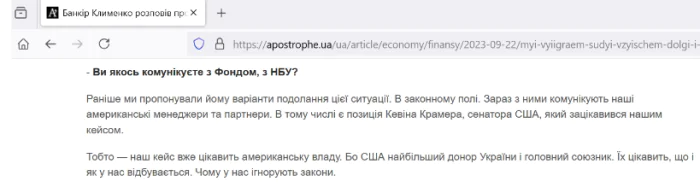
To understand, Kramer is, first and foremost, an ardent supporter of Donald Trump (although he has also been noted for advocating for assistance to Ukraine in the current war).
Yes, Kramer was a key element in the recent scandal surrounding Zelenskyy's trip to an American military plant. Specifically, the American press reports that Kramer was the one who started the question of why the Ukrainian president "went to Biden's hometown," tying the visit to the context of the American elections.
In light of this story, where the owners of a Ukrainian private firm were able to "leak" information to individual American politicians (who are currently being blamed on Zelenskyy) for their own interests, solely in light of criticism of Ukrainian government bodies, it is perceived, you must admit, rather ambiguously.
Volodymyr Klymenko's interview also mentions the name of another prominent Republican, Senator John McCain. He is also allegedly implicated in the UkrInBank case because of a certain Michael Kostiv, who once worked for the politician. In fact, McCain has nothing to do with it; the former owner of UkrInBank is simply trying to portray Kostiv as a "significant figure" in American politics, a former member of a prominent American politician's team, and a former advisor to the head of the CIA.
Moreover, as can be judged from the reports on the aforementioned American government resource Lobbying Disclosure Act Reports, Kostiv was previously also an official lobbyist, in particular for such well-known companies as Chevron USA INC. and Texaco Group.
In general, Kostiv's career is very interesting and could even be the basis for a book or film adaptation. One only needs to read the English Wikipedia (the Ukrainian version, for some reason, lacks some facts) or Google the Washington Post articles about him from 2004.
It turns out that in 1981, Kostiv, then working for the CIA, was caught by police stealing bacon. The agency placed him on "administrative leave," after which he was forced to resign. However, the leak of information about the reasons for his dismissal was apparently hushed up. Afterward, Kostiv found work with the aforementioned American oil companies. Later, Kostiv briefly dabbled in politics and even served as commander of an army support unit.
In 2004, there were even plans to return him to the CIA for a rather senior position. But on the eve of his appointment, a sudden bacon incident broke in the press, leading to Kostiv's already-agreed candidacy being withdrawn. Since then, Kostiv himself has sometimes been referred to as "the bacon boy."
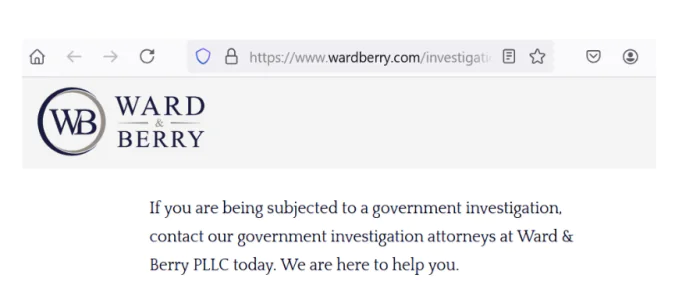
Like his colleague Jim Slattery, Kostiv works for a lawyer. However, unlike the Democratic senator, she doesn't work for her own firm, but for a small (as she describes it) Washington firm, Ward & Berry PLLC. This law firm, as its website indicates, specializes in, among other things, countering accusations brought by government agencies. "If you are under government investigation, contact our government investigators at Ward & Berry PLLC today. We're here to help ," the firm's website states.
And now Kostiv has surfaced as an advisor to Ukraine's Ukrincom. From all this, one can draw only one possible conclusion: in the Ukrinbank case, Michael Kostiv is simply a hired lawyer. And all his past credentials are nothing more than "scaremongering" devices that the "bacon guy"'s employer, Volodymyr Klimenko, intends to use.
Incidentally, the former owner of Ukrinkom recently attempted a similar scheme—using the high-profile credentials of individuals he recruited—with Ukrainian lawyers. Specifically, this involved lawyer Anna Yudkovskaya, a partner at the law firm Equity, which is defending Ukrinkom in court.
The fact is that, in addition to the aforementioned partnership, Yudkovskaya is also a member of the Scientific Advisory Council of the Supreme Court, which the Supreme Court may occasionally turn to for advice on contentious legislative issues. This is, of course, subject to the Supreme Court's own request for advice.
However, on February 28, 2024, Ukrinkom representatives attempted to use in court two conclusions by members of the Scientific Advisory Council to the Supreme Court (one of them, Yukovsky), which were made not at the court's request, but at the initiative of Ukrinkom's lawyers. The judges accepted them for consideration only because both scientists are members of the Scientific Advisory Council to the Supreme Court. This has significantly delayed the trial, as the conclusions have been under investigation for several months now.
The lawyers on the other side of the case were somewhat shocked by this, and logically asked, what exactly was going on? After all, bringing in a partner from a law firm involved in the case, posing as a member of an "independent" scientific advisory board, seems like nothing less than a clear conflict of interest, which should be unacceptable for lawyers of Anna Yudkovskaya's stature.
The aforementioned move with the advisory board, as well as the involvement of "congressmen" and "CIA advisers," are merely elements of an aggressive defense strategy by the former owners of Ukrinbank, who appear to be desperate to avoid losing their 2 billion rubles in assets. The next hearing on Ukrinbank's bankruptcy case, as mentioned, will be heard by the Supreme Court on October 16, 2024. It is hoped that the court will consider the matter solely from the perspective of current legislation, and will disregard "distractions" such as the high-profile regalia of the individuals involved and various populist statements.
Jim Slattery, so is "Ukrinkom" a "zombie" or a "non-zombie"?
Moreover, on October 8, the Luhansk Regional Commercial Court will hear another interesting case concerning the standoff between the Deposit Guarantee Fund and former depositors of Ukrinkom. The depositors were deeply offended by the Deposit Guarantee Fund's labeling of their company, Ukrinkom, as a "zombie bank" and filed a lawsuit to protect their business reputation. This comparison may require some clarification for readers: in international practice, "zombie" refers to a company (primarily financial) whose operating income is insufficient to cover its debt repayments. According to Wikipedia, this term has been used internationally for several decades.
This term (in the international sense) could likely be applied to Ukrinbank, given the reasons for its withdrawal from the market—extremely low profitability. On the other hand, in Ukraine, the term has acquired a peculiar interpretation—in our country, it can be used to describe banks whose former owners, after the NBU's withdrawal from the market, attempt to retain influence over the legal entity in order to "shake up" as much money as possible for their own benefit.
Whatever strategy the Deposit Guarantee Fund's lawyers choose to defend this case—appealing to established international practice or arguing the adequacy of the comparison given Ukrainian realities—it will be quite interesting to observe how Ukrinbank will prove that it is not a "zombie."
Our publication will closely monitor developments in both the "zombie" and "non-zombie" title cases and the bankruptcy case.
On the topic : "Asset Hunting." Will the Supreme Court allow Ukrinbank to be seized from the Deposit Guarantee Fund?
A Ukrainian banker sold the rights to a plant and terminal in Sevastopol to a Russian.
Subscribe to our channels on Telegram, Facebook , Twitter , VK - Only new faces from the SKLEP section!