
Kernel Holding's agreement with Agro-Region comes amid a stock collapse, minority shareholder lawsuits, allegations of persecution, international lawsuits, and suspicions of billions in budget losses.
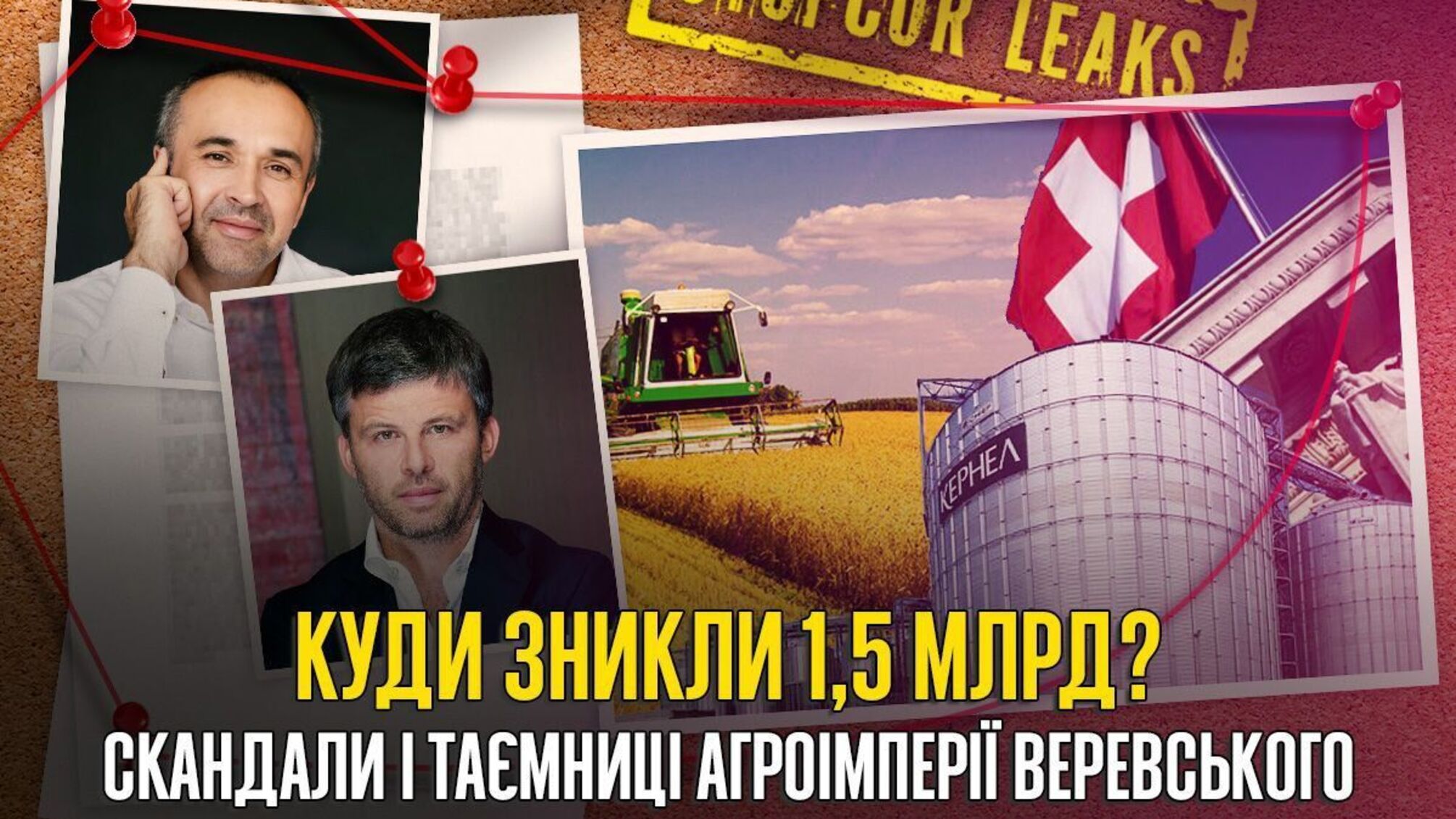
When Andriy Verevskyi leads Kernel Holding to a new agreement—the purchase of Agro-Region for $100–110 million, comprising 41 hectares of land—the company is already living within a different narrative. After issuing 216 million shares, which plunged the price from 26 zlotys to 1 zloty overnight and gave Verevskyi 94% control, minority shareholders are taking legal action; investor Pavlo Boyko claims pressure following the lawsuits; in Switzerland, Verevskyi is suing journalist Nick Feldman; and in Ukraine, meanwhile, stories are surfacing of agricultural asset redistribution involving Chernihiv MP Borys Prikhodko and export schemes that could have cost the budget 1,5 billion hryvnias during the war. StopKor also noted the story surrounding Kernel and Andriy Verevskyi as a continuation of a long-running corporate conflict that has been plagued by lawsuits and public scandals for several years.
Kernel Holding, agroholding owned by businessman Andriy Verevskyi, continues to actively pursue its activities in the Ukrainian market. The company is preparing to acquire the Agro-Region group, which has a land bank of approximately 41 hectares and grain elevator infrastructure. The beneficiaries of the group, through GARNA STOCKHOLM HOLDING AB , are former Ukroboronprom Chairman Aivaras Abromavicius and Lars Peter Elam Håkansson.
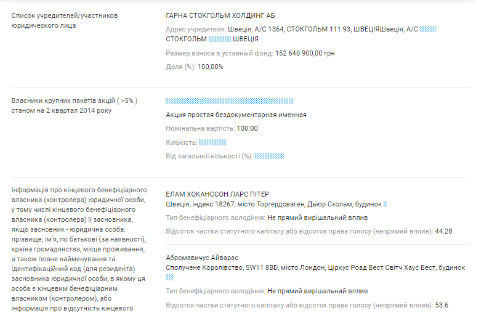
Beneficiaries of Garna Stockholm Holding AB
According to the publication Zakhid NET , the estimated value of the deal is $100-110 million, with the Antimonopoly Committee of Ukraine to decide. Incidentally, this is the second attempt; the first time, the companies failed to agree on a price.
To an outside observer, this looks like just another move by a major agricultural player. However, this move comes after events that have fundamentally changed the company's very model and led to a heated conflict with investors.
Manipulation, Issues, and Empty Meetings: How Verevsky Outsmarted Kernel Holding Shareholders
As recently as early 2023, Kernel Holding was a public company with a large number of minority shareholders. The business's founder, Andrey Verevsky, remained the largest shareholder but did not have full control.
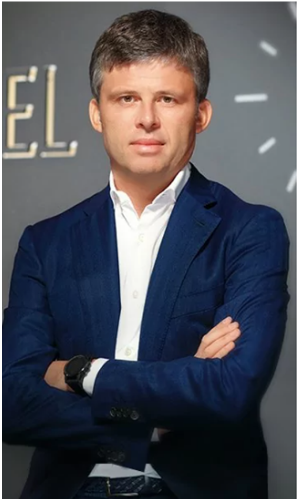
Kernel Holding
Through his subsidiary Namsen Limited, he owned approximately 38% of the shares (approximately 41% of the votes). This meant that key decisions required the support of other investors, and minority shareholders retained at least minimal influence.
In 2023, this situation changed. Control over the company was acquired through a combination of methods. The first element was a phased buyback of shares from the market. The second, and crucial, was an additional share issue. And all of this was accomplished in a very interesting and likely dishonest manner. Since 2022, Polish media outlets have been actively publishing stories, purporting to be Kernel, about the war in Ukraine, export problems, and even the possible closure of the company.
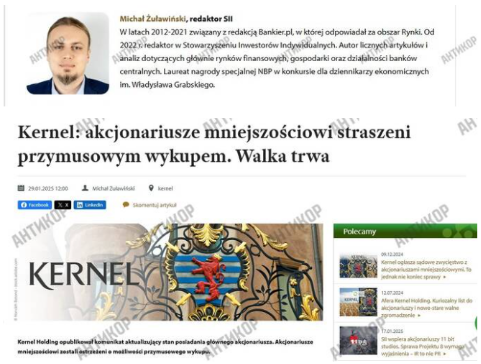
Information about Kernel in Polish media
Polish analyst Michal Żulawinski noted that the panic was artificial and that Kernel shares were subject to suspicious manipulation.
The goal was clear: to scare Polish shareholders, force them to sell their stakes, and allow Andriy Verevskyi to acquire a controlling stake. The panic was partially effective, but in May 2024, Ukraine opened seaborne exports, and Kernel shares quickly rose, stabilizing the market. The company even announced the purchase of two bulk carriers for its own exports.
Verevskyi's next step was to issue new shares. In May 2024, a shell company, Namsen LTD, was registered in Cyprus, and Kernel immediately issued 216 million shares. Namsen LTD purchased them and became the majority shareholder. As a result, the stock price on the Warsaw Stock Exchange fell from 26 zlotys to 1 zloty overnight. Panicked investors were forced to sell their stakes. Verevskyi effectively took sole possession of the shares.
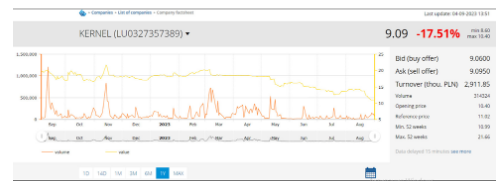
Stock market chart
After this transaction, the majority owner's stake exceeded 94%. Simply put, the number of shares was dramatically increased, and control was concentrated in a single hand. For minority shareholders, this meant the loss of any real influence over the company's decisions.
Moreover, after the concentration of control, the company made a decision that further escalated the conflict. In December 2023, the general meeting of Kernel Holding shareholders decided not to pay dividends for the financial year ending June 30, 2023.
An important point: during this period, the company officially declared $299 million in net profit. This means it wasn't a loss-making business or a crisis. The decision to pay zero dividends was made when more than 94% of the votes belonged to a single owner, and the votes of minority shareholders no longer mattered.
According to Polish media , Kernel's behavior in its interactions with shareholders is completely unacceptable. For example, Kernel's annual general meeting of shareholders was scheduled for December 11, 2023, in Luxembourg. This meeting is mandatory under local law and should provide minority shareholders with a genuine opportunity to influence the company's decisions. However, as Dr. Rafal Rzeszotarski, representing a group of minority shareholders, explains, the meeting never actually took place. Upon arriving at Kernel's office with lawyers and a local bailiff, he found the office empty, the receptionist clueless, and the "meeting" consisting solely of processing a PDF file containing voting records uploaded from Kyiv without signatures. The following day, Kernel published a list of resolutions allegedly adopted at the meeting on December 11, at 15:00 PM in Luxembourg. It turned out that the protocol was signed by only one employee, who physically showed up at the office around 16:40 PM—after the minority shareholders intervened. The other two people who formally signed the protocol did not submit statements of their presence.
All of these actions by Kernel Holding sparked a major international scandal, thereby compromising Ukraine's investment appeal. Polish pension funds and other investors joined forces in a class action lawsuit in the Luxembourg Court, and the case was classified as large-scale economic fraud. However, on March 28, 2025, the Luxembourg Court dismissed the claim of minority shareholders seeking to challenge the decision of Kernel Holding SA and its majority shareholder, Namsen Limited, to suspend the board's decisions regarding the issuance of shares in 2023.
The decision marks the latest stage in a long-running corporate dispute that highlights how difficult it is for minority investors to defend their rights against a controlling shareholder who has near-total control over the company.
Verevsky in legal battles: from a conflict with Kernel Holding investors to a defeat in Switzerland
Investor Pavel Boyko stated that after Kernel's actions, he began assisting the company's minority investors. He said he organized their joint efforts and initiated five lawsuits challenging the company's decisions, specifically the additional share issue and subsequent steps to delist the shares from the Warsaw Stock Exchange. The lawsuits, he said, are ongoing in Poland and Luxembourg, and the situation has attracted international attention.
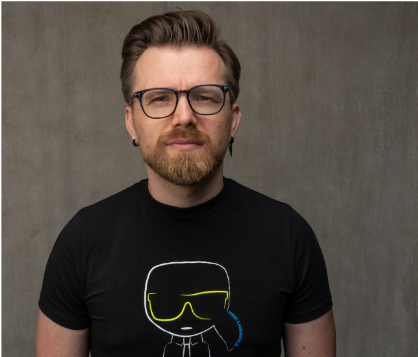
Investor Pavel Boyko
After the trial began, Boyko reported persecution in Ukraine. He claims criminal proceedings have been opened against him for organizing the illegal smuggling of people across the border. He calls these charges absurd and fabricated, citing a corporate conflict as the cause. Boyko also reported that the searches have placed significant psychological pressure on his family.
In April, he left Ukraine, and in June, he took his family abroad. Boyko claims he crossed the border legally. He cited his mother's disability and her employment at a strategic enterprise as reasons for leaving. He noted that he had previously left and returned several times, but this time he decided to remain abroad until the situation around Kernel was resolved.
However, Pavlo Boyko isn't the only one Verevskyi is "fighting." The investor announced on his Facebook page that he had filed a lawsuit against Ukrainian journalist Nick Feldman for an interview he conducted on YouTube. He did so in Switzerland, despite both being Ukrainian citizens.
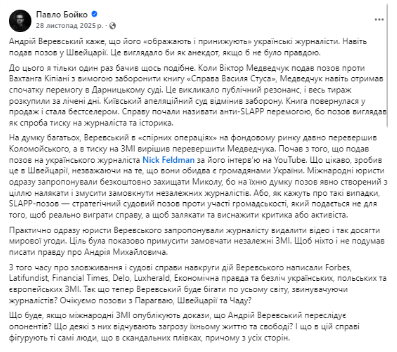
Pavel Boyko's Facebook post
However, a court in Switzerland denied billionaire Andrey Verevsky (Kernel) his claim and ordered him to pay Nick Feldman 7500 Swiss francs.
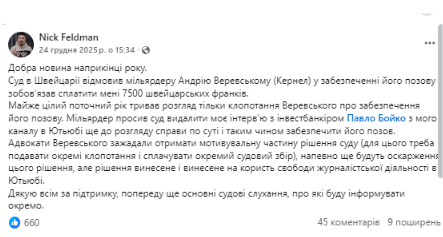
Nick Feldman's message to us on Facebook
Kernel Holding and the 1,5 billion hryvnias that were lost to the budget during the war
While Kernel was resolving disputes with shareholders in Europe, an even more scandalous episode erupted in the Ukrainian market—against the backdrop of the war, with the state budget already in critical condition. Ports in the Odesa region exported 750 tons of oil between May 2024 and March 2025, of which Kernel shipped only 325 tons. Interestingly, 153 shipments have to be manually verified. Shell companies, Yadro-Trade and Yadro-Torg, registered at the same address as Kernel's entities, suddenly began operating in the export chain.
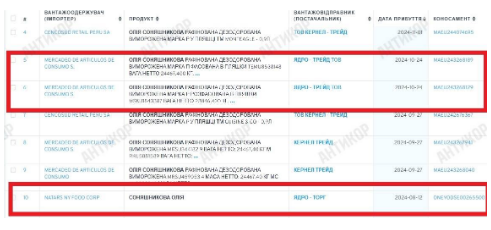
The companies "Yadro-trade" and "Yadro-torg"
According to media reports , payments for shipments were made in two ways: official Kernel Holding deliveries were paid for by corporate check, while deliveries through Yadro-Trade and Yadro-Torg were paid for by simple card-to-card transfers.
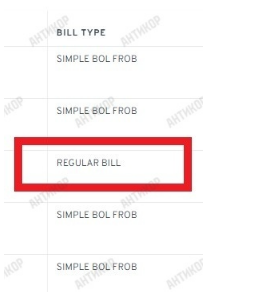
Payment to the companies "Yadro-trade" and "Yadro-torg"
The scheme worked like this: the export of vegetable oil shipments (24–26 tons) was processed through shell companies. Once the cargo was delivered, these companies disappeared from the registers, making it impossible to collect the tax due upon order fulfillment.
As a result, the scheme allowed profits from oil exports to escape tax control. Experts estimate that this scheme could have cost the state approximately 1,5 billion hryvnias—funds that could have been used to support the budget and the country's wartime needs, but instead ended up in private pockets.
This case demonstrates that even a profitable agricultural holding during wartime can turn ordinary logistics into a serious conflict with the state, when corporate interests are placed above transparency and control.
Kernel's Secret Deals: What Lies Behind the Formal Ownership
The aggressive corporate policy of the Kernel agricultural holding has likely long since become the norm, and one of its most high-profile manifestations is the conflict surrounding the company " Agrodom ." Following the tragic death of MP Valeriy Davydenko, the founder of "Agrodom," control over the majority of the enterprise passed to entities affiliated with Kernel. The deceased's mother, Valentina Davydenko, claims the company used a loan agreement to stage a hostile takeover of the enterprise and appropriated the harvest.
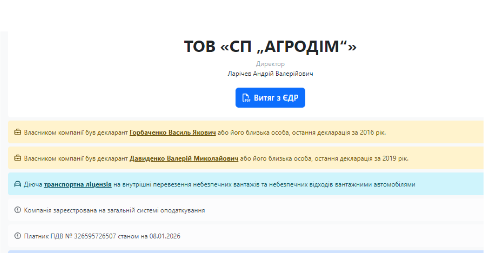
On July 2, 2020, the Antimonopoly Committee of Ukraine (AMCU) authorized Progressive Investment Strategies, a subsidiary of Kernel Holding, to acquire more than 50% of Agrodome. Valentina Davydenko filed a petition with the AMCU to review the decision, claiming she controlled the company and that the committee based its decision on false information. Due to a lack of documentation, her petition was dismissed.
Subscribe to our X channel , Telegram channel and Facebook page!
Stay informed about who is doing business, in politics, and supporting corruption in Ukraine!
In 2020, Kernel published a refutation: the company was not the controlling shareholder, but merely acquired a 24% stake and provided an $11 million loan. Following the borrower's default, the obligations to sell back the stake ceased, so Kernel no longer had a legal obligation to return the shares. However, there is some interesting information here, as reported by Nashi Dengi . As of January 2019, Valentina Davydenko was listed as the beneficiary of Agrodome.
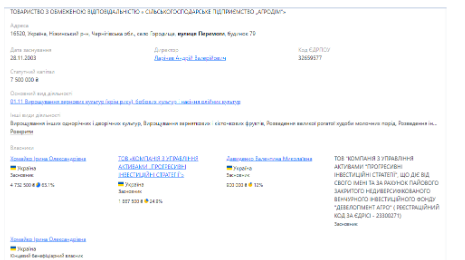
Valentina Davydenko is one of the owners of the Agrodom company.
However, as of May 13, 2019, the list of founders also included the company Progressive Investment Strategies with a 24,9% share, Alexander Bedrikovsky with a 12% share, and Irina Khomaiko with a 51,1% share, who is also associated with A. Verevsky.
In May 2021, a new clone company , LLC SP "Agrodom," was registered at the same address and with the same director, with a paltry authorized capital of 10 UAH.
According to Valentina Davydenko, villagers were forced to renegotiate land leases in favor of the new enterprise, which effectively allowed Kernel to expand its land holdings in the Chernihiv region. Most interestingly, the founder of the new "Agrodom" was an individual named Oksana Vyacheslavovna Slipenchuk.
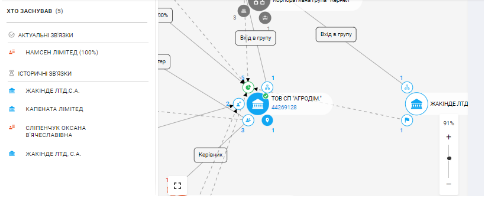
Information about the founders of the new company "Agrodom"
According to publicly available data, Slipenchuk is a private entrepreneur who produces furniture in Poltava.
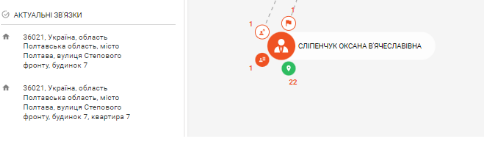
Oksana Slipenchuk's registration details
Isn't it surprising that, while in Poltava, she suddenly registered a company and began acquiring land all the way in Chernihiv Oblast? And she remained the beneficiary for a whole year. And then, strangely, the company ended up in the hands of Andriy Verevskyi.
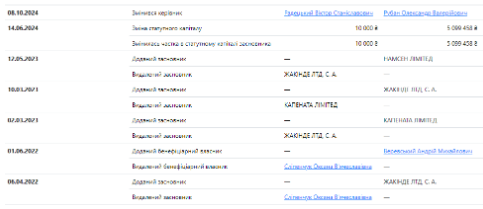
Information on changes in beneficiaries
But that's not the full tragedy of the situation. In July 2021, a company registered in the UAE Free Trade Zone appeared for the first time in the files of the Chernihiv Regional Commercial Court. This entity has the same address and owner as Oleksiy Bagriy's former company, Markeb Overseas FZE. Due to debt obligations, the offshore company attempted to acquire a stake in Agrodome. The cynicism lies in the fact that Bagriy is closely connected to the late Davydenko's associate and friend, Borys Prikhodko. Prikhodko and Davydenko were once suspected of embezzling 2 billion 69 million hryvnias (or $250 million at the then exchange rate) from PJSC Agrarian Fund. And both were co-owners of Terra Bank. Incidentally, it was Prikhodko who found his friend shot to death.
StopKor has already reported that Alexey Bagriy went abroad in 2023 with his son, Daniil Prikhodko, as a volunteer delivering humanitarian aid and never returned.
Photo from customs
So what's the deal? Are Prikhodko and Verevskyi taking over the late Davydenko's business? Incidentally, Boris Prikhodko's activities are even somewhat reminiscent of the way Kernel Holding (i.e., Verevsky) operates. After all, in 2024, Leonid Yakovishin reported a possible corporate raid on his company, Zemlya i Volya, as reported by Politika and Kompromat.
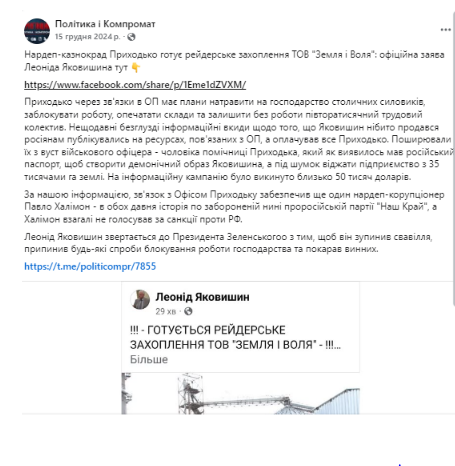
Media Message Politics and Compromising Material
The story of Kernel Holding and Andriy Verevskyi demonstrates how corporate decisions, legal conflicts, and financial scandals can coexist for years with continued business expansion. Despite international court cases, a loss of investor confidence, and questions about transaction transparency, the company continues to enter into major agreements, calling into question the effectiveness of oversight and the consequences for large businesses in Ukraine.
Skelet.Org
Kernel leaves the Warsaw Stock Exchange
Verevsky's hands were untied. Kernel's Polish shareholders fell out among themselves.
Subscribe to our channels on Telegram, Facebook , Twitter , VK - Only new faces from the SKLEP section!