
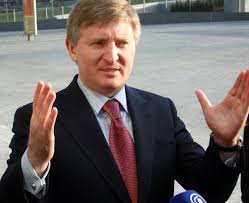
Rinat Akhmetov
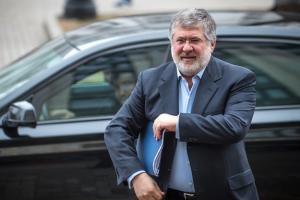
Igor Kolomoisky
Co-owner of the Privat business group Igor Kolomoisky has gone on the offensive against yesterday's master of Donbass, the owner
Rinat Akhmetov's SCM business group. The open conflict began with the January 12 filing of the Dnipropetrovsk company Business-Invest with the Kyiv Commercial Court to terminate the agreement for the sale of the state-owned 45,1% stake in PJSC Zapadenergo. The purchaser, following a privatization tender in 2011, was R. Akhmetov's Donbas Fuel and Energy Company holding company.
Photo for memory
At the gala reception on June 7, 2014, in the Art Arsenal of Kyiv in honor of the inauguration of the newly elected President of Ukraine Petro Poroshenko, I. Kolomoisky and R. Akhmetov communicated informally.
They even took a photo, their hands on each other's shoulders in a friendly gesture. From the outside, it looked very much like a reunion of long-lost classmates.
However, Igor Valerievich's ostentatious friendliness shouldn't have fooled his counterpart. It's clear that oligarchs are generally not known for their gentle, good-natured natures; every one of them is a shark at heart.
But even compared to his colleagues, I. Kolomoisky and his partners at Privat stand out for their particular aggressiveness.
This is evidenced by the numerous past corporate conflicts surrounding several regional power companies, the 1+1 TV channel, the Nikopol Ferroalloy Plant, the Kremenchug Oil Refinery, the AeroSvit company, the Ozerka market in Dnipropetrovsk, and a number of other assets.
I. Kolomoisky has fought with many people: former Prime Minister Pavlo Lazarenko, who retained significant economic interests in Dnipropetrovsk, brothers Igor and Grigoriy Surkis, and Konstantin Grigorishin, owner of the Energy Standard group.
But these events relate primarily to 2005-2010. Currently, the London High Court is hearing a lawsuit filed by Viktor Pinchuk, owner of the EastOne group, against I. Kolomoisky for $143 million in damages for a deal involving a 50% stake in the Kryvyi Rih Iron Ore Plant in 2004-2005.
Furthermore, in 2014, the co-owner of Privat, through the same Business Invest, first blocked the transfer of the state-owned Sumykhimprom corporation to Dmitry Firtash's Group DF holding company. He then effectively "squeezed out," as it's now fashionable to call it, the Vilnohirsk Mining and Metallurgical Plant and the Irshansk Mining and Processing Plant.
These state-owned enterprises were leased by Group DF for 10 years, but were then returned to state ownership by the government in the fall of 2014. Experts believe Igor Kolomoisky was the brains behind this idea. Ultimately, Igorsky Mining and Metallurgical Combine (IGOK) and VGMK were transferred to the state-owned United Mining and Chemical Company, headed by a former Privat Group executive.
Igor Valerievich had already crossed paths with R. Akhmetov regarding the redistribution of property.
Indeed, if the return of the Kryvorizhstal plant, privatized by the Investment and Metallurgical Union consortium of R. Akhmetov and V. Pinchuk, to state ownership in 2005 can still be conditionally considered within the framework of the Kolomoisky-Pinchuk conflict, then the attempt to return the Dniproenergo company, privatized by DTEK, to the state was clearly a personal attack on the influential Donetsk oligarch.
However, that attempt by the government led by Yulia Tymoshenko ended in failure, and the situation returned to a state of equilibrium for R. Akhmetov. His relationship with I. Kolomoisky since then can be described as "neither peace nor war."
Moreover, they have been successfully partnering since 2007 at the Kryvyi Rih Iron Ore Plant, the largest underground iron ore mining enterprise in Ukraine, which includes four mines.
According to financial statements, 99,9% of KZhRK shares belong to the Cypriot offshore company Starmill, which is equally owned by SCM and the Privat Group.
On the warpath
There's no doubt that the owner of SCM would like to maintain the status quo in their relationship. But, as noted above, few oligarchs have managed to avoid a business conflict with PrivatBank in Ukraine.
Another thing is that I. Kolomoisky never acted recklessly. Not only did he increase his fortune under a loyal government, but he also lost nothing when political opponents, represented by the Party of Regions, supported by R. Akhmetov, came to power in 2006 and 2010.
Meanwhile, SCM's owner was unable to avoid losses in 2005. However, the election of Viktor Yanukovych as president in 2010 strengthened his position, allowing him to offset the loss of Kryvorizhstal with new acquisitions, including a 45,1% stake in Zakhidenergo, which includes the Burshtynska, Ladyzhynska, and Dobrotvirska Thermal Power Plants.
The value of this asset lies in the fact that the Burshtyn TPP is directly connected to the European power grid (UCTE). It is the only one in Ukraine that has the physical capacity to export electricity to the EU, as all other TPPs operate within the CIS unified power grid, which differs from the UCTE in its technical parameters.
In this regard, the absence of other applicants for the state-owned 45,1% stake in Zakhidenergo, which was put up for privatization by the State Property Fund of Ukraine (SPFU) in 2011, seems strange at first glance.
However, it is entirely logical that, in the absence of competition, DTEK purchased this stake at the privatization tender for only UAH 100 above the starting price, for UAH 1,9321 billion.
Thus, the deal amounted to only 0,052% more than the initial price. This fact will likely be used by Business-Invest in its legal proceedings.
The company claims that the terms of the privatization tender were formulated by the State Property Fund in such a way that only DTEK could participate in the bidding.
The court will determine how true this thesis is. However, it does explain, in its own way, why R. Akhmetov had no competitors at the time.
In this regard, we can recall the previous battles surrounding auctions for the right to export electricity (EE), in which Konstantin Zhevago's Belotserkovskaya TPP JSC attempted to participate.
For various reasons, this company was never admitted to the tenders held by the transmission line operator, NEC Ukrenergo. As a result, DTEK was the only electricity exporter from Ukraine under Viktor Yanukovych.
So Privat has some reasons to feel short-changed during the previous round of state pie-sharing. And the current political situation gives this group reason to hope for revenge.
Whose chances are there to sing romances?
Without delving into the legal aspects of the dispute, it's important to remember one important circumstance. In the very specific conditions of Ukrainian justice, any detail can be interpreted in either direction.
Therefore, the one with the most power at the moment—or, more precisely, influence over the government—almost always ends up right. There's no doubt that, from this perspective, I. Kolomoisky holds all the cards.
The overthrow of the Party of Regions essentially led to the collapse of R. Akhmetov's political influence. Yes, he managed to get some of his people elected to the new Verkhovna Rada through the Opposition Bloc and single-member constituencies.
But in the OB, influence had to be shared with people from D. Firtash's orbit. Moreover, despite previous experience in 2005 and 2007-2009, the OB representatives were clearly unprepared for the new conditions of working in opposition, which were far harsher than before.
The only thing keeping the pro-government patriotic majority from completely and utterly devouring the spineless opposition is Ukraine's Western partners—the US and the EU—who still want to see some semblance of democracy here.
Meanwhile, I. Kolomoisky has influence not only over three of the five political forces in the current coalition, including one of its pillars, the People's Front, led by Prime Minister Arseniy Yatsenyuk and National Security and Defense Council Secretary Oleksandr Turchynov.
He also has at his disposal a number of volunteer battalions formed with the direct participation of Privat, including financially.
And this, in conditions where the official law enforcement system is in a semi-paralyzed state, is a more than compelling argument.
This was proven by the events at the Odessa Oil Refinery in December and January, where armed men entered the plant's premises, forced the guards to face the ground, and took away tens of millions of dollars' worth of petroleum products to the Sintez-Oil company, part of the Privat Group.
One can also take the episode with the initiation of a criminal case by the tax police against the general director of the state concern "Ukrspirt" Mykhailo Labutin on charges of embezzlement of more than 200 million hryvnias.
As usually happens in such cases, the high-ranking official suddenly became ill after this, and instead of being taken to a pre-trial detention center, at the request of his lawyers, he was taken to a hospital.
True, police guards were posted near the suspect's room to prevent him from escaping. Some time later, armed members of the Aidar volunteer battalion arrived at the hospital and took M. Labutin away to an unknown location.
Thus, without any trial, he was effectively released from custody and allowed to flee justice. This incident took place in Kyiv at the end of December.
Technically, the police had every right to shoot to kill the Aidar fighters. But they didn't do so, because strictly following regulations and departmental orders could have ended badly for them. The fellow officers who participated in the hospital raid would hardly have left it to the Ministry of Internal Affairs officers.
Based on this, a forceful scenario for resolving the issue with Zapadenergo on the part of Privat seems entirely logical and highly probable.
After all, unlike Igor Kolomoisky, R. Akhmetov doesn't have any armed forces under his control. And there's no hope of protection from state law enforcement agencies.
In this context, one can also consider the episode with the blocking of humanitarian supplies to Donbass by R. Akhmetov’s foundation at the end of December 2014.
The passage of vehicles carrying food and medicine was then blocked by the Privat-controlled Dnepr battalion and Right Sector fighters.
Clearly, the Privat group wanted to test the owner of SCM to see if he had anything to offer in return. It turned out he had nothing much.
Yes, the cargo convoys were allowed through after US Ambassador to Ukraine Geoffrey Pyatt, the international human rights organization Amnesty International, and a number of influential Western media outlets publicly condemned the actions of the volunteer battalions.
But they didn't let it through right away, that is, not at the first whistle. So R. Akhmetov can't count on the international community's reaction as the only reliable tool for protecting his interests.
Legally, in the courts, he can and probably will appeal to the fact that the state-owned 45,1% stake in Zapadenergo was offered not at a reduced price, but at market value.
Because before the sale, an independent company conducted an assessment of Zapadenergo, based on which the State Property Fund of Ukraine set the starting price for the tender.
But here, again, we must take into account that the post-Maidan atmosphere in Ukraine is now such that anyone who wants to side with the “former” is considered bad form.
It's also worth recalling how the transfer of VGMK to state ownership occurred. Yes, the government made the decision, and D. Firtash's lawyers took it upon themselves to challenge it in court. It's clear that until the dispute was settled, Group DF continued to manage the enterprise.
But on September 22, the deputy governor of Dnipropetrovsk region, Gennady Korban, also a partner of I. Kolomoisky and a former participant in numerous corporate wars at Privat, arrived there.
Group DF's account of the subsequent events is as follows: "Without presenting any permits, a group of unknown armed individuals, accompanied by Dnipropetrovsk regional state administration officials and police officers, stormed the plant's premises using physical force. As a result of the violent takeover, workers were not allowed to return to work, and the plant's management was forcibly removed from office."
That's how simply and unpretentiously the enterprise came under the control of the United Mining and Chemical Company. And since it was successful once, the temptation to repeat the success is very strong. In this case, with Zapadenergo.
Can R. Akhmetov prevent this scenario? I think so. On one condition: joining forces with President Petro Poroshenko, for whom the growing influence of I. Kolomoisky is also dangerous.
And also with D. Firtash, V. Pinchuk and other representatives of big business, dissatisfied with the strengthening of Privat to the status of a new Family.
Whether they all have enough diplomatic skills for this will be shown in the near future.
Vitaly Krymov, specially for OstroV
Subscribe to our channels on Telegram, Facebook , Twitter , VK - Only new faces from the SKLEP section!