
Alexander Bogatyrev
Our new investigation reveals the facts about how Ukraine purchased blood screening machines from Oleksandr Bogatyrev's companies, even though they are in fact unusable for blood screening. It also reveals the truth about document forgery, the multi-million dollar scams of the former Minister of Health's son, and why we are failing to stop the epidemics of HIV/AIDS, hepatitis, and other deadly diseases in Ukraine. Without exaggeration, this is one of the most shocking investigations Medical Control has ever conducted.
There's a myth that the driving force behind corruption is dishonest officials. And that once corrupt officials are replaced with "honest" ones, corruption will instantly disappear. The damage this notion has caused (and will continue to cause) to our country is indescribable. In the healthcare sector, this myth about corruption and the methods of combating it is even more damaging, since here the losses from corruption can be measured not only in money but also in the lives and health of people.
Without downplaying the role of the notorious "human factor," Medical Control believes that to achieve results in the fight against corruption in healthcare, it is necessary to be able to uncover schemes, and not just name the people behind them (as asking about specific names is, in general, the job of law enforcement agencies).
The very concept of a "corruption scheme" implies that it is indifferent to the names of its perpetrators; it is omnivorous and universal. Here, it's important to pay attention not to what's immediately obvious, but to examine the "architecture" of this house of cards down to its foundations, to its very foundations.
One of the classic examples of corruption in domestic healthcare is the scheme involving the mass deployment of ARCHITECT analyzers by the Ukrainian blood service. "Medical Control" has previously published articles on demonstrable instances of corruption directly related to this equipment: embezzlement of budget funds for the purchase of expensive equipment and consumables, the manufacturer's monopoly and opaque pricing policy, budget fraud and targeted funding for the purchase of consumables for ARCHITECT analyzers by the Ministry of Health, low levels of blood transfusion station availability, lack of oversight and evaluation of budgetary efficiency, single-party procurement, etc. (Article 1, Article 2).
"Medical Control," while clarifying the details of this corrupt scam, attempted to clarify the situation regarding the use of ARCHITEKT analyzers directly in the country where this equipment is manufactured—the United States. The findings exceeded all our expectations. But see for yourself.
Blood donor screening organization in the United States
The Food and Drug Administration (FDA) oversees blood center operations and the safety of blood products in the United States. This agency inspects all blood centers in the United States (at least once every two years) to ensure that their procedures and blood products meet quality and safety standards, which must be comparable to those required by pharmaceutical companies for the production of blood products.
The full list of donor screening tests for infectious agents and diagnostic tests for HIV, as defined by the FDA, does not include routine use of the Architect analyzers in US blood centers.
Let's look at the screening methods and tests used by American blood centers to identify the infections for which the Ministry of Health purchases consumables for the ARCHITEKT analyzer.
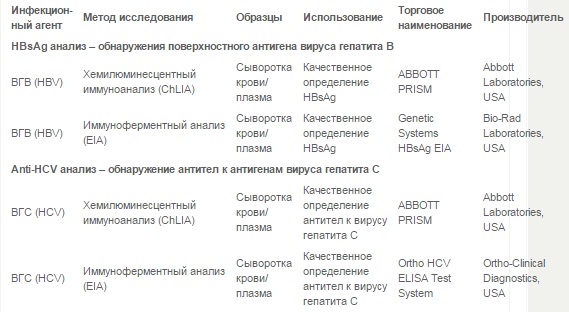

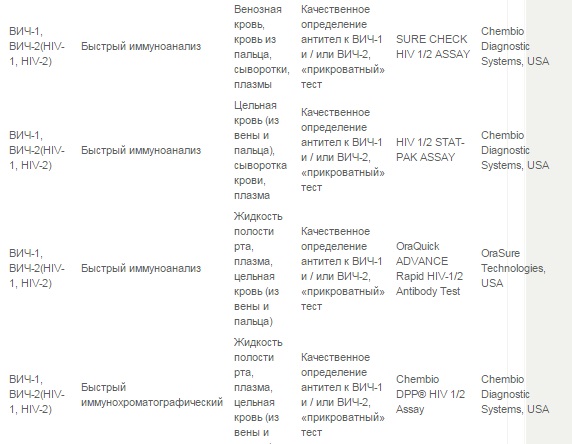
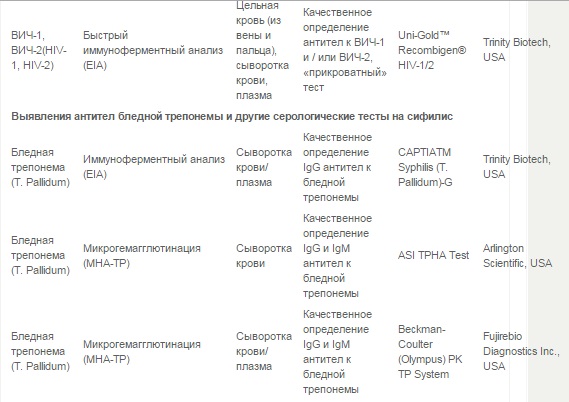
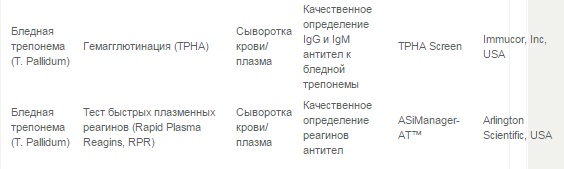
The only type of infectious disease testing that requires the use of ARCHITEKT analyzers is the Anti-HIV-1/2 and HIV-1 Antigen Combo analysis (simultaneous detection of HIV-1 antigen and antibodies to HIV types 1 and 2):
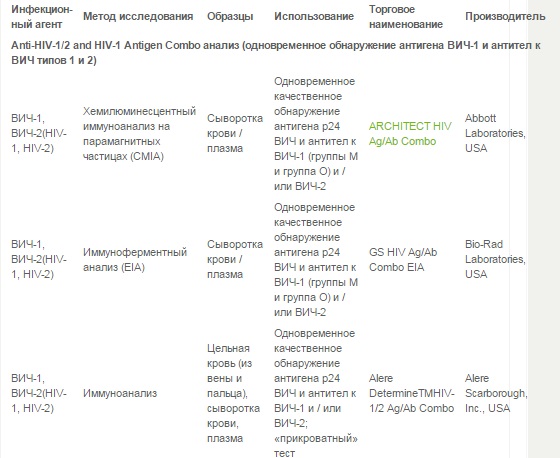
However, the safety and efficacy report for the ARCHITECT HIVAg/Ab Combo reagent (Abbott) prohibits the use of this test for screening donor blood or plasma:
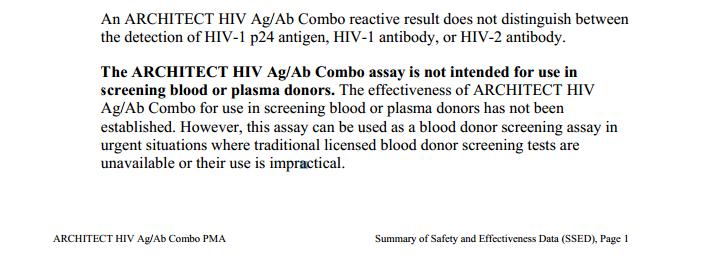
Thus, the most common methods of screening donor blood in the United States are: enzyme-linked immunosorbent assay (EIA), chemiluminescent immunoassay (ChLIA), and the widespread use of rapid immunoassay (rapid tests for "bedside" use).
It's worth noting that American blood centers commonly use equipment manufactured by Abbott Laboratories, USA. However, unlike Ukraine, American blood services use a completely different type of analyzer: instead of the "Ukrainian" ARCHITEKT analyzers, they use ABBOTT PRISM analyzers. This difference in the domestic and American approaches to using equipment from the same manufacturer stems from adherence to the basic principles of donor blood screening.
Basic principles of screening: ARCHITECT (Abbott) vs. PRISM (Abbott)
Since the target audience for screening is asymptomatic patients, screening is a widespread phenomenon. For example, the annual number of blood donations in Ukraine exceeds 740 units.
Such a large number of screening tests typically yields a relatively small number of detected cases of infection, so the issue of carefully justifying the financial costs of screening is paramount. The first principle is that screening should not be expensive or burdensome to resources, as its primary purpose is to determine the degree of risk of infection and establish the need for and justification of subsequent, more costly diagnostic testing.
Another key principle for screening tests, along with cost, is high test sensitivity. However, it's common for many positive results to be "false positives."
The adherence to these principles by American blood centers (incidentally, many conferences of the American Association of Blood Banks (AABB) are held under the unambiguous slogan "Balancing patient safety and cost-effectiveness"), and their complete non-compliance by the Ukrainian blood service – this explains the difference in the type of equipment used.
According to the manufacturer itself, Abbott Laboratories, USA:
ABBOTT PRISM is a specialized analyzer for blood transfusion centers, which offers a full menu of tests for blood screening: viral hepatitis - 4 markers (Anti-HBc, Anti-HCV, HBsAg, HBsAg Confirmatory), retroviruses - 2 markers (Anti-HIV-1/HIV-2, Anti-HTLV-I/HTLV-II) and 1 marker for Chagas disease.
ARCHITECT is a multifunctional immunological analyzer with a high performance and fast results processing, which allows for a wide range of studies - 65 different diagnostic markers: viral hepatitis (8 units), retroviruses (1 unit), metabolic markers (11 units), tumor markers (8 units), cardiac markers and markers of acute renal failure (6 units), reproductive function/endocrinology (11 units), drug monitoring (9 units), thyroid markers (9 units), drug monitoring (transplantation - 3 units) and protein markers.
It's clear that, given the same initial diagnostic method (for PRISM, a chemiluminescent immunoassay (ChLIA) and for ARCHITECT, a chemiluminescent paramagnetic immunoassay (CMIA)), the cost of conducting one screening test on a specialized donor analyzer (PRISM) and on a high-performance multifunctional analyzer (ARCHITECT) will differ significantly (the PRISM analyzer was used for comparison as a sample product from the same manufacturer – M.K.). In short, Americans know how to count money, and we don't.
For four years now, the Ukrainian Ministry of Health has continued to purchase expensive consumables for the diagnosis of four infection markers (hepatitis B and C, HIV 4/4, and Treponema pallidum) for this multifunctional 65-marker behemoth. (Note that the number of markers that ARCHITECT can analyze in the Ukrainian and Russian registration certificates exceeds the number of markers listed on the manufacturer's website—over 80 markers. For example, the manufacturer's official website contains no information about the ARCHITECT's ability to screen blood for Treponema pallidum (syphilis) markers, while in Ukraine these consumables are registered, curiously enough, as "Reagents for ARCHITECT and CELL-DYN Analyzers.")
But this is only one side of the coin – the financial one, which indicates the economic inefficiency of using ARCHITECT analyzers.
There's also a darker side to this moon—the safety and use of this product. A letter from the FDA to Abbott Laboratories (USA) regarding approval of reagents for the ARCHITECT analyzer (HIV 1/2 test system) will help shed some light on this issue. We provide excerpts from the letter below:
“…This test system is not intended for screening donated blood, plasma, or tissue… The sale and distribution of this device is restricted by a marketing authorization in accordance with 21 CFR 801.109… FDA has determined that these marketing authorizations are necessary to provide reasonable assurance of the safety and effectiveness of the device.”
This information is further confirmed on the official website of the manufacturer:
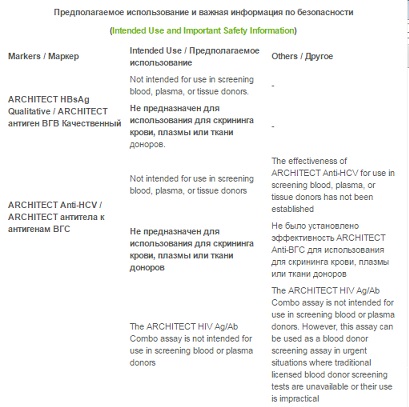
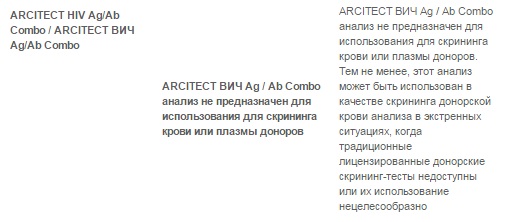
The overall shelf life of the test system components for the ARCHITECT platform is particularly alarming:
ARCITECT HIV ½ – reagents and controls (8 months), calibrators (6 months) when stored under storage conditions from +2 to +8 C;
ARCITECT VGV – reagents, controls and calibrators (8 months) subject to storage conditions from +2 to +8 C;
ARCITECT VGS – controls and calibrators (7 months), reagents (7 months) when stored under storage conditions from +2 to +8 C.
Given the specific supply chain requirements for imported products in Ukraine (1-3 months), consumers are limited to a period of only 3-5 months for using all test systems. How it is possible to meet the annual demand for blood screening tests for infections with consumables with a shelf life of 3-5 months is unclear.
Instead of conclusions
The Russian blood service uses ARCHITECT analyzers, which are not used by American blood centers (blood banks) due to cost and technical reasons. The US Food and Drug Administration (FDA), which oversees blood center operations and the safety of blood products in the US, has stated that ARCHITECT analyzers are not intended for screening donor blood, and a special regulation restricts the sale and distribution of this equipment.
Unlike in Ukraine, American blood service institutions use specialized transfusion platforms for blood screening, such as ABBOTT PRISM, which ensure the necessary quality of screening tests and low cost.
The Russian Ministry of Health chose a completely different development strategy – purchasing expensive, non-core equipment and equally expensive consumables. From 2011 to 2014, over 85% of the total funding for donor blood screening was siphoned off to purchase expensive tests for the ARCHITECT analyzer, which covered approximately 22% of the country's testing needs.
Just from the sale of ARCHITECT analyzers and consumables for them, Alexander Bogatyrev’s company, Biomedinvest LLC, managed to earn more than 115 million UAH.
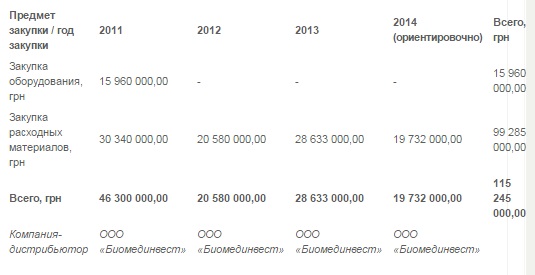
It is important to correctly assess not only the profitability indicators of this scheme, but also its hidden advantages and prospects.
By introducing expensive equipment into the blood service system, Alexander Bogatyrev has created a monopoly in the domestic healthcare sector (remember, the ARCHITECT analyzer is a closed-loop system, and it is impossible to use consumables from other manufacturers).
Secondly, its monopoly position allows Biomedinvest LLC to dictate its prices to the Ministry of Health, since it's impossible to compare the prices of consumables in the same way as, for example, ARV medications. The only possible approach is to compare the costs of different screening methods with comparable sensitivity and specificity for detecting infections.
Third, the risks associated with funding the purchase of consumables for the ARCHITECT analyzer are minimized. Targeted budget funding for the purchase of these tests depends on just two or three Ministry of Health officials (not numerous doctors or regional specialists), who are well versed in handling routine budget reports and documents.
Fourth, purchasing expensive tests not only allows for significant profits but also allows for even greater savings. Since the Ministry of Health's budget calculation methodology is extremely complex and specialized for Ministry of Finance staff, the idea of the dire state of the national blood service and the low level of supply needed for its normal functioning, which threatens catastrophe, is annually documented by "medical professionals." Naturally, no one points out that the Ministry of Health's entire budget "appetites" are calculated based on the full use of the most expensive screening method available—the ARCHITECT analyzers.
Fifth. The bulk purchase of expensive tests by the distributor, Biomedinvest LLC, entails substantial discounts from the manufacturer. On the one hand, the distributor perfectly fulfills its sales plan, while the parent company, in turn, gains a high market position and long-term guarantees of effective operations in Ukraine's healthcare sector. However, earnings, market profit figures, and discount amounts are impossible to track, yet it is precisely these discounts that create the corrupt component of this process.
The fact that this corruption scheme continues to operate successfully is confirmed by the following facts.
In 2014, the Ministry of Health again secretly divided budget funds for the provision of consumables for blood transfusion stations into two main categories: “consumables for ARCHITECT” and “everything else.”
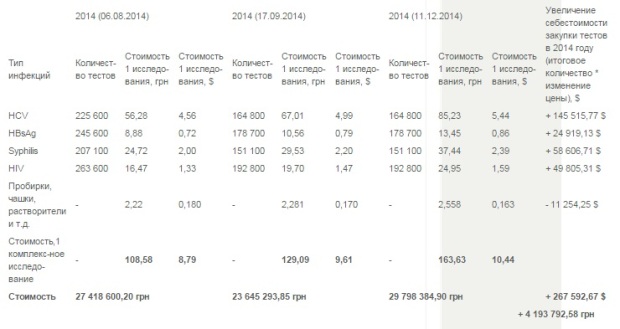
Prices for consumables for ARCHITECT analyzers skyrocketed in 2014. First, Biomedinvest LLC raised prices by 37,81% compared to 2013 and proposed that the Ministry of Health pay UAH 27,418,600.20 for consumables instead of the expected UAH 19,732,000—an increase of almost UAH 10 million.
The Ministry of Health has assessed Biomedinvest LLC's "new pricing policy" by reducing the procurement requirements by a third and reopening the bidding process, but at the prices proposed by Alexander Bogatyrev.
But at the new auction, Biomedinvest LLC raised its prices again, demanding an additional UAH 4,275 million (compared to its previous price of a month ago). Bogatyrev's company not only significantly exceeded its previous bids, but also exceeded the maximum recorded price for its products. The purchase was again unsuccessful. Do you think that's the end of the story? Not at all.
By the orders of the Ministry of Health of Ukraine dated 04.11.2014 No. 809 and 17.11.2014 No. 845, a new, higher price was registered for consumables for ARCHITECT analyzers (12665/2013, 13534/2014, 13783/2014), and Bogatyrev himself achieved that the Ministry of Health carried out a purchase “from a single participant”.
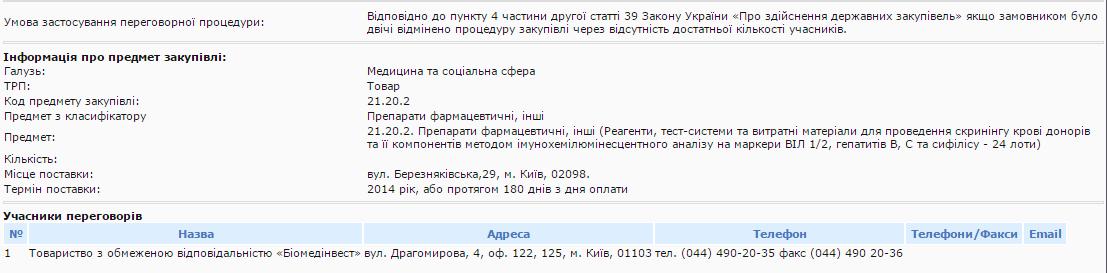
Meanwhile, Biomedinvest LLC's position has shifted slightly, claiming that the Ministry of Health should overpay not UAH 4,275 million, but a whopping UAH 10,066 million for their products. Please note that the quantitative procurement parameters for the "second auction" and the "negotiated procedure" (the third procurement procedure) have not changed. And now the Ministry of Health's leadership is reaping the fruits of its own efforts: where can they find an additional ten million in two weeks to please Mr. Bogatyrev, since at the beginning of 2014 they themselves had deliberately allocated a specific amount for the purchase of these products—namely, UAH 19,732,000.00? Finding the money isn't the biggest problem; the main question is: how can they "rewind" the documents and how can they pull this all off legally?
It would seem that, in a situation where the price of consumables for ARCHITECT analyzers increased by 207% in 2014 compared to 2013, the Ministry of Health needs to reconsider its approach to implementing the blood donation program, which flourished so rapidly under Bogatyreva.
But officials continued to purposefully assist Bogatyrev, not even to earn money, but to literally create money out of thin air. We've already pointed out that the true cost of consumables for ARCHITECT analyzers is a closely guarded secret (we're working on this). But it's worth noting that with each disclosure, Biomedinvest LLC raised the price of its products not only proportionally to the currency's value but also "step by step" increased the cost of the products in dollar terms. Ultimately, this allowed Biomedinvest's owner to earn an additional 4,193 million hryvnias out of thin air in a year, and through a negotiated process at that:
But that's just the small stuff. Medical Control has learned from reliable sources that this year's procurement of consumables for ARCHITECT will be UAH 29 million, not UAH 27 million. And in the Ministry of Health's 2015 budget proposal, the only program, along with immunoprophylaxis, for which funding was planned to be significantly increased is the development of blood donation. According to the draft budget documents, funding for blood donation in 2015 is to be increased by UAH 100 million compared to 2014, reaching UAH 160,915.3 million—an almost threefold increase. Note that not a single kopeck has been allocated for the treatment of AIDS, tuberculosis, oncology, oncohematology, diabetes, transplantation, or childhood orphan diseases. Everything goes to blood donation.
The news of apparent budgetary lobbying for increased funding for the blood donation program strangely coincided with the appearance of a letter from Biomedinvest LLC within the Ministry of Health regarding the possibility of installing ARCHITECT analyzers in four more regions of Ukraine, provided the Ministry of Health meets the following condition: providing them with the necessary reagents and consumables from the state budget. Reread the above discussion of the unlimited consumption volumes and the potential for "inflated" funding for these analyzers.
In fact, this situation is exceptional: only two of the Ministry of Health's 17 programs received funding increases this year. The reasons, it seems, are already clear to the reader.
And it becomes unclear: has Raisa Bogatyreva left the Ministry of Health?
Of course, having done her part for her son's "business," his mother quietly retired. But the other cogs in this scheme continue to milk the state. Alexander Bogatyrev's business hasn't disappeared, and his companies continue to thrive in the Ukrainian equipment and consumables market.
All those who pioneered the implementation of ARCHITECT analyzers, authorized the project, and actively promoted it have not only remained with the Ministry of Health, but have even been promoted. This includes Yevgeny Moroz, the current Deputy Minister and head of the Ministry of Health's Tender Committee, who has served as the Ministry's primary point person for blood donation issues throughout his career. His former subordinates, Viktor Yaroshevsky and Vitaly Demsky, are now the sole heads of the ministry's blood sector. They are responsible for all budget paperwork at the ministry level and overseeing the procurement process.
Specialist experts responsible for the rationale, scientific justification, and widespread promotion of this equipment also made a significant contribution. They were the ones who assessed the applicability of the diagnostic method, the performance parameters, and the appropriateness of using these analyzers within the realities of our blood service. We would like to especially highlight the specialists whose financial and career advancement is closely tied to the success of the companies in Alexander Bogatyrev's group (in some cases, to the success of Abbott): Vasyl Novak (former chief transfusion specialist), Victoria Yanovskaya (former chief laboratory diagnostics specialist), and Irina Andrianova (head of the HIV/AIDS reference laboratory at the Ukrainian AIDS Prevention and Control Center). It's clear that regional specialists (who use the ARCHITECT analyzer) also receive a small piece of the pie for their silence and signature.
The people mentioned above conceived this scheme, legalized it, implemented it, are implementing it today, and hope to continue to do so. But so far, none of them are rushing to consider responsibility. And they should be.
Perhaps the Ministry of Health itself doesn't yet know what to do with this whole "Architekt" story. It's clear that, first of all, it's not worth pursuing this scheme, expanding the equipment inventory, or pumping money into spending specifically on "Architekt" analyzers.
Read our next articles to find out what you can do next and how to prevent similar situations from occurring in the future.
Subscribe to our channels on Telegram, Facebook , Twitter , VK - Only new faces from the SKLEP section!