
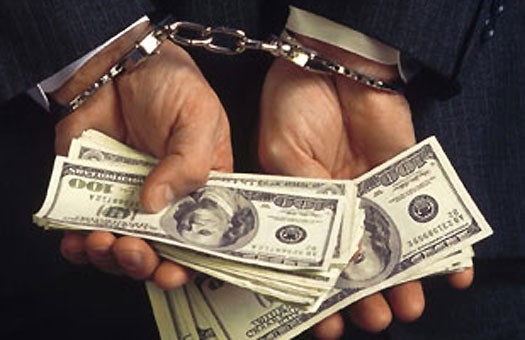
 Former Chairman of the Brovary District Administration Nikolai Didenko, who was accused of extorting $42 million, has secured a review of his case.
As reported in the Unified Register of Court Decisions, Didenko yesterday requested the court to remand the case for further investigation. He is requesting the identification of the special equipment used to record the bribe and to determine whether the audio and video recordings could have been falsified. The former official is also interested in how the banknotes proving his guilt were stored during this time: they contain fingerprints and the inscription "khabar" (illegible to the naked eye). It is likely that if it is established that the banknotes were improperly stored, it will be possible to substantiate their substitution during the investigation. This would remove the evidence for the bribery charges.
For six years now, the Brovary district has held the dubious distinction of being the country's largest bribe-maker: local officials extorted and received the largest bribe in Ukrainian history. This title was "awarded" by former Interior Minister Yuriy Lutsenko. At least, Ukrainian security forces have yet to record any larger "gifts."
This story began in the summer of 2008. The financial crisis was already sweeping across the world, with several major banks collapsing. However, Ukraine seemed oblivious to the situation and continued to experience a credit and mortgage boom. Banks issued large loans, and businessmen bought up land with lavish expenditures. Among them was Syrian entrepreneur Alhaj Yahia Akhmat. In mid-2008, he decided to invest a large sum in the construction of a cottage community near Kyiv.
His search for land for an investment project led him to the Brovarsky District. The brokers assisting the Syrian suggested the client consider land within the Pogrebsky Village Council of the Brovarsky District as a development site.
The favorable location was offset by its legal status. The 36-hectare plot of land he sought belonged to several residents of the village of Pogreby, and development on it required agreements with each of the owners. This didn't suit the foreigner. Akhmat wanted the land to be state-owned and allocated by the authorities to his trusted associates, who would later become co-founders of the development company he founded.
The intermediary accommodated the client's wishes. To this end, he persuaded the landowners to relinquish their land (for an appropriate fee) to the state. All that remained was to formalize this transfer and subsequently secure local government approval for the allocation of the land to the desired individuals. The Syrian assured the intermediary that he would cover all associated costs.
True, he had no idea of the scale of such expenses. Here's what became known from the criminal case materials reviewed by Ridna Brovarshchyna.
To implement the project, the Syrian's representative contacted the then head of the Brovarsky District Land Resources Department. The official saw no problem with allocating land according to the proposed plan, with one caveat: a large fee would be required for the approvals, which would be signed by the Brovarsky District administration.
As will later be stated in the criminal case materials, officials initially demanded $38 million from the Syrian businessman for the allocation of 36 hectares of land in Pogreby.
The official requested this money for himself and another signatory of the permit papers—the head of the Brovary District Administration—as well as for local residents who would give up their plots to the Syrian.
The intermediary conveyed the local officials' wishes to the foreigner and convinced him that, without a bribe, a cottage community was only possible in the businessman's imagination. He was forced to accept Ukrainian reality, but on his own terms: he would only repay the money once the land was transferred to his people.
Domestic officials don't operate under this scheme—as usual, money comes before money—and there was a hitch. Furthermore, part of the bribe was intended to reward landowners for giving up their plots. Brovary's leadership clearly had no intention of taking the money out of their own pockets.
But the large sum forced local authorities to zealously seek a compromise, which yielded results: cadastral maps revealed a small amount of state-owned land adjacent to the agreed-upon plot. It didn't require purchasing it from local residents; it was enough to use their official position to allocate it to the right people.
The six-hectare plot found was clearly too small for a cottage community, but it allowed for progress to be made and the gradual allocation of land to the Syrian businessman to begin.
During negotiations, the foreign entrepreneur was offered another site nearby – 40 hectares on the territory of the Semipolkovsky village council in the Brovarsky district.
As would later be stated in the criminal case materials, the Syrian was asked for an additional $4 million for the land in Semipolki (less prestigious than Pogreby). Only later, when negotiations became more substantive, did the parties agree to reduce the bribe to $7,2 million for the land in Pogreby (at $2,000 per 100 square meters). The amount for the plots in Semipolki—$4 million (at $1,000 per 100 square meters)—remained unchanged.
Thus, the total amount of the bribe for the provision of 76 hectares of land near Kyiv was reduced from $42 million to $11,2 million. This is the amount mentioned in the prosecutor's indictment.
It's worth noting that the suitcases subsequently seized by investigators at the time of the bribe-giving and arrest contained only 11 million hryvnias. As Interior Minister Yuriy Lutsenko later explained, this sum was the "first tranche" for the paperwork required to allocate 76 hectares of land for the construction of a cottage community.
The Boryspil City and District Court began hearing the case against Brovary officials in mid-July 2010. The defendants, suspected of extortion, included the former head of the Brovary District Administration, Mykola Didenko; the former head of the district land resources department, Mykhailo Kolodiy; his deputy, Oleksandr Stetsyuk; and two other intermediaries in organizing the crime—a total of five people.
Law enforcement and judicial authorities deliberately did not entrust the fate of the accused to the Brovary Court in order to avoid influencing the judges.
They have not yet been sentenced. The prosecutor's case in court is somewhat weakened by the fact that the bribe was never delivered to the final recipient. During the operation to arrest the criminals, police seized two suitcases containing the money from an intermediary—a "liaison" between the recipient and the owner of the large sum. This person was delivering the "first tranche" to local government officials. Therefore, the main defendants—the former head of the Brovary District Administration, the former head of the Land Resources Department, and his deputy—are charged not with bribery, but with attempted bribery, a lesser offense.
The defendants did not admit their guilt and refused to testify in court.
All of them are in Ukraine. After lengthy detention, Mykola Didenko and Mykhailo Kolodiy were released on March 31, 2010. Oleksandr Stetsyuk was released back in October 2009. Currently, all of them are under travel restrictions. This hasn't even met with approval from the authorities. When Mykola Didenko, former head of the Brovary District State Administration in the Kyiv Oblast, was released, then-Deputy Prime Minister Volodymyr Sivkovych called it "negligence or a crime."
If the court finds the defendants guilty, the most severe punishment will be meted out to former head of the Brovarsky district administration Mykola Didenko, who faces up to 12 years in prison, and former head of the district land resources department Mykhailo Kolodiy, who faces eight years in prison.
The Kyiv Regional Prosecutor's Office, representing the prosecution, considers their guilt proven, the agency's press service previously reported.
But in November 2014, former head of the Brovary District Administration, Mykola Didenko, secured a review of his case. The Boryspil Interdistrict Court of Kyiv Oblast ruled that the prosecutor's office had failed to adequately substantiate its charges. The case of the "largest bribe-takers" was sent to Prosecutor General Vitaliy Yarema for further investigation.
Subscribe to our channels on Telegram, Facebook , Twitter , VK - Only new faces from the SKLEP section!