
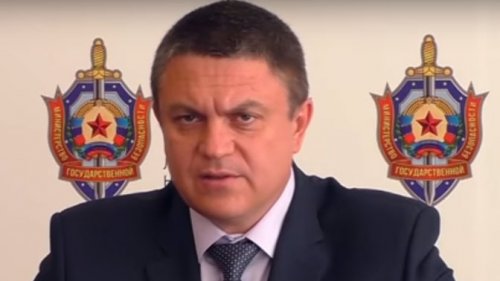
Leonid Pasechnik. The new head of the LPR. Strokes to the portrait.
LEONID PASECHNIK. FROM THE ARCHIVE:
Leonid Ivanovich Pasechnik (March 15, 1970) was born into a family of police officers. His father, Ivan Sergeyevich, worked for the USSR Department for Combating the Embezzlement of Socialist Property (OBKhSS) for 26 years. In 1975, the family moved to Magadan, where he worked in the gold mines. Leonid Ivanovich graduated from the Donetsk Higher Military-Political School. He worked in the SBU: head of the anti-smuggling unit of the main department "K" of the SBU Directorate in the Luhansk region, head of the Stakhanov inter-district department. He became famous for the arrest of a large shipment of contraband at the Izvarino checkpoint on August 15, 2006 (US$1,940,000 and Russian rubles), where he refused a bribe as a matter of principle. In March 2007, the SBU lieutenant colonel received the medal "For Military Service in Ukraine" from the President of Ukraine for his integrity and professionalism during the operation. According to colonelcassad , on October 9, 2014, he was appointed Minister of State Security of the LPR.
NB! The funniest thing is that the SBU website still has an article praising the LPR MGB Minister and claiming that even before the war, he made a point of not taking bribes.
At the celebrations marking the 15th anniversary of the Security Service of Ukraine, which took place on the eve of the event at the National Opera of Ukraine, the President presented state awards to the best officers of the Ukrainian special service. Among them was our fellow countryman, Lieutenant Colonel Leonid Pasechnik, head of the anti-smuggling unit of the Main Department "K" of the SBU Directorate in Luhansk Oblast. Leonid was awarded the Medal "For Military Service of Ukraine" for successfully conducting a special operation to intercept a large shipment of contraband currency at the Izvarino customs post. However, not only for this...
Seat with a secret
Intelligence that residents of the Luhansk region were smuggling cargo across the state border from Ukraine to Russia was accumulated by investigators in stages. Initially, the precise nature of the shipment was unknown. But the level of secrecy with which the perpetrators operated confirmed that the cargo was serious and was being transported in secret locations. The black SUBARU Legacy used by the smugglers was loaded and fueled to the brim in Luhansk, then driven hundreds of kilometers non-stop along the highway to their destination in Russia. The only stop the car made was at a customs post, and although nothing suspicious was ever found there, certain details led Leonid Pasechnik, who was in charge of the smuggling operation, to suspect that the perpetrators were smuggling cash across the border.
"It was August 15, 2006," says Leonid Pasechnik. "We had information that the smugglers were preparing another 'trip.' We knew the car would be heading to the Rostov Region either through the Izvarino customs post in the Krasnodon district or through the Dolzhansky post in the Sverdlovsk district. So I took steps to block both routes: a group of our officers, posing as customs officers, went to the Izvarino post, while I 'drove' the car from Luhansk. The plan was that if the car went through the Sverdlovsk district, I would overtake it and wait at the Dolzhansky post. But upon reaching Krasnodon, the Subaru driver turned toward Sverdlovsk. I called the guys at the post and told them to wait, he'd be there soon. I stopped not far from the post." At 1:40 p.m., the car pulled into the post. The driver was asked to fill out a customs declaration. Which he did, indicating that he was carrying approximately 14,000 Russian rubles, and nothing more. When the Subaru owner signed the declaration, he was asked to proceed to the hangar for a thorough inspection of the vehicle.
"It was clear the contraband was in a hiding place," Leonid Pasechnik continues, "but it still had to be found. I was really worried about having to remove the door trim—the car was only two months old, and it was quite expensive. Then these guys called: 'We've checked the entire trunk—there's nothing. Empty!' I said to them: 'Guys, what are you doing?! Look! The trunk, the back seat!'"
The car ran on gas. There was a gas cylinder system in the trunk, positioned in such a way that it was completely impossible to reach the back of the trunk. It seemed like the cylinder took up all the space. Something told me the hiding place was between the back seat and the trunk. When the guys got to the back seat, they found it wobbly—unscrewed. They pulled it out. They reached behind the seat, and wads of cash—dollars and rubles—tumbled out. Alexander, my subordinate, called me: "That's it, Leonid Ivanovich. We found it!" "Thank God," he said, and drove off to the post. To be honest, in my joy, I even forgot to ask how much money was there. I called Sasha back: "Ask the carrier how much it is?" I heard Alexander ask him a question, then said: "It's a ton of money! 2 million dollars!" A couple of minutes later, Sasha called again. It turns out the smuggler offered to part ways "amicably," saying, "guys, I'll offer you half of this amount—a million bucks—and—you didn't see me, I didn't see you... Ah, so the stakes are high! Sasha alerted the border guards and customs officers to the fact that the culprit had offered a bribe to the SBU officers, and subsequently reported this to his superiors. The stash contained $1,940,000 and 7,243,000 Russian rubles (which at the time was equivalent to UAH 11,160,132.6 at the NBU exchange rate). A squad from the Alpha special forces unit, an investigative team from the SBU Directorate, arrived at the customs post. There were a lot of people at the post, and everyone, naturally, was curious to see what this astronomical, by our (and not only our) standards, sum of dollar cash looked like in person. But I had no right to allow outsiders access to the money. I stationed Alpha officers around the vehicle and wouldn't let anyone near it except the investigator and the witnesses until the money had been counted and the necessary paperwork completed. The currency was placed in sacks. It turned out to be two large sacks—the kind you'd find for sugar at the market. And they drove to Luhansk. Two Alpha officers rode in the car with the money, followed by an escort vehicle.
Big, dirty money...
The criminal investigation into the currency smuggling case has been completed, and the materials have been submitted to court. However, Leonid Pasechnik declined to comment on the origin of the smuggled currency: "It's premature to discuss this. This is precisely the direction we're currently working on. The only thing we can say with certainty is that the money was obtained illegally."
Serious smuggling always involves big money. And it's no secret that to avoid legal trouble, smugglers are willing to bribe law enforcement and compromise anyone who shows weakness. Therefore, operatives working on the anti-smuggling front must, without exaggeration, have ironclad principles. But even that isn't enough—a special kind of courage is required. To transport large consignments of goods, smugglers use heavy-duty trucks like KRAZ, Ural, and MAZ, which often not only ignore operatives' orders to stop, but also deliberately create dangerous situations, simply by rushing straight at people standing in their way. To stop a speeding vehicle, it's sometimes necessary to jump on the running board or chase the all-terrain vehicle in a car over rough terrain. Leonid Pasechnik has seen many such cases during his years of service in the anti-smuggling unit.
Leonid Pasechnik. I have the honor!
Leonid's first lessons in integrity and officer's honor were taught by his father, Ivan Sergeevich, who worked in the police for 26 years – in the OBKhSS.
"When I was a boy, our family lived in the north, in Magadan, where my father worked in gold mines," Leonid recounts. "My father had to solve numerous gold thefts. He apprehended 20, 25, and even 30 kilograms of stolen precious metal. Once, in the early 80s, he apprehended criminals who had stolen 60 kilograms of gold and were preparing to smuggle it to the mainland. They offered him a bribe—200 Soviet rubles. My father refused. I'm sure he never even considered taking the money. He often repeated to me, 'Live honestly, according to the rules—you will earn honor and glory.' That's how he lived himself. He received many awards, not only from his department but also from the state."
The Medal "For Military Service of Ukraine" is Leonid Pasechnik's first state award. But 37 is no age for a lieutenant colonel. He has stars, awards, and a lot of work ahead of him. And he has no shortage of optimism and like-minded friends.
Yulia Eremenko, head of the press service of the SBU Directorate in the Luhansk region
Skelet.Org
1 comment for “Leonid Pasechnik. The new head of the LPR. Strokes to the portrait."
Add a comment
You must be logged in to post a comment.
Subscribe to our channels on Telegram, Facebook , Twitter , VK - Only new faces from the SKLEP section!
SKELET-info usually unearths dirt and skeletons in the closets of those in power. In Pasechnik's case, one can only envy Luhansk. God willing, instead of the current bastards in power, people like Pasechnik will emerge throughout Ukraine...