
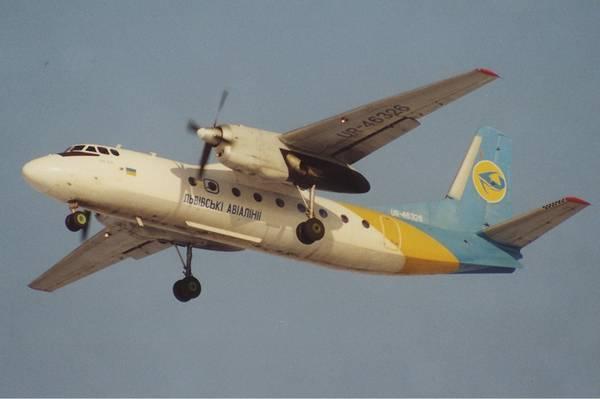
A successful and thriving state-owned enterprise was plundered in just a year. A corpse is to blame.
Back in 2005, the state-owned airline Lviv Airlines was successful and thriving. The company had two dozen aircraft carrying passengers and cargo, and employed 150 professional pilots and over a hundred maintenance personnel. It also had warehouses stocked with all the necessary equipment.
That same year, it was recognized as Ukraine's best enterprise based on the following criteria: profit, time utilization, and labor productivity. A year later, the company had incurred losses of thirty million rubles; five years later, the losses had reached fifty million; eight years later, not a single aircraft remained, and the enterprise itself is now in liquidation.
Beginning of the End
Since declaring independence, the airline has acquired several "military" aircraft. In 1995, Lviv Airlines received three Il-76 and two An-12 aircraft. They were transferred to the company from the Armed Forces in exchange for housing for the military. It was at that time that the airline was allocated nearly 200 apartments for employees in a new building near the airport. In fact, these apartments were exchanged for the aircraft. In total, the company's hangar contained seven Yak-42s, six An-24s, two An-12s, and three Il-76s. The latter are still considered the most cost-effective cargo aircraft in the world.
"The planes were in the air for eight hours every day," says Serhiy Smishchuk, a member of the Lviv Airlines Free Trade Union, who has worked at the company since 1994. "As recently as 2006, our planes were still flying to Africa, transporting cargo. Passenger planes were flying just as efficiently. Where all that money went—we still can't find out."
The union began looking for clues in 2005, immediately after employees were informed that the company was becoming unprofitable. Since the airline is state-owned, workers repeatedly demanded that the government, represented by the Ministry of Transport and Communications (now the Ministry of Infrastructure), provide a financial and economic justification for the decision that Lviv Airlines was unprofitable.
But the company's trade union appeal was ignored. And in response to one of the Free Trade Union's inquiries in 2011, the Ministry of Infrastructure wrote: "Since the establishment of the Lviv Airlines State Enterprise (2004), the company's operations have not been profitable." And then, for some reason, they only calculated losses for the last three years, meaning only since 2008.
How a successful Ukrainian company could transform into a massive debtor in just one year remains a closely guarded mystery. "As we learned, in 2005-2006, a scheme was in place: they would negotiate with a travel company, bring people to the plane, pay for the flight, and then fly them to Italy," Mr. Smishchuk explains of one of the many shady schemes. "The prosecutor's office even opened a criminal case, but later quietly closed it."
Incidentally, from 2006 to 2011, the Free Trade Union filed twenty (!) criminal complaints with the prosecutor's office. Based on these complaints, legal proceedings continue to this day. According to union representatives, the prosecutor's office has repeatedly inquired about Lviv Airlines' operations, but the cases have never reached court.
The prosecutor's office tried
However, in response to our newspaper's information request, the Lviv Regional Prosecutor's Office counted six criminal cases opened during the company's operations between 2005 and 2014. Most of them relate to non-payment of wages to employees and date back to last year. The prosecutor's office estimated that the company owed its workers nearly three and a half million hryvnias as of July 2013.
"The union defends our workers' interests in unpaid wages, and we've won dozens of cases," continues union member Smishchuk. "We pursue and win virtually all cases in the European Court of Human Rights, and we've already filed five applications to the same European Court, since even their decisions aren't enforced in Ukraine."
The other two criminal cases that resulted in written reports to the prosecutor's office involved the sale of an An-12, the leasing of aircraft to private entities, and the transfer of a Yak-42 aircraft. In the first case, the criminal proceedings concerned the sale of an An-12 at a reduced price and the leasing of the aircraft to Vega LLC and Sirius LLC. The criminal case was opened in 2008 under several articles: "misappropriation or abuse of property through abuse of official position," "bringing to bankruptcy," "abuse of official position," "abuse of official authority resulting in grave consequences," and "official negligence resulting in grave consequences."
"During the investigation of this criminal case, it was established that the persistent insolvency of Lviv Airlines, the existence of significant accounts receivable and payable, and the illegal sale of the An-12BK aircraft were the actions of the airline's former CEO, O.P. Kovalchuk," the Lviv Regional Prosecutor's Office told UM in response to the newspaper's information request. However, the criminal case was closed due to the death of the accused.
We flew there...
Serhiy Smishchuk of the Free Trade Union reports that one of the An-12s was sold at a reduced price. "We found some obscure exchange where the plane was sold for two million hryvnias," Smishchuk says. "Even though the real market value of such an aircraft is between three and five million dollars. And the Il-18 was sold for a million hryvnias, the same price as a Mercedes."
But the most interesting part of this convoluted story is that the aforementioned Mr. Kovalchuk, who is accused of driving the company into permanent insolvency, resigned from his position back in 2006! This was before the sale of the aircraft and long before any agreements with private companies for aircraft leases were concluded. However, Mr. Kovalchuk did die in 2009, so he is unlikely to challenge the charges.
Is the flight normal?
De facto, after Oleg Kovalchuk and by 2010, Lviv Airlines State Enterprise was led by three more general directors. Some of them were acting directors, but all had to pass a competition and be appointed by the relevant ministry.
The editors have a copy of the order of the Ministry of Transport, signed by Iosif Vinsky, dated November 12, 2008, regarding the appointment of Dmytro Ivanovych Chervedyuk as acting general director of the State Aviation Enterprise Lviv Airlines: “Think about it, after 2006, all general directors were appointed to the position not at the State Aviation Enterprise Lviv Airlines, but at the State Aviation Enterprise Lviv Airlines,” explains Mr. Smishchuk.
And this seemingly minor difference in name—aircraft enterprise and aviation company—turned out to be quite important. "That is, de jure, managers were appointed to a non-existent enterprise," Smishchuk continues, "while in reality, the directors had full powers and rights. Even a judge at the Zheleznodorozhny District Court in Lviv filed a request with the Unified State Register asking, 'Can these legal entities be considered a single enterprise?' The court's response was a clear 'no.'"
It now becomes clear why the General Director of the State Aviation Enterprise, and not all subsequent managers of the State Aviation Enterprise, bears responsibility for the events of 2007-2009.
Another interesting observation that gives rise to thought: the criminal case regarding the signing of contracts with Vega LLC and Sirius LLC was opened in 2008. From the prosecutor's office's previous responses to the Free Trade Union, it can be concluded that the contract with Sirius Airlines LLC was signed in 2002. However, the aircraft and crew exchange agreement with Vega LLC was signed in November 2009. The agreement was signed by then-Deputy General Director Serhiy Podgorodetsky. However, the prosecutor's office found no criminal activity at the time, since, according to the terms of the agreement, Lviv Airlines operated flights for Vega LLC. Vega LLC owed the State Anti-Corruption Agency over one million hryvnias.
"When Evgeny Dykhne (acting CEO) and Sergey Podgorodetsky (first deputy) took over the airline's management in 2007, the company's losses were already estimated at a million per month!" Sergey Smishchuk continues. "Then Dmitry Cheverdyuk became acting CEO, and Podgorodetsky remained in his post as deputy to the new CEO."
Let me add an interesting fact: Sergei Podgorodetsky served 20 years in the army, was a railway station commandant, then deputy director of the Lviv Airlines state-owned enterprise, and is now a millionaire who owns a stake in the Ukrainian airline Atlasjet Ukraine, based in Lviv. Quite an impressive career, isn't it?
Incidentally, union members claim that in 2009, when the lease agreement with Vega LLC was signed, Dmitry Chervedyuk was the airline's CEO, and Alexander Chervedyuk was Vega's CEO. But no responsible authorities at the time saw any family ties or violations.
Kristina Inzhuvatova, published in the publication "Ukraina Moloda"
Translation: Argument
Subscribe to our channels on Telegram, Facebook , Twitter , VK - Only new faces from the SKLEP section!