

The League of Oligarchs Who Left Behind. Weekly Review: January 12-18
Last week, the Prosecutor General's Office of Ukraine recalled that it is expected to provide the results of its investigation into the crimes of former associates of ex-President Viktor Yanukovych. At a press conference on January 16, Vitaliy Yarema announced that former Minister of Ecology and Natural Resources Mykola Zlochevskyi has been placed on the wanted list, and $23 million in his UK accounts has been frozen.

Nikolay Zlochevsky
Zlochevsky's department was responsible for distributing permits for the extraction of minerals, particularly oil and gas from Ukrainian subsoil. However, the former minister didn't exactly discredit himself. His company, Burisma Holdings, is considered one of the largest private gas producers in Ukraine, and last year it actively worked to burnish its reputation both in Ukraine and abroad. Consider the appointment of US Vice President Joe Biden's son, Robert Hunter Biden, to Burisma's board of directors, along with former Polish President Aleksander Kwaśniewski. The next logical step for Ukrainian security officials, in theory, should be to strip Mykola Vladislavovich, known in certain circles by the nickname "Dr. Evil," of his main asset—hydrocarbon production licenses in Ukraine. And the prominent Western politicians on the company's board of directors will likely be of no help to the former minister.
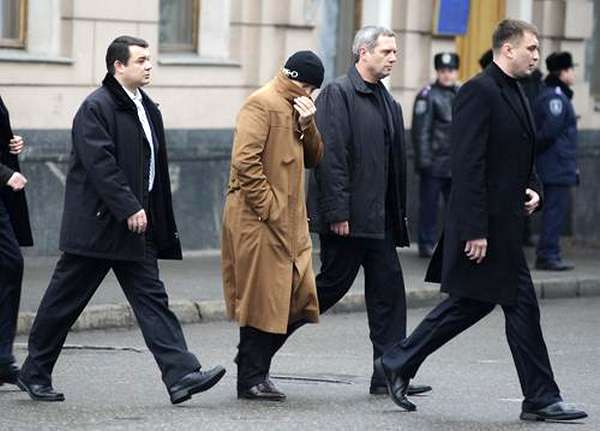
Yuri Ivanyushchenko (center)
In addition to Zlochevsky, the Prosecutor General's Office also targeted two other notorious figures from the "Rostov Lustrat" circle: former First Deputy Head of Yanukovych's Administration Andriy Portnov and fugitive "authority figure" Yuriy Ivanyushchenko, better known by the nickname "Yura Yenakievsky." According to Yarema, they were charged with crimes. That same day, Portnov's profile appeared on the website of the Ministry of Internal Affairs of Ukraine in the section "Persons Hiding from Authorities." The agency of interest (the Main Directorate for Combating Organized Crime of the Ministry of Internal Affairs) was also identified, as was the article of the Criminal Code he is charged with—Article 191, Part 3 ("Misappropriation, embezzlement, or taking possession of property through abuse of office, repeated or by prior conspiracy by a group of persons"), which carries a prison sentence of 3 to 8 years. Not the best news for the former official, who happily announced that he had received a one-year Schengen visa last November.

Portnov's "Schengen"
Now he'll have to hole up in Moscow, or at best, visit friendly countries like Zimbabwe or North Korea. "Yura Yenakievsky" isn't on the police's wanted list yet, but we can assume he will be soon. Another piece of bad news for the former top overseer of Ukraine's alcohol industry is the seizure of his funds in the European Union (approximately 72 million Swiss francs). For this, the aforementioned trio (Portnov, Ivanyushchenko, and Zlochevsky, or "PIZ" for short) collectively receives a well-deserved "-3" from us.
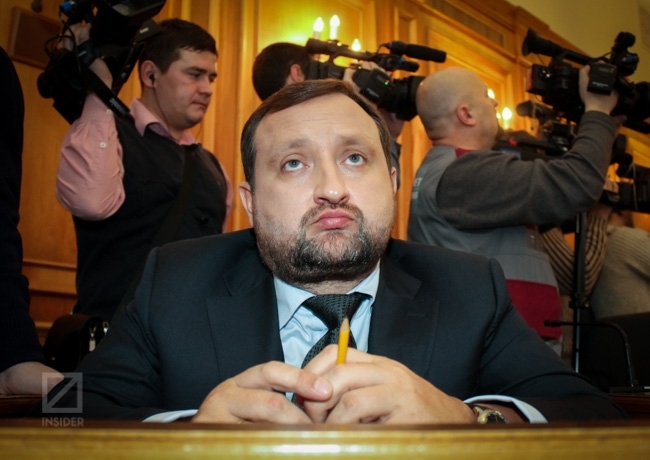
Sergey Arbuzov
Last week, two more "family" figures whom law enforcement has been searching for since last year—former First Deputy Prime Minister Serhiy Arbuzov and former head of the Ministry of Taxes and Revenue Oleksandr Klymenko—decided to make their presence known by lashing out at the current occupants of their offices, criticizing and offering advice. The former is accused of embezzlement and misappropriation of property through abuse of office on an especially large scale, which carries a prison sentence of seven to 12 years under the Criminal Code, and the latter of abuse of power or official position with grave consequences (five to eight years in prison in certain places). Arbuzov, for example, declared that "National Bank Governor Valeria Gontareva should give frank answers to all the uncomfortable questions during her report to the Rada," and expressed astonishment at what's happening with the exchange rate and foreign exchange reserves. "Over the past year, the National Bank's gold and foreign exchange reserves have fallen by 63%. As of today, they stand at approximately $7,5 billion, a record high for Ukraine in the last decade. Over the course of a month—from December 1, 2014, to January 1, 2015—Ukraine's international gold and foreign exchange reserves fell by 24%," Arbuzov stated, barely containing his "righteous anger."
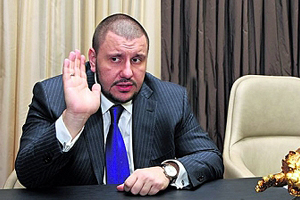
Alexander Klimenko
Meanwhile, his colleague Oleksandr Klymenko is haunted by the tax collection mechanism in Ukraine. Having grown a beard and posed for a photo with a wistful expression against the backdrop of a chessboard somewhere on Rublyovka, the former head of the Ministry of Social Development has likely cemented his position as a titan of thought. He began rattling off figures on his Facebook page about tax and customs collections, ending with addition lessons. "In total, the Tax and Customs Service fell short of UAH 15,9 billion + UAH 3,8 billion = UAH 20 billion. Do you think this money could have been used, for example, by the army? I won't even mention healthcare, education, and other 'insignificant' expenditure items in the current situation...," Klymenko writes. Who, however, for some reason, doesn't mention his armored meeting room, where VAT refund issues were discussed, or the cash-out facilities he oversaw under the previous government. Sergei Arbuzov, naturally, is also silent about his "achievements"—primarily, the fact that in less than two years of peace in Ukraine, while he was in charge of the National Bank, its gold and foreign exchange reserves shrank by more than $10 billion. Therefore, Arbuzov and Klymenko receive their hard-won "-2" points from us—for putting on a good front while playing a very bad game.

Co-owner of Mriya agricultural holding Nikolai Guta, put on the wanted list
Nikolai Guta, co-owner of the pre-bankrupt Mriya agricultural holding, also ended the week with a significant loss. Like Portnov, he was added to the list of individuals absconding from authorities. Furthermore, the Ministry of Internal Affairs claims to have court approval for Guta's arrest. He is suspected of committing a crime under Part 4 of Article 190 of the Criminal Code—"fraud committed on an especially large scale or by an organized group." For this offense, he faces a prison sentence of 5 to 12 years. It's doubtful that creditors of the ailing company, whose total debts exceed $1,2 billion, are involved in this case. And judging by the latest information, new management, unaffiliated with the Guta family, is expected to be appointed as early as the end of January.

Viktor Yanukovych and Dmitry Firtash
Dmytro Firtash, who, unlike the aforementioned individuals, has already been found but not yet placed in a state prison, had a more successful week. On January 14, at the general meeting of creditors of PJSC Sumykhimprom, a decision was approved to buy out the debts of secured creditors who refused to approve the rehabilitation plan for PJSC Sumykhimprom. That is, VAB Bank, Ukreximbank, and Raiffeisen Bank Aval, for a total of approximately UAH 340 million. According to our information, Firtash's companies, which had agreed to a similar deal the day before with Industrialbank, to which Sumykhimprom owed UAH 160 million, agreed to buy out the debts. This allows Firtash to gain unconditional control over the rehabilitation of the plant, which is of strategic importance to him, and is worthy of a +1 rating.

Oleg Lyashko
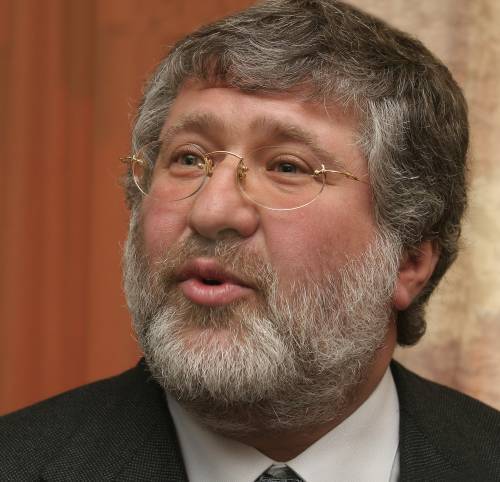
Igor Kolomoisky
Ihor Kolomoisky is the winner of the week. His rival Oleh Lyashko's much-hyped bill, aimed at allowing the state to seize control of Ukrnafta, has proven a dud. As a reminder, on January 13, the Verkhovna Rada voted to amend the Law of Ukraine "On Joint-Stock Companies," which lowered the quorum required to hold a general meeting of a joint-stock company from 60% to 50% plus one share. Kolomoisky's entities own 42% of Ukrnafta and have repeatedly blocked attempts by its main shareholder, Naftogaz of Ukraine (which owns 50% plus one share), to hold a shareholder meeting. As it turns out, the bill contains provisions that fail to address key issues with Ukrnafta.
According to MP Oleksandr Kirsh, it states that "the general meeting of a joint-stock company whose authorized capital includes the state's corporate rights and in which the state owns 50 percent or more of the company's common shares has a quorum when registering for participation shareholders who collectively own more than 50 percent of the voting shares," whereas the joint-stock company, not the state, owns 50 percent plus one share of Ukrnafta. An attempt to correct the error on January 16 by re-voting on the bill with a clarified wording failed, with both Kolomoisky's supporters from the People's Front and his "anti-Kolomoisky" supporters from the Petro Poroshenko Bloc failing to secure the necessary votes. So, it appears Igor Valerievich will retain his management at least until 2016. During that time, if he so chose, he could easily retain only a couple of chairs in its assets. For this, the “great schemer” gets his “+2” points, while his opponents, in his own words from a heated correspondence with Lyashko, “learn the ropes.”
Alexey KOZHEMYAKIN, SLED.net.ua
Subscribe to our channels on Telegram, Facebook , Twitter , VK - Only new faces from the SKLEP section!