
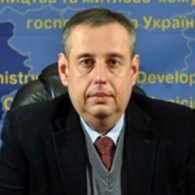
Dmitry Isaenko
Dmitry Valerievich Isaenko is a well-known figure in the construction industry. A former fitter from Balaklava, with virtually no higher education (he graduated from the Leningrad Military Construction School), he has successfully built a career in ministerial positions, regardless of the country's political upheavals. Consider this: Dmitry Isaenko is currently Deputy Minister of Regional Development and Construction under Vladimir Groysman. But before that, Isaenko outlived ministers V.G. Yatsuba, V.S. Kuibida, V.N. Tikhonov, A.M. Bliznyuk, and G.P. Temnik. In other words, ministers come and go, but Isaenko, the eminence grise, remains firmly in his seat. And it would be fine if this were only the case at the Ministry of Regional Development and Construction.
But even at his previous place of work – in the Central Specialized Construction Department of the Ministry of Defense – Dmitry Isaenko “outlasted” Shkidchenko, Marchuk, Kuzmuk and GritsenkoHis remarkable resilience and adaptability can be explained by only one thing: D. Isaenko is quite useful in his position. And how can he be useful to the powers that be? There's only one way: through corrupt schemes for laundering state funds.
It's noteworthy that the current Ministry of Defense is still reeling from the consequences of a construction scam that began more than eight years ago (involving apartments that were supposed to be built by Erker, a private enterprise, for military personnel). The scam was uncovered back in 2007, and Isaenko was dismissed from the Ministry of Defense in disgrace. However, Dmitry Valerievich himself immediately found a cushy position at the Ministry of Regional Development, Construction, and Housing, while the courts and the enforcement service are still unable to recover from Erker either the 8 million hryvnias in damages or even a portion of the apartments built for the military personnel. For those interested in learning more about the scam, we recommend searching for just one article: "Military Duty and Apartment Debts." In short, the former director of the Ministry of Defense's Construction Department, D.V. Isaenko, is the former director of the Ministry of Defense's Construction Department. On December 8, 14.12.2004, he signed a contract with the private company "Erker" to build two buildings in Bila Tserkva—one with 117 apartments, the other with 23 apartments. The total area is 7648 and 1441 square meters, respectively, for a total of just over 9 square meters.
In accordance with the requirements of Article 34 of the then-current Law "On the Procurement of Goods, Works, and Services Using Budgetary Funds," the terms of the contract must not differ from the terms of the winning bidder's tender offer and must not be amended after its signing. The contract price was UAH 17,725,000, with a fixed price of UAH 1950 per square meter of total housing area. The average cost of constructing one square meter of housing in the Kyiv region, as determined by the State Construction Committee of Ukraine, was UAH 1851 in December 2004 (when the contract was signed). In other words, the Ministry of Defense, as they say, treated its partner with compassion and understanding and, taking into account the potential risks associated with rising prices and inflation, set a price higher than the official average. The very next day after the contract was signed (December 15, 2004), the Ministry of Defense transferred UAH 14,468,000 to the Erker private enterprise account, and in June 2005, another UAH 2,370,000. Thus, 85% of the apartment cost was paid in advance a year before completion, and 95% of the apartment cost was paid six months before the agreed-upon deadline. However, when the deadline arrived, the management of the private enterprise demanded an increase in the per square meter rent in the 117-apartment building to UAH 2450. After some time, Erker private enterprise managed to defend its position through unlawful court decisions, in no small part thanks to the proactive efforts of Dmitry Isaenko, who agreed with all the arguments of the private developer. Moreover, D. Isaenko ordered apartments from the Erker private enterprise to be accepted at inflated prices per square meter, even before the court's decision came into force. As a result, a net profit of UAH 8 million ended up in the pockets of "the right people." To prevent any future problems, several apartments were gifted to prosecutors. And it should be noted that prosecutors are still actively working on their acquisitions. At least, all complaints from the Ministry of Defense remain unanswered. Furthermore, the Ministry of Defense is unable to even enforce the decision of the Kyiv Regional Commercial Court, issued in case No. 146/10-06/9/5 dated March 27, 2014, according to which the Erker private enterprise must transfer 1560 square meters of living space to the Ministry of Defense. The decision has long been in effect, but Isaenko, with the help of his "pet" prosecutors, is obstructing its enforcement (see documents).
Incidentally, even the government newspaper "Uriadovyi Kur'ier" suspected Mr. Isaenko of corrupt activities. The articles "What does the army need such a business" (December 8, 2005, No. 234) and "About the phenomenon of colonel's inertia" (May 11, 2006, No. 86) spoke of his "prosecutor's cover," which was allegedly paid for with apartments "presented" to two prosecutors from the Central Region Military Prosecutor's Office—V. Kozachuk and A. Demenko.
D. Isaenko is also known for other frauds within the Ministry of Defense system. Specifically, he lobbied for multiple Kyiv City Council decisions to allocate land for the military-industrial complex in Kyiv, followed by a lease agreement. The agreement was drawn up for 3-5 years (during construction), but then no one paid the rent. Sometimes the lease was set for 15-49 years (in cases where tenders for sale were necessary). Most often, corrupt judges, in concert with local and regional authorities and the prosecutor's office, decided to transfer defense land to construction companies. But in any case, no consideration was given to compensating the army. The public is aware of only one example of the transfer of military-related facilities and lands under this scheme, which took place in Kyiv's Pechersky district on the so-called Black Mountain, where a military unit with a total area of over 20 hectares had been located since 1958. Over time, the Ministry of Defense lands were converted into luxury residential development. The construction lasted ten years and enriched more than one generation of officials.
Today, as mentioned, Isaenko is Deputy Minister of Regional Development, Construction, and Housing and Utilities, as well as the Chairman of the Interdepartmental Commission for the Affordable Housing Program. In this position, during the Yanukovych era, he established himself as an indispensable "ministerial caretaker," responsible for the major renovations of the presidential residences in Foros and the Carpathians. He still holds this position today.
Here's what former Deputy Head of the Defense Ministry's Capital Construction Department, member of the Officers' Union, and retired Colonel Yevgeny Chernenko wrote in a letter to then-Prime Minister Azarov and Prosecutor General Pshonka: "The Affordable Housing program is an opportunity for thousands of former military personnel who dedicated their best years to serving the nation to obtain housing..."
I believe that a number of officials became millionaires by defrauding military personnel in need of housing. ... Dmitry Valerievich Isaenko had the active support of then-Minister of Defense A.S. Gritsenko and his Deputy Kredisov V.A., with whom he actively worked and through whom he implemented ideas for the alienation of funds and property of the Ministry of Defense…”
In his appeals to the prosecutor's office, Yevhen Chernenko recalls both the role of Anatoliy Gritsenko in this conflict and the director of the branch of the Ukroboronbud company (which was created under the direct supervision of Mr. Isaenko), Melnyk, who was convicted of illegal alienation and sale of the property of the Ministry of Defense.
This year, after the government's reshuffle, Colonel Chernenko wrote a statement regarding Mr. Isaenko's "services" to Prosecutor General O. I. Makhnitsky. He requested a legal assessment of his activities and a determination of the damage caused to the state and Ukraine's defense capability by organizations under his control.
However, the prosecutor's response was a banal brush-off about the lack of need for a prosecutorial response. This once again casts doubt on whether the purge of corrupt officials is truly an immutable principle of the new government, rather than a populist declaration. And whether this problem will be addressed immediately. It's perhaps worth adding that the response to retired Colonel Chernenko was personally signed by V. Kozachuk, who, according to the aforementioned article in the Government Courier, owes the resolution of the housing issue to D. Isayenko.
D. V. Isaenko's official powers still allow him, so to speak, to take into account the interests of the Erker company. A telling fact: at the request of Erker, the ministerial protocol of the interdepartmental commission for a residential complex in Vyshnevoye (on Mashinostroiteley Street) was amended in the column "proposed price per square meter": "the figure 6850 was replaced with the figure 7400." The protocol was signed on May 30, 2012. Since then, under the state program "Affordable Housing," Erker has been building housing at a price of 7400 UAH per square meter only in Vyshnevoye, and, for example, in the urban-type settlements of Volodarka and Bila Tserkva at 5000 and 6250 UAH per square meter, respectively. How can such an inflated price be explained? Could this not be the same scheme that was tested years earlier with the Ministry of Defense? What is this if not lobbying for the interests of the Erker private enterprise by the Ministry of Regional Development?
In 2012, the maximum cost of building a square meter of housing in the Kyiv region—6435 UAH—was set in an appendix to the main regulatory document of the state program "Affordable Housing." The full title of the document is "Procedure for the Use of Funds Allocated in the Budget for the Provision of State Support for the Construction (Acquisition) of Affordable Housing." It clearly states that the cost of one square meter of total area must not exceed the maximum cost specified in the appendix. However, an exception was made specifically for Erker Private Enterprise. The company received 965 UAH more per square meter than it was entitled to for construction. Do such decisions enhance the prestige of the state program and are aimed at improving housing affordability?
Next comes the urban development system. The corruption component here amounts to 300 million hryvnias per year. The regulators of this budget-spending system are urban development and architecture bodies—regional and capital departments, district and city administrations.
Upon appointment to the position, after consultation with Dmitry Isaenko, a representative of the Ministry of Regional Development, future architectural administrators swore allegiance to corrupt schemes that involve using the graphic portion of urban planning documentation (planning schemes, general plans, zoning plans, and detailed plans) to regulate urban development activities in the country.
It's also well known that to obtain a conclusion on land allocation for land use (according to land management projects) and "urban planning conditions" for land development, clients must contact the chief architects of districts, cities, and regions. Obtaining these conclusions and urban planning conditions requires graphic information—extracts from urban planning documentation. It is precisely this graphic service that underlies the financial activities and yet another corruption scheme of Dmytro Isaenko. The fact is that in Ukraine, urban planning and architecture authorities register, on average, 1000 applications for urban planning regulation services daily—in 25 regions, 490 districts, and 350 cities. The price of an extract from urban planning documentation (or bribes to avoid it) ranges from 500 to 3000 UAH per document. Therefore, an average of 1 million UAH is in circulation per day! Mr. Isaenko's personal percentage is unknown. But he's probably sharing with his "managers" again, otherwise it's simply hard to explain how such a "skilled" specialist has so far escaped the scythe of lustration...
The material has been added to the section Send SKELETa
SKELET-info
Subscribe to our channels on Telegram, Facebook , Twitter , VK - Only new faces from the SKLEP section!