
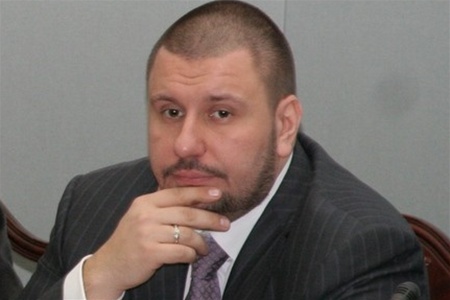
Alexander Klimenko
Take a closer look at the numerous photographs of Oleksandr Klymenko online and in the press. It's simply astonishing – his face seems to have stepped straight out of the illustrations in "The Criminal Man" by the renowned Italian anthropologist and psychiatrist Cesare Lombroso. I recall how in November 2011, when Yanukovych appointed a young man named Klymenko as head of the State Tax Administration, the entire country shuddered at the sight of that low forehead, close-set eyes, and massive jaw – all the hallmarks of a crook, according to Lombroso! And then came his next rise, even higher – to the head of the newly formed Ministry of Revenue and Duties… "He's a real thug – how could someone like him become a minister!" exclaimed even those who had never heard of the Italian professor's work. To understand how this man managed such a meteoric career, we need to unravel some of the mysteries of his biography.
Young Insides
Alexander Viktorovich Klimenko was born on November 16, 1980, in Makeyevka (Donetsk region). From 1997 to 2005, together with his older brother, Anton, he founded and managed a number of small commercial entities: East-Ukrainian Information and Production Systems LLC (wholesale trade), Skif Group Security Company LLC, and Donbass Development Group LLC (trade). However, the Klimenko brothers' main project was the Antalex Group of Companies, founded in Makeyevka in 2000 (with an annual turnover of UAH 30 million in the early 2010s). It was involved in the manufacture and sale of corrugated packaging, construction, real estate leasing and sales, securities trading, food products, and a number of other businesses.
In 2002, Oleksandr Klymenko graduated from the Donetsk State University of Management, and in 2010, from the Dnipropetrovsk regional branch of the National Academy of Public Administration under the President. In 2011, he received a PhD in economics (specializing in economics and national economic management). However, for some reason, the title of his dissertation is not listed in online dissertation catalogs.
Incidentally, while still a student, in 2000, Alexander Klimenko became editor-in-chief of the glossy magazine "Day and Night," controlled by Antalex. In his editorial columns, the future minister repeatedly shocked readers with all sorts of "pearls." For example: "Our magazine has changed its appearance and now appears before you with a respectable exterior and a youthful interior," or "...Of course, you can publish whatever you want, but if you want anyone to read this disgrace, you'll have to sweat it out trying to make the final product more palatable, more interesting, more useful," and so on.
While the younger brother was slacking off at university and trying his hand at journalism, the more intelligent (even seemingly) elder brother was taking his first steps into politics. And right away – in a variety of ways. For example, in 1998, Anton worked at the headquarters of Lazarenko's party, the All-Ukrainian Union "Hromada"; in 1999, on the eve of the presidential elections, he headed the Donetsk regional headquarters of the leader of the Socialist Party of Ukraine, Oleksandr Moroz; in the 2002 parliamentary elections, he was already campaigning for his fellow countrymen to vote for Brodsky's Yabloko party; and a month before the elections, he switched to the Our Ukraine bloc, becoming Viktor Yushchenko's trusted representative in Donetsk on the eve of the 2004 presidential elections. In 2005, after the merger of the "Zayushchenko" political forces into the People's Union "Our Ukraine" party, Anton Klymenko was appointed head of its regional organization. By the way, his patrons at that time were Roman Bessmertny and Petro Poroshenko.
Apparently with some help from his older brother (the family's "brains"), in 2005, Oleksandr Klimenko took the position of deputy head of the Specialized State Tax Inspectorate for Large Taxpayers in Donetsk. In this position, the younger Klimenko became renowned for his ability to extract taxes from entrepreneurs. But not from all of them—sparing, for example, his future allies in the Party of Regions.
Well, Klimenko Sr. played along with the Party of Regions during the local elections of 2006, as well as during the parliamentary elections of 2006 and 2007, “leaking” the elections to it.
The murky Donetsk-Kyiv transit
His brother, Alexander, became “related” to the Party of Regions, or rather, to the “family” of its leader, Viktor Yanukovych, long before he formally joined it in September 2013 (that is, when he was already holding the post of minister).
Around 2003, the Klymenko brothers met Serhiy Arbuzov, the head of the newly established UkrBusinessBank. This financial institution was involved in converting and laundering dirty money. The Klymenko brothers likely also cashed out their own money through UkrBusinessBank, and during one of these transactions, Arbuzov proposed that the brothers become part of a larger family money laundering operation.
In late 2004, when Viktor Yanukovych lost the presidential election and then the prime minister's seat, Serhiy Arbuzov, thanks to Anton Klymenko, quickly joined the ranks of the NU-NS. And Oleksandr reliably shielded the Yanukovych-Arbuzov business from scrutiny during the "orange regime."
Moreover, between 2006 and 2010, with the support of Alexander Klimenko, UkrBusinessBank became one of the largest centers of Donetsk conversion.
After Yanukovych won the 2010 presidential election, Arbuzov left for Kyiv, while Oleksandr Klymenko remained "at home and in charge" for a while. In early 2010, he was appointed first deputy, and then head of the regional tax office. In this position, he carried out a brilliant operation: with the help of Oleksandr Yanukovych, he transferred major taxpayers from the Luhansk region to the Donetsk tax office, leaving his neighbors with virtually no tax base!
Moreover, Alexander Klimenko implemented the "Site" scheme in Donetsk, developed by a "family" who had decided to centrally control all Ukrainian conversion centers from Kyiv.
After the successful completion of this scam, Klymenko Jr. was taken to the capital. In February 2011, he became Deputy Chairman of the State Tax Service of Ukraine. The "Ploshchadka" project was already fine-tuned and running like clockwork, "mastering" up to 60 billion hryvnias per year, according to the Security Service of Ukraine (SBU).
This "valuable asset" is then tasked with heading a very important "family" structure—the raiding sector—created on Oleksandr Yanukovych's personal orders. Oleksandr Klymenko personally oversaw the extortion of businesses from many major Ukrainian businessmen: Kosyuk, Tigipko's wife, Zhvania, Zhevago, and others.
He probably handled this task with flying colors, as in February of that year he was appointed Chairman of the State Tax Service.
Lover of all things crocodile
In December 2012, Viktor Yanukovych appointed Oleksandr Klymenko as head of the newly created Ministry of Revenue and Duties of Ukraine. Apparently convinced of absolute impunity, the minister became embroiled in one high-profile media scandal after another. For example, he shamelessly appeared in public wearing incredibly expensive watches: in November 2011, a rose gold Swiss watch from A. Lange & Sohne, which could be purchased in Ukraine for €12,4. In December 2012, he also wore an IWC Portuguese Vintage 1939, also from Switzerland, but more expensive, costing over $41,5 (with a platinum case, sapphire crystal, and crocodile leather strap). According to media reports, only 500 of these watches were ever produced.
Incidentally, as journalists have noted, Minister Klymenko has an unhealthy passion for anything made of crocodile skin. He even had a black briefcase made of this reptile's skin (worth at least tens of thousands of dollars), which he carried to work at the ministry. He also had a dark brown chair in his office—also made of crocodile skin. Experts estimate its value at over $70!
Furthermore, Alexander Klimenko ordered the construction of a small church with the obligatory gilded domes in the ministry's courtyard. Its construction costs are estimated at hundreds of thousands of dollars.
His subordinates were also surprised by the "iron room" built in the ministry building for confidential negotiations—a room lined with stainless steel polished to a mirror shine, with a heavy 30-centimeter-thick door and a wheeled handle, like the safe in the Uncle Scrooge cartoon. The floor and furniture were made of transparent plastic—apparently, the owner of the "armored room" was paranoid about bugs.
Also, by order of Klimenko, a gym with a real boxing ring and a salt sauna were equipped in the ministry building!
True, as the head of the department swore to journalists, all of this was built or purchased with his own money (although it’s hard to check now).
After Euromaidan, journalists were able to visit the Klymenko family's luxurious estate, located in the Beloozersky National Park near the Kaniv Reservoir. Cages containing rare animals were discovered there: Amur tigers (of which there are now fewer than a thousand left in the wild) and Carpathian brown bears.
Money was transported in trucks
Well, you could only enter the floor where Alexander Klimenko's office was located after a special device on the door checked your fingerprints against the list of those allowed into the classified room.
The owner of such luxurious office apartments certainly had something to hide. The "Ploshchadka" scheme, first developed in the Donetsk region and then implemented nationwide, operated on an even larger scale. Thanks to cashing encouraged from above, rivers of money flowed from all over Ukraine, collected at dozens of "certified sites," directly into Klymenko's office. So much cash flowed in that the minister even had to install a special banknote-wrapping machine in his office. Stacks of bills, stacked in large boxes, were then hauled out of the ministry by truckloads!
Where did this flow go? According to the Security Service of Ukraine (SBU), 8% of the turnover of such platforms went to the state budget (!), which, in essence, was an admission of the existence of state racketeering in the country! Another 2% was directed to a special fund (without specifying its purpose). Law enforcement officials also established that, as a result of the activities of such platforms, conversion fees increased from the usual 4-6% to 10-15% since 2010.
After taking office as minister, Oleksandr Klymenko's personal income immediately doubled: in 2011, he declared 699 thousand UAH, and in 2012, it was already 1,314 million UAH.
The Klymenko family business also grew rapidly. In addition to seizing lucrative business projects, enterprises, and companies the brothers had their eye on across Ukraine, they also created fictitious companies, pushing them to collaborate with large domestic businesses.
The fraudulent scheme worked like this: a real company pretended to purchase goods and services from a shell company run by the Klimenko brothers, but instead of completing the transaction, the phantom company secretly returned the money in cash, thereby reducing the company's tax liability in exchange for a portion of the proceeds.
In total, according to law enforcement estimates, Alexander Klimenko and his brother stole at least $11 billion from the state (through lost taxes and fees)!
In particular, the financial group under the brand name "Unison," founded by the Klimenko brothers back in 2011 (which included an insurance company, a bank, etc.), operated under this scheme, with clients simply lining up. Among these "slave" or "Donetsk" companies were some of the most renowned companies and enterprises, well-known in Ukraine and far beyond: Viktor Pinchuk's Interpipe, Alexander Feldman's AVEK concern, Kharkiv Thermal Power Plant-5, the state-owned NAK Nadra Ukrainy, Yuriy Ivanyushchenko's Mariupol Heavy Machinery Plant, Sergey Taruta's Dnipropetrovsk Pipe Plant, and Viktor Nusenkis's Yasinovsky Coke and Chemical Plant —to name a few. Many smaller enterprises, such as those in the agricultural sector such as Chumaki Private Enterprise and others, were also clients of Unison Group LLC. They insured their property, took out loans, and used other services.
Don't let this lead to a new Maidan!
On February 22, 2014, Oleksandr Klymenko fled to Russia. He tried to remain quiet there, waiting for his older brother, Anton, to use his old connections to negotiate with the new Ukrainian authorities for forgiveness for their "sins." Specifically, Anton Klymenko negotiated with Roman Bessmertny, who had once been his good friend. Although currently in the "political" shadows, Bessmertny still enjoys an influential status as a close associate of Poroshenko. Furthermore, the Klymenko brothers even began selling previously seized assets to Ukrainian companies, such as the aforementioned Chumaki private enterprise.
However, when Viktor and Alexander Yanukovych learned of this, Alexander Klimenko was immediately forced to begin financing separatists in eastern and southern Ukraine, and everything he had already managed to sell in Ukraine in 2014 was urgently returned by any means necessary to the ownership of the Yanukovych "family."
As everyone remembers, it ended tragically: on May 2, clashes between pro-Russian and pro-Ukrainian forces in Odesa left 46 people dead and nearly 200 injured. Hot on the heels of this, the SBU exposed a money-for-profit center that was used to fund the mass unrest in Odesa on that fateful day. Law enforcement officials claim that the funds in this bloody "envelope" were transferred from former First Deputy Prime Minister Serhiy Arbuzov and former Minister Oleksandr Klymenko.
And on September 24, 2014, the National Bank of Ukraine liquidated another "envelope"—Green Bank—linked to the Klymenko family. He was caught laundering approximately 20 billion hryvnias between 2013 and 2014.
True, Kyiv's notorious Shevchenkivskyi District Court in August ordered the Security Service of Ukraine (SBU) to retract its statement regarding Oleksandr Klymenko's involvement in the events in Odesa. However, the public doesn't particularly trust these servants of justice, appointed back under Yanukovych. Moreover, public outrage is brewing over reports that Oleksandr Klymenko is trying to beg for an "indulgence" from the current government.
And also considering that certain entities are already preparing a new, thriving Kyiv bank for Klymenko's return—Mykhailivsky Bank, which, during the turbulent year of 2014, somehow managed to quadruple its assets, bringing them to almost UAH 2 billion. By some strange coincidence, Mykhailivsky Bank's office is located in the same luxurious Kyiv building as Unison Group. Furthermore, Klymenko's company maintains deposits at Mykhailivsky Bank. Furthermore, there is some very unpleasant information that the newly formed bank is being advised by the investment company ICU, which until recently belonged to NBU Governor Valeria Gontareva!
Coupled with discontent over other “compromises” between the authorities and the separatists, a third Maidan could begin in Ukraine at any moment.
Subscribe to our channels on Telegram, Facebook , Twitter , VK - Only new faces from the SKLEP section!