
The Cabinet of Ministers is monopolizing the market. The losers are the chemical, metallurgical, and private mining companies. The winners are Naftogaz and Ihor Kolomoisky's companies.

Yatsenyuk
In the summer, industry began actively searching for alternative gas sources. The impetus came from the cessation of supplies by Russia's Gazprom in June, as well as the government's stance, which prioritized supplying households and district heating and power companies (DHPs).
Prime Minister Arseniy Yatsenyuk's statement at a government meeting on September 23 spurred diversification.
"Any Ukrainian or foreign company willing and able to purchase gas for its own needs, in accordance with the requirements of the Third Energy Package, will have access to Naftogaz's transit capacity," Yatsenyuk said at the time. "If you want to import gas for industry, we'll open the door for you."
But the doors did not remain open for long.
Restoration of monopoly
On November 7, the Cabinet of Ministers adopted Resolution No. 596. "To establish that from December 1, 2014, to February 28, 2015, industrial, energy, and heat-generating enterprises are required to purchase natural gas exclusively from the guaranteed supplier, NAK Naftogaz," the document states.
The decision is accompanied by a list of 90 enterprises obligated to purchase gas from the state monopoly.
Why did Yatsenyuk and Naftogaz CEO Andriy Kobolev ( read more about him in the article "Andriy Kobolev: An Inconspicuous "Veteran" of the Gas Pipeline ") cancel market liberalization three weeks after its introduction?
"The reason is simple: a lack of funds to pay for imported gas, both Russian and European," says energy expert Valentin Zemlyansky.
In this regard, NAK is trying to attract industrial consumers. Enterprises are reliable clients and often pay in full and on time.
Meanwhile, the budget is insufficient to cover the tariff gap. The hryvnia devaluation has created an additional burden. Even the current tariffs for industry no longer cover the cost of imported gas.
"Naftogaz has a budget deficit of approximately UAH 46 billion," says Serhiy Sapegin, director of the Psycheya Scientific and Technical Center. "The company's ability to support itself from the budget is minimal. Therefore, with this decision, the Cabinet of Ministers is attempting to shift its problems onto the shoulders of private gas producers."
The government has its own rationale for adopting a non-market solution. "Naftogaz cannot ensure payment for imported resources without counter-guarantees to purchase this gas on the domestic market at a price that covers its cost," the Ministry of Energy and Coal Industry stated in a statement.
In other words, to provide the country with a scarce resource, consumers are forced to buy it from a single supplier, who imports it anyway.
"NAK has been working toward this decision for a long time. First, a de facto ban on gas imports for everyone except Naftogaz until September 1, followed by the introduction of VAT," says Dmytro Marunich, co-chair of the Energy Strategies Foundation. "Then a proposal to pump 50% of private producers' gas into underground gas storage facilities, with the expectation that it would be delivered to them in January."
The beneficiaries are Naftogaz, Kolomoisky and Firtash
As a result, Naftogaz will only marginally improve its balance of payments. The monopolist can profit in two ways.
Firstly, due to the difference between the price of reverse gas ($350 per thousand cubic meters) and the estimated price ($385).
According to expert Marunich's calculations, if the volume of cutoff supplies is approximately 0,15 billion cubic meters per month, with a tariff difference of $35, then NAK's additional revenue will amount to $5,25 million per month. Importantly, this will be offset by devaluation in the coming months, unless tariffs for industry are increased.
Secondly, a 2% premium on the gas sales price to consumers. Marunich believes this could bring Naftogaz approximately UAH 30 million more per month.
Another revenue-generating option could be a voluntary/compulsory "offer" for private companies to sell gas to NAK at a price below UAH 5100 per thousand cubic meters. This would partially resolve the need to purchase foreign currency to pay for imported gas.
Consumers not included in the list approved by Resolution No. 596 also benefit. Access to cheaper raw materials will allow their production costs to be lower than those of their competitors. The list does not include major consumers such as Dniproazot, the Marganets and Ordzhonikidze Mining and Processing Plants, or the Kryvyi Rih Iron and Steel Works—enterprises commonly associated with Ihor Kolomoisky's Privat Group.

Igor Kolomoisky
Also not on the list are Dmitry Firtash’s chemical enterprises: Cherkassyazot and Rivneazot.
Privat is not on the list because its enterprises use Ukrainian-produced gas, purchasing it from the state-owned company Ukrnafta, which is controlled by Kolomoisky.
However, Kolomoisky's plants may be left without gas due to another document. Presidential Decree No. 876 of November 14 requires the use of domestically produced gas during the heating season only for household and housing and utilities needs.
Experts tend to attribute this selectivity to political motives. "Companies belonging to the Privat Group were excluded from the list because Kolomoisky, although an oligarch, is patriotic," Zemlyansky believes. "As for Firtash's chemicals, he owns the gas stored in the underground gas storage facility. If this regulation applies to his companies, it will amount to double discrimination: first, they were prohibited from extracting their own gas from the underground gas storage facility, and then they were required to purchase the same gas from NAK."
The ruling is largely neutral for Firtash's companies. On the one hand, he's not on the list, but on the other, he's already purchased alternative gas, but the government won't allow him to extract it from underground gas storage facilities.

Dmitry Firtash
However, a source at Firtash's Group DF, speaking on condition of anonymity, told INSIDER that the group's chemical plants are still extracting gas from underground gas storage facilities.
"The ban is unconstitutional. We've appealed it in court. And if we don't use our gas, the factories in Rivne and Cherkasy will shut down," the source said.
Perhaps Yatsenyuk hopes Firtash can do what the Cabinet of Ministers cannot: negotiate an acceptable gas price with Gazprom. "Chemists have already been banned by a separate decree from extracting gas from underground gas storage facilities. But they can buy and transport it," says Yuriy Korolchuk, an expert at the Institute for Energy Research. "They're leaving the window of supply from Russia open for Firtash."
Losers: chemists, metallurgists, and private miners
The Cabinet of Ministers' decision will primarily affect the state-owned Odessa Port Plant, metallurgical plants (Metinvest), Rinat Akhmetov's heat and power generating enterprises (DTEK), and the ArcelorMittal Kryvyi Rih metallurgical plant.
DTEK CEO Maxim Timchenko has already stated that he does not rule out filing a lawsuit regarding the legality of this decision.
The second category of victims are private production companies. Over the first nine months, they produced 2,2 billion cubic meters of gas, a 30% increase compared to the same period last year.
"This could lead to production shutdowns for some private producers," said Vadim Glamazdin, deputy general director of the Center for Energy Research. "It will be unprofitable for them to sell gas to NAK at the prices it will be buying."
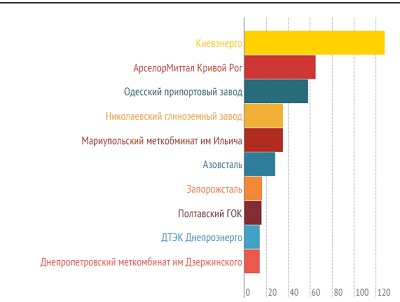
Largest gas consumers in October 2014
Now, private companies are faced with a stark choice. They can sell gas to Naftogaz at a discount, or they can independently seek buyers among small private consumers, public institutions, and housing and utilities companies, facing logistical challenges and non-payment.
At what price will Naftogaz buy fuel from private production companies?
"Representatives of the state-owned Ukrgazvydobuvannya cited a break-even point of 800-1000 UAH per thousand cubic meters. If this figure is at the same level as residential tariffs, the NAK will be able to produce a price mix of domestic and imported gas, achieving a cost price of around $230-250 per thousand cubic meters," says Zemlyansky.
Private producers have already begun fighting the Kobolev-Yatsenyuk scheme. "The resolution does not contribute to resolving the energy crisis and contradicts Ukraine's commitments to the EU regarding gas market liberalization," stated the Association of Gas Traders of Ukraine.
"The adoption of this resolution will lead to a significant reduction in investment in gas production and, accordingly, will entail a reduction in gas production by private companies," the press service of Naftogazdobycha, part of Akhmetov's DTEK, told INSIER.
A group of mining companies has appealed to President Petro Poroshenko to repeal the decree. They are asking the guarantor of the Constitution to suspend the decree and simultaneously appeal to the Constitutional Court to assess its compliance with the Basic Law.
"Independent gas producers will be forced to reconsider their investment projects," Sapegin asserts. "Considering that the return on investment is 3-5 years, we're already seeing the beginning of a decline in gas production, which will eventually become catastrophic."
The European Energy Community reacted extremely harshly to the Cabinet's decision. "Despite the temporary nature of the regulation, it sends a negative signal regarding market reforms," stated a letter from Janez Kopacz, head of the EEC Secretariat, to Prime Minister Yatsenyuk.
Everyone to court
In addition to its dubious economic consequences, the decree has an ambiguous legal basis.
"From a legal perspective, these measures are completely at odds with both antitrust legislation and a number of other fundamental legal acts," says Vitaly Radchenko, partner at CMS Cameron McKenna.
Antimonopoly legislation (Article 15 of the Law “On the Protection of Economic Competition”) establishes a direct prohibition on government bodies from restricting competition.
The Law "On the Fundamentals of the Functioning of the Natural Gas Market" provides for equal access for all entities to the gas transportation system and freedom to choose a supplier, and prohibits the state from interfering in the processes of distribution, transportation, storage, and consumption of natural gas.
In addition to the sectoral laws "On the Fundamentals of the Functioning of the Natural Gas Market" and "On Oil and Gas," the resolution violates Ukraine's obligations under the Treaty establishing the Energy Community and the Energy Charter.
"If the Cabinet of Ministers or the President don't repeal the decree soon, the private sector will react immediately, especially since there are ample legal grounds for appeal," Radchenko believes.
The adoption of the resolution may lead to foreign investors seeking protection of their rights through international investment arbitration against Ukraine.
Perhaps EU pressure and court decisions will be able to stop the return of the monopoly.
Subscribe to our channels on Telegram, Facebook , Twitter , VK - Only new faces from the SKLEP section!