
Nikolay Belov, General Director of the State Enterprise "V.A. Malyshev Plant"
It's no secret that every autumn, the domestic armored vehicle industry (and the national military-industrial complex as a whole) traditionally experiences a "heated atmosphere" surrounding the adoption of the next State Budget. Traditionally, in the section of this document entitled "Procurement and Modernization of Weapons and Military Equipment for the Armed Forces of Ukraine," the primary focus is on two Ukrainian "wonder weapons"—the T-84 "Oplot" main battle tank (MBT) and the An-70 military transport aircraft.
But we'll talk about the sad saga of the An-70 some other time, and for now let's take a closer look at the products developed by the Kharkiv Machine-Building Design Bureau (KhKBM) named after Alexander Alexandrovich Morozov (headed by Lieutenant General Mikhail Borisyuk, General Designer) and manufactured by the Kharkiv State Enterprise Vyacheslav Alexandrovich Malyshev Plant (General Director since August 2014 - Nikolai Belov; previously, the company was headed by Vadim Fedosov) - the T-84UM Oplot-M MBT and the deeply modernized T-64BM Bulat MBT.
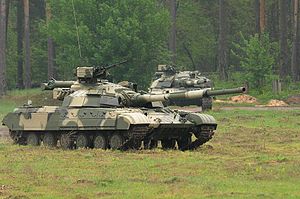
T-64BM "Bulat"
The last five years have been a mixed bag for the developer and manufacturer of the T-64 and T-84. On the one hand, in April 2009, state trials of the latest modification of the first of these vehicles, the Oplot-M, were completed, and on May 28, 2009, this tank was officially accepted into service. On the other hand, the most successful year for the "eighty-four" on the domestic market remains the rather distant year of 2001, when the Armed Forces of Ukraine acquired 10 T-84s (then not only without the "M" prefix, but also without the name "Oplot"), which even marched ceremoniously along Khreshchatyk Street during a parade celebrating the 10th anniversary of the country's independence.
True, that success was rather peculiar: having received only 20% of the UAH 78,8 million stipulated by the contract, the V.A. Malyshev Plant, in response to an offer to pay the remaining funds, received its tanks back. Four of them were subsequently (in 2003) sold to the United States (under the T-80UD brand, which in itself speaks to the T-84's genuine innovation) as part of an American program to purchase weapons from potential adversaries for evaluation.
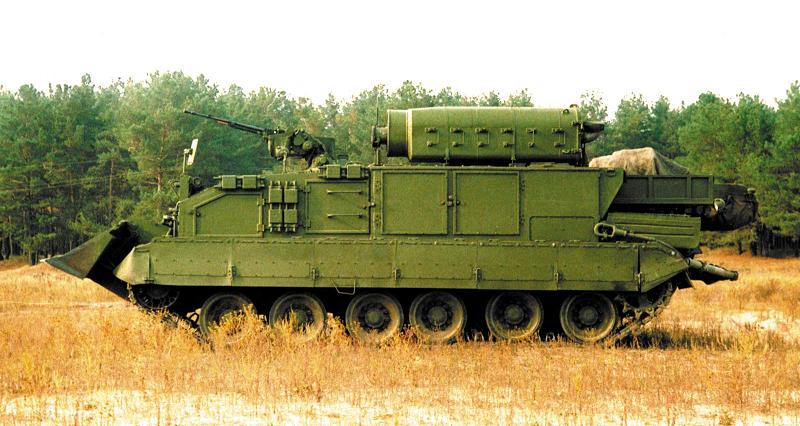
BREM-84
Be that as it may, the T-84 has still not been included in the Ukrainian Ministry of Defense's weapons procurement program, despite the Armed Forces' stated readiness back in 2008 to purchase 10 Oplot-M tanks, as well as three armored recovery vehicles (BREM) based on them (BREM-84 Atlet; it was accepted into service in November 2008) and a special order from the third president of Ukraine, Viktor Yushchenko, regarding this matter. However, the V.A. Malyshev Plant signed a series of contracts with the Ukrainian Ministry of Defense for the modernization of the T-64B and T-64BK main battle tanks (the latter being the command version of the vehicle) to the T-64BM Bulat standard. In total, the State Program for the Development of the Armed Forces of Ukraine for 2006-2011... In 2012-2015, it was planned (and – a rare case – completed) to modernize 147 T-64B and T-64BK tanks to the BM Bulat level, and plans for 2012-2015 include the modernization of another 223 vehicles.
As for the Oplot-M, the tank forces of the Ukrainian Ground Forces simply have no need for this vehicle. There are two reasons for such a categorical conclusion. Firstly, Ukraine still retains a significant portion (over a third) of the vast tank fleet inherited from the former USSR, which is more than twice its needs: as of January 1, 2014, 2262 MBTs were available, while the maximum requirement (even taking into account a 50% reserve for replacement of losses) was no more than 1100 vehicles. Therefore, the new tanks are simply redundant in the already overburdened forces and storage bases. Secondly, any serious discussion about the Oplot-M would only be possible if it were truly a new tank, and not just another modification of the T-80, designed 45 (!!) years ago (in 1969). Finally, thirdly, this tank is simply too expensive: in terms of cost/effectiveness, upgrading the T-64B to the T-64BM "Bulat" is far (many times) preferable. Moreover, there's no need to adopt a new ARV—even if they have a drawback (which is doubtful), it's more practical to use existing tank chassis from surplus stocks for conversion into ARVs.
As for alternative modernization options, according to Ukrainian tank builders themselves, almost all of the upgrades that make the T-84 superior (including the 1200-horsepower 6TD-2E diesel engine) can be implemented on the T-64 and T-80UD. The only feature of the Oplot that would be difficult to retrofit to these vehicles as part of a so-called "limited modernization" is the welded turret, which offers approximately 10% greater shell resistance (and even then, not against all types of projectiles). However, this alone is clearly insufficient grounds for adopting the new MBT into service and mass production.
So is it even worth bothering with purchasing new tanks in the foreseeable future? After all, the Oplot-M is clearly not ten times better than the Bulat (not to mention the possible modernization of the T-80UD) (although it will cost an order of magnitude more – around 76 million hryvnias per tank; the Oplot's price tripled in dollar terms from 2001 to 2014, and tenfold in hryvnia terms; the BM Bulat, meanwhile, has "only" increased in hryvnia terms by eight times during this time). Accordingly, based on the cost/effectiveness criterion, reintroducing the T-84 into service is impractical. Another thing is that, as Ukrainian practice shows—under all presidents and all prime ministers—decisions to order any type of weapon or equipment for the needs of the national Armed Forces, or to refuse such an order, are, as a rule, not at all related to the quality of these very items, but rather to the actual need for new “specialized products” for the Ground Forces, Air Force, and Navy…
Of course, all this doesn't mean that until Ukraine's tank forces are brought up to the proper level of combat readiness and technical serviceability, any modernization should be completely abandoned. For example, it would be advisable to install new "Nozh" or "Nozh-2" dynamic protection (reactive armor) on existing tanks during factory repairs. It would also be desirable to increase the number of commander-equipped tanks (with additional communications and navigation equipment) per tank battalion from four to 13. Speaking of tank service life, it should be noted that the potential for extending it through properly managed overhauls is somewhat underestimated.
Meanwhile, foreign experience offers interesting examples. Here's one: in 2008, General Dynamics Land Systems signed a contract with the US Army worth a total of $116 million to refurbish 204 M1 General Abrams main battle tanks to the AIM standard. Under AIM technology, Abrams tanks are completely disassembled and, during the overhaul, restored to a "new" condition with zero (!) miles, reducing the cost of subsequent maintenance and repairs while maintaining a high level of combat readiness. The refurbishment of all 204 tanks was completed by the end of 2009. Again, I'd like to point out the cost of such a large-scale overhaul—it amounted to only approximately $0,57 million per tank.
So what's the bottom line? First and foremost, the top priority must be to bring the existing tank fleet and tank formations, units, and subunits into combat readiness. The tank forces of the Ukrainian Ground Forces have more pressing needs (supply of ammunition, fuel, lubricants, spare parts, funding for factory repairs and so-called deep (also factory) forms of maintenance). But, unfortunately, these are far from being fully met—for example, in 2013, only 237 of 727 tank crews participated in live-fire exercises, and driving training was practiced on only 36 (!!) vehicles. As of October 2009, the serviceability rate of the national Armed Forces' tank fleet had fallen to 60%, compared to the standard of 90%. Moreover, according to available data, over the past five years, the technical condition of armored vehicles has not only failed to improve, but has actually worsened. Meanwhile, it is no secret that without the proper level of combat training of personnel and maintenance in proper technical condition, a tank (like any other weapon system) is nothing more than a pile of more or less expensive scrap metal...
Second, any serious modernization of Ukrainian MBTs only makes sense once the potential for increasing the combat capability of the existing fleet in its current (or similar) configuration has been completely exhausted. Third, as for the procurement of new tanks, the issue should be pushed back even further—it should only be considered after the modernization potential of the existing vehicles has been exhausted. And since this is a very distant prospect (somewhere after 2030), such a new MBT should not be the Oplot (even with the M prefix)—it will simply be completely obsolete by then.
However, this doesn't mean Oplot-M production is unnecessary. It is. For export. Moreover, this problem requires an urgent solution – as SLED.net.ua previously reported, as of October 1, 2014, not a single Oplot-M MBT had been produced under a contract worth approximately $240 million, which calls for the production of 49 of these vehicles for the Royal Thai Army. Even though Ukrspetsexport signed the corresponding contract with the Thai Ministry of Defense back on September 1, 2011…
This is all the more unfortunate because the fate of not only the contract itself, but also Thailand's subsequent tank purchases from Ukraine, has been left in limbo. The potential total volume of these purchases was estimated to be quite impressive, up to 200 units. Moreover, the choice fell on the Oplots precisely because Bangkok already has positive experience of military-technical cooperation with Kyiv (previously, the Thai army purchased 112 Ukrainian BTR-3E1 armored personnel carriers and technical support vehicles based on them, and subsequently an additional 121 of these APCs).
But Oplot's victory in the tender was far from easy. According to the usually well-informed Bangkok Post, the Royal Thai Army, in addition to the Ukrainian offer, also considered purchasing German Leopard 2A4 MBTs, Russian T-90S Vladimirs, and South Korean K1A1 Rokit tanks. However, the technically superior Leopards were deemed too expensive. As for the T-90S, it must be assumed that the significantly higher price of this vehicle compared to the T-84U, coupled with the Vladimir's lack of any clear advantages over the Oplot, led to the Russian competitor's withdrawal from the tender.
The problem, however, is that the Ukrainian tank is favored by Thai military officials, while the South Korean tank has clearly had and continues to have a clear majority of supporters among Thai tank crews themselves (and combat troops in Thailand traditionally wield considerable influence in such matters). The Oplot's problem lies in the automatic loader for its main armament—the 125mm tank gun and anti-tank guided missile launcher. While offering no rate of fire advantage over manual loading (the same 6-8 rounds per minute), the automatic loader can fire only 22 rounds (this is determined by its capacity). After that, the tank must either load the remaining rounds from the ammunition rack (18) into the automatic loader (which takes time and also requires the tank to come to a complete stop), or switch to manual loading, albeit with a very low rate of fire—just 1,5 rounds per minute. – and in this case the gunner also becomes the loader, which further reduces the effectiveness of fire.
Furthermore, the automatic loader has the drawback that when reloading, the gun must be set to a fixed angle (the so-called "chambering angle") of approximately 5,5 degrees. Therefore, the Oplot gun cannot be fired with a constant sight; it must be re-aimed after each shot. All this significantly limits both the T-84U's operational effectiveness in the field and, especially, in real combat. In fact, its only significant advantages over the South Korean K1A1 in the specific conditions of Thailand are its price (according to unofficial data, the Ukrainian tank costs approximately $200 less) and its slightly larger ammunition capacity (40 rounds versus 32). However, the latter is negated by the aforementioned peculiarities of using this ammunition.
But overall, if we compare the performance characteristics and price of the Ukrainian and South Korean products, it's easy to conclude that terminating the contract with Ukraine in favor of Rokit if there are further delays in deliveries of Oplots to Thailand is a very real possibility. However, time will tell...
For now, a few words about the notorious (but always—well, almost always—present) "diamond interest." Which Ukrainian officials, industrialists, and generals benefit from the purchase of Oplots for the Ukrainian Armed Forces? At the risk of being "beaten with slippers," I'd first like to speak in defense of such an unpopular class as the generals—they (unfortunately) do NOT decide this issue.
No, this does not mean at all that there are no blockheads and thieves among the Ukrainian generals - both of them (as well as those who "harmoniously" combine both of these disreputable qualities) are found among them (the Ukrainian generals) in very large abundance (which is confirmed by the arrest on November 22 of this year of the now former head of the Department of State Procurement and Supply of Material Resources of the Ministry of Defense, accused of a "modest" deal with diesel fuel in the amount of 443 million UAH). But since 1992, it has been the custom in Ukraine that the issue of supplying the national armed forces with new weapons, military, and special equipment has been decided not by the country's Ministry of Defense, but by entirely different authorities: the president (with the "active" and, admittedly, "not blameless" participation of his Secretariat/Administration), the prime minister (with the equally "active" participation of the Cabinet of Ministers), and the leadership and central office of the ministry overseeing the military-industrial complex (which, at various times, was various government agencies; currently, it is the Ministry of Economic Development and Trade of Ukraine). Four years ago (in December 2010), the state-owned concern Ukroboronprom joined them. Incidentally, it's interesting to note that, let's say, the aforementioned concern's "overhead costs" for fulfilling arms contracts after the "Revolution of Dignity" increased by a third—from 30% to 40% of the total contract value... Truly a "worthy revolutionary achievement"!...
But this is, so to speak, the "general part." But here is the specific (though, of course, far from complete) list of those who will benefit from the "defrosting" in 2015 of a contract dating back to 2010 for the purchase of 10 Oplot-M MBTs for the Ukrainian Army (the current deal value is UAH 760 million, compared to UAH 650 million at the time) and 3 BREM-84 Atlet IFVs (the current deal value is UAH 84 million; in total, all this money could have been used to upgrade 119 (!!) T-64B MBTs to the T-64BM Bulat standard; for comparison, a tank brigade has 94 such vehicles in service, while a mechanized brigade has 31 or 62):
Chief – General Designer of the State Enterprise Kharkiv Morozov Machine Building Design Bureau named after A.A. Morozov, Lieutenant General Mikhail Borisyuk;
Nikolai Belov, General Director of the State Enterprise "V.A. Malyshev Plant" (the plant’s interest in producing the Oplot BM is also in the fact that the profitability of this project is determined at 25%; for the modernization of the T-64, this figure is only 7,5% - because there are enterprises capable of offering the same service; at one time, this alone forced the V.A. Malyshev Plant to reduce the price bid for the Bulat project by 28,5%);
General Director of the state concern "Ukrobonprom" Roman Romanov;
Director of the Department of Defense Economics and Security of the Ministry of Economic Development and Trade (this department is the successor to the Ministry of Industrial Policy of Ukraine) Petro Nebotov;
Acting Minister of Economic Development and Trade of Ukraine Valeriy Pyatnitsky;
Ukrainian Prime Minister Arseniy Yatsenyuk (publicly “signed up” for the Kharkiv “armored bush” back in June of this year).
And finally, Ukrainian President Petro Poroshenko deserves a special sympathy: at the instigation of his Administration officials, during his October 2014 visit to Kharkiv, he already described the Oplot (along with the "cracked" BTR-4) as "the best, most modern example of Ukrainian weaponry." And now, for the President, "working back" is a process fraught with considerable domestic political costs. So, for now, the Oplot case seems to be alive and kicking. However, this brings absolutely no benefit to the tank crews of the Ukrainian Armed Forces. Only harm. And great harm.
* - According to legend, the monarch of Siam (the former name of Thailand), when he wanted to ruin one of his dignitaries, gave him a white elephant.
Sergey MIDDELDORF, specially for SLED.net.ua
Subscribe to our channels on Telegram, Facebook , Twitter , VK - Only new faces from the SKLEP section!