
A recent attempt to privatize the Odessa Port Plant ended in failure due to a lack of bidders.

The only company publicly expressing interest in privatizing the plant was a firm whose owners are wanted in a NABU criminal case involving embezzlement at the Odesa Port Plant itself. The government plans to put the plant up for sale again, using a new scheme with a step-by-step price reduction, writes Olga Prokopishina, Censor.
On the evening of November 24, the Ministry of Economy, Environment and Agriculture announced that the auction planned for the next day to sell the Odessa Port Plant would not take place due to the lack of registered participants and that the state would prepare a repeat tender for the privatization of the plant under different conditions.
Odessa Port Plant. A Failed Auction
The Cabinet of Ministers approved the terms of the Odesa Port Plant privatization on August 26. The following requirements were imposed on the future owner of the country's largest chemical plant:
- maintain the plant’s main activities (production of fertilizers and nitrogen compounds);
- invest at least UAH 500 million in modernization of capacities and development of production;
- pay off wage and budget debts within the first year, which as of June of this year amounted to UAH 366,8 million;
- pay off overdue accounts payable in stages (except for claims of sanctioned persons and structures associated with the Russian Federation/Republic of Belarus);
- comply with environmental and social standards.
The government approved the starting price for the enterprise at 4,5 billion hryvnias (approximately $108 million), determined by the auction commission of the State Property Fund.
"The lack of demand at the initial stage may indicate that the initial price exceeds the market price, combined with other financial obligations the buyer must assume," the Ministry of Economy commented on the unsuccessful auction.
The ministry added that it supports a bill proposed by a group of people's deputies, which provides for the possibility of offering large privatization projects with a gradual reduction in the starting price.
In a comment to BusinessCensor, the Ministry of Economy clarified that the bill in question refers to draft law No. 13620, authored by Servant of the People MPs Dmytro Natalukha and Oleksiy Movchan.
The document envisages the sale of state property, particularly mining and energy enterprises, and small-scale privatization projects, exclusively through a step-by-step reduction of the starting price. This, according to the drafters, will make the privatization process "fast, transparent, and competitive." However, according to the Main Scientific and Expert Office of the Verkhovna Rada, this could lead to "certain negative consequences: the sale of state property at a price that does not reflect its true market value (...) since investors willing to pay a fair price will not participate, as they will perceive the risk of non-competition and backroom deals."
Subscribe to our X channel , Telegram channel and Facebook page!
Stay informed about who is doing business, in politics, and supporting corruption in Ukraine!
The bill was registered a few weeks after the announcement of the privatization of the OPZ, but it has not yet been considered in the session hall.
It proposes a number of other controversial provisions, some of which are not directly related to privatization. For example, the draft stipulates that the Ministry of Justice will lose its authority to regulate the sale of seized property. This function is proposed to be transferred to the Ministry of Economy.
BusinessCensor contacted the Ministry of Economy and the State Property Fund several weeks before the auction, asking for comment on the terms of the competition, including the starting price.
The fact is that attempts to privatize the Odessa Port Plant have been ongoing for at least several decades, but most auctions have ended in failure. Only once, back in 2009, was a tender finally held: with a starting price of 4 billion hryvnias, three bidders were registered: Azot-Service, Frunze-Flora, and Nortima.
During the auction, 19 bids were made to increase the starting price. The tender was conducted by voice, with the auctioneer announcing the sale of a stake to Nortima (affiliated with Igor Kolomoisky and Gennady Bogolyubov's Privat Group ), which had the highest bid of 5 billion hryvnias (approximately $625 million at the time).
A few days later, the State Property Fund's tender committee, which was handling the sale of the enterprise, decided not to recognize the results. The then-acting head of the Fund, Dmytro Parfenenko, called UAH 5 billion an "inadequate price" and accused the bidders of collusion. At the time, officials claimed that an adequate price for the Odesa Port Plant should have been at least UAH 8-9 billion (over $1 billion).
The Odessa Port Plant has the largest ammonia production facility in the post-Soviet space, a large-scale urea production facility, and a unique terminal for transshipping ammonia to seagoing vessels.
So how reasonable is a starting price of around $108 million in 2025?
Odessa Port Plant. Asset price
The Ministry of Economy responded that the starting price was determined by the State Property Fund's auction commission based on the book value of the latest financial statements.
"This is a technical starting point that reflects the current state of the enterprise ," the Ministry of Economic Development and Trade stated in its response. "The plant has been inactive since 2022: during this time, its fixed assets have deteriorated, some technologies have become obsolete, repair and commissioning needs have accumulated, and operational and logistical risks have increased, leading to a further depreciation of the facility due to asset degradation and loss of expertise."
We also asked whether the auction organizer had the opportunity to investigate the potential bidder for integrity and lack of ties to Russia, given that applications for the Odesa Port Plant tender were accepted until November 24, and the next day, a new owner for the strategically important enterprise was to be determined at auction.
The Ministry told us that the requirements for verifying integrity, ultimate beneficiaries, etc. are assigned to the State Property Fund.
The State Property Fund itself ignored the request.
The main creditor of OPZ
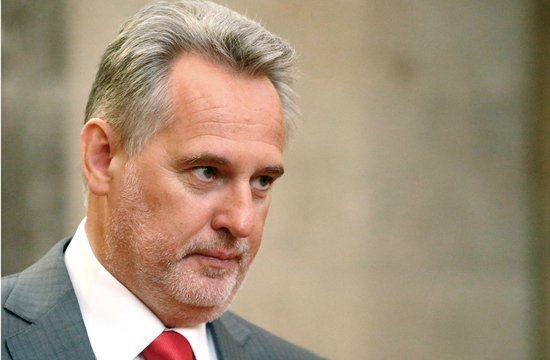
Dmitry Firtash
In addition to the starting price, investor interest in the privatization of the Odessa Port Plant is influenced by the company's historical debts, which the new owner must address.
According to 2024 financial statements, OPP's debts for "goods, works, and services" amounted to UAH 10,46 billion. The lion's share of these debts has been outstanding for more than ten years and is owed to Dmitry Firtash's Ostchem holding company.
Odesa Port Plant's debts to Firtash arose during Viktor Yanukovych's presidency in 2013 under a contract for the sale and purchase of Russian natural gas.
At that time, the state-owned plant received Russian gas through Firtash's companies at a price of $430 per thousand cubic meters. Meanwhile, Dmitry Firtash's companies, Ostchem and Ostchem Gas Trading, purchased it from Russians in 2013 for $264,5 and $268,5, respectively.
Between February and December 2013, Ostchem issued invoices to OPZ for $508,76 million. In 2016, it filed a lawsuit in the Stockholm Arbitration Court to recover the debt from OPZ. In the arbitration proceedings, the then-management of the state-owned plant acknowledged Firtash's claims for $193,25 million and $55,03 million in penalties as of April 2016.
Ostchem subsequently appealed to Ukrainian courts to recover these funds from OPP. However, this was unsuccessful in Ukraine due to the position of the Supreme Court of Ukraine: Ostchem owed money to Russia's Gazprombank, having transferred its rights under several gas supply contracts to Ukrainian enterprises. Therefore, as noted in the Supreme Court's June 2021 ruling, Gazprombank, a member of the aggressor country, could have become the actual recipient of the payments resulting from the OPP debt collection.
As BusinessCensor previously reported , Firtash's companies could have earned approximately $3,7 billion from the resale of Russian gas to Ukrainian enterprises in 2012-2013.
A Reuters investigation notes that Gazprombank opened $12 billion in credit lines for Ostchem in 2010-2011, which Firtash used to purchase chemical plants in Ukraine (the Stirol concern, Severodonetsk Azot, Cherkasy Azot, Bank Nadra, and the Nika Tera port, as well as the majority of regional gas companies). Dmytro Firtash had also previously expressed a desire to purchase the Odesa Port Plant.
Firtash is currently under sanctions from the National Security and Defense Council until June 2034, which means he cannot participate in privatization, lease state property, or fulfill financial and economic obligations to it.
As follows from the announced terms of the competition, the potential owner of the plant is also being asked to ignore debts to Firtash.
Single applicant and criminal cases
The only bidder to publicly announce its participation in the Odesa Port Plant privatization auction was Agro Gas Trading. According to the Ukrainian edition of Forbes, Andrey Verevskyi's Kernel agricultural holding was interested in the plant's privatization , but the company has not officially announced its presence.
Agro Gas Trading claims that they submitted all documents on time for the tender scheduled for November 25, but were unable to register for the auction. This was allegedly due to actions by SmartTender, a platform within the Prozorro electronic bidding system.
However, NABU suspects the owners of this company of involvement in corruption schemes at the Odesa Port Plant itself.
The Odessa Port Plant produces ammonia and urea, as well as agricultural fertilizers. Gas is the primary raw material used for fertilizer production.
Due to debt, the Odessa Port Plant was unable to purchase gas itself, but instead received raw materials through a tolling arrangement: the supplier provided the state-owned plant with gas, which the plant used to produce fertilizer, which it then transferred to the raw material supplier. Thus, the supplier only paid the company for processing and the use of the plant's capacity.
In the final years of the plant's operation, the company "Agro Gas Trading" owned by Alexander Gorbunenko and Vladimir Kolot, who are currently suspected of criminal prosecution by the National Anti-Corruption Bureau of Ukraine (NABU) and are wanted, was such a supplier for the OPZ.

Alexander Gorbunenko, Vladimir Kolot
According to investigators , in early 2020, State Property Fund head Dmitry Sennichenko secured the election of "loyal" members to the Odesa Port Plant supervisory board, who subsequently approved the appointment of a plant director under his control. As a result, members of the criminal organization illegally extended supplementary agreements with Agro Gas Trading for the processing of gas into urea and ammonia until October 2021.
DOSSIER : Dmytro Sennichenko: How to plunder the remains of Ukraine. PART 1
According to NABU estimates, the fee for processing gas into fertilizer was understated. As a result, the Odesa Port Plant lost over UAH 390 million from May to December 2020 alone. The gas supplier earned excess profits, while the head of the State Property Fund and other participants in the scheme received bribes.
According to estimates by the A-95 Consulting Group, in 2020 alone, Agro Gas Trading earned $44 million in profit from the OPZ scheme (according to official reporting, in 2020, Agro Gas Trading earned UAH 164,5 million in profit and had UAH 5,4 billion in revenue. At the same time, OPZ received a record UAH 1,2 billion in net loss with a turnover of UAH 2,3 billion.
According to investigators, from November 2019 to July 2020, then-head of the State Property Fund Dmytro Sennichenko received $1,3 million in kickbacks from this scheme. Investigators estimated the total profits of the probable criminal organization at 2 billion hryvnias.
The co-organizer of the scheme (the "overseer" of OPZ) was the former advisor to the chairman of the State Property Fund, Andrei Gmyrin, a relative of the co-owner of the company that supplied OPZ, Agro Gas Trading, Vladimir Kolot, who was married to Gmyrin's sister.
The second co-owner of Agro Gas Trading, Alexander Gorbunenko, is allegedly the cousin of another Gorbunenko, Denis, who previously headed Rodovid Bank. In November 2024, the UK imposed sanctions against Denis Gorbunenko for his involvement in corruption schemes benefiting oligarch Dmitry Firtash.
In response to a request from BusinessCensor, Agro Gas Trading called the NABU investigation "far-fetched."
Reasons to sell
Experts agree that now is not the best time to put the Odesa Port Plant up for sale. During the war, investors will bid for this state-owned asset below cost. The asset's price could rise significantly after the fighting ends.
"The Odessa Port Plant has now completely lost its investment priorities and the attractiveness it once held. Therefore, selling it now makes no sense. The sale should be put on hold at least until the end of military operations. Once the war ends, its value will double," Ilya Neskhodovsky, an expert with the ANTS National Interest Defense Network, predicted in a comment to DW .
"It's hard to say how much Odesa Port Plant might be worth, but the crown jewel of our chemical industry certainly can't be worth $100 million. What is $100 million? A single unit at a chemical plant costs more; it's just pennies for a plant like that." They (ed., members of the criminal group involved in the NABU case) earned $80 million in two years. And the State Property Fund is selling the entire plant for a hundred ," Sergei Kuyun, director of the A-95 Consulting Group, told BusinessCensor.
According to him, it is currently impossible to privatize the plant on terms favorable to the state.
"Now's the worst time to sell—it's impossible to get a reasonable price. There's war in the country. In light of the recent scandals, I get the impression that someone is trying to make money through corruption, using administrative resources. This price is clearly dictated by the enormous accounts payable that have accumulated over many years. But, apparently, the goal is to sell this valuable asset for next to nothing ," Kuyun added.
According to the expert, the plant could be launched under state control.
"NAFTOGAZ Ukraine has the financial capacity and is raising significant loans. It could get this plant up and running. In the worst-case scenario, it could be mothballed to improve safety; that's normal practice ," the expert added.
Skelet.Org
The OPZ plant is up for privatization again: Kernel among potential bidders
Subscribe to our channels on Telegram, Facebook , Twitter , VK - Only new faces from the SKLEP section!