

Who is Oleg Tatarov and how did he rise to the top of the law enforcement system?
In the wide Soviet-era corridor on the third floor of the Presidential Office, there was recently an unexpected object for this space: a table tennis table, writes UP.
At one time, it was requested by the deputy heads of the OP, Kyrylo Tymoshenko and Yuriy Kostyuk , in order to somehow relieve tension in their new jobs.
But if we take a broader view, table tennis is the title sport at Bankova during Zelenskyy’s time.
Besides the aforementioned deputies of Andriy Yermak , the first assistant to the president , Serhiy Shefir , and the same head of the Servant of the People faction in the Rada, David Arakhamia , are also interested in it.
Oleg Yuryevich Tatarov, curator of the vertical power structure from the Office of the President, also plays ping-pong.
"Tatarov always attacks. He has a very aggressive style of play. He trains with a coach, and when he gets to the table, he immediately puts his opponents on the defensive ," one of Tatarov's playing partners admitted in a conversation with UP.
This description of the behavior of Yermak's deputy was repeated more than once during dozens of conversations between UP journalists and current and former politicians.
But references to Tatarov's attacking style were not related to sports, but to his work for the Presidential Office.
Since his appointment to Bankova in August 2020, Tatarov has immediately become Zelenskyy's main "toxic asset."
The President had to constantly justify himself for the Deputy Head of his Office, but for some reason the guarantor continued to hold on to him tightly.
Moreover, when the NABU came to Bankova Street with suspicions regarding a scandalous bribery case dating back to Tatarov's time at Ukrbud, the president's inner circle felt that Zelenskyy perceived this as an attempt to exert pressure—not on Tatarov, but on himself personally.
The case of the Deputy Head of the Office was buried then, but a grateful Oleg Tatarov has since become Zelensky's "loyal soldier."
After almost three years at Bankova, Oleg Yuryevich managed to build a vertical power structure under the president that had been forgotten since the late Kuchma era, where almost all law enforcement agencies were under a single control center.
Tatarov's level of influence and breadth of knowledge have grown so much during this time that sometimes people in power begin to doubt who is truly the second person in the country after the president.
UP tried to find out how Tatarov managed to transform himself from a political exile during the Yanukovych era into a super-influential official in Zelenskyy's office, how he found an antidote to his conflicts with Andriy Yermak, and whether the concentration of power in his hands will pose a threat to democracy in Ukraine.

Who is Oleg Tatarov and how did he rise to the top of the law enforcement system?
Oleg Tatarov: A Child Prodigy in the Ministry of Internal Affairs and the Fateful Maidan Briefings
Oleh Tatarov's name became known to the Ukrainian public during the Revolution of Dignity. As deputy head of the Main Investigative Department of the Ministry of Internal Affairs, he frequently commented on the events on Maidan on behalf of the ministry.
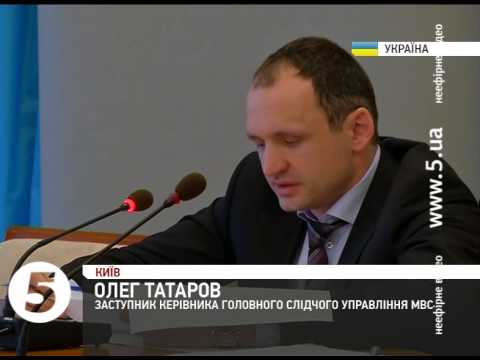
After the victory of the Revolution of Dignity, the new authorities and activists will remember Tatarov for his speeches. Given the outrageousness of Tatarov's words, he has become the embodiment of almost absolute evil. He embodies everything Yanukovych's security forces did during the Revolution of Dignity.
To be fair, however, it should be noted that the deputy chairman of the Main Investigative Department of the Ministry of Internal Affairs himself was not involved in Berkut crimes. He was questioned by Maidan investigators, but they found no charges against him. He was not even subject to lustration because his position did not meet the minimum threshold.
The criticism of Tatarov's actions during the Euromaidan era is a matter of values. He was, and still is, flesh and blood of the police system. If he didn't share the actions of the Berkut and Zakharchenko's clique, then why did he keep appearing at those outrageous briefings?
From Oleg Tatarov's speeches during the Revolution of Dignity:
On January 22, 2014, on Krepostny Lane in Kyiv, a group of individuals driving cars pursued four buses of the Berkut special police unit and blocked traffic. They used baseball bats to strike the bus, smashed the window, and attempted to injure police officers. Their masks were also confiscated, indicating that the protest was not peaceful but rather that they were preparing to commit unlawful acts. Police disarmed the attackers, and 18 were taken to police stations. Investigators have opened a criminal case for hooliganism combined with resistance to police, under Part 3 of Article 296 of the Criminal Code of Ukraine. Punishment for this offense is up to five years in prison.
January 23, 2014.
"Police officers do not use firearms. Some of the dead had wounds to the back of the head, suggesting that the shots were fired nearby by individuals who were among the protesters ."
February 19, 2014
Tatarov also justified the storming of the Maidan on December 11, 2013, and suggested that the beating of activist Tatyana Chornovol at the time could have been a provocation . And after the abduction of Dmitry Bulatov, one of the Automaidan leaders, he released information that could have discredited the victim, claiming that Bulatov had purchased an expensive laptop with donations.
If Tatarov didn't share Yanukovych and Co.'s lawlessness, then why didn't he resign, like dozens of other decent security officials?
The answer to this question can be found by looking at Tatarov's biography several years ago.
If you put aside the ill-fated briefings of the Maidan era, Oleg Tatarov's professional career began as a model story of a legal prodigy.
First, a young man from a poor family in the district center of Novoukrainka in the Kirovohrad region enters the Kharkiv University of Internal Affairs.
But just a few years later, he found himself in the capital, where he even graduated with honors from the Academy of the Ministry of Internal Affairs. He then graduated with honors from Kyiv's Taras Shevchenko University. Tatarov defended his PhD dissertation in 2007, when he was 25. He received his doctorate at 28.
In 2010, Oleg Tatarov transferred from his research work at the Academy of Internal Affairs to a regular investigator position at the Main Investigative Directorate of the Ministry of Internal Affairs. Just a year later, Vasily Farinnik, then head of the Main Investigative Directorate and simultaneously deputy minister to Anatoly Mogilev, appointed 29-year-old Tatarov his deputy.
Interestingly, just before his appointment, the young investigator actually submitted a request for a transfer from the Main Investigative Directorate to a regional office. As one of the directorate's employees at the time told UP, Tatarov had a conflict with his immediate supervisor, General Vasily Topchiy.
"Farinnik thought for a day and then fired Topchiy and made Tatarov his deputy. He had friends at the Ministry of Internal Affairs Academy who recommended Tatarov ," one of Tatarov's close sources told UP off the record.
In the closed, conservative structure of the Ministry of Internal Affairs, such a rapid career advancement in 2010 was possible either through "Donetsk connections," which were nonexistent, or through truly extraordinary abilities.
According to people familiar with Farinnik's structure at the time, Oleg Tatarov became his top "smart guy," handling almost all the work for the head of the Main Investigative Directorate. It was from this time that he amassed a wealth of connections within the internal affairs system.
During this same period, Tatarov participated in the development of a new Criminal Procedure Code, which would later be popularly known as the Portnov Code. Interestingly, however, during the development of the new Criminal Procedure Code, the Deputy Chairman of the Main Investigative Committee, Tatarov, and Deputy Head of the Presidential Administration, Andriy Portnov, did not meet.
They would meet later, when Portnov said on one of Shuster's broadcasts that Tatarov needed to "work on his mental abilities." The dispute centered on Article 207 of the Criminal Procedure Code: how long it allows for the detention of a person without a court order after committing a crime.
"Tatarov said it was 6 o'clock. Portnov, on air when Oleg wasn't there, laughed at him. So Tatarov went straight to Bankova Street, went to Portnov's reception area, and asked, 'Can we meet?' Portnov heard who was there and accepted. Tatarov opened his PDA and told him it was 6 o'clock ," one of the witnesses to that conversation told UP.
This story is quite symbolic in terms of understanding Tatarov's rise within the Yanukovych-era Ministry of Internal Affairs: he was ready to knock on doors, and behind them were people who heard him.
"Tatarov's career was soaring. Then Maidan happened, and the Ministry of Internal Affairs was sitting around deciding who would go to the briefing. Everyone understood what kind of work it was and kept a low profile. Finally, they sent the 'young man,' Tatarov. And once he's gone, he's got to keep going ," says one of Yermak's close contacts in the current government.
Just before Euromaidan, Tatarov fell out with Mykola Chinchin. The latter had then become head of the Main Investigative Directorate, replacing Farinnik. The new boss, wanting to rid himself of his deputy's influence, sent Tatarov to the information department.
"One evening, Zakharchenko called Tatarov and said, 'Where do you live? A car is coming soon.' Oleg asked where he was supposed to go. 'You're going to Shuster, you have to speak.' And that's how Tatarov became speaker ," another UP source close to Tatarov recounted.
Essentially, Tatarov's rise to Speaker due to the lawlessness perpetrated by Zakharchenko's team ruined his promising career in the Ministry of Internal Affairs. Yanukovych and his men fled to Russia, while the deputy head of the Main Investigative Directorate remained in Ukraine: essentially, he wasn't their man. Perhaps in terms of his values, but as a team member, no.
The impact of the Maidan on Tatarov's career can be clearly seen if we compare it to the career of his colleague and godfather , another deputy head of the Main Investigative Directorate during the same period, Maxim Tsutskiridze.
They held the same positions at the same time, but Tsutskiridze managed to defend his dissertation afterward and worked in the Ministry of Internal Affairs until the "eternal" minister, Arsen Avakov, appointed him deputy head of the National Police. Instead, Avakov quickly dismissed Tatarov from his post immediately after the Maidan victory.
The "exile" to the information department ruined Tatarov's prospects, but essentially saved him from persecution after his dismissal: he didn't sign any documents, and everything he said at briefings wasn't his own idea, but rather received orders from the chain of command.
Oleg Tatarov was not subject to lustration, but with such a public history, his chances of holding any government positions were zero.
In 2014, Kherson Governor Andriy Putilov attempted to place Tatarov in his regional state administration. However, he faced such a wave of public outrage that he soon abandoned the idea.
The loss of his career and prospects due to what he considered unfair accusations broke Tatarov. People who interacted with him describe his "before" and "after" as two very different people.
"Tatarov was downright furiously offended, so to speak, and 'bitten' all the so-called 'orange' people. He wasn't a kind person before, but after the Maidan, he started taking revenge ," says one political source who has known the current deputy head of the Office of the President for a long time.
Tatarov was barred from joining the camp of the revolution's victors; he didn't want to join the camp of the losers. So the former security official tried to find a niche for himself in the middle, on the front line, so to speak.
In 2015, his former boss at the Ministry of Internal Affairs, Farinnik, hired his subordinate to join his law firm immediately as managing partner. Thus, the firm "Tatarov Farinnik Golovko," later renamed "Credens," became one of the Party of Regions' main defenders in court.
After the Revolution of Dignity, the former rulers of life began to have problems with the courts, and the "regionals" could not trust their defense to someone they did not know.
"I didn't know them personally, but their firm was recommended to me by people I trusted. At the time, Lutsenko, as Prosecutor General, was bringing all sorts of cases against me, and Tatarov ( as my lawyer – UP ) and I were present at numerous committee hearings in the Rada and at interrogations.
"He's a very good lawyer, he grasps the essence of things quickly, he knows how to put investigators in their place, he gives very effective advice on procedures, and so on ," recalls Vadim Novinsky , a former client of Tatarov's, in a conversation with UP . He is now subject to sanctions by the National Security and Defense Council, not without the participation of his former lawyer .

Vadim Novinsky and lawyer Oleg Tatarov
To understand the background of Tatarov's clients, one can recall that he was the one who handled the cases of the aforementioned odious Andrei Portnov and the widow of the attacker of Sergei Sternenko.
Besides this, Tatarov took another rather lucrative position—head of the legal department at Ukrbud. This formally state-owned company was, in fact, run for many years by the capital's developer and former MP Maksym Mykytas.
"Construction is a huge, constant stream of legal work. Every day, there are thousands of cases: searches, permits, court battles. This is especially true for huge companies like Ukrbud. Therefore, it's both a good training ground for a lawyer and a good source of income ," one of the capital's developers explains to UP.
Finally, by the end of Petro Poroshenko's term , one could say that Tatarov's affairs had settled down. But what should have ensured a peaceful retirement brought only public problems.

Who is Oleg Tatarov and how did he rise to the top of the law enforcement system?
The era of new faces in Tatarov
Following Volodymyr Zelenskyy's victory in 2019, new and often unknown figures began to rise to power at all levels. Ze!Team even had a dedicated project for this purpose: " Lift ."
In the spring of 2020, Tatarov managed to ride this elevator to the fourth floor of the OPU, where the president's office is located.
Just at the beginning of March of that year, Oleg Tatarov completed distance learning at the University of London and was scheduled to fly to Britain for his graduation on the 5th.
But on March 3, his secretary reported that he'd received a call from the Presidential Office asking him to come in. It all seemed like a joke, but it turned out to be true.
At that time, the era of the new, ambitious head of the Presidential Administration, Andriy Yermak, was beginning at Bankova Street. He had managed to dislodge Zelenskyy's longtime friend, Andriy Bohdan , and wanted to strengthen his position by appointing new, his own people.
However, at the first interview, Tatarov was not offered his current job.
"Oleg was asked what he envisioned as a possible job. He immediately said he wouldn't go to Avakov's job at the Ministry of Internal Affairs because they'd 'outsell' him there, give him an office and no work. But he could try his hand at being a deputy in the Prosecutor General's Office ," one of the witnesses to that meeting with Zelenskyy told UP off the record.
This prospect sparked righteous indignation in the then Prosecutor General, Iryna Venediktova, who declared that “he is Yanukovych’s lawyer” and that she would not allow him to be appointed as her deputy.
Irina Valentinovna was so persuasive that the idea of Tatarov joining the UCP was abandoned. And in August, Yermak decided to make him his deputy in the security forces.
"Bohdan had one person overseeing both the judicial and law enforcement departments—first Ruslan Ryaboshapka, then Andrey Smirnov. Because they're two arms of the same organism: if you separate them, they start competing and squabbling ," one of Bohdan's close Ze! team members recalled in a conversation with UP.
In his public appearances, Yermak explained that the HR department of the Presidential Office suggested he hire someone from Yanukovych's Ministry of Internal Affairs. When Ukrainskaya Pravda asked the head of the Office of the President during the reporting process who had advised Tatarov, he couldn't recall.
However, the head of Zelenskyy's Office may have met Tatarov earlier. At the very least, they may share an interesting connection.
Few remember, but immediately after the appointment of the new head of the Office of the President in the spring of 2020, a scandal erupted, dubbed the " Yermak tapes " by the media. The scandal centered on the fact that the head of the Office of the President's brother, Denis, allegedly negotiated the employment of unnamed individuals in government agencies.
Yermak's brother's lawyer in this case was Ivan Kholondovich , whose services were also used by Andrei Portnov. Kholondovich's dissertation supervisor at the time was none other than Oleg Tatarov.
Initially, the newly appointed deputy chairman of the Office of the President faced two tasks: dividing Smirnov's influence and balancing the power of then-Interior Minister Arsen Avakov. Zelenskyy's inner circle viewed the minister with undisguised wariness and distrust.
However, immediately after his appointment, the president's team realized that Tatarov could be used as a specialist with a much broader profile.
For example, he was involved in preparing the election campaign for the local elections in the fall of 2020. The deputy chairman of the OPU, responsible for law enforcement, checked whether potential candidates from Servant of the People had any criminal or media ties.
"The team immediately regarded Oleg as a technocrat. Although the media wrote terrible things about him, he is given tasks at the table, and he conscientiously carries them out, without saying a word to anyone ," one of Zelenskyy's influential allies described Tatarov in the summer of 2020.
By the end of that year, the "technocrat" began to make his mark. At that time, the competition for the position of head of the State Bureau of Investigation concluded, and Alexey Sukhachev "won ." UP sources in various political forces and law enforcement agencies unanimously called Sukhachev Tatarov's protégé.
But Yermak's deputy was not destined to rejoice in new personnel prospects in December 2020. That month became the point of greatest tension in Tatarov's new career.
On Friday, December 18, 2020, NABU investigators unexpectedly showed up at none other than the Presidential Office with a search warrant and a prepared charge sheet for the law enforcement deputy head of the Office.
Investigators argued that while working at Ukrbud, Tatarov may have been involved in bribing an expert to perform a fake expert assessment. The assessment was intended to save the construction company's director from trouble with law enforcement, and would have given the expert a nearly 100% discount on a parking space in Pechersk.
The scandal was high-profile, but only just. NABU's attempt to abruptly arrest the law enforcement agency's curator demonstrated how much influence he had gained in the system in just six months. It's no exaggeration to say that the entire power vertical was involved in the operation to save, if not Tatarov's reputation, then at least his safety.
By decision of the Prosecutor General's Office, the case was taken away from the National Anti-Corruption Bureau of Ukraine (NABU). The investigation was transferred to the Security Service of Ukraine (SBU), where it was successfully languished until the end of 2021. And just before Christmas that year, the Shevchenkivskyi District Court ordered the SBU to close Tatarov's case due to "expiration of the investigation deadline."
The deputy head of the Office of the President retained his post. But it was difficult to say the same about the president's appearance before the public and his foreign partners.
After this, Tatarov disappeared from public view. But his influence only grew.
In the summer of 2021, Arsen Avakov finally lost his ministerial post . Zelensky then decided to appoint the now-deceased Denys Monastyrskyi to the Ministry of Internal Affairs.
Tatarov, too, played a key role in the shadows of that story. He orchestrated Avakov's dismissal, after he had expelled him from the Ministry of Internal Affairs in 2014.
It is Tatarov who, through his connections in the system, must become an anchor for all influence groups while the new leadership figures out how to operate.
Before his appointment, Monastyrsky headed the Verkhovna Rada Committee on Law Enforcement, but he clearly lacked the experience to lead the Ministry of Internal Affairs. Instead, Tatarov knew the entire top brass of the agency, and they, in turn, knew him.
"Oleg, in essence, once oversaw the entire investigation at the Ministry of Internal Affairs—he knew how that machine worked. And the moment he helped seize control of the Ministry of Internal Affairs from Avakov and prevented that system from working against the Office—that's probably one of the things Zelenskyy highly valued Tatarov for ," one of the current government's top officials says off the record.
It was precisely through this ability to quickly integrate into systems, integrating his people, and simultaneously controlling sensitive processes that Tatarov quietly and deliberately expanded his influence over almost the entire law enforcement system in the country. Almost?

Who is Oleg Tatarov and how did he rise to the top of the law enforcement system?
Oleg Tatarov is in power: master of daddies and lord of bad news
During the full-scale war, Ukrainian security forces received very broad powers and maximum public trust.
Ukrainians' trust has grown not only in the Armed Forces, but also in structures such as the Security Services and the National Police, which have achieved unprecedented levels of support.
It is obvious that with the growth of the influence of the security forces, the influence of the one who “coordinates” them has also increased proportionally.
"At the beginning of the full-scale war, there were still some people who balanced Oleg. For example, he couldn't command Bakanov because he was Zelenskyy's friend. He couldn't pressure Venediktova to sign anything because she was wary of him. Monastyrsky, although he was entirely the president's man, had his own opinion ," a high-ranking source in a law enforcement agency told UP.
“But after the resignations of Bakanov and Venediktova and the death of Monastyrsky, Tatarov became almost all-powerful ,” the source adds.
"Never in the history of Ukraine has there been such an influential person. Different security agencies have always targeted different influence groups. And now everyone is integrated into the same vertical power structure under Tatarov: the investigation, oversight, and, to some extent, the courts—everything there is ," adds another UP source from the Cabinet of Ministers.
During the time when Venediktova headed the Prosecutor General's Office, she was credited with making a joke about the influence of Tatarov and his former employer, Portnov: there was the Tatar-Mongol yoke, and now the Tatar-Portnov yoke has arrived.
Currently, the deputy chairman of the OPU ensures the "coordination" of law enforcement agencies, in particular by placing his people in positions at various levels.
Thus, according to the UP, the following are taking their cues from the deputy chairman of the OPU:
- Director of the State Bureau of Investigation Alexey Sukhachev;
- Deputy Director of the Bureau of Economic Security Vitaly Gagach;
- Head of the Main Directorate for Counterintelligence Protection of Critical Infrastructure Facilities and Countering the Financing of Terrorism of the Security Service of Ukraine Artem Shilo;
- Deputy Chairman of the National Police Maxim Tsutskiridze;
- Acting Head of the National Police Ivan Vygovsky.
"It's often mistakenly said that Malysh ( the head of the SBU – UP ) is Tatarov's son. That's not entirely true. Vasya is understandably at fault for Oleg, since Tatarov helped him become head of the SBU. But the president chose Vasya; he'd been keeping an eye on him for a long time.
"As for the Prosecutor General, Kostin is Yermak's man. Andrey simply transferred Kostin to work with Oleg ," an influential source in the presidential office's team explained to UP.
It's difficult to call Tatarov and Interior Minister Ihor Klimenko human beings. He clearly wields influence within the system and is developing his own team within the ministry. But in a structured system of power with a single decision-making center, the Interior Minister must still "coordinate" with the relevant deputy head of the Office of the President. The same applies to the leadership of ARMA (the Asset Search and Management Agency), customs, and so on.
Also, according to the Ukrainian Prosecutor's Office, the deputy chairperson of the OPU has close working relationships with several judges. These include, for example, Ruslan Kozlov, chairperson of Kyiv's Pechersky District Court, and Yevhen Martynov, chairperson of Kyiv's Shevchenkivsky District Court.
The question remains open as to whether Yermak's deputy has any influence on the newly created anti-corruption bodies.
"You see, the new head of the NABU, Kryvonos, or his deputy, Uglava, are, to put it mildly, hardly Tatarov's people. But Oleg doesn't need to appoint his own people there to avoid creating a scandal with his international partners. He only needs to recruit someone within the organization to receive advance information about cases and searches," explains an influential source involved in the creation of the National Anti-Corruption Bureau.
The same applies to the Specialized Anti-Corruption Prosecutor's Office. The deputy head of the SAP is Andriy Sinyuk, who, according to the UP, is friends with Oleksiy Symonenko.
The same person who had once taken Tatarov's case to the NABU and whom the UP later documented among friends at the birthday party of the law enforcement deputy head of the OP. However, no direct evidence of "collaboration" between the aforementioned individuals and Tatarov has yet been established.
However, even with such an insane concentration of power, Zelensky's team advises against viewing Tatarov as anything out of the ordinary.
"You're wrong to demonize Oleg. Yes, he has significant powers, but they're not his. He's part of the vertical. Everything he has belongs to Zelenskyy. Tatarov is a function. It would be strange if someone in such a position at such a time weren't super influential ," one member of the presidential team shrugged.
Another source on Zelenskyy's team explains that the president has become noticeably emotionally drained during the war. He's demanding not lengthy, legally correct but convoluted solutions, but quicker and tougher decisions.
Tatarov has a knack for finding simple solutions for the president that produce immediate results. Although these solutions often have a dubious outcome: this happened before the war with the arrest of Petro Poroshenko, and continued during the war with the cases of Kolomoisky and Pavelko.
And so, although all businesses complain about the State Bureau of Investigation or the Bureau of Economic Security, Zelenskyy sees these structures as the only ones pressuring Kolomoisky and Firtash.
Meanwhile, Yermak's deputy is extremely discreet and discreet. He tries to avoid any meetings outside the OPU, drives a used Mercedes, and commutes almost exclusively between home and work.
Moreover, he does this not only to avoid the attention of journalists, but also to avoid receiving unnecessary questions from management.
"Tatarov has a clear understanding of how Zelenskyy's government operates and how Yermak reacts. He's accepted these rules and plays by them. That's why he's as private and obedient as possible ," one of Zelenskyy's team members explained to UP.
According to the Office, even when Zelenskyy directly assigns a task to Tatarov, he immediately reports it to Yermak. And when the task is completed, Oleg Yuryevich reports first to Andrey Borisovich, who then decides who will break the news to Vladimir Alexandrovich: Yermak himself or Tatarov.
However, despite this apparent asceticism, Tatarov's position is actually reminiscent of the role of a Maybach driver: the owner's business is a priority, but once that is done, the driver can take the expensive car to solve his own problems.
"Oleg has become quite adept at using what he has. For example, say there are 20 or so cases against you or your department. You go to Tatarov, and he says, 'It wasn't me. You bastard, I'll solve it, don't worry.' And he does solve it. But you know he opened the case with one hand and closed it with the other, and now you're held responsible for saving him ," one official told UP.
Overall, Tatarov's responsibilities within Zelenskyy's team are quite broad: from overseeing various criminal cases to collecting "files" on potential and current team members, opponents, military personnel, and so on.
"Tatarov has another function: to bring bad news before others know about it. For example, there's a governor, and he could become a problem. Tatarov brings a folder, Zelensky gives the go-ahead to remove the governor, and then the security forces come for him." But when the official is no longer part of the team ," says a source close to the president.
"On the other hand, Oleg is the one responsible for ensuring that his people aren't torn apart by the security forces. He'll simply help some, ' recommend ' lawyers to others, and so on. Like, 'We'll take you down, but we won't let you strip.' And people are grateful for that ," the source adds.
With such enormous influence, Tatarov is a crucial tool for the Office to "maintain tone," particularly for its own members. UP previously reported that, as of early spring 2023, more than 100 members of parliament from various factions were involved in cases involving various law enforcement agencies.
However, the work of Yermak's security deputy team can only be considered partially effective. At least, this is what one of the previous government officials, currently facing several cases in Ukraine, told Ukrainska Pravda.
"I look at our cases. There's little legal expertise there. They have resources and they're trying to exploit them. There's more knee-jerk tactics than sophisticated legal work. That's why there are so many cases against everyone, and so few have any real problems in court ," explains our "former" source.
A relatively new area to which Zelenskyy has begun to involve Tatarov in recent months is personnel issues, especially in the regions.
According to UP sources in the government, Tatarov helped select several recently appointed heads of military administrations. These include the heads of military administrations in the Kherson, Luhansk, Zaporizhzhia, Dnipropetrovsk, and Kyiv regions.
***
Oleg Tatarov is one of the most controversial figures in the current Ukrainian government.
The enormous influence over the power bloc concentrated in his hands alarms many political and business players both inside and outside the country.
It is clear that there is an unspoken agreement among foreign partners not to press domestic sensitive Ukrainian issues while the country fights for its independence from the Russian aggressor.
"We met with Biden at the G7, and, you know, he didn't mention Tatarov's name," a key member of Zelenskyy's team once half-jokingly responded to a question from UP about whether the information about possible Western sanctions against the deputy head of the OP was true.
But, as UP sources in government and diplomatic circles assure us, Biden is the last one who has not yet mentioned this name.
Roman Romanyuk, Roman Kravets, translation by Skelet.Org
Subscribe to our channels on Telegram, Facebook , Twitter , VK - Only new faces from the SKLEP section!