
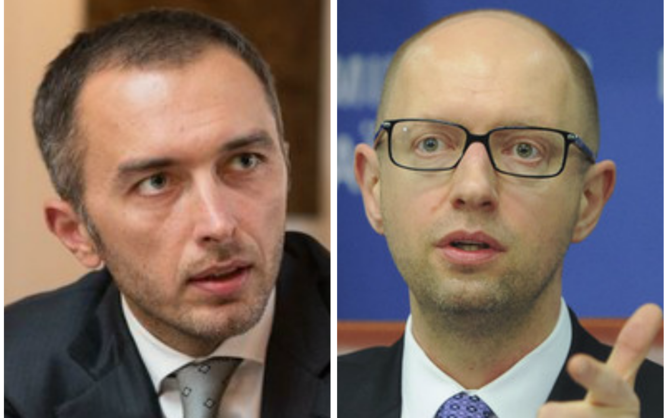
Oschadbank CEO Andriy Pyshnyy (left) and Prime Minister Arseniy Yatsenyuk (right) decided to raise Oschadbank's prestige in Ukraine.
State-owned Oschadbank has challenged the long-standing hegemony of Ihor Kolomoisky's PrivatBank in the retail market. Both sides are wielding heavy weapons.
Late September. Ukrainian media outlets are filled with articles about the aftermath of the defeat of Ukrainian troops near Ilovaisk.
At this time, then Minister of Defense General Valeriy Heletey joined military operations on a new front for him – the banking front.
On September 23, the general sent a telegram to the Chief of the General Staff and Commander-in-Chief of the Armed Forces of Ukraine, in which, in typical military style, he ordered "to take urgent measures" to implement the Cabinet of Ministers' decision to transfer ATO participants, and then all Armed Forces personnel, to state-owned banks.
The telegram stated that if contracts were not concluded by October 1, the soldiers' salaries would be paid in cash. Heletey's letter became one of the instruments for implementing the Cabinet's decision, which opened a new front.
The battle's participants are the largest state-owned financial institution, Oschadbank, and the largest private financial institution, PrivatBank, co-owned by prominent businessman and governor of the Dnipropetrovsk region, Igor Kolomoisky.
The clash began with a relatively local conflict—regulatory payroll plans for government employees—and has escalated into a full-scale war for market share. Both sides are wielding heavy artillery.
Activation of the Sleeping Giant
Tatyana Frundina, head of PrivatBank's department for promoting services to budgetary organizations, says she and her colleagues noticed the "activity" immediately after the appointment of the new government.
At the same time, Oschadbank was headed by Andriy Pyshnyy (Read more about him: Andriy Pyshnyy: Yatsenyuk's Godfather and Oschadbank's Killer ) , a fellow party member and personal friend of Prime Minister Arseniy Yatsenyuk.
“Then we learned from our clients in government agencies that the [country’s] leadership was actively promoting Oschadbank,” says Frundina.
PrivatBank defines "activism" as administrative pressure on the heads of government agencies and companies to force them to switch from the privately owned PrivatBank to the state-owned Oschadbank in terms of servicing their payroll projects.
Apart from Heletey's letter, the brief history of administrative pressure, according to PrivatBank employees, was as follows.
In May, the SBU, represented by its head, Valentyn Nalyvaichenko, wrote a letter to Yatsenyuk. In it, Nalyvaichenko reported that between 2010 and 2014, state-owned enterprises and structures were transferred from state institutions to private banks.
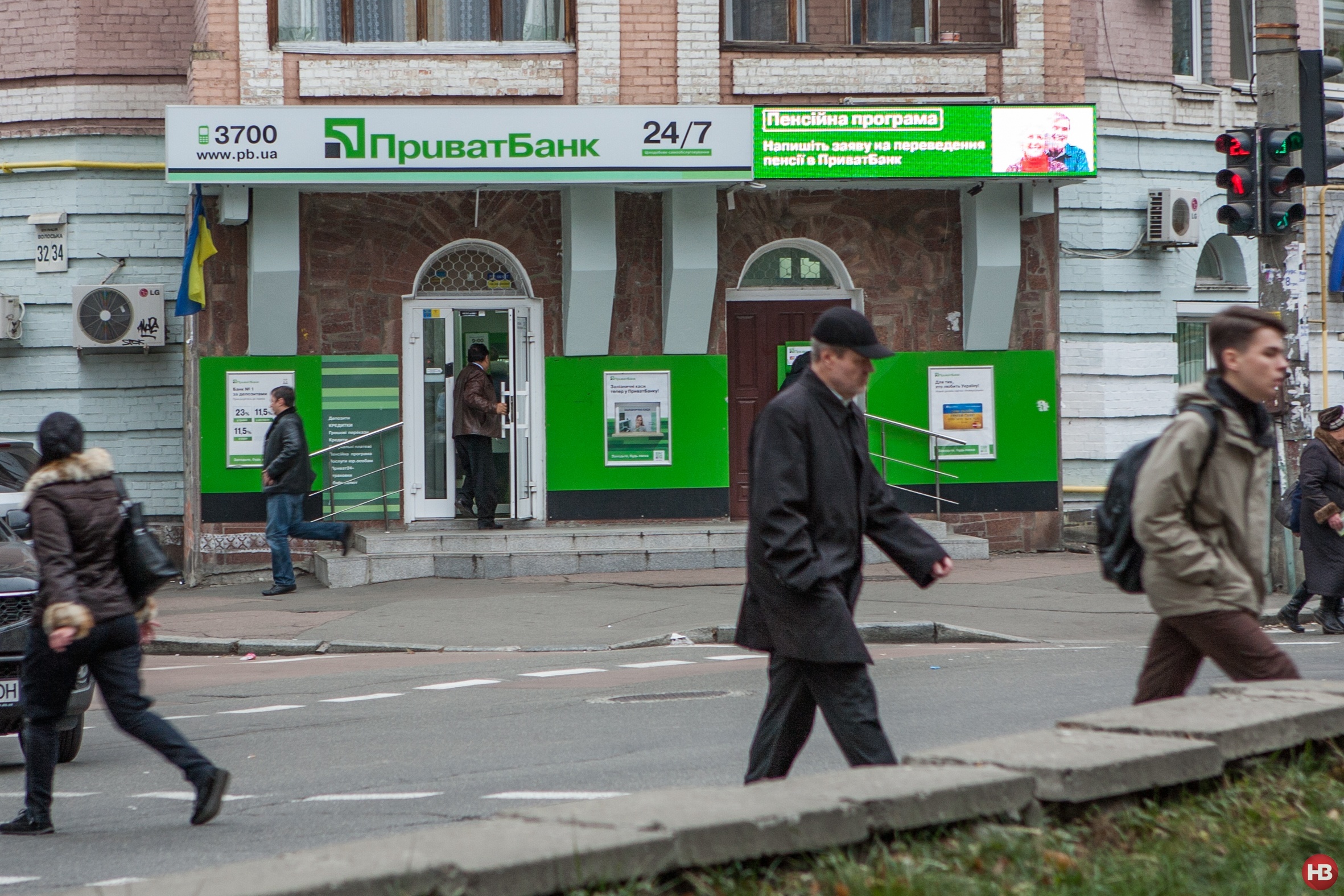
A bank for the masses: PrivatBank's main competitive advantage is its wide network and convenient web banking.
All of this allegedly occurred with the active lobbying of representatives of commercial banks, while clients themselves migrated from state-owned banks to private ones not for economic reasons, but as a result of corrupt agreements.
As a result, entire vital sectors of the country's economy became dependent on Russian banking institutions and domestic private banks, the letter stated.
Following this, in September, Yatsenyuk instructed several agencies at once—the Ministry of Internal Affairs, the Ministry of Defense, the Ministry of Justice, the Security Service of Ukraine, the State Fiscal Service, and others—to transfer their employees' payroll to state-owned banks by December 1.
PrivatBank is confident that the latter refers, of course, to Oschadbank, the largest state-owned financial institution, which is also headed by an associate and comrade of the Prime Minister.
This campaign is not targeting the Ukrainian subsidiaries of Russian banks, as was stated as the rationale for this move, but rather PrivatBank as the largest holder of salary projects.
According to NV, 50% of the 305 employees of the Ministry of Internal Affairs receive their salaries through PrivatBank.
The bank's share in the Ministry of Defense is 56%, in the State Fiscal Service it is 94%, and in the State Border Service it is a full 100%. Oschadbank's share in these structures, however, is a modest 4-6%.
Frundina explains that the war began with salary projects for security forces and spread to all civil servants.
Similar stories, according to her, are happening in medical institutions, public utilities, and state administrations.
She also emotionally refutes the words of the head of Oschadbank that the government's work with state agencies is purely advisory in nature.
If they continue what they've started, we'll see a different Oschadbank by the end of 2015 — Andrey Fedorov, owner of fedoriv.com
"If this isn't a directive, but a recommendation, then why, when it reaches our clients, is it perceived as a direct order, and why are our clients pressured if they don't want to apply for Oschadbank cards?" says Frundina.
But this is only one side of the story.
The struggle of opposites
Oschadbank Chairman Andriy Pyshnyy believes that the crying of Yaroslavna, as perpetrated by PrivatBank management, stems from Kolomoisky and Gennady Bogolyubov's ( read more about him in the article Gennady Bogolyubov: What is PrivatBank's other half keeping quiet about ? ) fears of losing their near-monopoly positions in the payroll market.
The real reason for PrivatBank's discontent, he continues, is that the post-Soviet dinosaur Oschadbank has begun to change dramatically and aggressively compete with PrivatBank on all commercial fronts.
Pyshnyy says his bank has developed a new development strategy together with the consulting company PricewaterhouseCoopers.
Now it strives to become a successful state-owned bank—a strategy similar to those pursued by the American Bank of America and Russia's Sberbank. Specifically, the concept of new branches and the quality of services have been completely revamped.
Instead of traditional savings banks, the bank is now building branches with spacious lounges, electronic queue management systems, children's play areas, and hot and cold water dispensers. The bank has opened nearly 50 such branches and continues to open two to three a week.
It's a small number compared to the 5 old-style branches, but it's a start, says Pyshny. "Oshchadbank is a bank for millions, and it should become a bank for millions," he says.
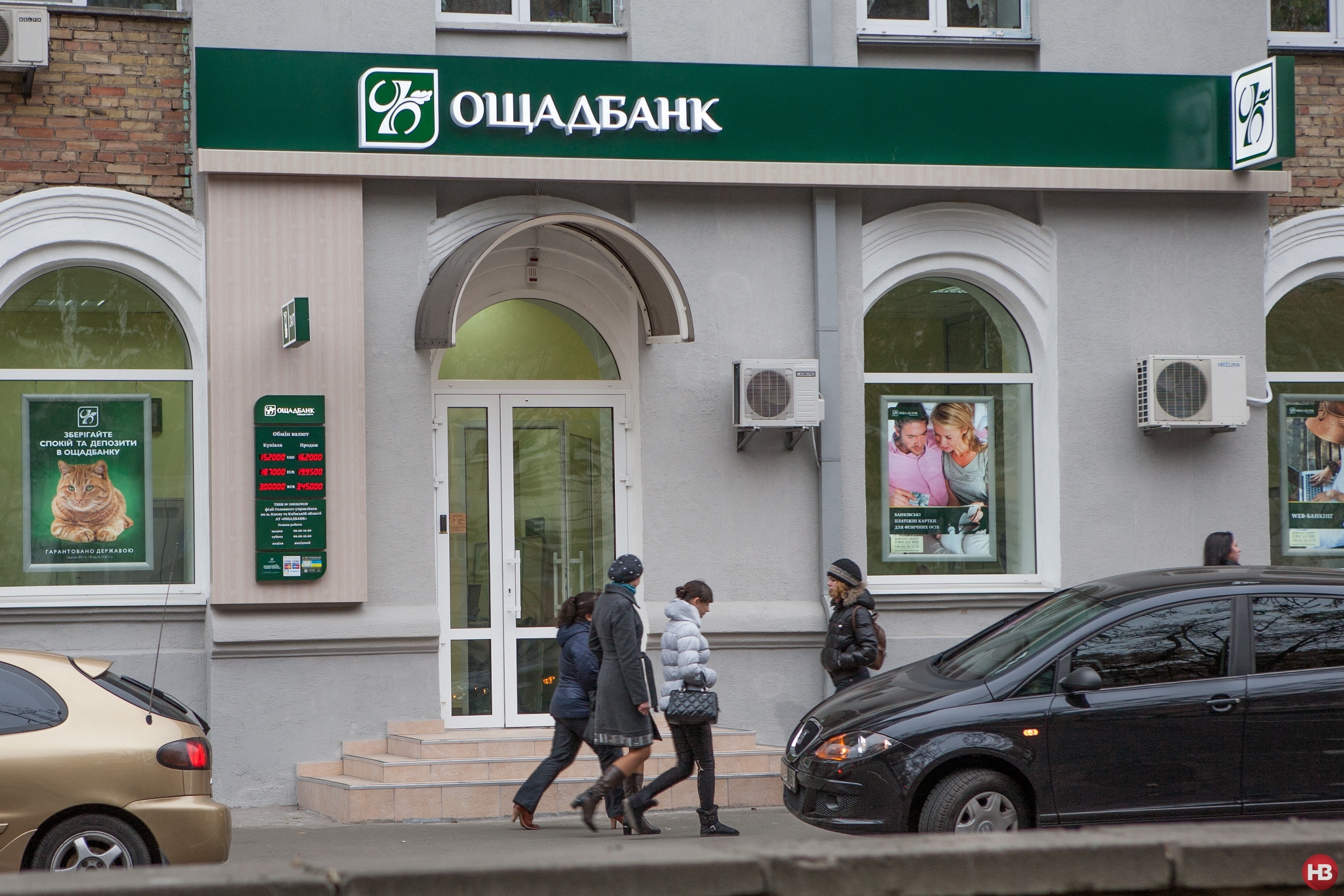
Instead of the usual savings banks, Oschadbank is now building branches with spacious halls, electronic queue management devices, and children's corners.
New specialists who have transferred from large institutions with foreign investments will also be involved in radical changes at the bank.
Salaries and bonuses for management personnel at the state-owned bank have been made entirely market-based, says Pyshny.
One of the first specialists hired by the bank was the head of human resources. His job was to help recruit staff and teach existing employees to smile and work in a new way.
Oschadbank considers PrivatBank's claims that government officials are pressuring clients in the interests of state-owned banks to be far-fetched.
According to Andrey Pyshny, his bank's employees simply give presentations to clients, highlighting the institution's strengths, something they hadn't done before.
In particular, bank employees are now actively communicating to potential clients the 100% state guarantee on all deposits and information about the quality of online banking.
Fierce competition has begun to irritate PrivatBank, continues Pyshnyy, who has joined his extensive media resources in the PR campaign against his bank.
Plans for growth
In any case, Oschadbank will need years and significant investment to displace PrivatBank, which has been building its position for years.
Most bank reliability ratings, including the NV list, already place Oschadbank in first place thanks to unlimited state support and a 100% deposit guarantee from the same state.
However, Oschadbank is significantly inferior to its competitors, primarily PrivatBank, in terms of its ability to work with clients and the scale of its retail business.
According to Oschadbank, this state institution's ATM network consists of only 1,96 machines. PrivatBank, on the other hand, has almost four times as many.
The ratio of POS terminals is also unfavorable for the state institution—five and a half times lower. Oschadbank's number of active payment cards is seven times lower than PrivatBank's.
Frundina explains that Privat has been building its business in the public sector for over 10 years. "When I started working, we only had 700 payroll clients. Now we have around 3,8 million, 2,9 million of which are in the public sector."
Conquering a market isn't the same as maintaining it. And PrivatBank is managing to maintain it. For now.
Many clients consider Privat's online and mobile services to be one of its main advantages.
Oschadbank has everything it needs to catch up with its rival, says marketing specialist and owner of the feedoriv.com agency Andrey Fedorov, who worked on a project with Oschadbank this year.
"I know the bank's management has a strategy, confidence, and passion. If they continue what they've started, we'll see a different Oschadbank by the end of 2015," says Fedorov.
However, implementing this strategy will require years and significant investment, explains Dragon Capital analyst Anastasia Tuyukova.
Andrey Yukhimenko, the material was published in issue No. 27 of the magazine "New Time" on November 14, 2014
Subscribe to our channels on Telegram, Facebook , Twitter , VK - Only new faces from the SKLEP section!