
 Just yesterday, all-powerful, they fled swiftly and inelegantly, carrying away their loot. Whatever they couldn't immediately take away was assisted by various teams from the new government. But the desire to regain influence in their homeland remained. Today, with the Zaporizhzhia region receiving a "yellow" terrorist threat level, the question of Artem Pshonka's influence in the south of the region has become particularly acute, reports Antikor.
Feudal Principality of Pshonka
During the Yanukovych era, Artem Pshonka, son of then-Prosecutor General Viktor Pshonka (read more about him in the article " Viktor Pshonka: The Rise and Fall of a Prosecutor's Caesar ") , successfully re-entered parliament in the 2012 elections. A native of Kramatorsk, he landed in the Zaporizhia Oblast with the overwhelming support of the Party of Regions.
Artem began "sowing" his future allotment back in late 2011, when the contours of the new electoral system were just beginning to emerge. Pshonka's 81st constituency included the southwest of the Zaporizhia region—poor and desolate rural areas. Among the seven constituencies, the largest city was Tokmak, with a population of 30.
In the impoverished steppe wilderness, the Prosecutor General's son began weaving his network. His operatives began building a system of stable "feeding" of all public sector employees. Teachers, postmen, village council employees, and social workers all integrated into the chain of command for the elections. In the village, an extra hundred hryvnia, and sometimes a bottle of vodka, meant much more than in the city—and people agreed to take the money for food rations, go to the polls, and bring their families to the polls to cast their ballots for Artem Pshonka.
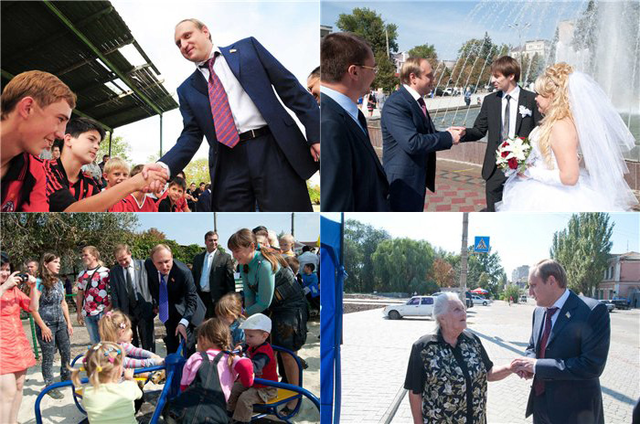 Naturally, a vertical chain of command was established under Artem Viktorovich's control—officials at all levels spoke volumes about how much such a remarkable candidate was doing for the community. Ultimately, the Prosecutor General's son garnered a record 65 percent of the vote, in less than a year of cultivating the 81st district. Over the next year or so, until the change of power, Pshonka only strengthened his influence in the district. A well-coordinated team of curators was constantly at work there, monitoring the established network—which later became a tool for monitoring dissatisfied individuals.
Where to go, where to go?
But the transformation of the 81st District into a feudal fiefdom was interrupted by the Maidan and the change of power. Pshonka's father and son, along with other members of Yanukovych's team, fled to Russia. But they were, to put it mildly, not very welcome there – as greedy fools who had thwarted Putin's plans for a "soft" takeover of Ukraine. Vladimir Vladimirovich is said to have coined the trenchant phrase: "Yanukovych's Ukraine was devoured by the appetites of greedy youths!"
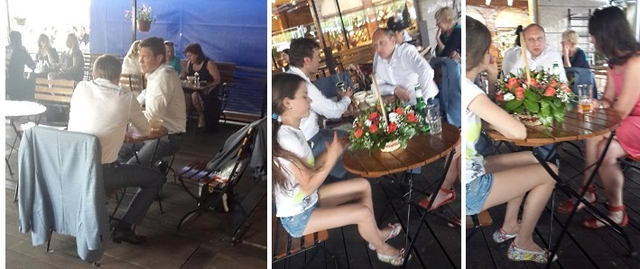
May 2014, A. Pshonka and O. Tsarev, Moscow
Klimenko (Read more: Oleksandr Klimenko. He left, but really wants to return ), Kurchenko, and other young reformers tried to prove their usefulness and relevance. Money poured into the Zastup party and Dumchev's movement (Read more: Dumchev. The era of political déjà vu in Kyiv ). The guys began to be entrusted with various business schemes in the occupied Donbas.
But Artem Pshonka took a different approach. In the offices of Putin's administration, he began to explain that he retained considerable influence in Ukraine's 81st district, his native one, and was ready to use it to destabilize the situation in the frontline region at the right moment. His stories needed to be backed up, and the snap parliamentary elections proved to be a perfect time. He simply needed to find the right "tool," which turned out to be the Berdyansk oligarch Alexander Ponomarev.
I really wanted to expand.
Meanwhile, on the eve of the early parliamentary elections in 2014, another MP, Oleksandr Ponomarev, quietly left the Party of Regions and in the summer of 2014 joined the parliamentary faction "For Peace and Stability!" This group of former Party of Regions members who had not gone into hiding was hastily cobbled together with funds from Kurchenko, a junior business partner of the Pshonka family and Yanukovych.
Ponomarev had long dreamed of becoming the new Rothschild and really wanted to expand his influence under the new government – and he fell for it.
It's worth noting that Ponomarev and Pshonka's districts aren't just neighbors. Pshonka actively helped the Berdyansk businessman fend off the advances of Anisimov, the "overseer" of the Zaporizhzhia region, in 2012-13.
The connection between the Berdyansk MP and the Prosecutor General's son didn't break after the revolution, but rather strengthened. In September 2014, members of the "For Peace and Stability" faction, still members of parliament, made a controversial visit to the Russian State Duma. Officially, Alexander Ponomarev wasn't with them. But unofficially...
Evil tongues claim that the main topic of conversation with Artem Viktorovich was the upcoming parliamentary elections. Ponomarev was confident about his 78th district, with Berdyansk at its center—he had managed to find common ground with the new government and prove his loyalty. But he wanted more, and for the vacant 81st district, it was advisable to negotiate with representatives of the old government. Alexander Sergeyevich targeted his junior business aide, Sergei Valentinov, for that "Pshonka principality."
But Ponomarev needed a "bonus" to strengthen the "Berdyansk paratrooper," the completely unranked Valentinov, against his local opponents. And that "bonus" was supposed to be the "network" built by Artem Pshonka and his managers two years ago.
The negotiations were said to have been successful. The businesslike Ponomarev also reached agreements not only on politics but also on economics. The Berdyansk Reapers company is said to have begun supplying its agricultural machinery to Belarus and Kazakhstan. From there, transporting the goods to Russia, to end consumers, was not at all difficult.
But the increase in supplies began a little later, and immediately after the Moscow talks, some very interesting characters appeared in Sergei Valentinov's campaign headquarters. Valentinov and Ponomarev were brought into the fold, and interesting things began to happen behind their backs...
Guests from the capital in the provinces
Imagine—six poor rural districts, a sea of villages and urban-type settlements, a single city of 30 people. Endless steppe, sun-baked and slightly salty. And suddenly, in such a landscape, appears Yulia Kovalevskaya, a People's Deputy of two convocations! Yes, the same Kovalevskaya, the godmother of the famous Lukash and Pshonka, who was spotted on the Party of Regions' "black ledger" lists, and who employed Yanukovych's cook as a fictitious assistant to the deputy. Oops!
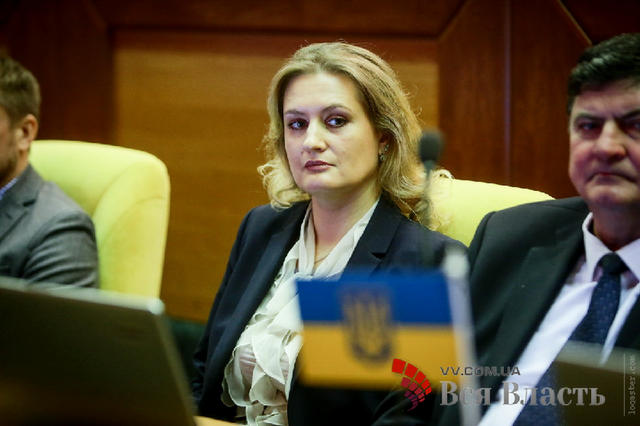
Yulia Kovalevskaya (née Lyakhovich) is a colorful figure even by the standards of the Party of Regions. A nurse by training, Kovalevskaya made a meteoric rise as a party functionary within the Party of Regions, not without the help of the late Crimean Prime Minister Vasyl Dzharty. (Notably, a whole host of Dzharty's allies has recently emerged within the Zaporizhzhia Oblast executive branch: Maksym Shishlov, Kateryna Yurchenko, and Sergey Burkhovetsky.)
After moving to Kyiv in 2006, she twice became a member of the Verkhovna Rada, working for O. Klyuyev, where she was responsible for special information campaigns. In 2011, she joined the inter-factional parliamentary association "Youth Choice" (a wing of the Party of Regions), founded by the younger Yanukovych and O. Pshonka. And in 2012, with the help of Lukash and Pshonka, she became the head of the training department for party activists and campaigners at the central office of the Party of Regions.
After the Maidan, she didn't disappear, but with the help of influential former Party of Regions members, she held on to her position as First Deputy/Acting Head of the National Agency of Ukraine for Civil Service—a body with the authority to conduct an internal investigation into any government agency or individual official. It's said that Kovalevska's appointment completed a well-orchestrated corruption scheme involving the Prosecutor's Office, the Security Service of Ukraine, and the National Civil Service, creating a "milking machine" for high-ranking officials, who were deliberately driven to commit offenses and then mercilessly extorted.
As we can see, Yulia Sergeevna is a complex person, not very public, and involved in the shadowy dealings of the "Family." A subtle psychologist and manipulator, skilled in intrigue, she can manipulate politicians and keep many secrets.
Yulia Sergeyevna has extensive connections within the Central Election Commission, allowing her to influence the vote counting process. It's worth noting that her husband, Artem Valerievich, holds a senior position at DIAD LLC, a confectionery factory that relocated from Gorlovka to Russia's Penza Oblast after 2014. And you're talking about a Lipetsk factory, a Lipetsk factory.
Kovalevskaya herself has always been involved in controversial political activities. For example, she even currently works with the controversial "Ukrainian Choice" party led by Putin's crony, Viktor Medvedchuk, on behalf of her public organization.
And so, apparently at the behest of Artem Pshonka, this wonderful lady began working in the fall of 2014 at the campaign headquarters of a simple candidate from the BPP, Sergei Valentinov.
Ironically, the Zaporizhzhia Oblast public only noticed Yulia Sergeyevna a year later, in the fall of 2015, when Kovalevskaya appeared on the Opposition Bloc list for the Zaporizhzhia Regional Council. In the regional center, they began to wonder how someone with such a background had ended up in the backwater of Tokmak and on the provincial regional council. Few realized that Yulia Sergeyevna had appeared in this backwater much earlier, and not by chance.
Her company, VIP-Consulting, became a contractor for Sergei Valentinov's campaign. Officially, VIP-Consulting trains election commission members for independent candidate Valentinov. In reality, Yulia Kovalevskaya is acting as the "key person" to reactivating Pshonka's network, which had been dormant for over a year. Training election commission members is the perfect cover for such work.
Kovalevskaya also brought along Tatyana Graban and Natalia Korneichenko. Having worked in Valentinov's campaign as managers of VIP Consulting, they later became his full-time assistants in the Verkhovna Rada... to keep an eye on him.
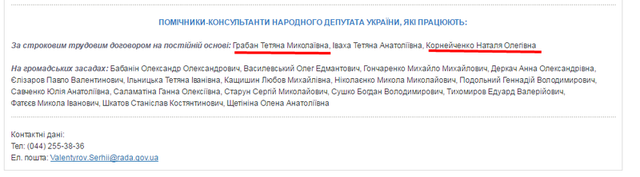

T. Graban

N. Korneichenko
It's noteworthy that on her Facebook page, Tatyana Grabar, S. Valentinov's official assistant, currently lists her place of work as a Moscow-based news agency. And why not?
But even with her loyal assistants from VIP Consulting, Yulia Sergeevna couldn't reach every village council head and school principal. Yulia Sergeevna gathered Artem Pshonka's numerous remaining henchmen in the area, arranged a necessary communication session with the "boss in exile," and began her work.
Who ensured Valentinov's victory?
As a result, the following “trusted personnel” of Pshonka Jr. tacitly ended up in Valentinov’s campaign:
— his longtime assistant and business partner, Lyudmila Lyubim, head of the municipal institution "Regional Fund for Support of Individual Housing Construction in Rural Areas" and a fellow countrywoman of Pshonka, originally from Kramatorsk. As a thank you for all the good she and Kovalevskaya would later secure an easy run for the regional council in the Tokmak district from the Opposition Bloc in the local elections, a year after the parliamentary elections.
— the now-lustrated former head of the Akimov district, Anatoly Blokha, who took part in collecting construction kickbacks in the Pshonki district.
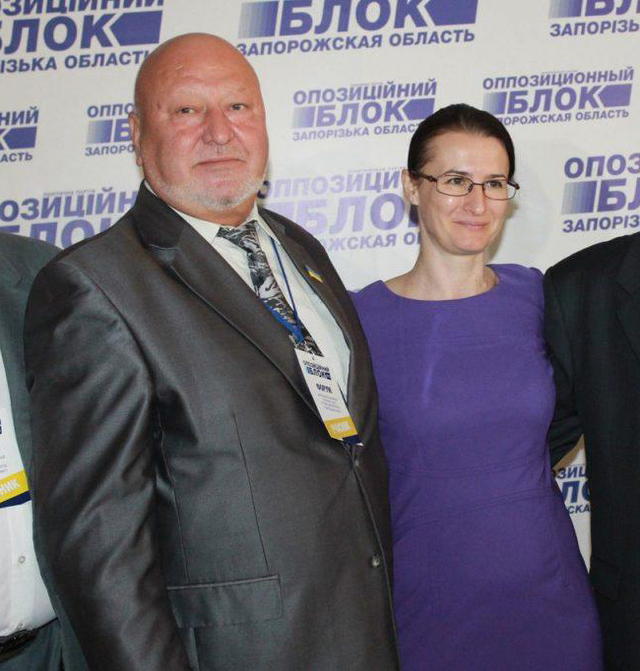
A. Blokha, L. Lyubim
— Lyubim’s deputy for the municipal institution, Anatoly Kazantsev, is also a native of Kramatorsk
— former head of the Priazovska District State Administration, now regional council deputy Vadim Sukhina
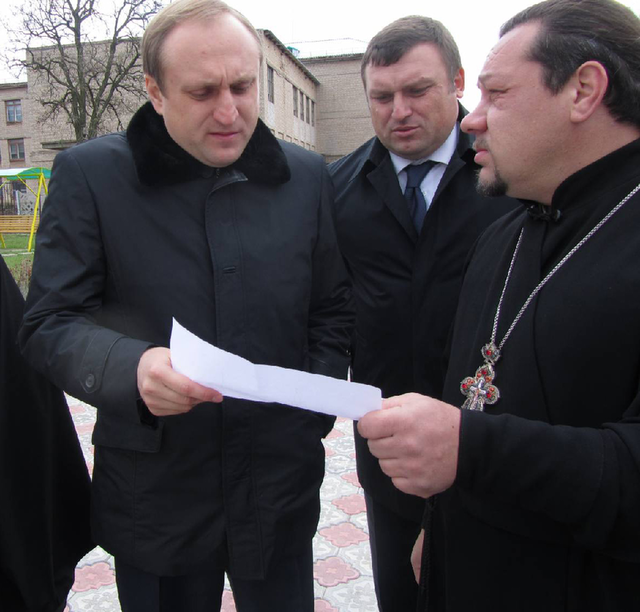
— one of the heads of Pshonka's charitable foundation and pharmacy owner Oleh Surzhan, whose fraudulent dealings with the property of the Tokmak community have been previously reported. Surzhan managed to "stand out" by squeezing into the regional council this term not as a member of the Opposition Bloc, like his fellow Party of Regions members, but as a member of Batkivshchyna.
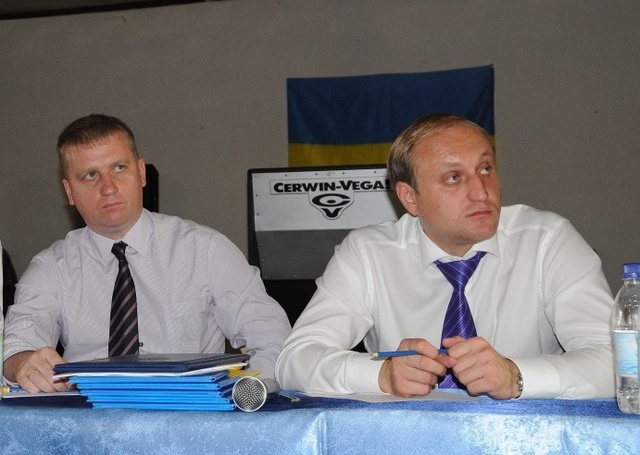
— Artem Pshonka's former assistant, Alexander Verbitsky
— former head of the Veselovskaya District State Administration Irina Kukovinets, etc.
Yulia Kovalevskaya lined up all these "Pshonkov fighters," and a few others, at Sergei Valentinov's headquarters. And they launched a network, securing the victory of the unknown Valentinov. It's enough to watch the video that went viral, where, with a wave of a magic wand, chief physicians allowed Valentinov's eyeglasses into hospitals, and local law enforcement dropped criminal cases, and everything becomes clear. But the much-publicized distribution of the candidate's eyeglasses was just the tip of the iceberg. Far more "pranks" were disguised, and only echoes reached the regional center.
How many Zaporizhzhia deputies does Pshonka have in his pocket?
There's another unclear point in Pshonka's relationship with Ponomarev and Valentirov. Specifically, how generously did Artem Viktorovich invest in the 2015 local elections, if at all? As previously reported, a year ago, Alexander Sergeyevich Ponomarev carried out a large-scale acquisition of "party assets." Ponomarev's "portfolio" included the BPP in his and Valentirov's constituencies (and recently, the entire region), as well as Nash Krai and the Agrarian Party throughout the region. The MP then spent heavily on funding their election campaigns in the region, as well as his political infantry in the local councils of the 78th and 81st constituencies (12 territories). And in his native Berdyansk, he bought the victory of the hastily chosen mayor, Vladimir Chepurny, and a dozen of his people into local parliamentary seats.
Those who know the cautious and calculating Ponomarev say frankly that spending so much on politics is completely uncharacteristic for him, and he doesn't have that kind of spare cash. Meanwhile, the financial potential of the Pshonkas, father and son, is estimated by experts at one and a half billion US dollars. Perhaps Oleksandr Sergeyevich received cash from the same Artem Pshonka, who had helped him with his people a year earlier? And what, then, is Pshonka's influence in the parties and territories Ponomarev has acquired? Considering the recent scandal in Kherson involving Our Land, where FSB curators and funding came to light, one can't help but wonder: WHOSE money was Ponomarev pouring into his parties' election campaigns?
Rumor has it that immigrants from Viktor Fedorovich's team are paying an unofficial fee to Russia to support troops in the LPR and DPR. To ease the burden on their own budgets, they lobby in Russia for the business interests of merchants based there... for a percentage.
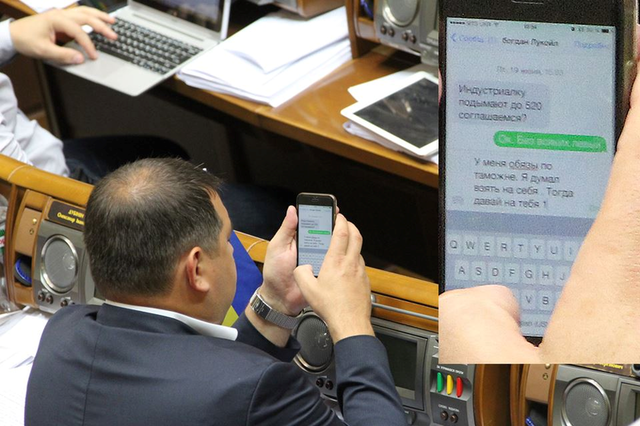
Last year, correspondence between Sergei Valentinov and a manager at Lukoil (a Russian oil company) was leaked to the media. The MP noted his "obligations to customs" regarding Lukoil. Valentirov and Ponomarev's company, Agrinol, needs cheap raw materials for their lubricants and oils, as well as markets for their finished products. The fact that the proceeds from these deals go to armaments on the other side of the front is irrelevant.
Now, let's get serious. If you look at a map of the Zaporizhia region, you'll see that the districts of Valentirov, Ponomarev, and Yevhen Balitsky, known for his pro-Russian statements, occupy the southern half of the region, adjacent to the Sea of Azov. And they form the very "gateway to Crimea" that was so much talked about a year ago and continues to be talked about. A separate article could be written about Yevhen Balitsky, who was also a member of Kurchenko's notorious "For Peace and Stability" group and recently gained notoriety for "picking up" the issue of special status for our region after the SBU cracked down on the "Social Zaporizhia" movement. But the fact that MPs Ponomarev, Valentirov, and the aforementioned regional council member Lyudmila Lyubim regularly attend his events has been mentioned only in passing. Which is a shame.
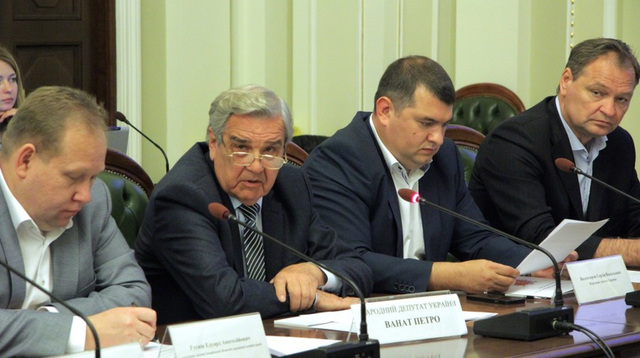
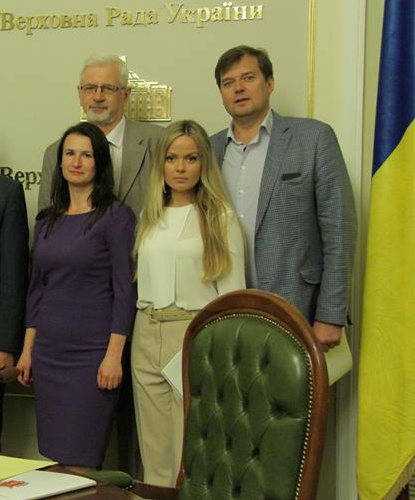
L. Lyubim, E. Balitsky, VR, discussion of special status
If we assume that Ponomarev received the cash from Pshonka Jr. a year ago to buy up the parties—Agrarnaya, Nashe Krai, and partly the BPP—then it's interesting to see how many regional and district council deputies Artem Viktorovich has influence over. It turns out he has five direct allies in the regional council (below), four in the Opposition Bloc (Kovalevskaya, Lyubim, Sukhina, and the elder Balitsky), and one in Batkivshchyna (Surzhan). Potentially, Pshonka has 10 more deputies in the Nashe Krai faction, where those from Ponomarev's faction are particularly prominent: Serhiy Tkachenko (chairman of the budget committee), Oleksandr Babanin, Oleg Budyansky, and Elena Bodasyuk. He also has BPP deputy Artem Popov, also close to Ponomarev. In total, we have 16 seats over which Pshonka Jr. can influence. Not bad?! Of course!
Now let's add to this the recently seized regional "BPP" party. With its parliamentary bayonets, things can be done, too.
Self-defense, whose are you?
But political influence in these difficult times isn't enough to achieve serious results—power is also needed. Therefore, Pshonka began actively taking an interest in paramilitary groups, which are nothing new in modern Ukraine. And, apparently, this interest led to a "constructive dialogue" with the puppeteers. Now, in the south of the region, precisely in the districts of Valentirov, Ponomarev, and Balitsky, all sorts of "self-defense" groups continue to flourish, often unaware of whose interests they serve.
As early as April 2015, they staged a public outrage at a local session in Berdyansk—https://www.youtube.com/watch?v=ucaQ1W7OYcI. It made no sense, but it was more than enough for a good show. A. Ponomarev was behind the raid. In Melitopol, raids on businesses and government officials' offices by men in camouflage became regular occurrences. Lastly, Balitsky's name is sometimes mentioned in these incidents.
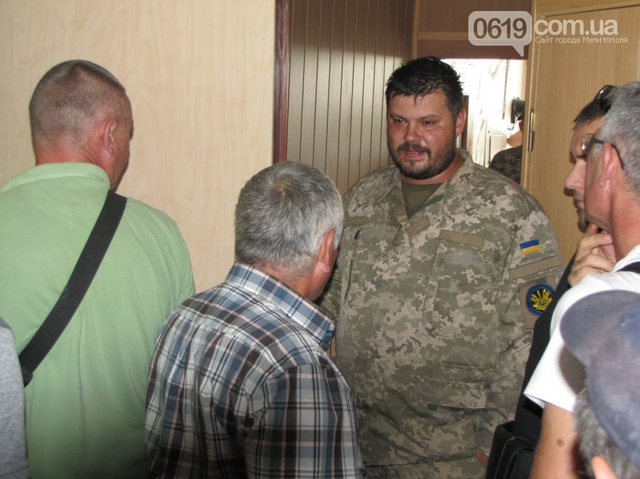
In Tokmak, they're trying to oust the city council secretary from the BPP, and then they're wreaking havoc on the local municipal newspaper. Valentinov's name is mentioned in the organization of the raids. And so on.
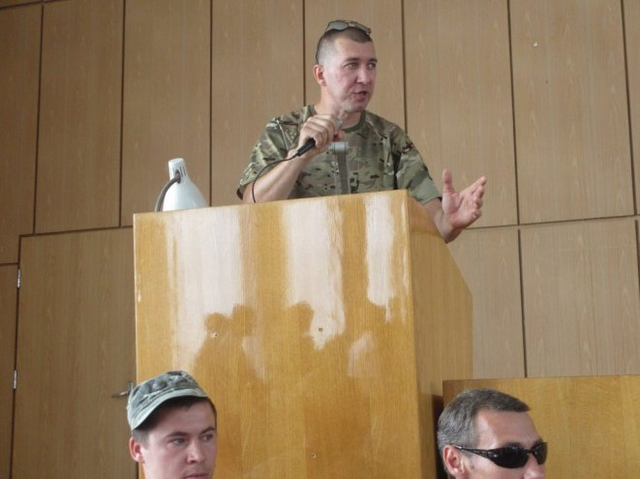
Meanwhile, in the northern regional center, where hotheads are far more prevalent, such excesses don't occur. In fact, the paramilitary structures there disband due to lack of funds. In the southern districts, however, they deliberately "feed themselves" and occasionally present the desired image. And who's providing them with the cash for offices, gas, and salaries? Clearly, moonlighting projects like the aforementioned art projects don't cover the current needs of such structures. And given the geography, it appears that the main sponsors of the numerous "self-defense" organizations are precisely Pshonka's men.
What might happen on "Day X"?
It's clear that Artem Pshonka, running around Moscow and puffing out his cheeks, is telling far more than his people here are capable of. It's also clear that Ponomarev and Valentirov are also counting on doing far less than Artem demands of them at the "hour of reckoning." However, nothing prevents Artem Viktorovich from acting beyond the two MPs, directly issuing orders to his well-placed men. And it's not just VIP Kovalevskaya. Rumor has it that he personally calls Lyubim, Verbitsky, Blokha, Kazantsev, and others periodically to ask how things are going in the region, what the electorate is thinking, and how his "successor" is behaving.
So, no one will stop the use of pro-Russian members of the "Pshonkov network," recreated for political purposes, for information gathering and quiet sabotage. Or for hosting and sheltering a group of saboteurs. And certainly no one will stop Kovalevskaya, Lyubim, and other characters from engaging in overt and subtle separatist activities. Theoretically.
For example, Yulia Kovalevskaya is currently actively involved in the Women for Peace movement, establishing its local branches in the Valentirov district.
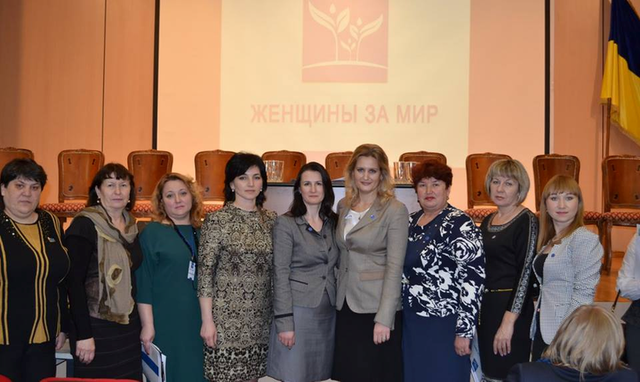
Women for Peace Movement, in the center – L. Lyubim, Yu. Kovalevskaya
Today they gather, drink tea, gossip, and talk about their health. But tomorrow, if tensions escalate in the east or, God forbid, a conflict erupts on the southern border, they could very well begin "peacefully" blocking military convoys. Well, we're supposedly women, we're supposedly for peace, so take your hands off us and let us lie on the pavement.
And the "self-defense" groups financed by Pshonka are unlikely to rush to the front as volunteers when the situation worsens. But they're always welcome to sign up to "guard strategic facilities," so they can launch saboteurs against these facilities at the right moment.
Pshonka's actions are unmotivated. Neither his former district, nor its residents, nor the Zaporizhzhia region itself, are of any concern to the fugitive MP. He's playing on two fronts. His focus is on business interests, regaining influence here and gaining influence there. He'll do this by any means necessary—by surrendering his district to a BPP representative, by promoting his people to power under various banners, by negotiating with the "damned junta," or by blackmail...
It's very difficult to answer the question, "How much can Pshonka influence the Zaporizhzhia region on Day X?" And it's not up to journalists to answer it.
In general, it would be better to conduct touching preventative work in addition to searching for an answer – so that the preconditions for such a question do not arise in the first place.
Read more: Alexander Klimenko. He flew away, but really wants to return and expand.
Dumchev. The Era of Political Déjà Vu in Kyiv
Ivan Dezhurny
Subscribe to our channels on Telegram, Facebook , Twitter , VK - Only new faces from the SKLEP section!