
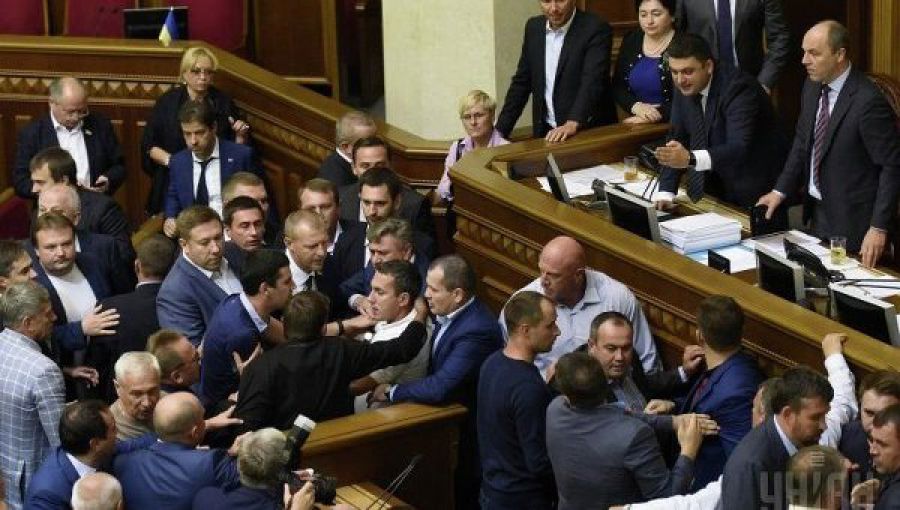
 It's always been clear that parliamentary candidates spend exorbitant sums on aggressive advertising and the services of political strategists for reasons other than improving the lives of ordinary Ukrainians. Upon entering the building on Hrushevsky Street, newly elected MPs, as a rule, quickly forget their campaign promises. However, they always remember their obligations to their superiors and sponsors. Perhaps this is why, in each new term, following the pompous opening of the new political season, MPs inevitably descend into a banal tug-of-war to please their "masters."
At the direction of the Bankova
Political experts also point out that the current Rada is catastrophically incapable of making independent decisions. According to data from the Institute for Policy Analysis and Management, compiled from a survey of over thirty political experts, anyone but the four hundred-plus deputies who took their seats based on their electoral ranking influence the processes under the Verkhovna Rada's dome.
"The influence of various political players on the work of the current Verkhovna Rada is simply enormous," says Anna Svidchenko, an expert at the Institute for Policy Analysis and Management. "According to the experts surveyed, the incumbent President, Petro Poroshenko, exerts the greatest influence on parliament's work. These results are primarily due to the president's growing influence through the Petro Poroshenko Bloc faction. The key decisions we've recently seen were made with the support of this force. For example, the controversial law on local elections was adopted precisely under the auspices of the presidential administration."
However, it's difficult to call Bankova's influence decisive. According to experts interviewed, the president isn't the only one wielding the primary levers for directing the Supreme Council's work. Representatives of financial industrial groups, or, in simpler terms, oligarchs, also exert a similarly significant influence on what happens within the parliament.
"This fact isn't particularly surprising. After all, it's no secret that most decisions in the Verkhovna Rada are driven, essentially, by the economic interests of the groups behind the main political players," says Svidchenko.
Western authorities
Experts also named the United States and the European Union among the major political players exerting enormous influence on the Ukrainian parliament. Moreover, if we add up the percentages of influence Western partners exert on the legislative process, it turns out that Ukraine's "friends" exert even more influence on the Rada than the oligarchs. This is easy to agree with, especially considering how US Deputy Secretary of State Victoria Nuland and US Ambassador to Ukraine Geoffrey Pyatt persuaded the deputies to adopt constitutional amendments. Interestingly, the Kremlin's influence, which coalition representatives constantly harp on, is estimated by experts to be minimal—1,52%.
Clearly, such a large number of actors exerting varying influence on the work of the country's main legislative body could not help but impact its effectiveness. Considering that, in defending the interests of their sponsors, deputies are sometimes forced to go against their own comrades, it's no surprise that the life of the Verkhovna Rada's democratic coalition is constantly under threat.
"The crisis in the parliamentary coalition is more likely to be driven by domestic politics than foreign policy. According to our data, the instability of the parliamentary majority is attributed to the influence of financial and industrial groups on factions and the various interests of domestic players in Ukrainian politics. The crisis is fueled by President Petro Poroshenko's growing influence across all spheres of political life, which is clearly causing discontent among other coalition members, who are ceasing to be effective actors in the Ukrainian parliament," Svidchenko notes.
Last times
Experts also cite the serious interest of some groups in reforming the Verkhovna Rada coalition as one of the main causes of the parliamentary crisis. Although the options for a new majority are limited, the constant scandals under the veil could sooner or later become grounds for revising the coalition agreement and inviting other players to cooperate. The approaching local elections are also having a significant impact: coalition members are willing to reconsider their attitudes toward their colleagues to achieve their goals. Incidentally, the personal ambitions of faction leaders also rank high among the causes of the coalition crisis. According to experts, the already difficult situation is exacerbated by factors such as the lack of reforms and development, the oligarchs' sphere of influence, the helplessness of the central government, and its overall decline in approval ratings.
Therefore, it's possible that the coalition, and indeed the Verkhovna Rada itself in its current regime, is on its last legs. For example, many experts are already raising the possibility of early parliamentary elections in Ukraine. They estimate that this could be caused by the simultaneous withdrawal of all factions from the coalition. A violent overthrow of the government is also possible, ranking third on the list of possible reasons for dissolving parliament.
"A parliamentary crisis exists, and at least 90% of experts surveyed acknowledge it," says Ruslan Bortnik, director of the Institute for Policy Analysis and Management. "The problems and causes of this crisis are internal and are the result of the actions of senior officials and the oligarchic war. Moreover, influence over processes under the sway of the Verkhovna Rada is significantly fragmented among many influence groups. This demonstrates not only a certain anarchy of the process but also the difficulty of characterizing the processes currently unfolding in Ukrainian politics. Interestingly, despite the internal causes of the crisis, one cannot help but note the significant influence of external players. Unfortunately, almost all experts noted that the influence of civil society is quite insignificant."
Anton Stepanov, RIA Novosti Ukraine
Subscribe to our channels on Telegram, Facebook , Twitter , VK - Only new faces from the SKLEP section!