
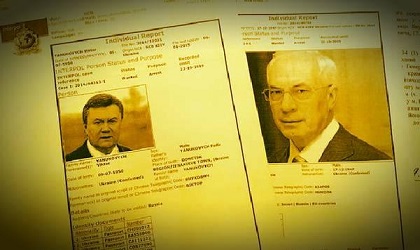
Business on Interpol: Why no one was looking for Yanukovych's gang.
Recently, Interior Minister Arsen Avakov announced that Interpol had finally placed Viktor Yanukovych on the wanted list. This occurred in January 2015, although, according to the minister, Ukraine had contacted Interpol about this matter back in March 2014.
It is impossible to verify the minister's statements regarding the timing of the Ukrainian side's appeal—the minister provided no documentary evidence to support his claims. Avakov also failed to disclose which law enforcement agency—the Ministry of Internal Affairs, the Security Service of Ukraine, or the Prosecutor General's Office—initiated the Interpol complaint against the former Ukrainian president. This further raises questions.
The main one is what exactly caused Interpol to delay its decision for so long—almost 10 months—instead of the 10 calendar days stipulated by Interpol's rules.
The minister, who works for taxpayers, does not consider it necessary to let them into the secretive activities of the security forces.
It remains a mystery why the overwhelming majority of state criminals associated with the so-called Yanukovych "family" were only placed on Interpol's wanted list in late 2014 - early 2015, or were not placed on it at all (for example, Oleksiy Azarov, Artem Pshonka, etc.).
Journalist Sonya Koshkina (Left Bank) may explain the motive behind the Interior Minister's (and Prosecutor General's) actions in an interview: "For example, here's a story I'm sharing for the first time. It's mid-June. On the eve of the vote to replace Makhnitsky with Yarema, I accidentally learn that Andrei Klyuyev has been removed from the Prosecutor General's Office's wanted list.
The vote was scheduled for Thursday, and on Wednesday evening, Klyuev was removed from the wanted list. That's it! No more charges against him! As far as I know, it cost a pretty penny—several million dollars, but oh well. At the time, I was just getting ready to fly to Moscow for a meeting with Alexander Yanukovych, again for the book. I was thinking of trying to record Klyuev while I was at it.
So, on Wednesday evening, he's removed from the wanted list, but there's no public announcement. On Thursday morning, in the Rada, I approach his brother, Sergei, asking for a meeting with Andrei. "I'm going to Moscow," I say. "So he's in Kyiv!" Sergei cheerfully replies. Interestingly, I didn't even have time to articulate the "bookish" purpose of my meeting with Andrei Petrovich—he was so certain they'd "solved" everything that he blurted out the good news straight to my face, without really considering the consequences.
On Thursday, as planned, the Rada voted for Yarema. That evening, the SBU again placed Andriy Klyuev on its wanted list—this time under its own authority.
We are talking about a state crime: someone is removing from the wanted list (or not placing on the wanted list) people involved in the theft of billions of dollars in assets and an attempted coup d'état with the aim of dismantling the state of Ukraine, and organizing the mass murder of people.
Who could this person be?
The National Bureau of Interpol in Ukraine is overseen by the Ministry of Internal Affairs, represented by the Minister of Internal Affairs (Arsen Avakov). Upon his instruction, notices of wanted persons reasonably suspected of a crime are entered into the Interpol database.
Technically, information about the wanted person is entered into Interpol's operational system, officially called the "Telecommunication System - I-24/7" (the numbers indicate that it operates 24 hours a day, seven days a week). Using this system, Interpol National Bureau staff populate databases, including the Wanted Persons Database (ASF).
Interpol National Bureau employees have individual access keys (login and password) to the I-24/7 system. These keys allow them to track who, when, and what information was entered into the database. A record of any changes remains in the system forever.
The Minister of Internal Affairs "signs for Interpol" requests for individuals against whom criminal cases have been initiated by the Ministry of Internal Affairs. He also endorses requests for search warrants received from the Prosecutor General's Office (signed by the Prosecutor General (Vitaliy Yarema) and the Chairman of the Security Service of Ukraine (Valentyn Nalyvaichenko).
The Minister of Internal Affairs, the Prosecutor General, and the Chairman of the Security Service of Ukraine (SBU) can also remove a person from the Interpol wanted list, each within their own jurisdiction.
However, requests to remove a person from the Interpol wanted list, submitted by the head of the SBU and the Prosecutor General, require a visa from the Minister of Internal Affairs.
In any case, this is the official procedure that has been in place since the opening of the Interpol National Bureau in Ukraine. And it's unlikely to change.
In fact, the history of Interpol's Ukrainian headquarters has already seen examples of senior officials manipulating their "wanted" status. A charismatic example was the removal of Ihor Bakai (Minister Yuriy Lutsenko, Head of the National Bureau of Interpol Kyrylo Kulikov) from the wanted list for several days, allowing the embezzler to settle his personal financial problems in Switzerland. Details can be found in the publication "For Whom the ATO, For Whom the Banquet. Part 2: Marauders and Traitors in the Rear."
During Yanukovych's tenure, the Prosecutor General's Office announced that a number of influential individuals had been placed on Interpol's wanted list, but for some reason, materials on corrupt officials were not included in the Interpol General Secretariat's database, as the media learned.
Let us emphasize: there is no way to bypass the legal process of not including, adding, or deleting information on an individual's international wanted list. Submitting an Interpol wanted list is a purely technical procedure: Ukraine submits the request, and within 10 days, the individual is added to the database. The only exceptions are politicians, whose wanted list submissions are reviewed individually by a special commission of the Interpol Central Bureau, which carefully examines the evidence provided.
Interpol can refuse to place someone on the wanted list only in two cases:
— the request for a search is politically motivated, that is, it is persecution for political reasons, which is unacceptable;
— the request for a search warrant is not based on a reasoned justification, meaning that the charges are poorly prepared.
Let's return to the realities of Ukraine.
Thus, it is a well-known fact that Viktor Yanukovych, as well as several dozen individuals from his inner circle, were not placed on the international wanted list through Interpol for a long time. The length of this period exceeds all reasonable timeframes for an investigation. The widespread failure to place officials and outright criminals—V. Yanukovych's accomplices—on the international wanted list also suggests possible sabotage of the law by senior government officials.
There is also at least one known case where a person placed on the international wanted list was unlawfully removed from the wanted list: Andrei Klyuev.
In fact, Yanukovych's top officials and he himself were placed on the international wanted list in early January 2015, when a public scandal erupted around this dirty story.
Who could have sabotaged the wanted listing of prominent state criminals—corrupt officials, embezzlers, bandits, and murderers?
The Prosecutor General, the Minister of Internal Affairs, and the Chairman of the Security Service of Ukraine (SBU) are submitting unfounded complaints against individuals to Interpol Headquarters—it's simply unbelievable. Firstly, each defendant in a criminal case is guilty of numerous crimes. Secondly, no law enforcement agency leader would entrust the investigation of high-stakes cases to amateurs—it's just not worth their while.
This means that one of the aforementioned heads of the country's security agencies deliberately delayed the issuance of a wanted notice for "Yanukovych's guard." It's not difficult to determine who is to blame. It's enough to request a signature from the person (a specific Interpol National Bureau officer), at the request of which security agency (the Ministry of Internal Affairs, the Prosecutor General's Office, or the Security Service of Ukraine), when (date), and which specific defendants in high-profile criminal cases (Pshonka, Yanukovych, Zakharchenko, etc.) were put on the wanted list.
And also by whom (a specific employee of the National Bureau of Interpol), at the request of which law enforcement agency (the Ministry of Internal Affairs, the Prosecutor General's Office, the Security Service of Ukraine), when (date and for how long) and which specific defendants in high-profile criminal cases (Pshonka, Yanukovych, Zakharchenko, etc.) were removed from Interpol's wanted list.
Based on this data, it's possible to obtain a comprehensive answer as to who is personally responsible for the criminals' carte blanche to conceal their criminal activities and the freedom to dispose of billions of dollars in stolen assets.
In any case, the blame for the criminals being able to roam the globe and freely dispose of assets in Ukraine for almost 10 months lies with at least two officials: Prosecutor General Vitaliy Yarema and Interior Minister Arsen Avakov. The former clearly failed to demonstrate integrity and proper proactiveness in this matter. Without the latter's knowledge, this disgrace—an official crime—could not have been perpetrated so cynically and provocatively for so long.
It's also likely that the freedom or lack of freedom of several pillars of the Yanukovych regime was a decision made by Ukrainian President Petro Poroshenko. By granting freedom to these utter criminals, Poroshenko was pursuing some political agenda (bargaining with Putin, for instance) or his own personal one. Such "gifts" to Ukraine's wealthiest criminals could have yielded enormous financial dividends.
The worst-case scenario is that it turns out that officials working for Russian intelligence agencies were the ones dragging their feet on the international wanted list. Why not? The Ukrainian Ministry of Internal Affairs, from which General Vitaly Yarema emerged, was a breeding ground for FSB and GRU agents long before Yarema became a captain.
Moreover, the Ministry of Internal Affairs' Organized Crime Control Department even became a base for the formation of "death brigades" like the "Goncharov Gang" (Kyiv), the "Bukhgalter Gang" (Odesa), or even the aforementioned "Oplot" (Kharkiv). And today, it's not just the author of these lines who sees that even under the embezzler Yanukovych, two orders of magnitude more corrupt officials were imprisoned than under Prosecutor General Yarema. And that's a fact. So what should we make of Yarema in this situation?
And as before, bandits and murders in Ukraine are covered up by generals.
Gennady Moskal, with a general's bluntness, put it bluntly: "If there are no significant individuals in the Interpol database, then information about them wasn't sent there. They're just playing dumb."
People's actions speak louder than their words. What are the words of Avakov, Yarema, and Poroshenko worth if, in fact, ALL the key criminals of the Yanukovych regime are free, Rinat Akhmetov, head of the Donetsk organized crime group "Lux," rules from Kyiv, and Viktor Medvedchuk is left unquestioned?
The bitter truth is that many of the highest positions in the state, just as under Yanukovych, are now occupied by unprincipled, immoral, greedy people for whom Ukraine is merely a source of profit, and the people of Ukraine a source of enrichment.
These people will spend a long time telling us about the hardships of war, the empty budget, prancing around in embroidered shirts and posing against the backdrop of ATO fighters. Filling the vacuum of their deeds for the good of Ukraine and its people with chatter and masquerade. How long they can continue to flaunt their words with impunity depends only on us. They will have to answer for the "investigation" into the Maidan shooting and the "protection" of Yanukovych and company.
Sergei Fedorov, "Argument"
Subscribe to our channels on Telegram, Facebook , Twitter , VK - Only new faces from the SKLEP section!