

Alexander Bobkov. A member of Ukraine's most feared gang, as the FSB's new "compromise figure."
The MP who betrayed Ukraine is Alexander Bobkov. Tatyana Zarovnaya writes on the website ORD.
A new wave of rumors was preparing the ground for a looming leadership change in the "DPR." A new FSB protégé, a former "rygi" MP named Alexander Bobkov, was tipped for the post of "DPR Director." Who is he? The founder and sponsor of Kharkiv's Oplot. A member of the most ruthless Ukrainian gang, known as the Givi Nemsadze organized crime group (whose undisputed fiefdom since the 90s has included the Budyonnovsky and Proletarsky districts of Donetsk, as well as the town of Mospino). A new "republican" oligarch who benefited from the "nationalization." And, according to his rival, Alexander Khodakovsky, the leader of the "Vostok" gang, a fake warrior. Formally, from 2015 to 2016, Alexander Bobkov "served" in the First Army Corps of the "DPR," but, as the "Vostok" member clarified in one of his blogs, "Bobok" is only listed as a company commander in the illegal international gang "Pyatnashka." He holds no official position in the "republic," but has already created two projects that he hopes will serve as a party base during the upcoming fake "elections" in the "DPR." These projects are: the "Happy Labor Donbass" public movement, which Bobkov's channel "Oplot" heavily promotes, and "the largest youth organization in the "DPR," "Young Republic."
Here's some information from the public biography of the former Verkhovna Rada member: "Afghan veteran," driver, director of the Budyonnovsky Kolkhoz Market since 1992, chairman of the Budyonnovsky District Council from 2002 to 2010. Since 2004, chairman of the Donetsk city organization of the Party of Regions, since July 2010, deputy head of the regional organization of Boris Kolesnikov's Party of Regions , deputy of the Donetsk Regional Council, director of the Horlivka Coke and Chemical Plant. Since 2012, he has been a member of parliament.
"Bobka" (as this figure is known behind his back in the "republic") managed to break into the Verkhovna Rada only through a single-member constituency and at the cost of a great deal of terror. He achieved a nationwide record—81% of the vote. The key to this "phenomenon" lies in the same place as the "secret" of the former market director's entrepreneurial success—his close ties to Givi Nemsadze's organized crime group (our hero was elected in the constituency where Givi's gang has been wreaking havoc since the 90s).
When Bobkov was young and hot-blooded, his friend Givi founded the tradition of burying rivals in mass graves. It was thanks to this support that Alexander Bobkov became head of the district council in 2002, a position he held for eight whole years (rumor has it that he would gather his subordinates for district council meetings with the words, "The showdown will be at such-and-such a time"). In 2004, they fought together against the "orange plague"—at pro-Yanukovych rallies in Donetsk and Kyiv, they were responsible for supplying titushki, ensuring support for the Donetsk mafia's creatures. And in 2005, under the "orange" head of the Donetsk regional police, Mikhail Klyuyev, Givi's fortunes began to fall apart: three mass graves were unearthed in Donetsk. They found the owners of the businesses seized in favor of Givi, some missing persons (liquidated on contract), and former gang members who wanted to "get out of the game" (incidentally, Vasily Paskal, who was then working in Donetsk, was actively involved in the gang's development). It was then that Givi was forced to flee to Russia, although his forced exile didn't hinder him in the least from leading the gang in Donetsk.
The skinhead bacchanalia in the Proletarsky and Budyonnovsky districts, controlled by Alexander Bobkov and Nemsadze, was as much a tradition as the mass graves. It was so outrageous that even the satellite "progressive socialists" and "communists" were outraged—the "brothers" threw them out of the commissions with threats and blows.
But I personally remembered the name Alexander Bobkov in 2006, when the elderly communist Ilya Morozov was burned alive in the Budyonnovsky district. On March 25, 2006, two criminals from the Nemsadze gang climbed a tree to the second floor, broke a window, and threw Molotov cocktails into the room where Morozov was located. Morozov was the first secretary of the Budyonnovsky district party committee, a charismatic man with a sincere hatred of criminals. Having become the leader of the election process in the most criminal district of Donbas and defying threats, he signed his own death warrant... He ultimately died two days before the election, making way for Bobkov. I still remember the unfortunate widow who witnessed the horrific massacre: the old man turned into a living torch, and the footprints of the burning man remained on the melted linoleum...
The crime was so brutal that representatives of the Communist Party of Ukraine (CPSU) allowed themselves unexpected frankness. For example, Volodymyr Bidevka, a former Communist Party regional council member and now a "deputy of the DPR People's Council," said that Bobkov was the only possible mastermind behind Morozov's murder. The Donetsk regional committee of the Communist Party of Ukraine (CPSU) openly blamed the murder on the Party of Regions, "which declared its monopoly on all power in southeastern Ukraine" (quote from the press release). The communists demanded punishment for the killers, but never followed through (naturally, since they always worked in tandem with the "riffs" in Donbas).
After this, Nemsadze's thugs even calmed down a bit: they broke the jaws of those they disliked, but avoided lethal consequences. In 2010, while helping Professor, they exceeded the "common sense" figures handed down from above: according to the Party of Regions' most daring forecasts, voter turnout in Donetsk was expected to be around 70% (with the actual figure being 30-40%), but in the Bobkov-Nemsadze fiefdom, it was a record 72,36%.
After Yanukovych's victory, Givi was able to return home, despite the fact that he remained wanted on Interpol's website on suspicion of organizing 57 murders. First, he "surrendered" to the friendly Prosecutor General's Office, explaining that he was on the run only because he feared political persecution from Yushchenko, whom he had opposed in 2004. Renat Kuzmin, the "Murka" enforcer (deputy head of the Prosecutor General's Office), personally took on the task of dismantling the case. He secured convictions for the gang members on minor charges and then petitioned for the leader's pardon. You'll laugh, but due to the statute of limitations and the insignificance of the crimes committed (!), Donetsk's most corrupt court, the Kyiv District Court, ruled that the "rafikniuchem" was innocent. On September 15, 2010, the killer's leader was officially recognized as a victim of the "Orange" political repressions! The court, represented by its chairman, Vladimir Baulin, ruled that the gang was led by Givi's brother, Guram, who died of cancer in 2003. However, dozens of victims directly pointed fingers at Givi and asked that the deceased not be implicated. Their courage must be commended—the parents of the victims appeared in court despite threats.
During the Maidan, Bobkov focused on creating and financing the Oplot gang. It was his headquarters in central Donetsk that hospitably welcomed two hundred armed Oplot members. Meanwhile, his friend Givi "sent" criminals to the capital's Euromaidan to kidnap and torture Maidan protesters.
When the "Russian Spring" was already raging in Donetsk, Ukrainian MP (!) Oleksandr Bobkov dared to address officials at the Proletarsky District Council with an anti-Ukrainian agitation. He talked about how Ukraine would be saved by creating "six federal states, like Bavaria." He talked about how wonderful Putin's vision of Ukraine's federal structure was, and what a great man he was, and how lucky Crimea was to have him (this was after the "Crimean referendum")... He argued that it would be right to break the country into several "republics"... He confused his audience with tales of the terrible things National Guard soldiers were doing. And he tried to persuade the district executive committee staff to support a referendum on "Donbas independence"... The staff filmed this speech and handed it over to law enforcement, but – oh, miracle! – No one ever charged Bobkov with undermining territorial integrity.
They say the unknown "Sasha-Gavrilovsky-Kurchata" (Zakharchenko) owes his career to him. In April 2014, along with a group of two dozen "Oplot" supporters, he occupied the Donetsk City Council building, and the city's mayor, Alexander Lukyanchenko, explained:
"These guys aren't seizing, they're guarding. They're peaceful protesters."
A gang of thugs wearing "Oplot" armbands leisurely occupied the Donetsk City Council, and Lukyanchenko immediately began blackmailing Kyiv. And Alexander Zakharchenko made his first official statement: "We have come here demanding a local referendum. We ask the executive committee to assist with the preparations. We want to present our demands to the Verkhovna Rada for the adoption of Alexander Bobkov's bill. It has been submitted, and the Party of Regions faction has rejected it."
In short, Bobkov's bill, which the "peaceful Oplotovites" were talking about, was an attempt to achieve everything the Kremlin currently wants in its enclave in Donbas, only at a great cost in bloodshed. All of Alexander Bobkov's key ideas in this bill found resonance in the Minsk agreements, which are leading Ukraine to capitulation... Thus, the name of one of the main organizers of the war was exposed.
On April 28, Zakharchenko's Oplot group seized the television center at 61 Kuibysheva Street in Donetsk, and hung the flag of the "Donetsk People's Republic" on the state television company's building. The regional television and radio company was renamed Oplot TV, now directly commanded by Alexander Bobkov. Meanwhile, "peaceful protesters" posted guards armed with Kalashnikov assault rifles at the seized television center. Alexander Bobkov had already cut off Donetsk residents from Ukrainian television, while Governor Sergei Taruta continued to "naive," reassuring citizens: "This is the Oplot group; they're helping ensure security." Six months later, Bobkov attended Zakharchenko's "inauguration."

Bobkov before Zakharchenko's "inauguration"
An analysis of the "republic's" management team suggests that the same old team of "strong managers" from the Party of Regions continues to rule Donetsk. "Bobok's" buddy, Igor Martynov, has found a place in the "DPR"; the former director of a culture and recreation park has become the head of the occupation administration in Donetsk. Ivan Prikhodko, deputy head of the Voroshilovsky District Council, has become the head of the occupation administration in Horlivka. Alexey Granovsky, who was head of the Donetsk city branch of the Party of Regions, rose from the position of Minister of Fuel and Energy, and now heads the "Ministry of Industry and Trade."
We have already written about Bobkov's current influence on the "republic" here.
And here.
However, it wouldn’t hurt to recall the main points.
1. The new FSB protégé in Donetsk was precipitated by a lack of trust in Akhmetov, which led to problems for his men. This included Alexander Khodakovsky, the former commander of the SBU's Alpha Group and the leader of Vostok (a security guard for Akhmetov's property in occupied Donetsk). Khodakovsky was stripped of his seat in the "People's Council of the DPR," and an information campaign against him was launched within the "republic." During the war, Alexander Bobkov managed to establish personal connections with Akhmetov's ally Surkov and other Kremlin figures, acquiring property in the Moscow region, Rostov Oblast, and Crimea.
2. Today, almost the main financial flows in the terrorist enclave belong to the Bobkov-Orlov financial-industrial group (Andrey and Vladimir, the former a member of parliament of Ukraine of the 5th and 6th convocations, the latter his father-in-law). In Donetsk, this financial-industrial group is understood to include the Energoimpex coal corporation, which owns eight coal preparation plants, the Gorlovka Coke and Chemical Plant, a transport company, the family-owned Europrombank, the Energokapital metallurgical plant, and a hotel in occupied Crimea. And, allegedly, coal from private and state-owned mines, as well as from "kopankas" seized by militants, is being transported from the occupied territories to Ukraine via the Orlovs and Bobkovs. Allegedly, MP Yefim Zvyagilsky also suffered at the hands of these figures . They say that the Zasyadko mine also passed to the Bobkov-Orlovs, and Nasalik's ministry has a tidy percentage of this business.
3. In the "DPR," Bobkov maintains close ties with "Minister of Revenue and Duties" Alexander Timofeev (the same "Tashkent" with whom Nasalik negotiated coal supplies to Ukraine). The "Republican Bank of the DPR" is also controlled by Alexander Bobkov and the Orlovs, and is run by the former chairman of the Orlovs' bank, Europrombank (11 Taras Shevchenko Boulevard, Kyiv). "Minister" Timofeev, together with Bobkov, controls all "nationalized" firms (those seized from entrepreneurs who broke with the "DPR").
Interestingly, Artem Furmanyuk's article on ORD was followed by a "rebuttal" in the "DPR media"—an "image interview" in which Bobkov discusses not only the Kyiv junta but also the hundreds of millions of dollars spent on Yanukovych's rigged 2004 election. He expresses resentment for his past actions: he'd done so much for his own party (and of course, with such criminal resources), yet he wasn't elected anywhere—not to the Cabinet of Ministers, not to the parliamentary party list, not to the mayor's office. And now his moment of glory has arrived!
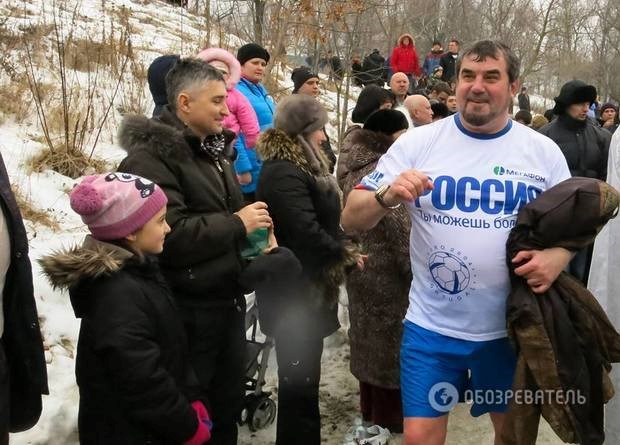
A cheerful Bobkov at Epiphany bathing in occupied Donetsk
"Zakharchenko's persona as the puppet leader of the fake republic no longer satisfies the Kremlin puppeteers. The former chicken seller and his entourage have become too corrupt, even by Russian standards. Under Zakharchenko, all "aid" sent to Donbas by the "brotherly" people was mercilessly stolen, from humanitarian aid to weapons. Moreover, the disobedient Zakharchenko even set his sights on his benefactor, Bobkov. Not long ago, the "DPR" militants "squeezed" the Maysky market in Donetsk's Budyonnovsky district from a member of the so-called "old Donetsk elite." Since the 90s, it had belonged to Bobkov jointly with the Donetsk crime boss Mikhail Lyashko, who was shot dead in Crimea. Zakharchenko's side was also sided with another longtime protégé of "Bobok," Timofeyev ("Tashkent"), who currently holds the position of "Minister of Revenue and Duties." So, Bobkov can hardly be considered one of their patrons anymore. Moreover, Russia is rushing to return Donbas to Ukraine's control, and therefore has a keen interest in eliminating the terrorist nouveau riche, who are not only hated by ordinary Ukrainians but also despised by oligarchs from the country's east. Like Rinat Akhmetov, for example. But he will definitely sit down at the negotiating table with Bobkov, as a junior partner, but a partner nonetheless. They shared too many ties in the past, and Bobkov now ranks several notches higher in terms of influence in the occupied territories. "And most importantly, in terms of odiousness, he cannot be compared to Zakharchenko, Timofeev, or Givi and Motorola, who have already been cleared out in preparation for the return of Donbass," Artem Furmanyuk commented on the current situation for ORD.
Let's add to the above that all the recent developments concerning ORDILO, both those originating within Ukraine (Artemenko and Pinchuk's plans ) and external ones (the arrival of Friend Kh**il in the White House and the Trumpization of global politics), suggest that change is indeed coming. However, it's doubtful the Kremlin will succeed in deceiving anyone in the West (let alone in Ukraine) by portraying Bobkov as a representative of the "rebellious Donbas." He looks even less like a man of the people than Zakharchenko. And among the accolades of this representative of the Donetsk "elite," the most important will always remain his affiliation with the organized crime group that Lutsenko and Mikhail Klyuyev described in 2005 as "the most influential, bloody, and brutal criminal organization in Ukraine." We can only regret that, just a short time later, the head of the Ministry of Internal Affairs, Yuriy Lutsenko, forgot about the mass graves and kissed those guys about whom he said: "Prison for the bandits."
Replacing Zakharchenko with Bobkov, of course, wouldn't be difficult (you could just give him a ride in an elevator, like Motorola), but putting on a good face while playing poorly—that's hardly it. Even the hat-wearing Viktor Yanukovych looks more like a "compromise figure" than the "fighter for special status for Donbas," who has the blood of old Morozov on his hands... Especially since the "Legitimate One" is racing full speed ahead to meet with "voters" in ORDILO. He's already sent letters with a plan for a "peaceful settlement" to world leaders, and has made a splash in the "republic's" media landscape... In his messages aimed at audiences in the occupied region, Yanukovych insists he misses his native land deeply and is ready to return...
1 comment for “A fledgling of Ukraine's most feared gang becomes the FSB's new "compromise figure""
Add a comment
You must be logged in to post a comment.
Subscribe to our channels on Telegram, Facebook , Twitter , VK - Only new faces from the SKLEP section!
Who is author?