
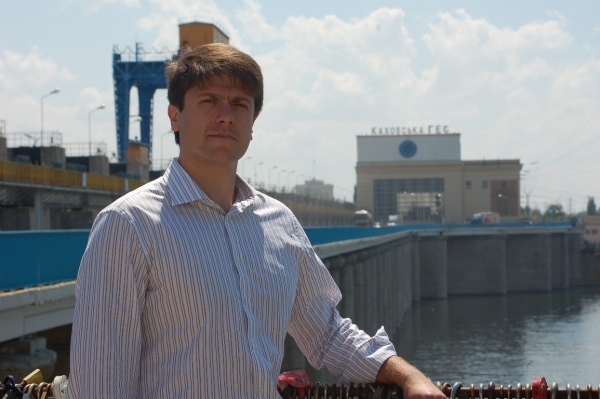
Ivan Vinnik
How a scoundrel from Nova Kakhovka became a representative of the presidential political force in parliament. How can a simple mechanic become a statesman? To do so, he needs to learn how to take out multimillion-dollar loans, organize corporate raids, and create businesses that evade taxes and don't pay their employees. This is precisely the path taken by Ivan Vynnyk , the former general director of Construction Materials Plant No. 1. And, to his credit, he achieved his goal: today, a seat in parliament is glimmering beneath him.
Do only cowards repay debts?
Ivan Vynnyk began his thorny path to parliament as a mechanic at the Novaya Kakhovka Electrical Machine-Building Plant. Then, unexpectedly, he switched to food production, becoming deputy head of supply at the Chumak company in 98. This is where the rosy part of his biography ends.
Having worked hard in supply chains, Ivan Vinnik decided to strike out on his own and start his own business in food retail and importing raw materials for the juice industry. He imported fruits, pastes, and concentrates from China and Uzbekistan. All supplies were financed by loans. Apparently, it was then that he decided that borrowing could be a profitable business in itself. A decade and a half later, by 2013, Vinnik's total personal liabilities to individuals and legal entities amounted to approximately $50 million.
But the debts would become unmanageable a little later. And in 2007, the current people's deputy founded Construction Materials Plant No. 1 (ZSM No. 1), a 360-employee company with a capacity of 450 cubic meters of concrete per year.
Mr. Vinnik's primary creditor was his Russian partner, V.K. Zykov, to whom Ivan Vinnik already owed $7 million at the time of the plant's construction. During the construction phase, Vinnik misled Zykov, claiming to have invested borrowed funds in the plant and promising to make him a founding shareholder. However, as it turned out, he simply cheated him. Subsequently, in February 2012, Zykov filed a complaint with the police requesting that criminal proceedings be instituted against Vinnik for fraud.
Another major creditor of Vinnik (worth approximately $1 million) was a Swiss citizen named Mr. Kurt. He, through his Ukrainian lawyers, eventually filed a lawsuit against Ivan Vinnik for non-payment.
Collaboration with Vynnyk proved deeply unprofitable not only for individuals but also for large companies. In 2008, Alfa-Bank opened a credit line of almost UAH 300 million for the ZSM No. 1 plant for the period until November 2010, with a further extension until March 2013. However, the borrower never repaid the loan.
Vinnik also signed a $1 million loan agreement with Chumak CJSC, but failed to fulfill the agreement. He repaid his personal debt to Vitmark-Ukraine and nearly paid off his debt to Erlan with illegal aerated concrete deliveries (the approximate total debt was approximately $2,7 million).
To cover his personal financial obligations, Ivan Vynnyk siphoned off at least $4 million from the working capital of a construction materials plant by the end of 2012, putting it in debt. The theft schemes that Ivan Vynnyk practiced at the plant have been known since the turbulent 90s: the plant's assets are sold to a shell company, which then sells them back, and the new buyer sells them back to the plant. As a result of his brisk "business practices," the company is mired in multimillion-dollar debts to investors, creditors, partners, customers, and staff (Ivan Vynnyk owes approximately 1,5 million hryvnias to employees alone). Significant debts to the tax authorities and to Khersonoblenergo are also hanging over it.
Anticipating the possibility that creditors would go to court to collect their debts, Ivan Vinnik decided to secure his property and personal belongings in advance. To do so, he acted cynically, as usual: on July 20, 2009, he fraudulently divorced his wife, Elena, and subsequently transferred all his real estate assets to her and their young daughter.
Incidentally, family connections clearly played a significant role in Ivan Vynnyk's ability to navigate difficult situations. His wife's uncle, Viktor Petrovich Lakizyuk, is a prominent figure in the judicial and prosecutorial community: in 2004-2005, he worked at the National Academy of the Prosecutor's Office of Ukraine, in 2005-2007, at the Supreme Court of Ukraine, and since 2012, at the National School of Judges of Ukraine.
Perhaps it was for this reason that the hapless manager, who had faced a number of criminal charges (for the illegal stripping of plant assets, tax evasion, and illegal VAT refunds), was released from criminal liability under an amnesty in February 2013 by a ruling of the Kakhovka Court. Officially, this was due to the presence of a minor child and the guarantee of the plant's staff, to whom he had failed to pay wages.
Raiding of the lowest order
The total losses of ZSM No. 1 LLC exceed 250 million hryvnias. Vynnyk was suspended by shareholders. In order to bring the company out of bankruptcy and restore profitability, a new director, Mykola Shiyan, was appointed; the plant was renamed Energy Product LLC.
However, the former CEO decided not to give in so easily and found no better option than to organize a hostile takeover of the plant. On March 31, 2014, a bus carrying approximately 50 people wearing helmets, bulletproof vests, and military-style uniforms arrived from Kherson to Nova Kakhovka. The attempted takeover was led by Dmitry Vasiliev, a Russian citizen and former executive director of the plant and a trusted confidant of Ivan Vynnyk. The assault was thwarted by the concerted efforts of the plant's management and staff.
On May 25, 2014, the Novaya Kakhovka City Department of the Ministry of Internal Affairs of Ukraine in the Kherson Oblast opened criminal case No. 12014230070001335 under Article 263 of the Criminal Code (illegal handling of weapons, up to five years in prison) for the defendant, Ivan Vynnyk, participating in a corporate raid. It would seem he wouldn't get away with it this time. But that wasn't the case. Mr. Vynnyk found a surefire way to evade responsibility: becoming a member of parliament.
On the eve of the snap elections to the Verkhovna Rada, he began positioning himself as a candidate for pro-presidential forces. After an unsuccessful attempt to gain a seat in parliament in the 2012 elections, Vynnyk decided to use his last chance to evade criminal liability.
His entire campaign was plagued by scandals. These concerned not only his commercial activities but also the electoral process itself. It's well known that, back in the previous elections in 2012, observers recorded vote-buying by Ivan Vynnyk, a candidate in the 184th majoritarian district in Nova Kakhovka.
In 2014, the "buckwheat method," which had failed two years earlier, proved more effective. Residents of Nova Kakhovka were given food packages in Vynnyk's name, containing, in addition to a candidate leaflet, a bag of tea, a bottle of sunflower oil, a packet of sugar, a packet of flour and buckwheat, and a first aid kit with essential medications.
So, on his second try, Ivan Vynnyk finally became a member of the Verkhovna Rada from the 184th single-member constituency. He should have calmed down now—heaved a sigh of relief that, with his past dealings behind him, he was temporarily inaccessible to law enforcement—and tried to do something useful for his native country. But that wasn't enough.
"Business" on parliamentary inquiries
According to his 2013 asset declaration published on the parliament's website, Ivan Vynnyk is relatively poor. His and his family's entire income consists of 80 hryvnias in financial aid of unknown origin. However, Ivan Yulievych managed to purchase a BMW 750 for 800 hryvnias. Such expenses require new, stable income (not a parliamentary salary of 6 hryvnias). Apparently, this is why the Novaya Kakhovka raider has adopted the business of parliamentary inquiries.
As Secretary of the Verkhovna Rada Committee on National Security and Defense (!), Ivan Vynnyk offers interested parties "services" for submitting inquiries to the Prosecutor General's Office, the Ministry of Internal Affairs, the Ministry of Defense, the Ministry of Justice, the State Penitentiary Service, the State Traffic Inspectorate, and others. According to committee staff, the price Vynnyk quotes to potential clients (depending on the complexity) ranges from $10 to $25 per inquiry. The subject of the inquiries is "nightmare" business inspections that circumvent the Prime Minister's direct prohibition. As the saying goes, "the grave will straighten the hunchback."
Today, the fact that someone like Mr. Vynnyk has somehow managed to worm his way into the Ukrainian parliament raises legitimate concerns. What good can our country expect from this specialist in loan defaults and debt accumulation, who has risen from the local level of Kakhovka and Kherson to the national level? It's unlikely to see any legislation aimed at reforming the old system or combating corruption.
Subscribe to our channels on Telegram, Facebook , Twitter , VK - Only new faces from the SKLEP section!