
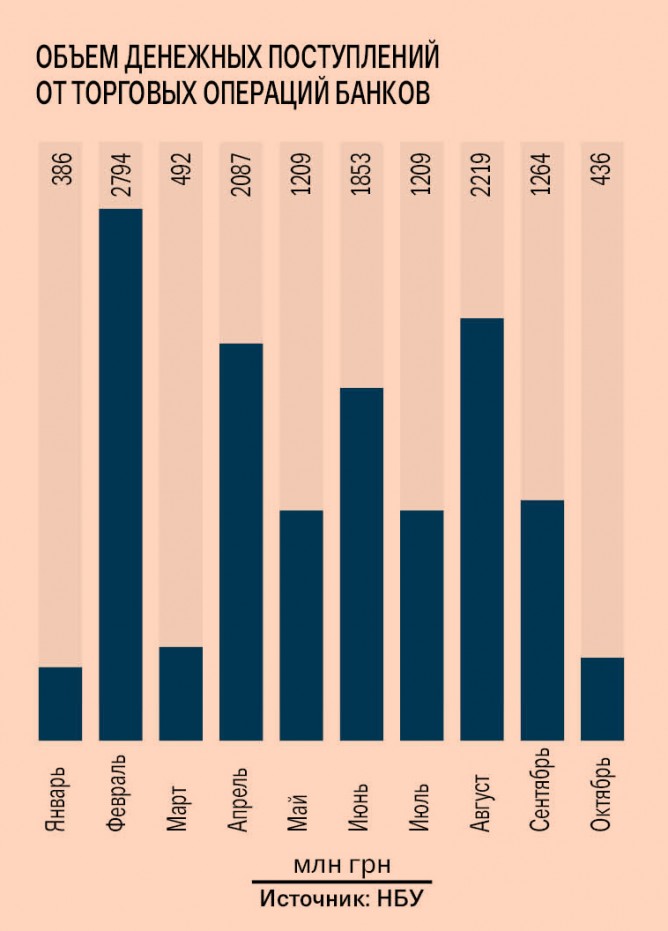
 The hryvnia's depreciation has had a severe impact on banking profitability. Revenue from virtually all types of financial institutions' earnings has fallen significantly. For example, trading revenue has fallen threefold. In October, it amounted to only UAH 436 million, compared to UAH 1,3 billion in September, according to the National Bank.
Plus and minus
Trading income includes the bank's earnings from trading securities, currencies, and precious metals. Financial institutions also reflect the revaluation of foreign currency assets and liabilities in this item. Almost all Ukrainian banks have foreign currency liabilities that exceed assets. Therefore, players automatically lose money when the hryvnia devalues. "If there is an open short foreign currency position (liabilities in foreign currency exceed assets – Capital) and the exchange rate rises, the revaluation of open positions is reflected as a loss for the bank. This reduces the trading income account," explained Kateryna Volodina, Head of Financial Markets Operations at Ukrsotsbank (UniCredit Bank).
Banks' trading income has also been reduced by the NBU's restrictions on the foreign exchange market. Financial institutions are now forced to adhere to the indicative exchange rate when conducting foreign exchange transactions, meaning the upper limit of the exchange rate is clearly defined, says Volodina.
"Considering that virtually all banks have pent-up demand (for foreign currency – Kapital), and exporters have adopted a wait-and-see approach and are in no rush to fully deploy export revenues, banks are narrowing their trading margins to stimulate exporters," she notes.
The devaluation also reduced banks' interest income, which accounts for approximately 75% of financial institutions' total revenue. "A sharp devaluation inevitably leads to a deterioration in the financial condition of companies and individuals, and consequently, to a deterioration in borrowers' ability to service their loan obligations, both in foreign currency and in hryvnia," says Tatyana Nurmukhametova, head of research at Nadra Bank. Overdue debt is growing—according to the NBU, it stood at 11,5% as of November 1, compared to 7,7% at the beginning of the year. Unofficial estimates place it at approximately 30% of the loan portfolio.
Banks suffered losses of UAH 13,5 billion in January-October.
Some banks even saw their interest income slip into the red. For example, Delta Bank's net interest loss as of October 1 was UAH 505 million, while Nadra Bank's was UAH 210 million. As a result, banks are reducing their lending, primarily to retail lenders, narrowing the pool of foreign currency borrowers, and creating additional reserves for overdue loans. From January to October, financial institutions allocated UAH 59 billion to reserves, resulting in a loss of UAH 13,5 billion.
Vicious circle
At the same time, banks were unable to retain deposits. Their outflow was triggered by the war, declining income, and devaluation. In the first 10 months of this year, the system lost 48 billion hryvnia deposits and over $8 billion in foreign currency deposits. This outflow of deposits, coupled with deteriorating borrower payment discipline, led, according to Nurmukhametova, to liquidity problems at a number of banks, bankruptcies of some, and increased distrust in the system as a whole. "I would venture to suggest that the devaluation and deteriorating portfolios have eroded the capital of the largest banks to a critical level. However, in the current environment, a planned hryvnia devaluation to bring official exchange rates in line with market realities is a long-overdue, albeit painful, necessity," said Tamas Hak-Kovacs, Chairman of the Board of OTP Bank.
At the same time, bankers claim they were prepared for this turn of events. "Considering that the country's balance of payments has been in the red for the past several years, we understood the risks of a devaluation of the national currency. Although, frankly, we didn't expect the hryvnia to depreciate so much," admits Mykola Voitkiv, Head of General Banking Risks at Finance and Credit Bank.
It's worth noting that the IMF previously described a rate of 12-13 USD/UAH as dangerous for Ukrainian banks, while today the dollar is trading at 15-16 UAH. "If the Ukrainian currency trades in the range of 10-11 USD/UAH, the consequences for banks, companies, and households will be acceptable. Balance sheets will be more severely impacted if the exchange rate consolidates in the range of 12-13 USD/UAH," the International Monetary Fund report stated. The stress test, which the IMF completed jointly with the NBU, also assumed a worst-case scenario of an average hryvnia exchange rate of 12,1 USD/UAH this year and 12,5 USD/UAH by year-end. Based on this, large and major financial institutions will need to recapitalize by UAH 66 billion. Clearly, at a rate of 15-16 USD/UAH, even this amount will not be enough.
Mark Pollock, Capital
Subscribe to our channels on Telegram, Facebook , Twitter , VK - Only new faces from the SKLEP section!