
A former Delta Bank investor will find it more difficult to support his comrade's business in exile in Vienna. This is Kirill Dmitriev.
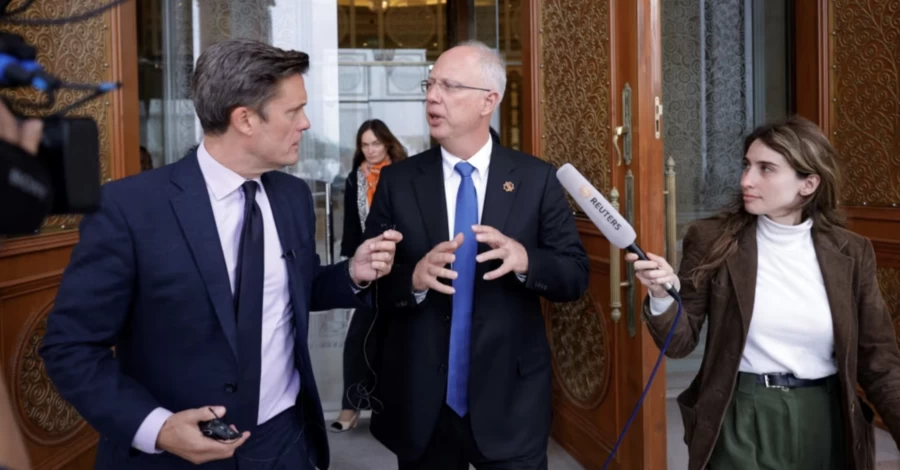
In early November, the National Security and Defense Council imposed economic sanctions against Vladimir Putin's right-hand man and the Kremlin's chief economic negotiator with the United States, Kirill Dmitriev, head of the Russian Direct Investment Fund. He will now be banned from any transactions in Ukraine, and all of his assets there are to be frozen. Despite the widespread attention surrounding the sanctions, the media has barely mentioned Dmitriev's key role in one of Ukraine's largest financial deals: the creation and subsequent bankruptcy of Delta Bank. According to sources, over the past several years, Nikolai Lagun, the bank's former owner and Dmitriev's former partner , has been unsuccessfully attempting to establish new contacts with the head of the RDIF. However, the sanctions regime could hinder the further deepening of these ties, writes Komsomolskaya Pravda.
Kirill Dmitriev and Nikolai Lagun. Delta for two
Kirill Dmitriev's name probably wasn't familiar to the average reader until recently, when he became Vladimir Putin's special economic envoy for negotiations with the United States. However, his role in Ukraine's broader economic and political processes is far more significant than one might imagine, as the investment banker's real influence on the country will soon be 20 years old.
According to his official biography, Kirill Dmitriev was born in Kyiv, then studied in the United States, taking courses at Harvard and Stanford, and worked at Goldman Sachs and the consulting firm McKinsey & Co. Since the early 2000s, he has worked in Moscow, where he served as the investment director of the Delta Private Equity fund. Rumor has it that the then-new and ambitious Delta Bank was named after this fund. It was formally founded by Nikolai Lagun, a former Ukrsotsbank employee of Victor Pinchuk , but in reality, it was Kirill Dmitriev who financed its creation , having also been introduced to the young banker by Pinchuk.
The bank's model of siphoning off citizens' funds and then issuing quick microloans at exorbitant interest rates was hugely profitable. The partners also founded a joint collection agency to collect debts from troubled borrowers. Delta also borrowed its draconian approach from Moscow: the financial institution's borrowers dreaded calls from the Chernihiv region, where, in Lagun's homeland, the collection center was located. The idea of locating it far from the capital also belonged to Delta Private Equity.
According to journalists, Lagun and Dmitriev were not equals in their joint projects—Kirill Dmitriev played the leading role. One of the ideas was to develop the bank to an international level, gradually providing loans to large businesses. Consequently, Russian state funds could have been among the investments. "Sister" banks were opened in Russia and Belarus.
Kirill Dmitriev continued to control the bank, likely until its collapse in 2014-2015. For example, in 2011, when Lagun was planning to sell his stake in the financial institution to attract investment from Cargill, Dmitriev attempted to block the deal, and when he failed, he appealed it in international arbitration. This effectively means Dmitriev retained an interest in the financial institution. However, from this period onward, Lagun began to act more independently and fraudulently.
It was at this time that schemes for actively siphoning funds offshore began to operate. These schemes are now being investigated by law enforcement agencies and, as a result, Lagun has been placed on an international wanted list, forcing him to flee Ukrainian justice in Austria. However, according to some theories, some of the offshore schemes may also have been controlled by Dmitriev, a more experienced investment banker who could have assisted his junior colleague in selecting both European counterparty banks (such as Meinl Bank, Bank Frick, East-West United, and Bank Winter in Austria and Switzerland) and in the best way to hide the illegally siphoned funds. As a result, the bankruptcy of Delta Bank, which resulted in at least $2,3 billion in losses for depositors, as well as the state (represented by the National Bank, the Deposit Guarantee Fund, state-owned Sberbank, and Ukreximbank), remains unpunished to this day. This is what "high-quality" offshore routes mean.
Beyond banking, Lagun and Dmitriev became co-investors in a controversial construction project near Kyiv—the Olympic Park cottage community. Dmitriev's shareholding was formally registered to his father, Alexander, but it was the Russian partner who provided the construction financing. The project ended in resounding failure: the community was never completed, leaving hundreds of investors with unfinished homes, who spent years defending their rights in court. Dmitriev and Lagun "sold" the troubled asset to former MP Vladislav Lukyanov. The cost of the scam—that is, the funds collected from investors, which never became homes—was approximately $23 million.
Emergency exit
Following Russia's invasion of Donbas and annexation of Crimea in 2014, a financial crisis erupted in Ukraine. Delta Bank was gradually heading toward bankruptcy, and Lagun began searching for backup options in the event of arrests or criminal prosecution.
According to media reports, it was around this time that the former owner of Delta Bank miraculously obtained a Russian passport. It can be assumed that his Russian friend, who by then had direct connections to high-ranking Russian elites, facilitated this. Since 2011, Kirill Dmitriev has headed the Russian Direct Investment Fund—both a wallet and an instrument of political and economic influence for Russia in its interactions with various countries. Dmitriev is a member of Putin's inner circle, as evidenced by both his frequent direct meetings with the president and his family ties. Media reports note that Dmitriev's wife, Natalia, is deputy head of the fund at Moscow State University, which is headed by Ekaterina Tikhonova, Putin's youngest daughter.
First, Lagun, and then his top manager and the mother of his minor children, former Delta board chair Elena Popova , received passports with the Russian flag. This allows them to better control their assets in Russia and the occupied territories of Ukraine, protect themselves from possible extradition from abroad, and also allow them to start a "new life" in Russia should Ukraine freeze all assets on its territory.
The "bet" Lagun made through Dmitriev more than 10 years ago only came to fruition in 2025, when sanctions were imposed against him for collaborating with Russia. Lagun has currently been absent from Ukraine for over three years and is currently in Austria (from where he could be one of the first to be extradited , as he is on the international wanted list). Meanwhile, Lagun is actively litigating for the right to avoid repaying major creditors from whom he borrowed money under personal guarantee. For example, last year, he lost over $100 million to the owners of the Foxtrot group of companies in a London court. According to Lagun's associates, Dmitriev may have also provided leverage to finance his former partner's legal fees in this case.
Following the full-scale invasion, Kirill Dmitriev was placed under expanded sanctions by the US, UK, Canada, and Australia. His assets abroad were blocked, and his freedom of movement was restricted. However, in March 2022, rumors circulated about his possible participation in initial negotiations between the Russian and Ukrainian sides (as an unofficial adviser). He subsequently became a more official negotiator for the US after Donald Trump was elected president . It's worth recalling that Dmitriev had already served in this role in 2016-2017, although it was less visible to the general public then. In 2022, the cases against Lagun intensified, and he decided to leave Ukraine. At the same time, sources claim, he was attempting to renew contact with Dmitriev, aware of his growing international influence.
As early as February 2025, media outlets and activists called for sanctions against Lagun specifically for his collaboration with Dmitriev. The decision was made only six months later, in September. The document introduced a comprehensive package of restrictions, blocking his assets and activities in Ukraine, with the exception of repayment of debts to the Deposit Guarantee Fund. The court is currently hearing a case concerning this debt, which, together with Lagun's other accomplices—the bank's former board and credit committee—amounts to UAH 23 billion. The sanctions are effectively the first official government recognition of Lagun's collaboration with an aggressor country and of financial crimes. Furthermore, there is currently active discussion about expanding the sanctions to include Lagun, the managers, and the nominal owners of his Ukrainian assets.
Sanctions noose
Even if Lagun and Dmitriev had maintained contact throughout this entire process, it will now be much more difficult for the Russian envoy to organize support for his comrade in Vienna. After all, Ukraine's imposition of sanctions on both of them could automatically lead to additional sanctions from other countries, as well as liability—including criminal penalties—for violating the sanctions regime. The National Security and Defense Council's sanctions include a traditional set of restrictions (blocking assets, banning any economic transactions, etc.) and are intended to be synchronized with international pressure on Putin's entourage. This effectively means that sooner or later, Ukrainian sanctions—like those against Lagun—will also be synchronized internationally.
While for Dmitriev, who was already under numerous sanctions, the Ukrainian restrictions are more of a political gesture and the final step in a long series of restrictions, for Lagun, they are only the beginning of his wanderings. His greatest concern should be the risk of extradition from Austria to Ukraine or deportation due to sanctions. He will have to relocate to either Russia or the UAE. However, as recent examples of extrajudicial extraditions from the Emirates demonstrate , getting Lagun out of there will be even easier than from Austria, especially with an international arrest warrant.
Subscribe to our X channel , Telegram channel and Facebook page!
Stay informed about who is doing business, in politics, and supporting corruption in Ukraine!
The imposition of sanctions against both Kirill Dmitriev (as a representative of the Russian government) and Nikolai Lagun (as a former Ukrainian oligarch with ties to Russia) effectively blocks the latter's path to a return to Ukrainian business, which he planned to do with Dmitriev's help over the next few years, perhaps even hoping for a complete takeover of the deal, which primarily benefits Russia. It's quite possible that after the end of the war, Lagun, in partnership with Dmitriev's companies, planned to act as one of the "investor-saviors" for Ukraine's devastated economy. Investing in Ukraine's reconstruction is a lucrative business opportunity for experienced financiers.
The National Security and Defense Council sanctions strengthen the Ukrainian authorities' toolkit for holding Lagun accountable. First, imposing the full range of sanctions simplifies the seizure of Lagun's identified assets in Ukraine, including, if discovered, his joint assets with Dmitriev. Now, such assets can be more quickly transferred to ARMA and sold to the state, paid as compensation to depositors, or used to finance the defense forces. Second, the sanctions encourage international cooperation: Austria and other EU countries receive a clear signal that Lagun is not simply a financial offender, but a collaborator with the enemy. This could increase the chances of his extradition. As European media have repeatedly reported , Lagun's case could serve as a test case for the Austrian authorities: he does not have political asylum, the charges against him are well-documented, and his extradition would demonstrate the effectiveness of joint anti-corruption efforts.
For the Kremlin, Lagun is only of interest to the extent that he can be useful. If his assets are frozen and his prospects for returning to Ukraine are blocked, Lagun's value to the Russians diminishes. He will likely remain in Austria, spending money on lawyers and lobbyists. And sanctions will limit these opportunities as well: it will become more difficult for him to finance expensive media campaigns for his own defense, since his transactions are monitored and his accounts are frozen.
Thus, the most likely scenario for Nikolai Lagun is further isolation and a gradual loss of any remaining influence. Even high-level connections like Kirill Dmitriev will now be of no help in any arena. Now it's up to the courts and law enforcement agencies. For only they have the power to deprive Nikolai Lagun of any hint of resuming or continuing his business activities. Extradition to Ukraine and prosecution under the criminal code will finally bring closure to this decade-long saga of the former banker Lagun and Delta Bank.
Skelet.Org
On the topic : A Russian business partner of the Gerus family still has a business in Ukraine.
The case of Ukrainian Nikolai Lagun should sober up Austria's policy of "openness to charlatans."
Subscribe to our channels on Telegram, Facebook , Twitter , VK - Only new faces from the SKLEP section!