
The plea bargain in the Sergei Pashinsky case continues to rage, raising ever-new questions about this type of sentencing. Let's try to address some of these. So, the plea bargain.
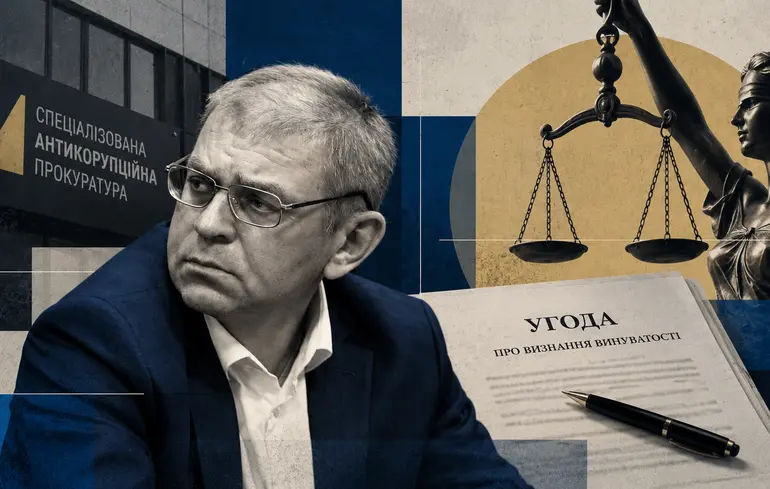
© Generated by DALL·E at the request of ZN.UA
On September 23, 2026, the High Anti-Corruption Court (HACC) approved a plea bargain with former acting head of the Presidential Administration Serhiy Pashinsky in the case of the seizure of Kurchenko's seized oil products. The verdict indicates that Pashinsky fully admitted his guilt in abuse of office and participation in a criminal organization and agreed to provide incriminating testimony. The total amount he must pay or contribute to the state and the Defense Forces is approximately UAH 1,1 billion, according to ZN.UA.
The public reaction to the initial news of this deal was almost unanimous: "He bought himself off." And this isn't the first such response to sentences resulting from these deals.
In recent years, plea bargaining verdicts in high-profile corruption cases have become increasingly common. According to the High Anti-Corruption Court (HACC), from 2019 to the end of the first half of 2026, courts issued 201 plea bargaining verdicts. During the first four years, these were isolated cases—between one and ten verdicts per year. But then, the number began to rise rapidly: 27 verdicts in 2023, 38 in 2024, and a whopping 72 in 2025.
The latest surge in numbers isn't surprising, as it coincided with the first full year of the law streamlining plea bargaining in corruption and corruption-related cases. And data for the first half of 2026 (35 convictions) indicate that the practice of plea bargaining has reached a relatively stable level. But is it really working?
Plea Bargaining: How Plea Bargains Are Concluded in Ukraine
Let's remember right away that a plea bargain is a criminal-legal compromise. The state agrees to a more lenient sentence, and in exchange, the accused admits guilt and undertakes a number of obligations: to incriminate accomplices, pay compensation, and agree to the agreed-upon punishment. In other words, a plea bargain is a conviction and a finding of guilt.
The terms of the deal are determined by the parties—the prosecutor, the defendant, and their defense attorney. The deal is approved by a court—in high-profile corruption cases, the High Anti-Corruption Court—and results in a guilty verdict. Therefore, the person who entered into the deal is considered a convicted person, not "released from liability."
Having received the indictment along with the transaction, the court verifies whether the terms of the latter comply with the law and the public interest and do not violate the rights of others. The court cannot rewrite the transaction or redistribute the payments provided for it—it can only approve or deny the document, justifying why it violates the law.
Denials of transaction approval during pre-trial investigations are rare; in fact, as of mid-September, the High Anti-Corruption Court (HACC) reported only four cases in which transactions were rejected and the case sent for pre-trial investigation. For example, in the Kurchenko oil products case, the court had already denied approval of a transaction with Sergei Pashinsky, finding that it provided for penalties not permitted by law, did not provide full compensation for damages, and delegated its execution to an unspecified number of third parties.
From the very beginning, cautions were raised regarding deals in corruption cases. Chief among these was the risk that plea bargains could become a way to "settle" with those who organized the schemes and were most responsible for the crimes committed. Therefore, the law limited the scope of individuals and grounds for plea bargains. A new law on plea bargains, adopted in October 2024, expanded the grounds for plea bargains: a plea bargain can now be concluded on the condition that another individual is convicted of any corruption or corruption-related crime, as well as on the condition that damages are compensated and that individual incriminates other defendants.
At the same time, the law significantly strengthened the "carrot" for defendants. It introduced Article 69-2 of the Criminal Code of Ukraine (CCU), which allows for a sentence lower than the minimum sanction to be imposed if other individuals are incriminated. If the court imposes such a sentence, the defendant can no longer be released on probation.
The maximum prison sentence for which probationary release is possible under a plea bargain has been increased from 5 to 8 years. It has also become possible to impose an additional fine even when the statute does not stipulate one. The procedure has also changed. Plea bargains are approved by senior prosecutors depending on the severity of the crime. A plea bargain can be re-applied to the court only once with the same person, and only after the grounds for the previous refusal have been addressed. This is precisely what we saw in the case of Sergei Pashinsky's second plea bargain.
But are these updates enough to create truly high-quality deals and how have they worked so far?
On the one hand, for the first time, sentences with penalties below the minimum sanction limit under Article 69-2 of the Criminal Code have appeared. In at least three of these cases, the convicted individuals are still serving actual, albeit shorter, prison sentences. These include former Supreme Court Chairman Vsevolod Knyazev, former Prosecutor General of Ukraine Volodymyr Dergunov, and former Defense Ministry official Oleksiy Stasyuk. On the other hand, the additional fine under Part 3 of Article 53 of the Criminal Code, although not always applied, is also applied, as is special confiscation.

Former Supreme Court Chief Justice Vsevolod Knyazev in the High Anti-Corruption Court hearing room, May 2023 // Getty Images
The disclosure mechanism is also yielding results. According to the Specialized Anti-Corruption Prosecutor's Office (SAPO), 15 people have already been sentenced based on the testimony of convicted cooperators, and in most cases where such testimony has been given or will be given, the trials are ongoing.
Regarding special confiscation, the law still doesn't explicitly stipulate the mandatory use of this instrument when concluding transactions, although we recommended making such a change. In our view, this is a gap that needs to be addressed: if there are grounds for special confiscation, the court should only approve the transaction if it provides for it. This way, the state will be guaranteed to receive the property obtained through crime.
This position is supported and expanded upon by the authors of an analysis of judicial practice for 2024–2025, prepared by the Center for Political and Legal Reforms jointly with the National Agency on Corruption Prevention (NAPC). They specifically note that courts often overturned seizures of land plots, vehicles, and assets precisely because plea bargains with investigators did not include a confiscation requirement. In other words, property that had already been frozen by the state was returned to convicted defendants due to the specific wording of the plea bargain.
At the same time, the court's refusal to approve a plea bargain with former MP Oleksandr Kachny in a case of illicit enrichment is telling. The plea bargain involved the special confiscation of an apartment, house, and land formally owned by the husband of the deceased fictitious owner. Despite the fact that the husband acted under a power of attorney when purchasing the apartment, inherited the property free of charge, and explicitly confirmed in court that he was merely the nominal owner, the court refused to approve the plea bargain. The grounds for this refusal were allegedly unproven third-party awareness of the illegal origin of the funds. In our view, these circumstances did not give rise to such doubts.
Plea bargains: The main problems with current deals
Despite all the benefits of these deals, society doesn't always view them favorably, as the state doesn't always provide adequate justification for such verdicts. Here are what we believe are the main reasons why this is so.
The first reason is closed sentences.
The texts of some of the verdicts for these transactions, particularly those against Pashinsky, the former chairman of the Western Commercial Court of Appeal, Boris Plotnitsky, and other defendants, are completely sealed. Because of this, it's impossible to determine from the court's and SAPO's public communications what exactly the state received in exchange for mitigated sentences. And since these are often high-profile individuals, public outrage is an expected reaction to this secrecy.
One of the first and still most high-profile cases of a closed verdict was the deal with former Ecology Minister Mykola Zlochevsky , who attempted to close the criminal case against him in exchange for a $5 million "super bribe" offered to the heads of the NABU and SAPO. Under the plea bargain concluded in August 2023, the High Anti-Corruption Court fined Zlochevsky 68 hryvnias. Furthermore, under the terms of the deal, he donated 660 million hryvnias to the Supreme Court of Ukraine. And that's all. And since the verdict was completely classified, the public never learned whether the "public interest" rules were followed and whether the state could truly be said to have benefited from the agreements.
This plea deal was, in fact, one of the main reasons for even discussing updating the legislation regarding such sentences. And since then, we at TI Ukraine have consistently insisted on the need to publish as much information about the plea deal as possible, so that Ukrainians would not have such questions.

Bags of dollar bills handed over as bribes in the Zlochevsky case // SAP / Facebook
Complete closure often fails to even fulfill its intended purpose—to conceal cooperation with the investigation. After all, if the convicted person is legally obligated to testify against accomplices, they will still learn of the deal due to the very fact of the severance of proceedings.
Let's remember that the High Anti-Corruption Court (HACC) already has the ability to seal certain details of verdicts without having to classify the entire text. For example, in the case against the head of the Poltava Regional Roads Agency, the court left the public interest justifications and other parts of the verdict public. The same verdict regarding the deal with Pashinsky was also initially sealed, which we immediately flagged as a very bad precedent. The High Anti-Corruption Court quickly responded to our criticism and released the partially sealed verdict, revealing the details of the deal.
The second reason is the lack of clear rules by which transactions are concluded.
In response to our inquiry, the SAP confirmed that there is no separate internal methodology for assessing the feasibility of a transaction. At the same time, the agency's Development Strategy for 2026–2028 calls for the development of unified approaches—the prosecutor's office plans to involve judges, lawyers, and public organizations in this development.
The High Anti-Corruption Court also informed us that it had not generalized its practice regarding transactions. At the same time, a discussion about finding a balance between the effectiveness of criminal justice, the inevitability of liability, the fairness of punishment, and public trust in the anti-corruption system is already underway . And the preconditions for developing clear transaction policies have also been laid.
Pashinsky's plea deal illustrates this process well. In its announcement, the SAP listed the amounts of fines and compensation, but offered no explanation as to why these terms were beneficial to the state. The necessary explanation only emerged with the verdict's release . Thus, we saw that as part of the plea deal, the prosecutor obtained testimony against other defendants, reducing the overall number of defendants in the case, creating a chance to try the remaining defendants before the statute of limitations expires.
However, this information appeared almost a week after the news of the deal, when society had already been discussing and outraged by the “billion for freedom” for several days.
The fact that the amount of compensation to the budget (600 million UAH) is less than the established damages (817 million UAH) was also no coincidence. The Pashinsky case involves a criminal organization, not a single defendant, and the damage was caused by the actions of seven individuals, not just one. Therefore, the parties agreed to partially release Pashinsky from civil liability, taking into account the obligations of the other convicted individuals under the transactions (111 million UAH in compensation and 40 million UAH to the Armed Forces of Ukraine) and his own 500 million UAH for the needs of the army. Overall, the compensation to the budget from all those convicted in this case does not yet reach the established damages. Whether future sentences against the remaining defendants will cover this damage is a question for the SAP.
The third reason is society's expectations. Society wants fair punishments.
Last year, a TI Ukraine sociological study showed that 60% of Ukrainians believe the most indicative criterion for an effective fight against corruption is the number of actual punishments for corrupt officials, and that such punishment should include imprisonment or confiscation.
Deals involving fines and charitable contributions do not meet this expectation. Therefore, the SAPO must explain them especially carefully, and the rules by which prosecutors enter into deals must be clear before the next high-profile case emerges.
Plea Deal. Is the Money Fair?
In almost half of the sentences we analyzed for transactions concluded between July 1, 2025, and June 30, 2026, the defendants pledged to make a charitable contribution to the Armed Forces of Ukraine. This practice emerged after Russia's full-scale invasion of Ukraine, before the adoption of the updated law on transactions in high-profile corruption cases, but today it can be considered almost mandatory for this type of sentence.
Charitable donations range from 10 to 20 million UAH. According to the High Anti-Corruption Court, more than 321 million UAH was allocated to the needs of the Armed Forces of Ukraine in 2025 alone. And according to the latest data from the Specialized Anti-Corruption Prosecutor's Office, thanks to deals in high-profile corruption cases, more than 1,6 billion UAH has already been allocated to the Defense Forces. Of this, over 1,1 billion UAH was donated through the state fundraising platform United24, over 272 million through the "Come Back Alive" foundation, and over 50 million UAH through the "Sternenko Community" foundation.
Serhiy Pashinsky's plea deal with investigators was a record-breaking one in terms of the amounts of funds included in it: 600 million hryvnias for damages to the state budget in stages over two and a half years; 400 million hryvnias or weapons worth that amount to the "Come Back Alive" foundation within six months of the verdict; 100 million hryvnias to the "Spilnota Sternenko" foundation for weapons within 30 days; as well as an 850 hryvnia fine as the main penalty and a 17 hryvnia fine and a year of disqualification from holding public office as an additional penalty.

Come Back Alive Foundation
There are three questions surrounding this money that actually concern all the amounts mentioned in other verdicts on the transactions.
1. Did inflation eat away at the compensation?
One of the most common arguments raised by critics of the Pashinsky deal is that the damages inflicted in 2014 are being compensated today with a nominal amount, which has significantly depreciated over the past twelve years. This means that UAH 600 million in 2026 is nothing like the amount Ukraine lost in 2014 due to the machinations of the former acting head of the presidential administration.
The argument has merit, but it is addressed not to the transaction as an institution, but to how the state as a whole protects its property interests in criminal proceedings.
Legislation generally does not leave the state defenseless against inflation. According to Part 2 of Article 625 of the Civil Code of Ukraine (CCU), a debtor who is in default on a monetary obligation must, upon demand by the creditor, pay the debt adjusted for the inflation rate and 3% per annum. The Grand Chamber of the Supreme Court concluded back in 2018 that this rule applies to all types of monetary obligations, regardless of the basis for their occurrence, meaning it should also apply to damages in criminal cases. Furthermore, Article 1192 of the CCU stipulates that the amount of damages from the loss of property is calculated based on its actual value at the time of the case hearing.
For a case involving misappropriated petroleum products, like the Pashinsky case, this may have practical implications, as we're dealing with property whose value fluctuated with the market, not a fixed monetary sum. However, recovering this difference would likely require another expert examination, which would also take some time and is unlikely to yield any results.
Claims for recovery of inflation losses can also be made in criminal proceedings by filing a civil suit. Case law provides examples of this. In a misappropriation case (Part 4, Article 191 of the Criminal Code), the Kamianets-Podilskyi City and District Court awarded the defendant inflation losses and 3% per annum. However, due to the application of the statute of limitations, the defendant's claim only covered interest for the past three years. Therefore, instead of the claimed inflation losses of over 419 hryvnias, the defendant was required to pay the state approximately 30 hryvnias.
A similar case is also pending before the High Anti-Corruption Court (HACC). In the case of Oleg Galushka, the head of a department of the Ukrainian Armed Forces, the Ministry of Defense claimed compensation for almost UAH 8 million in inflation-adjusted losses out of over UAH 21,5 million in primary damages. However, the court acquitted him and dismissed the claim. The review of this verdict is currently ongoing—in June 2026, the Supreme Court overturned the HACC's decision upholding the acquittal, so the issue of compensation for damages, taking into account inflation-adjusted losses, may also be reconsidered.
To recover inflation losses, the obligation must be monetary, that is, clearly defined as a specific amount. In criminal cases, this is generally only possible when the issue concerns embezzlement or misappropriation of funds, rather than other types of damages. In the Pashinsky case , the appropriation of a specific sum of money was not at issue—the subject matter was petroleum products.
Therefore, the problem isn't that the law prohibits taking inflation into account, but that no mechanism automatically does so. The court cannot independently index the amount of damages and go beyond the stated claims. And if the injured government agency or prosecutor, acting in the interests of the state, fails to file a claim for compensation for inflation-related losses, they will not be recovered either under a guilty verdict in standard proceedings or in proceedings related to a transaction.
In the Pashinsky case, a civil claim was not filed at all. Therefore, the claim for inflation losses could neither be satisfied by the verdict nor taken into account by the transaction, and the amount of damages was fixed at the 2014 nominal value of 600 million hryvnias. Furthermore, even a filed claim for such compensation is subject to the risk of the statute of limitations, which, in cases involving events dating back ten years, could reduce it to symbolic amounts.
Hence the recommendation. The issue of inflationary losses should be addressed primarily to the prosecution (in our case, the SAP) and the agencies representing the injured state. The requirement to recover them should become a standard part of civil lawsuits for the theft of state property, and their consideration should be one of the criteria by which the prosecutor assesses the amount of compensation in the transaction.
A separate discussion is needed on whether the requirement for "full compensation for losses" as a prerequisite for a transaction covers only the nominal amount of damages or also their actual value at the time of the transaction. Currently, the law does not directly address this issue.
Moreover, some of the public's complaints about the "leniency" of the sentence concern issues that a plea bargain does not resolve. The court did not order the confiscation of property in Pashinsky's case: the SAP explained that the corresponding additional penalty under Article 255 of the Criminal Code was introduced in June 2020, that is, after the events of the case. Therefore, the principle of prohibiting the retroactive application of a law that worsens a person's situation applies here.
2. Why does the money go to funds and not to the budget?
Former head of the High Anti-Corruption Court (HACC), Vera Mykhailenko, explained at the time that the prosecution and defense agree on where and how much charitable contributions will be made, while the court merely verifies whether the deal with the investigators complies with the law. Therefore, the question "Why these specific funds?" should be addressed to the parties to the deal, not the court.
But it's worth asking this question honestly. Are there any legitimate concerns about the transparency of the funds involved in the deal? And if there are no such concerns, what's the difference for the state between revenue going to the budget and revenue going to a fund that professionally and accountably purchases weapons for the military?
During a war, a significant portion of the budget is already allocated to defense. A foundation—"Come Back Alive," "Sternenko Community," or any other—could be a faster and more effective channel in this chain. Moreover, "Come Back Alive" explicitly states that it does not take a percentage of donations for administrative expenses.
The real risks here are different. The first is that the fund is not connected to the accused or his associates. The second is that the fulfillment of the condition can be verified.
Failure to fulfill a contractual agreement is subject to separate criminal liability, and the SAPO can request the HACC to overturn the verdict and hear the case under the standard procedure. It's telling that, throughout the court's tenure, prosecutors have never filed such a motion.
According to the SAP, no cases of intentional non-fulfillment of contracts have been identified, and no convicted individuals have been held accountable for violating the terms of the contracts. Fulfillment of the terms is confirmed by payment documents, which are presented to the court and the prosecutor and included in the case file. This means that verification of the transfer of funds does exist, but it is carried out solely by the SAP. Further reliance can be placed on the public reporting of the relevant charitable foundations, which should be open to the general public. If there is a request for reporting specifically on convictions based on HAKS transactions, it would make sense for the relevant foundations to publish such specific information on how the funds resulting from such convictions and transactions were used. This would facilitate an understanding of the specific needs of the army being met through donations.
Meanwhile, public reaction to Pashinsky's agreement to make donations to the "Come Back Alive" and "Sternenko Community" foundations also produced unexpected results. On September 28, the High Anti-Corruption Court (HACC) rejected a plea bargain plea agreement with MP Oleksandr Kachnyy for illicit enrichment in excess of UAH 12,7 million. Kachnyy pleaded guilty and agreed to donate UAH 3 million to the "Come Back Alive" foundation project. In her rejection, the judge stated that the use of these funds would be beyond the control of the parties and the court, and therefore the court could not be certain that these provisions were in the public interest.
3. Whose money is this?
This is the third and perhaps most important risk. A formally positive outcome—that is, compensation paid or a donation to the army—may be secured by opaque funds. The origin of the funds used to fulfill the terms of the transaction must be checked no less thoroughly than, for example, the origin of the funds used for collateral.
The SAPO confirmed that, in practice, damages are reimbursed and charitable contributions are made not only by convicted individuals but also by third parties—this is not prohibited by law. However, the Criminal Procedure Code of Ukraine does not provide for a separate procedure by which the prosecutor would verify the origin of such funds. The agency relies on banks, which, as entities subject to primary financial monitoring, are required to verify transactions in accordance with anti-money laundering legislation.

Head of the SAP Alexander Klimenko // SAP / Facebook
However, we must be consistent here and acknowledge something that critics find unpleasant: the mechanism of special confiscation. After all, it involves the confiscation of precisely those funds and property that are directly established by a court verdict to be of criminal origin. When this is used, the state knowingly replenishes the budget with funds obtained through criminal means.
Therefore, it's difficult to explain, purely from a pragmatic standpoint, why the same logic becomes unacceptable when the funds are received not through a special confiscation, but in fulfillment of damages or a charitable clause in a transaction. Ultimately, the money still ends up in the budget or the army, and still doesn't remain with the convicted person. Therefore, the outrage that "the money didn't go to the budget" concerns form, not substance.
Plea Bargaining: Why Plea Bargains Are a Good Thing, and Why They Need to Be Improved
The main argument in favor of Pashinsky's plea deal is not the amount, but the alternative. The events in the case took place in the spring of 2014, and the charges were only announced in February 2024. The statute of limitations for abuse of office in this case expires in 2028, so the parties explicitly linked the deal to the fact that it makes it possible to try the other defendants within that timeframe.
A full-fledged trial with multiple defendants, a large body of evidence, and procedural defense tactics could last for years. If the statute of limitations expired during this time, the defendant would be absolved of liability entirely, and the state would receive nothing: no sentence, no compensation, even partial. Despite the demands of the European Commission, statute of limitations rules in Ukraine have still not been reformed. Therefore, in cases investigated decades after the events, a plea bargain is often not an alternative to a harsh sentence, but an alternative to impunity.
A criminal trial always has a probabilistic outcome. The prosecution considers guilt proven, the defense considers it not, and the court draws a line. A plea bargain transforms probability into a guarantee: there's a guilty verdict, the status of a convicted person, real money, and testimony against other participants. A fine is the primary punishment under the Ukrainian Criminal Code. Therefore, talking about "buying off" a punishment that is itself a punishment is incorrect.
By comparison, another defendant in the Pashinsky case, Serhiy Tyshchenko, received an eight-year prison sentence under the deal, with probation. He transferred 40 million hryvnias to the Defense Forces and must pay another 110 million hryvnias to the budget over three years. The "Kurchenko oil products" case is not yet closed: there were other suspects, and not all of them accepted the deal.
At the same time, precisely because plea bargains have become the primary method for settling high-profile corruption cases, their quality must continue to be improved. The High Anti-Corruption Court (HACC) should standardize its approaches to assessing public interest and establish the practice of partially dismissing convictions instead of fully dismissing them in cases where it is not directly required to protect the individual or other proceedings. The SAPO should implement the measures in its Strategy for a Unified Approach to Pleas and publicly explain the benefits to the state in each high-profile case.
Subscribe to our X channel and Telegram channel!
Stay informed about who is doing business, in politics, and supporting corruption in Ukraine!
Parliament should make special confiscation a mandatory condition for approving a transaction where there are legal grounds. Wider use of shorter, more realistic prison sentences and additional fines would also improve the acceptance of such sentences.
Finally, the two issues fueling the most outrage over these deals lie outside the deal itself. These are the unreformed statutes of limitations, which force prosecutors to negotiate, and the fact that the state doesn't always utilize existing mechanisms for recovering inflationary losses, which devalues the nominal compensation—whether under a deal or a standard verdict. After all, the hundreds of millions of hryvnias in losses incurred in 2014 don't correspond to the same hundreds of millions in 2026.
These problems need to be addressed by both lawmakers and practitioners. Until that is done, a fair plea bargain remains a better outcome than a case that ends in nothing.
Skelet.Org
On the topic : Selling "white tickets": maritime pseudo-activist Korol entered into a plea agreement with investigators – case details
Plea Deal / Plea Deal
Subscribe to our channels on Telegram, Facebook , Twitter , VK - Only new faces from the SKLEP section!