
Will a small-scale land deal mark the beginning of the end for the empire built under Chernovetsky? So, the Suprunenko family.
An estate in Kyiv. Photo collage by Telegraph
The Suprunenko family's luxurious estate, built on the Kyiv coastline, has become the subject of an official criminal investigation. A former member of parliament for two terms, businessman Oleksandr Suprunenko , an associate of Denys Komarnitsky and a member of the so-called "young Chernovetskyi team ," has been charged with a crime. This residence had previously come under scrutiny by law enforcement: it was searched as part of a fraud case at Ukrzaliznytsia , in which the businessman's father, Ivan Suprunenko, was implicated.
Telegraf investigated the specific real estate in question and recalled what is known about the Suprunenko family—a name that has surfaced for years in the context of high-profile scandals in Ukrainian politics and big business.
The Suprunenko Family: Why Alexander Suprunenko Was Suspected
On January 27, 2026, the Solomyansky Prosecutor's Office of Kyiv announced a charge against a 55-year-old former people's deputy of two convocations for the unauthorized seizure of land in the coastal protective zone of the Dnieper River and the illegal construction of a residential building on it. Photos of the building released by the prosecutor's office suggest it is the estate of Oleksandr Suprunenko, a former people's deputy from the Party of Regions who was also elected to the Kyiv City Council.
According to prosecutors, the former MP owned a plot of land measuring only 0,1 hectares, but without any permits, he expanded it almost threefold, seizing municipal land, fencing it, and effectively restricting residents' access to water. The seized plot is located within a 100-meter coastal strip, where any construction or fencing is prohibited by law.
A one-story house with an area of 103 square meters was also built on this site. The prosecutor's office published a photo of this house.
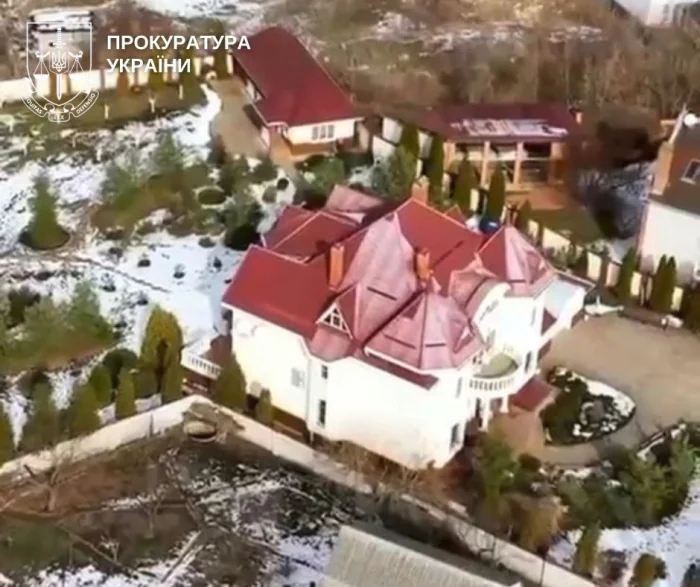
The Suprunenko family estate, photo by the GPU
According to Telegraph, the land in question is a plot of land with cadastral number 8000000000:66:016:0040, which is privately owned by Alexander Suprunenko.
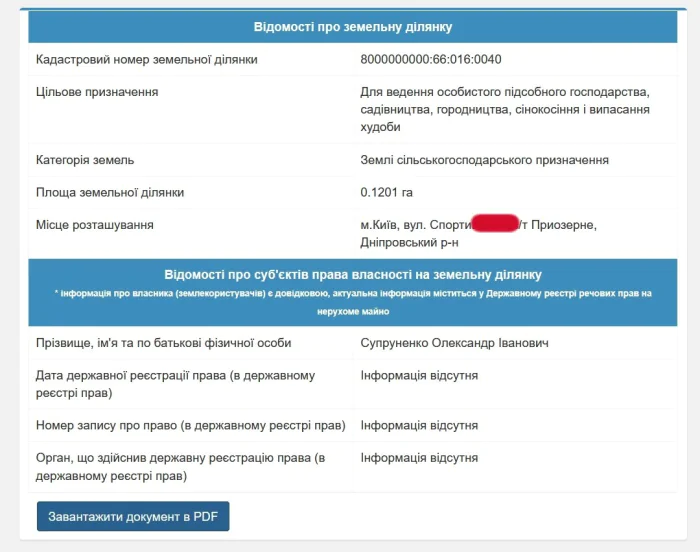
Extract from the real estate register regarding Alexander Suprunenko's plot
Its official designation is for private farming, gardening, vegetable gardening, haymaking, and livestock grazing, and its land category is agricultural. The plot is located in the Dniprovskyi district of Kyiv on Sportivnaya Street.
A comparison of the cadastral map with Google Maps satellite imagery revealed that the actual area occupied by Suprunenko's estate is indeed approximately three times larger than the officially registered area of the plot. The land extends along the shores of bodies of water and likely partially encompasses the Darnitsky reservoir.
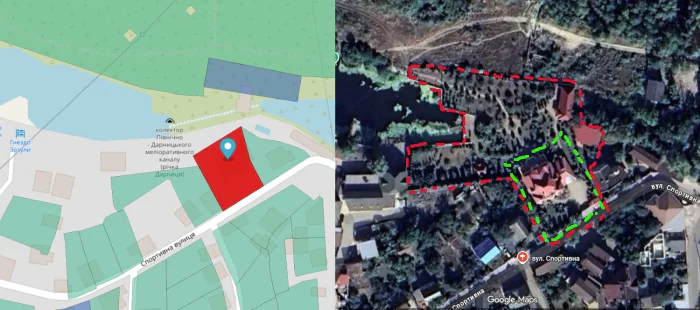
Land plot according to the cadastral register and its estimated actual area – comparison of the cadastral map and Google Maps. Collage by Telegraph
A house with history: Suprunenko's residence featured in a National Police report about a search in the Ukrzaliznytsia case.
As Telegraf has discovered, the very same estate and land plot currently at the center of the investigation against Oleksandr Suprunenko had previously been demonstrated by law enforcement in connection with another criminal case against his father, Ivan Suprunenko. For many years, Suprunenko headed one of the primary trade union organizations of Ukrzaliznytsia and, according to investigators, was involved in a large-scale scheme of illegal extortion in the transport industry.
According to investigators, conductors were forced to pay unofficial "fees" for the right to work on lucrative international routes. Sources at Ukrzaliznytsia claim that Ivan Suprunenko was the one who approved candidates and established "rules" for those seeking to work on European routes. A separate incident involved the sale of seats in service compartments—without recording them in the official sales system and without receipts. The cost of such trips ranged from 300 to 500 euros. Law enforcement estimates that in the first half of 2024 alone, the state lost over 73 million hryvnias, which was likely distributed among the participants in the scheme.
As part of this investigation, police issued a number of warrants and conducted dozens of searches at Ukrzaliznytsia premises, as well as at the offices and homes of suspects. It was in a National Police video report about one of these searches that Suprunenko's estate was featured.
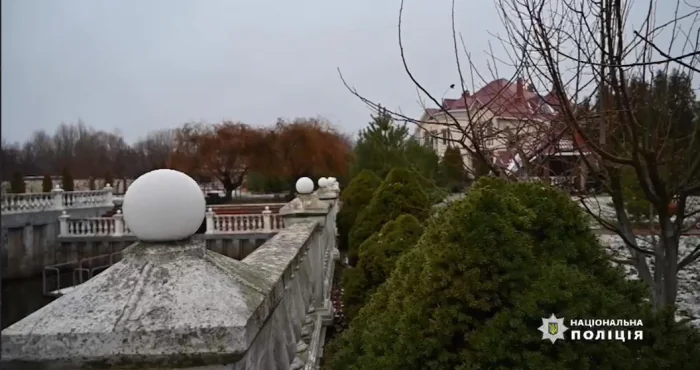
Suprunenko's house (the same one mentioned in the prosecutor's office's report) was previously featured in a National Police report. Screenshot of the video from the National Police's Telegram channel.
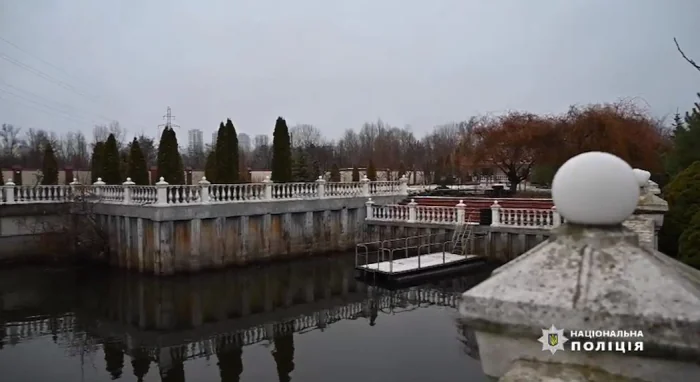
Part of Suprunenko's estate. Screenshot from a video from the National Police's Telegram channel.
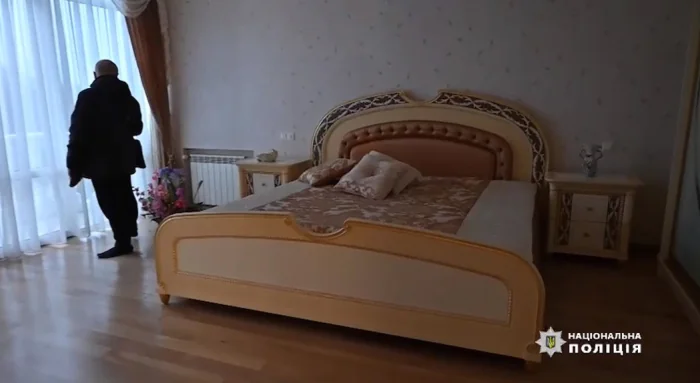
Bedroom. Likely the interior of Suprunenko's estate. Screenshot from a video from the National Police's Telegram channel.
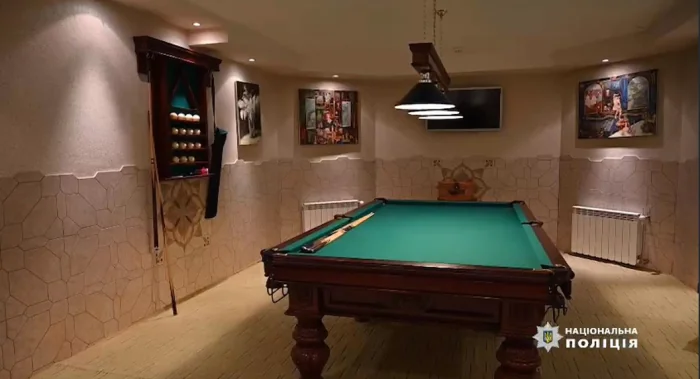
A billiard room. Likely the interior of Suprunenko's estate. Screenshot from a video from the National Police's Telegram channel.
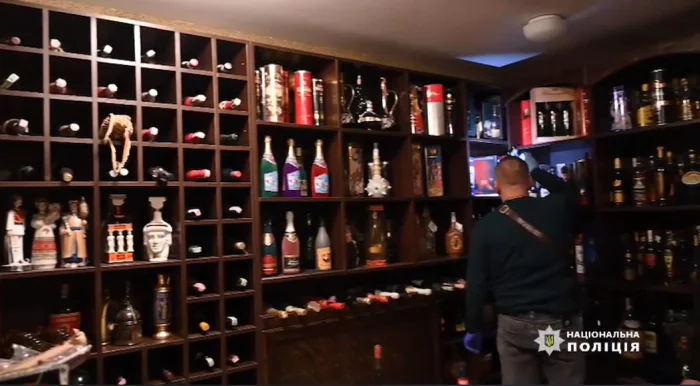
An alcohol room. Likely the interior of Suprunenko's estate. Screenshot from a video from the National Police's Telegram channel.
Who is Alexander Suprunenko: his political, family, and business background
Oleksandr Ivanovych Suprunenko, a Ukrainian politician and entrepreneur, was born on January 31, 1971, in Kyiv. He served as a People's Deputy of Ukraine in the sixth (2007–2012) and eighth (2014–2019) convocations, and was also elected to the Kyiv City Council. Suprunenko first entered parliament on the Party of Regions list, and then, as a non-partisan independent candidate, joined the "Will of the People" group.
Before his political career, Suprunenko worked in the private sector, from a driver and gas station operator to a company director in the 2000s. He holds a law degree and graduated from the National Academy of Internal Affairs.
Alexander Suprunenko, along with his brother Vyacheslav and several relatives and associates, is part of the so-called "Suprunenko brothers group," which, according to YouControl, currently comprises over 200 companies in various sectors. These include banking institutions ( Vyacheslav Suprunenko is a co-owner of 69,9% of ASVIO Bank), agricultural and manufacturing companies, legal entities, and construction firms.
The Suprunenko family is believed to be part of the "team of fledglings" of former Kyiv Mayor Leonid Chernovetskyi, under whom thousands of hectares of Kyiv land were embezzled and dozens of municipal enterprises were removed from city ownership. Oleksandr Suprunenko headed the land commission under Chernovetskyi. His brother, Vyacheslav Suprunenko, also a former Kyiv City Council member, was married to Chernovetskyi's daughter, Khrystyna (though the couple separated in 2011).
As ZN reported in a 2011 article, " My Dear Capital... ," Chernovetskyi's son-in-law, Vyacheslav Suprunenko, was a key figure, the de facto "decision-making center," in all the schemes of the time. There were dozens of them—fictitious leases, toilet schemes, courtroom fraud, and numerous other scams that allowed for the seizure of land and property. The most notable cases involved the seizure of major municipal enterprises.
Kyiv's utility companies were thus seeking their place in the market. Their shares were diluted through additional share issues, which have been widely reported in the media (Kyivmiskbud, Khreshchatyk Bank, Vodokanal, Kyivmlyn, and others), during which the city voluntarily ceded its corporate rights to businesses (incidentally, all of Suprunenko's operations), as Zerkalo Nedeli reported at the time.
Denys Komarnitsky, the so-called "overseer" of Kyiv, is believed to have been one of the participants in the schemes, along with the Suprunenko brothers. During Chernovetsky's tenure, he was the head of his faction on the Kyiv City Council, chaired the supervisory boards of several municipal enterprises, and was a member of the budget committee.
In 2011, Vyacheslav Suprunenko and Denis Komarnitsky were both involved in a criminal case involving an attack on lawyer Ivan Grantsev, allegedly in order to obtain documents containing information about the "young team's" property fraud. Chernovetsky's ex-son-in-law was even placed on an international wanted list, and Komarnitsky was arrested.
In 2016–2017, Oleksandr Suprunenko was involved in a high-profile tax evasion case —the tax authorities and the prosecutor's office filed claims against him for approximately 60 million hryvnias.
A separate story concerns Suprunenko's possible involvement in real estate fraud. Telegraf recently reported how companies associated with the Suprunenko family were surprisingly implicated in scandals involving attempts to seize and destroy historical sites in Kyiv (the grocery store on Khreshchatyk, the so-called "Grushevsky House," etc. ).
The Suprunenko Family. An Estate as a Clue: Can a Small Land Deal Destroy a Large Empire?
For many years, the Suprunenko family was more than just a collection of prominent political and business figures, but a coherent financial and political group, built on the land and property schemes of the Leonid Chernovetsky era. This was the time when the family accumulated its initial capital—assets that would later be transformed into banks, construction companies, agricultural businesses, and hundreds of legal entities.
After the collapse of the so-called "Chernovetskyi Young Team," the Suprunenko family remained publicly visible, maintaining contacts and influence. They retained their assets, restructured their businesses, and the saga of land, development projects, utility companies, and tax claims continued to plague the family-linked companies in the new political reality.
Subscribe to our X channel , Telegram channel and Facebook page!
Stay informed about who is doing business, in politics, and supporting corruption in Ukraine!
Therefore, the current case concerning the "illegal plot" and the house on the beach may seem minor, but only at first glance. In the history of major mafia empires, convictions often began not with high-profile crimes, but with minor infractions. Let's recall Al Capone, who, as we know, was initially imprisoned not for racketeering and murder, but for tax evasion.
It's symbolic that in Suprunenko's case, the investigation is starting with what's obvious: the land, its intended use, the fence, and the house that shouldn't be there. The only question is whether this story will remain an isolated incident or become the first step in dragging down Suprunenko's entire business structure, built back in Chernovetskyi's time.
Skelet.Org
On the topic : The import of drones to cover the withdrawal of currency from Ukraine by the leadership of the NBU and the State Customs Service
Subscribe to our channels on Telegram, Facebook , Twitter , VK - Only new faces from the SKLEP section!