
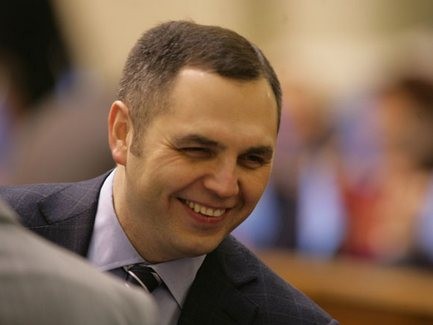
Andrey Portnov
The victory of the Maidan, after which former President Yanukovych and his closest allies fled Ukraine, never materialized in the Ukrainian judicial system. The judicial pool created by Yanukovych's lawyer, Andriy Portnov, continues to operate as before. Bribes, violations of complaint procedures, mutual responsibility, and a sense of impunity—this is how the people appointed by Portnov conduct their work.
This isn't just a matter of high politics, but also a problem for every Ukrainian—after all, it's ordinary citizens who turn to the courts. The middle class, which protested corruption on the Maidan, has yet to achieve justice in the judicial, permitting, and tax systems. The economic crisis is snowballing, but proactive people are still being denied the opportunity to rebuild their businesses, create jobs, and generate economic and social benefits. Instead, time, energy, and money are wasted fighting a system in which little, if any, has changed.
Marina, a volunteer (with many years of helping children) and a representative of a medium-sized Kyiv business, planned to build a child development center in Troyeshchyna. The obstacles she encountered prompted her to take to the Maidan and join millions of Ukrainians in demanding legality and opportunities for self-fulfillment in their country. Under the previous government, Marina nearly lost her legal property—the land where the children's center was to be built. She has been awaiting a court decision for two years, although the law stipulates that the Commercial Court has two months to consider her claim.
The history of this business project began back in 2006. Although it's hard to call the project a business, it's more of a charity. After speaking with hundreds of parents in a residential area, the woman realized the need to build a children's leisure center. She realized her idea would be highly sought after in a Kyiv district with the highest rates of child alcoholism and drug abuse, so she applied for a land lease.
In 2009, by decision of the Kyiv City Council, Marina leased and then registered ownership of a plot of land on Balzaka Street. In October 2012, the final permits were obtained, and a general contract for construction was signed. That same year, an investor for the project was found, and Marina transferred the land to the authorized capital of a limited liability company and assumed leadership of the company. As a local resident, Marina wanted to realize her dream of creating a modern creative space in Troyeshchyna where children could host a children's party, play for a few hours under the supervision of an experienced teacher, interact with other children, and learn something new and useful. From the very beginning, she was prepared to provide classroom space for children free of charge for the local community of the Ukrainian Orthodox Church and the Foundation for Autism. A business plan was developed, and the opening was planned for September 2013. However, construction hasn't yet begun, and Marina, instead of creating a project, has been forced to defend her rights before the prosecutor's office, the courts, and the suddenly active local community...
Following a campaign by activists and local politicians to discredit the upcoming construction project (they persistently talked about a nightclub among residential buildings), in January 2013, the Desnyansky District Prosecutor's Office filed a lawsuit with the Commercial Court demanding that the land purchase agreement and the state deed for the land be declared invalid. A woman, a former janitor at a neighboring building, filed a similar lawsuit with the Kyiv District Administrative Court. The Prosecutor's Office also succeeded in having the State Architectural and Construction Control Inspectorate rescind the declaration of commencement of construction. Those involved in construction in Kyiv know that in the past, the Prosecutor's Office left large developers alone, but instead targeted small and medium-sized businesses. Back in 2013, Serhiy Krymchak, secretary of the Kyiv City Council's Commission on Land Relations, Urban Development, and Architecture, openly stated that the prosecutor's office "by filing protests against Kyiv City Council land decisions is engaging in racketeering and blackmailing entrepreneurs." There was also little hope for the objectivity of the judges of the Commercial Court.
Strangely, the case was being dragged out, even though the law requires it to be heard within two months and, if necessary, extended for a maximum of 15 days. However, as it turned out, the Commercial Procedure Code doesn't apply to Judge Olga Gulevets. She ordered deliberately futile expert assessments and convened hearings only to announce formal reasons for postponing the hearing for a month. Furthermore, no evidence supporting the prosecutor's case has been provided. Amidst this legal absurdity and chaos, the parties were being asked to take "reasonable steps" and reach "balanced decisions." Marina decided to act solely within the legal framework and appealed to the High Qualification Commission of Judges, demanding that Judge Gulevets be disciplined for deliberately failing to comply with the requirements of procedural law. Such actions constitute a violation of a judge's duties. The court naturally doesn't care about the investor's losses, while the essentially suspended project requires foreign currency loans to be repaid, and Marina, as the director of a business that hasn't been created, receives only a minimum salary.
In the new Ukraine, will an ordinary Kyiv businessman be able to defend his right not only to a timely but also a fair judicial decision, given that Judge Olga Gulevets, according to recent reports, was appointed by Andriy Portnov? According to media reports, Olga Gulevets is extremely grateful to her patron, as his personal protection reliably protects her from liability for the most serious offenses—corruption.
As a reminder, the media reported on the case involving a trio of judges—Olga Gulevets, Alla Prygunova, and Anna Bondarenko. These judges are suspected of extorting a $22 bribe from a representative of a Kyiv company. The businesswoman decided to appeal to the prosecutor's office. During the investigation, the bribe demand was confirmed. However, the Pechersky District Court thwarted the attempt to apprehend the judges red-handed. On December 22, this court, at the request of an investigator from the Prosecutor General's Office, issued a search warrant for the offices of judges of the Kyiv Commercial Court suspected of corruption. However, court staff failed to notify the mediator and the judges. As the saying goes, "one crow will not peck out another crow's eye."
Subscribe to our channels on Telegram, Facebook , Twitter , VK - Only new faces from the SKLEP section!