

Alexander Onishchenko
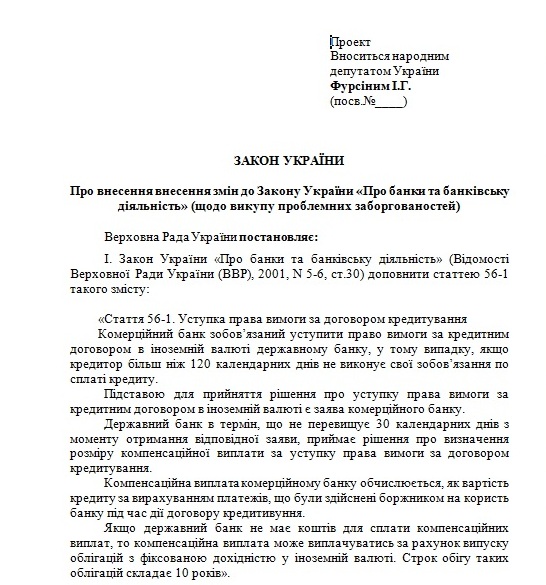
Bill No. 1145 (on amendments to the Law "On Banks and Banking Activities" regarding the buyout of problem debts) by MP Ivan Fursin (Opposition Bloc) can only evoke irony and sarcasm.
The first thing that surprises me about Fursin's initiative is: what does Article 56 of the Law "On Banks and Banking Activities" have to do with it? It's called "Client's Right to Information" and defines the list of information banks are required to provide upon client request (text of the law). Of course, the bill's author can correct this minor oversight. But what about the other oversights?
Fursin's bill states: "A commercial bank is obligated to assign the right of claim under a loan agreement in foreign currency to a state-owned bank if the creditor fails to fulfill its obligations to repay the loan for more than 120 calendar days."
The ground for sarcasm here is so vast that I don’t even know where to begin.
First, it's stated clearly and without compromise: a commercial bank is obligated to cede its rights. So, down with the right of a business entity to make its own decisions? Applause!
Second. This right must be ceded to a "state bank." Which bank exactly are we talking about: Oschadbank or Ukrexim? Their depositors will be delighted and will immediately start depositing there.
And who will decide which state-owned bank to cede to? Will commercial banks choose themselves, perhaps through tenders? Or will the Cabinet of Ministers and the National Bank appoint a "lucky winner"?
Incidentally, this fortunate state-owned bank will have to immediately increase its lending staff. And this staff will be comparable in size to the total lending staff of all commercial banks combined, as it will be tasked with servicing a huge number of loans, including problem loans.
Now about the criteria for problem loans subject to assignment. The bill seems to clearly state: payments are outstanding for 120 days. But why 120 days? The explanatory note to the bill provides no economic, political, or even practical or emotional justification.
Next. The bill, I repeat, states: "...if the creditor fails to fulfill its loan repayment obligations for more than 120 calendar days." But the creditor is considered the one who provides the loan. So, does the commercial bank's obligation to assign the claim arise if it fails to fulfill its loan obligations? Or is this also a typo, where the author confuses "creditor" and "borrower"?
Let's now assume that, according to the loan agreement, the borrower is required to repay the loan in the amount of $100 monthly, but something went wrong and they were paying $99. Over four months, the debt accumulated to $4, and they would fall into the correct category. From a common sense perspective, this is absurd.
In other words, the definition of criteria for classifying a loan as problematic requires serious revision.
The bill then contains three paragraphs in which the author alludes to the procedure for a state bank to pay a commercial bank for the assignment of a claim. Something is clearly missing here, but I hope that after analyzing the subsequent provisions of the draft, there will be no need to revise this procedure.
I'll move on to the final paragraph of Article 56-1 proposed in the draft. "If a state-owned bank lacks the funds to pay compensation, the compensation may be paid by issuing fixed-income bonds in foreign currency. The maturity of such bonds is 10 years."
And a quote from the explanatory note to the bill: "5. Financial and economic justification. The implementation of this bill will not require additional budgetary funds."
Let's leave aside the question of whether a commercial bank needs bonds from another bank (even a state-owned one). Not because each commercial bank will be able to decide for itself what to do with these bonds. But because, according to the bill, no one will ask the bank—it is obligated to assign the right and receive compensation. In this case, it would be a good idea to immediately specify the yield on these bonds or prescribe a mechanism for determining it.
A little more about bonds. Issuing any securities is a rather complex procedure, requiring labor-intensive, careful preparation, time, and money. This is especially true when it comes to securities issued by a state bank, especially those denominated in foreign currencies.
Moreover, state-owned bank securities are guaranteed by the state. Therefore, each issue of such bonds requires, at a minimum, a government decision. This, in turn, increases the state's liabilities, which, incidentally, cannot be unlimited.
If we imagine that the bill in question is adopted and comes into force, then, at a minimum, the following should happen:
1. The government, together with the NBU, must appoint a state-owned bank (or banks) that will be tasked with buying up bad loans.
2. Commercial banks take inventory of loans and press the designated state banks with their applications.
3. Designated state-owned banks quickly establish, equip, and staff appropriate branches across the country, accepting and processing applications. The creation and maintenance of these branches requires funds, which must be allocated in the budgets of these state-owned banks.
4. State-owned banks balance their budgets and determine how much money they need to pay compensation and, accordingly, what the bond issue volume should be. They then apply to the government for permission to issue bonds. Meanwhile, commercial banks are accumulating more and more problematic loans...
Now, regarding additional budgetary funds for the project's implementation, it's clear that not all problem loans transferred by commercial banks to state-owned banks will be repaid. This will result in losses for the state-owned bank.
From what or who are the state bank's losses covered? From the bank's profits. If there is a profit, the state misses out on its share, and if there is no profit, the loss also falls on the owner—the state. That is, on the state budget. So, the respected author of the bill, Ivan Fursin, either doesn't understand or is being disingenuous when he writes that "the implementation of this bill will not require additional budgetary funds."
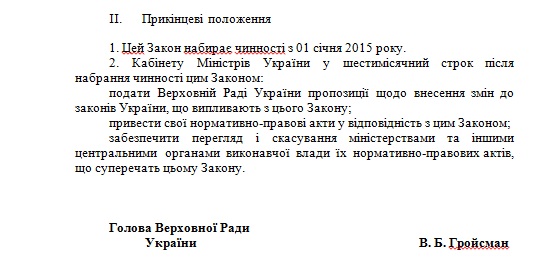
And finally, the author of the legislative initiative, I believe, was overly optimistic when he wrote that his proposed law would come into force on January 1, 2015.
Alexander Onishchenko, banking expert, for RBC-Ukraine
Subscribe to our channels on Telegram, Facebook , Twitter , VK - Only new faces from the SKLEP section!