
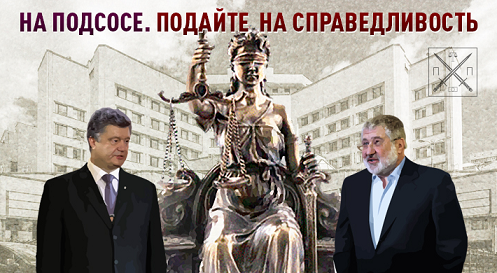
A year has passed since the Revolution of Dignity, and the time has come to gather the stones—the very same ones from Independence Square, which were stained with the blood of hundreds of people in January 2014. What has changed since then?
The new government has focused on what truly worries people. For example, corruption and state racketeering. When 1,5 million hryvnias are confiscated during a search of the regional traffic police chief, it speaks volumes of growing corruption. Or the 68,4 billion hryvnias the budget owes to the country's businesses, with 10,8 billion of that amount added last year. How will we repay this—with the blood of the men who are dying in Donbas so that a handful of corrupt officials can once again coerce Europe into another tranche of financial aid?
On democracy and the "pAperedniks"
Democracy is, above all, respect for rights and freedoms. And what we have as a result is armed men seizing dozens of facilities on oligarchic orders. "Volunteer" units, in the employ of the same Kolomoisky, are seizing oil refineries. The rank-and-file fighters are more modest—they simply beat up Kyiv residents in broad daylight on the streets for "disrespecting" their heroes. I haven't heard of any of them being punished. Democracy...
How are the "pApredniki" doing? They're the ones who should definitely answer for all their crimes. And what are the former ones doing? They're counting their victories in UKRAINIAN courts against the charges brought against them by the new democratic team.
And so all the promises and all the hopes melted away like a lilac mist in the morning. It's no wonder that the President was greeted by the relatives of the victims on the Maidan anniversary with cries of "Shame." It's surprising that they weren't greeted with those same cobblestones.
What's going on? The new team has, or rather had, the public's trust; they have legislative and executive power at their fingertips. Why this impotence?
So here's the explanation: it's all those damned judges making bad decisions. Yes, they were the bromine in the tea that led to the impotence of the state machine and prevented its wise leaders from leading the people to a bright future.
It seems that this is what all the scandals that have literally rocked the country's judiciary since the beginning of the year boil down to. So, today we'll talk about judges—those very same corrupt officials, bribe-takers, and millionaires in robes who have stood their ground on the path to yet another bright future.
But what's there to say about them? No one believes in the independence of judges in our country; the only question is who will seize a controlling stake in the Ukrainian judicial system. So far, there are two claimants to these assets, and each is carrying out their corporate raids with the help of their loyal vassals, just like in the days of feudalism, which, it seems, is what was built in our country.
But the tactics of both sides are simple: discredit all the judges; punish the unwanted ones, while simultaneously setting an example for the rest; accept the capitulation of the judges and run the court as they see fit, not according to the law.
How the judges' dirty linen is aired
On January 28, the Kharkiv Administrative Court of Appeal published appeals to the Prosecutor General's Office of Ukraine, the Council of Judges of Ukraine, and the Council of Judges of Administrative Courts of Ukraine on its website. The appeals addressed "disrespect, threats of violence, and pressure on individual judges and the judiciary of Ukraine by members of parliament."
"Recently, cases of pressure on judges have become systemic and overt, including from individual representatives of the executive branch and members of parliament."
In short, members of parliament from Samopomich, which has long been firmly in the pay of the country's most patriotic governor, Igor Kolomoisky, together with fighters from the Donbass Battalion, which has been twice defeated in the East, are threatening to "send a certain judge into a minefield."
Ukraine's judiciary is a rather closed world, where it's not customary to "air dirty linen in public," much less accuse members of parliament of exerting pressure on the administration of justice. So what prompted the Kharkiv judges to take such a step?
This concerns Judge Valentina Samoylova, who issued a verdict on the return to public service of former Deputy Prosecutor of the Kharkiv region Vladimir Sukhodubov, who was dismissed under the provisions of the "On the Purification of Power" law.
What can you say? A judge is being fired for reinstating a person who was fired under a law that the Venice Commission itself recognized as undemocratic and a violation of FOUR principles of democracy and justice.
Simply put, the lustration law, the day of whose adoption so many windows were shattered in the citadel of Ukrainian parliamentarism, is completely unsuitable for real-life use, as it essentially amounts to a piece of paper with huge holes in it, one in which any law school graduate would find numerous anomalies.
According to official data alone, 170 claims from lustrated victims are being considered in court.
But few people know that, in fact, the courts have already issued more than 20 rulings in favor of people subject to lustration, and in all of them, the courts expressly PROHIBITED the dismissal of these individuals. It is known for certain that Kyiv Prosecutor Serhiy Yuldashev is on this list of those subject to lustration, while the names of the other "lucky ones" are being concealed.
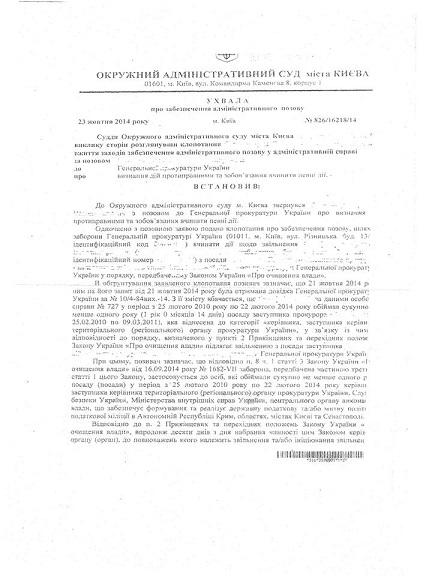
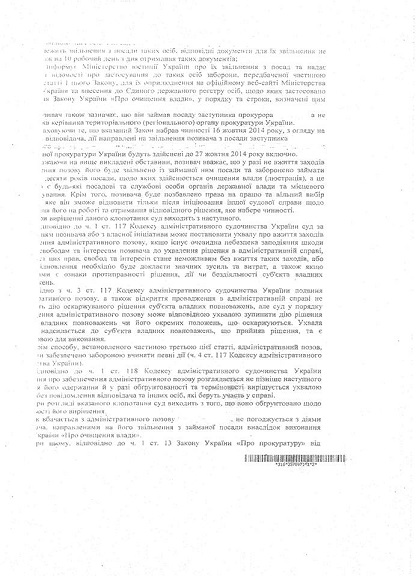

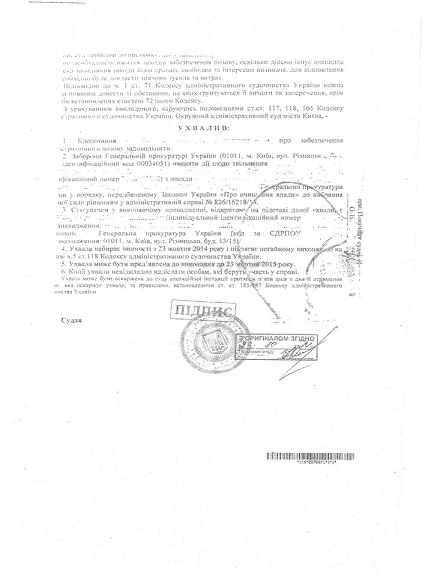
There are legal grounds for this: according to Part 3 of Article 117 of the Code of Administrative Procedure of Ukraine, the court may suspend the validity of a document issued by a subject of public authority.
So why is it that only Sukhodubov is on everyone's lips, while the judge who made a legitimate decision is subjected to outright harassment: from the innocuous posting of the judge's income declaration on Facebook by the head of the Ministry of Justice's lustration department, Tatyana Kozachenko, to the aforementioned innuendos from MPs—"heroes" of the ATO.
Why is she so lucky? The answer is simple, in the person of Sukhodubov: the "professional" government, incapable of even passing a law that complies with domestic legislation, is simply testing the waters to see how society will react.
At the same time, society is being accused of blaming those responsible for the lustration failure—not the Maidan's hapless lawyers, but the corrupt judges who, in theory, should be the target of the people's justified anger.
The Constitutional Court of Ukraine is currently reviewing the Law "On the Purification of Power" for its constitutionality, and the entire lustration process is essentially hanging by a thread, as everything depends on the judges. Therefore, the importance of a controlling stake in Ukraine's courts is even more crucial.
The "ex" factor
Adding fuel to the judicial fire were some truly unexpected figures: senior officials from the Yanukovych regime, who, according to the new administration, are guilty of colossal embezzlement and should be in prison. It's clear why they're not in jail; they've fled. But where are the cases of billion-dollar embezzlement that have been brought to court?
Instead, recently, the news has been spreading about court rulings in favor of "former" officials. Take, for example, the former First Deputy of the Presidential Administration of Ukraine, Andriy Portnov ( more about him in the article " Andriy Portnov: A Raider's Story "), who was accused of embezzlement and money laundering. The "former's" lawyers have won ELEVEN cases against the Prosecutor General's Office, and it appears they're not stopping there.
Or a very recent example: the lawsuit won by former Ukrainian Tax Minister Oleksandr Klymenko against the current head of the State Fiscal Service of Ukraine, Igor Bilous, for the protection of his honor and business reputation.
Both Portnov and Klimenko immediately seized the opportunity and announced their victory on social media, posting documents confirming their victory and accompanying comments. In short, they engaged in what is commonly referred to on social media as trolling.
How did the authorities react? They "recalled" the background of Judge Serhiy Vovk of the Pechersk District Court, who made this decision. This judicial official turned out to be the same one who convicted former Ukrainian Interior Minister Yuriy Lutsenko. What else could they expect from such a "official"?
This may be enough for the media, but for the court, obviously, it is not.
How can one not fight for control over the judges in such a situation?
However, there are some "successes" to "boast" about: the in absentia arrest of Yanukovych, Azarov, and Kolobov in connection with the embezzlement of 220 million hryvnias. This is, to put it mildly, not entirely legal, but it clearly demonstrates one thing: there is nothing against them, and a deal has already been reached with them.
The GPU blacklist
In line with the stakes, the power of the pieces deployed in the attack also increased. In January, the second contender for Ukraine's Themis, President Petro Poroshenko, launched the heavy artillery.
However, the epithet “heavy artillery” for the modern Prosecutor General’s Office is too strong a word.
Irina Kirilyuk, Kristina Tarasyuk, Vyacheslav Pidpaly, Oksana Dudar, Svetlana Volkova, Viktor Kitsyuk, and Oksana Tsarevich—besides being judges—all of these names have one other thing in common. All of them have been publicly accused by the Prosecutor General's Office of various violations, ranging from deliberately obstructing criminal investigations to falsifying them.
In short, these are the lepers who are to blame for the fact that no one has been punished for a whole bunch of high-profile cases, and the relatives of the Heavenly Hundred greet the President with curses.
But the undisputed star of this list is Svetlana Volkova, who "released" the prime suspect in the murders of 39 Maidan protesters, the one-armed Berkut major Dmitry Sadovnik. I wonder if the prosecutor's office even understands what kind of nonsense they were trying to sell to the public? It's akin to the long-ago murder of journalist Igor Alexandrov by the homeless man Veredyuk. They're like two Rambos—one old, one new. What happened to the former is common knowledge—he died suddenly.
The new government is designed to avoid repeating the mistakes of the previous one, and so it resolved the matter its own way: Sadovnik was released under house arrest. But no one will believe he's sane, or that the prime suspect in the country's most high-profile case was simply allowed to walk free. The judge was given a task, which she carried out conscientiously, and now must become the sacrificial victim, sacrificed on the altar of judicial "honesty and objectivity."
A fair trial from the President
But what about the Guarantor himself, Petro Poroshenko? Like many, he pins his hopes for improving the situation in the courts on judicial reform. Indeed, on January 13, the people's deputies adopted the draft law "On Ensuring Rights and a Fair Trial"—a kind of skeleton for future judicial reform. Incidentally, it's a carbon copy of the draft proposed by Andriy Portnov for Yanukovych. Even here, the "professionals" can't come up with anything of their own.
According to it, the President will have the right to:
— liquidate courts for the purpose of budget optimization, Article 19 of the Law of Ukraine “On Courts and the Status of Judges”; previously, this required changes to the court system or territorial-administrative division;
— sign the certificates of judges and court chairmen (although, by the way, he does not appoint the latter);
— transfer judges by decree to other courts, including higher courts (Article 75, paragraph 3 of the Law of Ukraine “On Courts and the Status of Judges”), as well as lower courts in the event of their being brought to disciplinary responsibility.
How many new mechanisms for pressuring undesirable judges are opened up to the authorities and the president personally if these opportunities are skillfully used.
However, the draft has not been finally approved, but has been adopted as a basis, so it can still be amended both in the direction of increasing the independence of judges and in the direction of increasing the President’s rights to control corrupt judges.
In this regard, I think it is no coincidence that a number of media outlets have reported that the head of the Supreme Commercial Court of Ukraine was allegedly detained while accepting a bribe, a claim that the Council of Judges has already denied and demanded an investigation into the source of the false information.
In this regard, the Prosecutor's Truth has some interesting questions:
— What is it like to be used by a judge in a new way: to receive bribes for decisions in favor of officials subject to lustration, and then to leave office in disgrace due to a strong-willed decision “from above”?
How many former officials have actually received court decisions, and when will the new government reveal its hand?
— perhaps, based on this, the Samopomich party will finally change its name and take on a more truthful name, for example, “Help Kolomoisky”?
Why is the Prosecutor General's Office of Ukraine disgracing itself by setting records for the number of cases lost to Andriy Portnov?
If the President single-handedly overturns the results of lustration, as in the case of Vladimir Vorobyov, then what are the courts, parliament, and the Cabinet of Ministers even for? Perhaps we should declare an absolute monarchy?
Subscribe to our channels on Telegram, Facebook , Twitter , VK - Only new faces from the SKLEP section!