
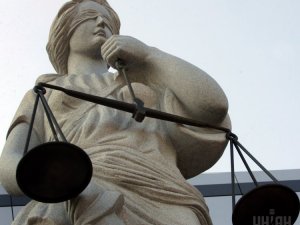
Themis
Why is the Ministry of Justice playing into the hands of Yanukovych-era oligarchs in the Sumykhimprom case?
In ancient Rome, Themis, the goddess of justice, was known as Justitia. She was depicted blindfolded, symbolizing the impartiality of her decisions and the equality of all before the law. However, in Ukraine, her worshippers apparently interpret the symbolism of the blindfold somewhat differently.
The bankruptcy of Sumykhimprom serves as proof of how Ukrainian judges and justice officials turn a blind eye to flagrant violations of state interests and the laws whose supremacy they are supposed to uphold.
Sumykhimprom is the largest enterprise in the titanium-chemical industry, officially designated as a strategic asset for Ukraine's economy and security. Its bankruptcy is a striking example of so-called "privatization," a practice that flourished during the reign of Viktor Yanukovych. The current government has so far proven unable to find effective methods to counter it. In 2010, the future owner of the "golden loaf" was just settling in on Bankova Street, while oligarchs in his inner circle were "sizing up" lucrative state assets. Thus, Dmytro Firtash, now restricted by the court to residency only in Austria, and his business partner, Serhiy Levochkin, had their own, so-called "interests" in the titanium-chemical industry and at that time controlled Crimean Titan, as well as the state-owned Irshansk Mining and Processing Plant and Volnogorsk Mining and Metallurgical Combine (the latter two enterprises were leased, from which the state received pennies). After Yanukovych came to power, Firtash and Lyovochkin set their sights on Sumykhimprom, but the state-owned enterprise was not put up for sale, nor were they even considering buying it at market price from the aforementioned individuals. However, they managed to gain control of Sumykhimprom, which they retain to this day, without much difficulty.
A Brief Course in "Express Bankruptcy"
That same year, 2010, Igor Lazakovich, a protégé of Firtash and Levochkin, was appointed head of the chemical giant. The sole purpose of his appointment, as time has shown, was to drive the company into bankruptcy, so that the company itself or its production facilities could then be bought for next to nothing. The method for achieving this was simple: the company shipped products to oligarch-affiliated entities at below-cost prices and purchased raw materials from companies linked to Firtash and Levochkin at above-market prices. As a result, Sumykhimprom rapidly sank into debt, while continuing to generate profits through inertia. These profits, like the company's debts, were concentrated in the same hands. But after a while, profits gave way to Sumykhimprom's projected losses. By late 2011, bankruptcy proceedings were initiated. Prosecutors at the time found no foul play and proceeded with the case.
A creditors' committee was formed, though it consisted exclusively of companies associated with Firtash and Levochkin: Industrial Investments Management Company LLC, which had requested the bankruptcy proceedings after it had inexplicably purchased UAH 40 million in claims from Forum Bank (after the case was opened, more than UAH 80 million in Sumykhimprom debt was purchased from desperate creditors), Nadra Bank, Sintez Resurs LLC, Krymsky Titan, and Ostchem International GmbH. The state was not admitted to this process, nor were representatives of other companies to which Sumykhimprom owed a combined total of over a billion hryvnia (including the state-owned Ukreximbank). Roman Marchenko was appointed administrator of the property.
The oligarchs thus removed the state from even formal control over the enterprise, which was almost 100% state-owned, and continued to siphon off profits for the benefit of their oligarch-affiliated entities. In March 2012, mineral fertilizers were sold to Sintez Resurs LLC, founded by a Cypriot offshore company, at a price 2 million hryvnias below cost. The fact that this and similar schemes caused damage to the enterprise, and consequently to the country, amounted to 135 million hryvnias was later established by the Sumy Oblast Prosecutor's Office.
In October 2012, the Sumy Regional Commercial Court instituted rehabilitation proceedings at Sumykhimprom. Igor Lazakovich was appointed as the rehabilitation manager for Sumykhimprom, under whose leadership Sumykhimprom went bankrupt. Roman Marchenko, who by then had become part of Firtash's ranks and successfully covered up all the excesses of the current management, remained the property administrator. Naturally, any financial recovery of the company was out of the question. The only result of the "rehabilitation team's" work was regular court appeals requesting extensions for the preparation of the rehabilitation plan (which the courts of Sumy, Kharkiv, and even the Supreme Commercial Court granted without justification, contrary to legal provisions).
How to not see the obvious
It was hoped that with the arrival of the new government, Sumykhimprom would be returned to state control. But in reality, this task proved to be no easy feat, not least because the Ukrainian Justice System remained blindsided in this matter.
In May 2014, the Sumy Oblast Prosecutor's Office opened a criminal case against officials of PJSC Sumykhimprom for selling products below cost in 2012 in order to obtain illegal profits. At that time, Sumykhimprom was already bankrupt, and Roman Marchenko was the executor of its assets. It would seem that identifying the culprits would be straightforward, since these were legally certified documents (contracts) signed and approved by specific officials. However, law enforcement is still searching for suspects. The case initially remained in the Investigative Department of the Ministry of Internal Affairs in Sumy Oblast for several months, but for unclear reasons, the Prosecutor's Office then transferred the materials for investigation to the Sumy Oblast Fiscal Service.
The Ministry of Justice handled the Sumykhimprom case even worse. More accurately, they failed to investigate it at all, or, for some "certain" reason, were unwilling to delve into its essence. The Ministry of Justice ordered the regional justice department in Sumy Oblast to prepare a report on the illegal bankruptcy of the company. Notably, the Sumy Oblast Justice Department turned to Marchenko and Lazakovich for information, who repeatedly delayed providing it. This is unsurprising—they essentially had to write a "confession." Having finally received the data and analyzed it, in late October, the Main Justice Department in Sumy Oblast "reported" to the State Property Fund that it had found no evidence of intentional bankruptcy of the company, despite all the evidence pointing to the contrary.
The only people who truly cared about the fate of the chemical giant were public activists. Thus, in August, a Public Working Group to address problematic issues in the Ukrainian titanium industry was established. Having collected substantial evidence of the deliberate bankruptcy of Sumykhimprom, its members appealed to the Prime Minister and heads of law enforcement agencies with a request to investigate the egregious violations of the law at the enterprise. A separate demand was made to the Ministry of Justice to conduct an investigation into the property manager, Roman Marchenko, who is a member of the Ministry's Public Council. Incidentally, the State Property Fund had also appealed to the Ministry of Justice with a similar request back in the spring of 2014.
In a letter from Deputy Minister Igor Bondarchuk dated September 4, 2014, regarding the redirection of the appeal, the Ministry of Justice forwarded the appeal to the Ministry of Justice Main Directorate in Kyiv and… apparently forgot about it, just as it had forgotten about the State Property Fund's spring appeal. Only in response to a complaint from the Public Working Group on October 20th did the Deputy Minister announce that the Ministry of Justice Main Directorate in Kyiv had finally issued an order ordering an investigation into R. Marchenko's activities from November 17th to 19th. The outcome of this investigation is still unknown, but the very situation of "bureaucratic ping-pong" indicates that the Ministry of Justice either doesn't care about the company's problems or is attempting to cover up Roman Marchenko's illegal activities. Ultimately, the inaction of state bodies only benefits the oligarchs behind Sumykhimprom's bankruptcy and who continue to siphon money from the company.
The country can still regain control of one of the key chemical industry companies. However, to do so, the local justice system will need to be given a free hand. Replacing the rehabilitation manager and the asset manager of Sumykhimprom could be the first step on the difficult road to recovering the company. It's the first, but far from the only one, because under the current creditors' committee, things at Sumykhimprom will certainly not improve – this committee serves Firtash's interests, which are diametrically opposed to the interests of the state. Will officials have the strength and courage to investigate all the facts and hold those responsible accountable, or will the scales of justice once again tip in favor of those who will lay a hefty sum at them? Time will tell.
Subscribe to our channels on Telegram, Facebook , Twitter , VK - Only new faces from the SKLEP section!