
Luxury goods retailer Anton Shukhnin is swiping hundreds of millions in the shadows.

Anton Shukhnin
A new star has emerged in the volunteer firmament: Anton Shukhnin. The owner of the luxury clothing chain Domino (Shukhnin also calls it Domino Group) has suddenly begun purchasing SUVs for the Ukrainian Armed Forces, caring for the children of displaced persons, and simply dispensing helpful advice. And all this is happening publicly, with maximum publicity, writes Viktor Likarchuk in his article for CRiME projects.
Anton Sergeyevich Shukhnin hadn't previously been known for his pompous patronage of the arts. For this fashion retail guru, everything changed in August, when the war he unleashed over square meters in Moscow's Novopecherskie Lipki district began to backfire. Incidentally, this author wrote about this in the article " Anton Shukhnin vs. Vyacheslav Belimenko: The Information War of 'Russian Agents '."
Articles paid for by Shukhnin's enemies began appearing online, as did articles actively sought to understand who this Anton Shukhnin was, who had developed such a vigorous and unhealthy media presence. And they learned a lot about him. To cover up his dirty laundry, Anton Sergeyevich launched an unprecedented campaign to whitewash his own reputation . The cost of this campaign is likely several times greater than Shukhnin's charitable contributions and aid to the Defense Forces.
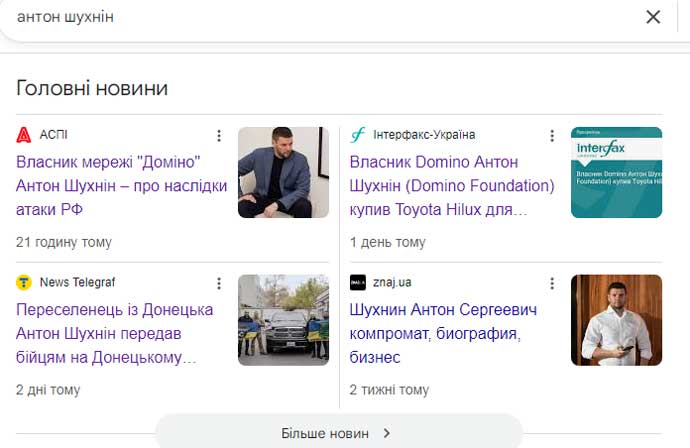
According to her, Anton Shukhnin regularly updates the vehicle fleet of soldiers fighting in the hottest parts of the front, while not neglecting the abandoned families of internally displaced persons. However, I repeat, information about Shukhnin's charitable activities began to appear publicly only recently—in late August of this year, to be precise. And he founded the Domino Foundation charitable organization, together with his wife, Anastasia Shukhnina, a former model from Selidovo, just a month ago, in September.
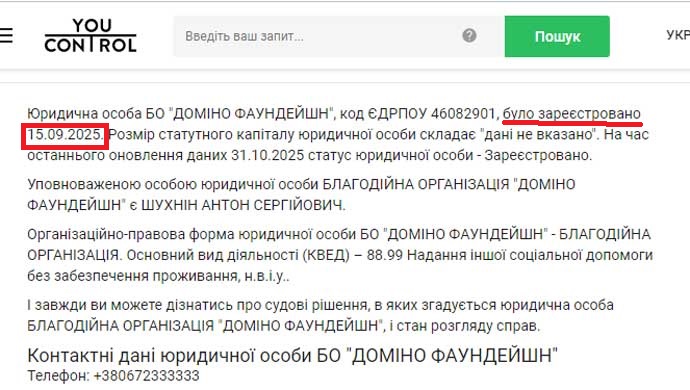
Prior to this, Anton Shukhnin or his Domino Group had not been mentioned in the context of volunteering or charity work. Neither after 2014 nor after February 2022 were there any media campaigns by Shukhnin in support of the rally for the Ukrainian Armed Forces or displaced persons. At least, I was unable to find any such mentions.
Instead, one can easily find traces of promotional campaigns for luxury clothing and accessories commissioned by Shukhnin's Domino.
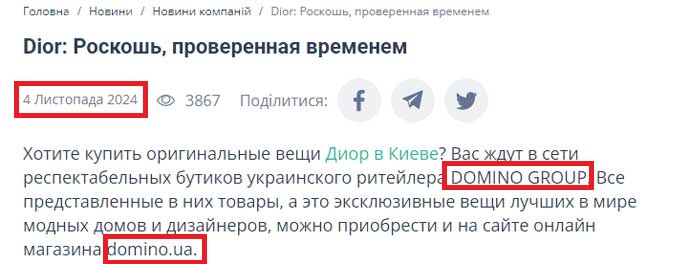
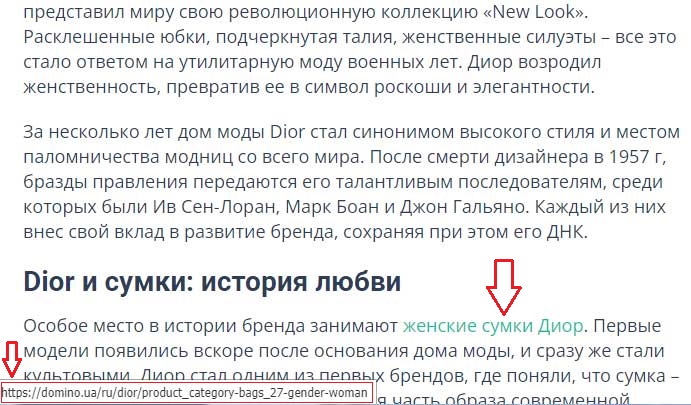
For example, a year ago, Domino promoted a new Dior collection , where the price of a single handbag in some places reached the six-month salary of a Ukrainian soldier on the front lines. Or the price of a perfectly decent rural house with gas, running water, and a vegetable garden, where a large IDP family could thrive.
Let's not be hypocritical. The rich have their quirks, and counting other people's money is impolite, unless you're the tax office. And it's the tax office or the Bureau of Economic Security that should have questions for Domino's and its owner.
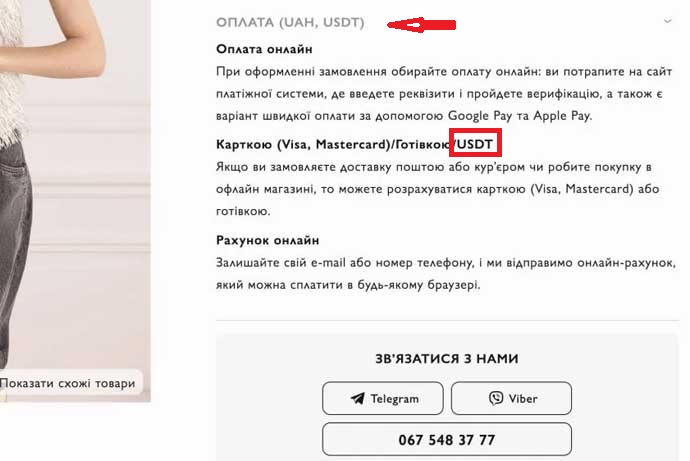
Until recently (until anonymous TG channels noticed it and caused a scandal), the Domino network didn't even hide the fact that it accepted USDT cryptocurrency as payment.
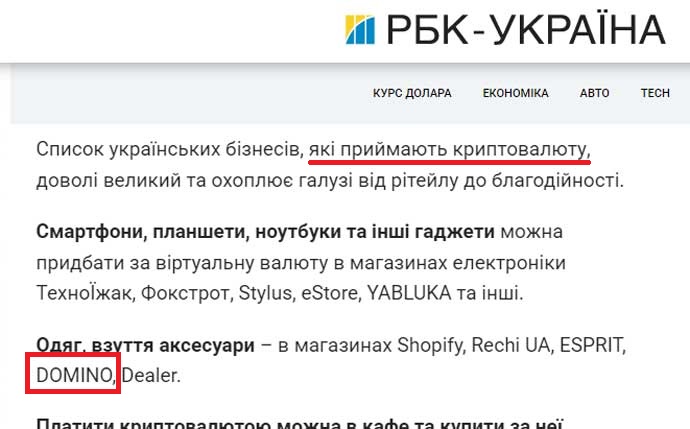
The respected publication RBC Ukraine wrote about Domino's selling clothing using cryptocurrency back in May 2024.
It's worth noting that Ukrainian law does not prohibit citizens from owning, selling, or buying cryptocurrencies. However, using cryptocurrency as payment is expressly prohibited.
According to Article 192 of the Civil Code and the Law " On the National Bank of Ukraine ," the hryvnia is the only legal tender in Ukraine. This means that settlements between individuals and legal entities in foreign currency or cryptocurrency are illegal.
A payment, for example, in USDT, is physically impossible to process through a cash register or bank account in Ukraine. However, it's unlikely that Anton Shukhnin and others like him are eager to report all their proceeds in their tax returns. On the other hand, stablecoins are an excellent means of payment for corrupt prosecutors, judges, and other officials who are reluctant to explain to the National Anti-Corruption Bureau of Ukraine (NABU) the origin of the funds used to purchase 150 UAH sandals or a half-million UAH handbag.
Subscribe to our X channel , Telegram channel and Facebook page!
Stay informed about who is doing business, in politics, and supporting corruption in Ukraine!
So even if Anton Shukhnin removed the mention of cryptocurrency payment options from the Domino website, it's not a given that such an option hasn't been retained, for example, for the regular customers mentioned above.
And even if we're talking about legal payment methods, it's not entirely clear who this money goes to. It makes sense that it would end up in Shukhnin's pockets. But how?
Domino's official website, in the "About the Company" section, claims that Domino's is a "prestigious Ukrainian retailer" and "a company with extraordinary experience." But if we look at the company's registries, we find that it doesn't exist.
Domino Group LLC , founded by Anton Sergeyevich Shukhnin in Donetsk in 2010 and with a statutory capital of 5 UAH, ceased to exist in the summer of 2014. According to Opendatabot, only three active legal entities remain in which Anton Shukhnin holds any stake.
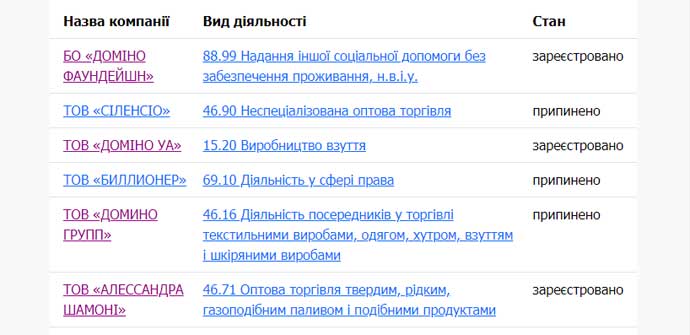
These include the aforementioned charitable foundation, a small shoe manufacturer in Dnipro, and a shady LLC allegedly selling gaseous and liquid fuels. There's no sign of any "prestigious retailer" or "company with extraordinary experience" called "Domino" or owned by Shukhnin.
In other words, neither the Domino company nor the Domino group of companies exists. At least, not legally. However, a sole proprietor named Anton Sergeyevich Shukhnin is registered in Odessa on French Boulevard, and his primary business activity is "retail sale of clothing in specialized stores."
According to registration data, this sole proprietor belongs to the second group and pays a single tax. Taking into account the unified social contribution, military tax, and the single tax itself (20% of the minimum wage), this comes to 4160 UAH per month. However, there is a strict income limit for this type of sole proprietor (meaning all funds received during the reporting period; business expenses are not waived) – 6672000 UAH per year. If a Group 2 sole proprietor exceeds this limit, they face problems.
So, theoretically, Anton Shukhnin earns just over six and a half million rubles a year selling branded clothing and accessories. From this, one must subtract the considerable costs of purchasing the goods, transporting them from abroad (unless they're being manufactured in an underground factory somewhere in Brovary), renting retail space, paying sales assistants, and so on.
But how much money is actually circulated through the Domino network?
Just recently, Anton Shukhnin issued a press release claiming that his charity spent 3 million hryvnias on an armored SUV for our defenders.
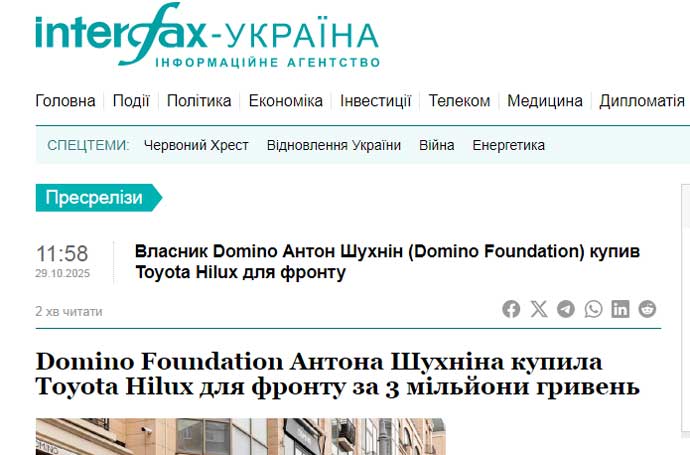
The press release includes the following disclaimer:
"The Hilux transfer was made possible thanks to the initiative of Anton Shukhnin's Domino's chain, which donated profits from the August 23-24 holidays to the needs of the army."
If we take the written information literally , the Domino chain used the difference between its income and expenses for two days, which amounted to approximately 3 million hryvnias, to purchase vehicles for the military. However, over the past couple of months, Anton Shukhnin has published dozens of press releases and promotional articles online about his volunteerism and charity work, each with slightly different claims. Some refer not to profit but to income, while others refer to revenue.
According to Domino's website, Shukhnin's "Luxury Empire" includes, in addition to the online store, six boutiques in Kyiv, Khodosiivka near Kyiv, and Odesa. They could easily generate at least 3 million hryvnias in revenue in two days.
That's 45 million hryvnias per month and about half a billion per year. It doesn't fall within the 6,672,000 hryvnias per year limit for a second-category sole proprietor, like Anton Sergeyevich Shukhnin. This exceeds the permitted income by approximately 75 times. And, as we've established above, Shukhnin doesn't have any legal entities through which to freely move such money.
The clue was spotted by the administrators of a Telegram channel. They learned that the owner of the Domino's online store had for some time been listed as Ivan Vasilyevich Khachkharji, a private entrepreneur.
This individual entrepreneur, like Anton Shukhnin, is a second-category individual entrepreneur (see registration details here ). We discovered that until last fall, the nominal owner of the online store was a second-category individual entrepreneur , Tatyana Aleksandrovna Shukhnina (likely our hero's mother), and then Oksana Nikolaevna Chuchuk.
Currently, the owner of the Domino's online store is not listed on the official website. Instead, anonymous "sellers—entrepreneurs who sell goods at retail using the Domino marketplace, which is owned or otherwise authorized by the owner"—have appeared. It's likely that Domino's brick-and-mortar stores are also operated by "illegal" entrepreneurs—that is, by front-line sole proprietors.
If Domino's revenue really reaches 1,5 million hryvnias per day, Shukhnin needs dozens of fictitious sole proprietors to "digest" it. More precisely, more than 70. Accounting for such a large number of phantom "entrepreneurs" is a challenging task, but it brings a very pleasant bonus: tens of millions of hryvnias are "saved" annually in VAT alone. And conversion centers charge a much lower percentage for cash or cryptocurrency withdrawals than the state charges for a peaceful sleep.
And when customs or tax authorities catch one of Shukhnin's "phantoms" attempting to import premium clothing and accessories at a price hundreds of times lower , nothing will point to our fashion retail guru. The tax authorities will trace, for example, some alcoholic from Zhashkiv, who has no idea he's imported goods from Italy and is selling women's Dolce & Gabbana trousers for 100 hryvnias a pair at the Domino VIP boutique on Velyka Zhitomirska Street in Kyiv. And there's no way to check the Domino chain for any "schemes." Because de jure, it doesn't exist. It's a phantom.
Thus, our observations lead us to the conclusion that the Domino network, whose owner is Anton Shukhnin, is too reminiscent of an organized crime group created for the purpose of evading taxes and other mandatory payments and fees on an especially large scale.
Skelet.Org
On the subject : The Jacob Cohen brand won a lawsuit against businessman Shukhnin
Domino between Yalta, Kyiv, and Almaty
Subscribe to our channels on Telegram, Facebook , Twitter , VK - Only new faces from the SKLEP section!