
The escalating conflict between MPs, officials, and the oligarch Ihor Kolomoisky, the governor of Dnipropetrovsk, has become one of the most high-profile events of January. The issue concerns attempts to strip the Privat Group of its sole control over Ukrnafta, the country's largest oil company. Meanwhile, less obvious processes are also seriously weakening the oligarch's influence in the oil business. Some call it a struggle for state interests, others a settling of scores, but it cannot be ruled out that someone is trying to carve out a piece of the pie that the bearded man from Dnipropetrovsk has been munching on single-handedly since the revolution. It is entirely possible that what is happening is merely the visible elements of a behind-the-scenes haggling over businesses, TV channels, political funding, and so on. The fight against Kolomoisky is like a revolution: it is waged by romantics, and the results are exploited by scoundrels.
Conflict with Kolomoisky over oil is an inevitable tradition of the first year of any government. It's simple: power flows are redistributed, and the winners demand the "suitcases" from the overseers of state-owned companies. Recent history has been no exception, at least in terms of public conflict.
Kolomoisky's most vulnerable asset is Ukrnafta. A controlling stake of 50% + 1 share belongs to the state-owned Naftogaz of Ukraine, but Privat, which has consolidated 43% of the shares, will soon mark 12 years since the company was effectively controlled. Since then, this smaller, but blocking, stake has allowed the minority shareholder to decide whether to hold a shareholder meeting, change management, and pay dividends to the state.
The fact is that, according to the law, a shareholder meeting can only take place if holders of 60% of the shares are registered. With just over 40%, meetings can be blocked, depriving the state shareholder of any influence over the company. But to avoid further escalation, Kolomoisky and his partners devised an excellent scheme. For many years, they have exploited the constant need for funds in the Cabinet of Ministers "of all convocations" and, in effect, traded the payment of legal dividends to the state for continued control of the company. "We'll give you your dividends and the glory of great economic reformers for 1+1, and you stay out of Ukrnafta's management and finances—that's roughly the principle." There is reason to believe that a separate dialogue was also established with the presidential hierarchy. Fortunately, the company regularly produces "arguments" for any dialogue...
The press often misrepresents the main criticism leveled at Kolomoisky and the goal of restoring effective state participation in Ukrnafta. A lack of understanding of the company's specifics and, most importantly, its significance and potential is the main problem facing the constantly shifting state-controlled "Kermanyches," who can't even grasp how much this entity earns and what it's capable of. Everyone understands the idea of "squeezing Kolomoisky out," but few who use such terminology know what to do with Ukrnafta. The state needs to strengthen its control over its finances and implement its strategic objectives, which "private" shareholders typically ignore, and Ukrnafta is no exception.
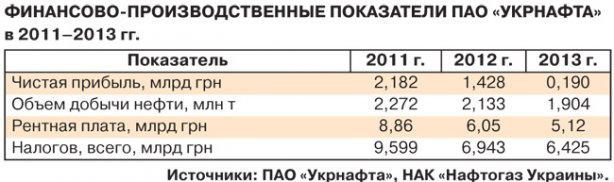
Firstly, cleaning up the company's finances will dramatically increase Ukrnafta's official profits and, consequently, dividends. The problem isn't so much that the evil governor isn't handing over dividends to the state, but that these dividends are paltry by oil industry standards. This is about transparent and fair accounting, not about squeezing out minority shareholders' rights. Secondly, state participation should be aimed at developing the company, as it has long been declining, starved of investment. If you like, it's about energy security, since the more oil and gas we produce domestically, the less we'll pay importers, who, in one way or another, rely on Russia.
Premature euphoria
The draft amendment to the Law "On Joint-Stock Companies" to reduce the quorum for shareholders' meetings from 60% to 50% of shares wasn't born this January, or even last year. This baton had been hanging over Ukrnafta's Privat management since Yushchenko's time, but was quickly hidden, presumably after the issue was "resolved." In 2010, the Party of Regions finally brought the draft back from the closet. However, soon after, Ukrnafta acquired a supervisor from the Dentist, and
In 2014, no one even tried to convene a shareholders' meeting.
So, the appearance of the baton in 2014 wasn't particularly surprising. But the fact that Oleh Lyashko's bill received the required 230-vote majority on January 16 was. The situation had never reached this stage before, and this makes it fundamentally different from previous ones. And although the attempt to effectively rein in Kolomoisky failed, as will be discussed below, the vote was extremely informative. Parliament's approval was based on the votes of the presidential faction, Samopomich, the Radical Party, the Opposition Bloc, and several independent deputies. At the same time, despite the bill's inclusion in the coalition agreement, only 13 of the 85 deputies from the "prime minister" faction, the People's Front, supported the bill. A short time later, the People's Front announced that it had not voted due to the draft's imperfections. We'll see how the faction votes for the "perfect" version, which Arseniy Yatsenyuk has already announced. To further reinforce his point, the Prime Minister instructed the Ministry of Energy and Coal Industry and Naftogaz to call a meeting of Ukrnafta shareholders and replace the company's management. But will this help?
Apparently, the radical leader didn't consult sufficiently with Akhmetov's lawyer, Voropayev, in the session hall. Indeed, Lyashko's hastily adopted bill, with its wording, had no chance of achieving its goal, as it referred to companies with state participation. But the state is an indirect shareholder in Ukrnafta, through the National Joint-Stock Company, which, as they say in the region entrusted to Ihor Palytsia , is a far cry from the "corporate rights of the state." However, even the prime minister's promised "improvement" to the bill, which would address this issue, is not guaranteed to overthrow Kolomoisky.
Privat long ago recognized the threat to its precarious position at Ukrnafta and took some steps to strengthen it. In 2010, between two rounds of the presidential election, a shareholders' meeting was held, at which a shareholder agreement was signed between the government (Naftogaz) and minority shareholders. In short, under this agreement, the state shareholder can't even sneeze without the approval of a minority shareholder. For example, the chairman of the board is appointed exclusively from candidates nominated by Privat. Or here's another: six board members are selected exclusively by the supervisory board, but... from candidates nominated by the chairman of the board, i.e., again, by Privat. It would seem that the state has a majority on the supervisory board—six out of ten members. But decisions are made only by a quorum of eight people, meaning, again, a minority shareholder is essential.
All provisions of this agreement have been incorporated into Ukrnafta's charter. Oh, and here's another thing: amendments to the charter can only be made by 75% of shareholder votes, which the state doesn't have when a minority shareholder attends a meeting. What Prime Minister and presidential candidate Yulia Tymoshenko received in return for sanctioning the agreement is unknown. It's possible that she simply received the right to the same legal state dividends that were paid at that meeting. We emphasize once again: with such provisions, the state will be unable to make any personnel or financial decisions at Ukrnafta.
"The legitimacy of this agreement is highly questionable, but its provisions are spelled out in the charter—it's a valid document that must be challenged in court," a source at Naftogaz Ukrainy believes. What are Kolomoisky's chances of winning a lawsuit in Ukraine? Let's just say they are theoretically possible.
However, it's not as if the yet-to-be-adopted bill to reduce the quorum is useless—it's the first step on a long road. And it's necessary in any case.
Kolomoisky's response
It should be noted that parliamentary events are not the only ones plaguing the Dnipropetrovsk oligarch recently. Sources in the Ministry of Energy and Coal Industry report that Deputy Minister Igor Didenko has no chance of remaining in his post under the current minister. (This is assuming the presidential minister himself isn't "ousted" first.) It's unclear whether Igor Nikolaevich has fulfilled the tasks and expectations placed upon him, but he has worked diligently to ensure that Dnipropetrovsk interests are not harmed and are expanded. In the spring of 2014, he penned at least five projects alone for refining state-owned industrial oil siphoned off by entities under the oligarch's control. Along with Didenko, other ministry officials involved in the Dnipropetrovsk governor's projects are also leaving.
But Demchyshyn's main move lies elsewhere. On January 21, the Cabinet of Ministers adopted an amendment from the Minister of Energy to the resolution on the procedure for conducting auctions for Ukrnafta oil. It is truly revolutionary, as it eliminates the 15% discount at which this oil had been sold in recent years. At 2013 prices, Ukrnafta's lost profits due to this discount amounted to approximately UAH 3 billion per year. This amount, therefore, can be considered additional profit for the buyers of this oil—Privat entities. At the time of writing, the amendment has not been signed by the Prime Minister. Will he?
Another surprise for Kolomoisky was the sharp decline in oil prices. At a meeting, the head of PrivatBank stated that Ukrnafta's breakeven point was at $45 per barrel. In other words, there was no money. None at all. Therefore, there was no money to pay taxes (oil rent) or dividends. As a reminder, Ukrnafta had not paid oil rent since the summer, and its current debt to the budget was approximately UAH 3 billion. At a shareholders' meeting in October, the company also pledged to pay the state UAH 1,9 billion in dividends. The tax service filed a lawsuit, but the court ruled against seizing Ukrnafta's assets.
According to our sources, it was during the dispute over how to repay Ukrnafta's debts to the budget that Privat leaders Kolomoisky and Palytsia raised the issue of repaying Ukrnafta's old gas debts and paying penalties for the sub-market price paid to the public over many years. Predictably, no one took the bait, and it was in this context that the much-discussed January letter from Ukrnafta's Cypriot shareholders, published by ZN.UA, emerged. In it, they threaten Ukraine with international litigation. In short, the investors point to Ukraine's violation of the Energy Charter Treaty, the infringement of their investor rights, and ultimately estimate their damages at $5 billion, proposing to initially reach an amicable settlement within 90 days.
***
The oligarch's willingness to fleece his impoverished country, even in court, is completely at odds with the patriotic image he's projecting. He made no such demands of Yanukovych, despite having the same grounds. The same threatening letter mentions claims against the state dating back to 2006. This is clearly a response to the formal and informal pressure exerted on him by the prime minister and president. The former, at a minimum, wants the budget debts to be paid off, but is that all? Whether Arseniy Petrovich wants systemic changes in his relationship with Ukrnafta will become clear very soon. This will be evident as the People's Front faction votes on the "quota" law, signs a resolution eliminating the discount on Ukrainian oil, and files a lawsuit challenging Ukrnafta's charter.
What does the president want, taking action through the Ministry of Energy and through parliamentary votes? The spectrum is broad, but it's clearly the same thing his predecessors wanted, and most likely the same thing the prime minister wants. It's possible the conflict wouldn't have happened if oil were at $100 a barrel instead of $48—then everyone would have had enough to be happy.
But there's another question: what to do with the dozens of deputies from both the presidential faction and others who vote and sincerely desire order and justice at the country's largest oil company? It will be difficult to brush this issue aside, and that's the biggest positive in this whole situation.
"Mirror of the Week. Ukraine" No. 2, January 23, 2015
Subscribe to our channels on Telegram, Facebook , Twitter , VK - Only new faces from the SKLEP section!