
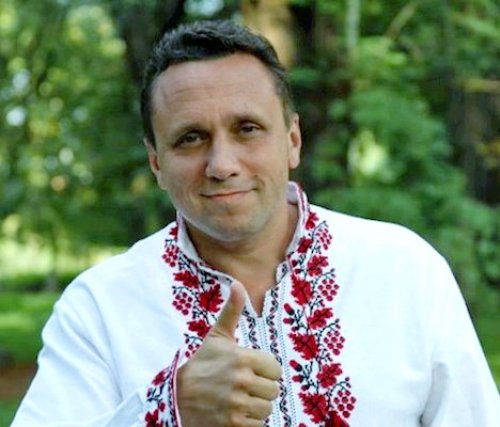
Vyacheslav Kredisov: Doctor of Fraudulent Sciences. Part 1
A thief, a liar, a fraudster, a bribe-taker, a traitor—Vyacheslav Kredisov bears all these "regalia," far from honorable in polite society. These descriptions were given to him by Ukrainians who had the misfortune of doing business with Kredisov, being family members, or even simply living in the same city. Where Kredisov is, there are always real estate scams, "rip-offs" of his partners, and a stream of false accusations against his former allies. He himself still proudly flaunts his doctorate in economics and the honorary title of "Honored Economist of Ukraine," hoping to mislead those who don't yet know the full truth about this "prominent businessman and philanthropist." Well, let's hope that Skelet.Org's material will open the eyes of as many Ukrainians as possible to Kredisov and prevent them from becoming his next victims.
Crime Fiction by the Kredisov Family
Vyacheslav Anatolyevich Kredisov was born on September 30, 1965, in Kyiv, to Anatoly Ivanovich and Lidiya Nikolaevna Kredisov. His father, a professor and doctor of economics, taught at Taras Shevchenko National University of Kyiv (then KSU) and the Kyiv Institute of International Relations (KIMO). From 1984 to 2009, he held the positions of deputy director and department head, and in the 2000s, he served as rector of the Intersectoral Institute of Management. It was he who followed in his sons' footsteps, helping them earn an education at a prestigious university, establish their careers, and take their first steps.
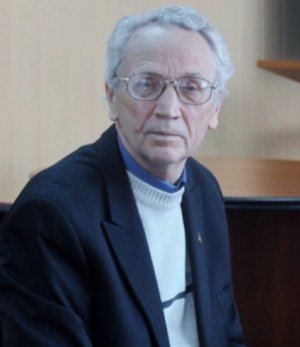
Anatoly Ivanovich Kredisov
So, after graduating from high school in 1982, Vyacheslav Kredisov went straight to join his father at Kazan State University, in the economics department. But in 1983, he had to take a break from his studies to serve in the army, so he didn't graduate until 1989. He then stayed on for graduate school, where he married his classmate, Svetlana Zorina (from Donetsk). In 1992, they defended their PhD dissertations together, with Anatoly Ivanovich also helping them.
But by then, economics as a science no longer held much interest for Vyacheslav Kredisov: by the late 80s, he had gone into business, selling Western consumer goods. However, his father helped him here too: while most aspiring Ukrainian businessmen at the time were importing and selling individual batches of "this and that," Vyacheslav Kredisov, thanks to his father's connections, was able to reach Western companies and sign contracts with them, becoming their distributor. He began importing popular chewing gums "Dirol" and "Stimorol," Tuborg beer, cosmetics and household chemicals, clothing, stationery, bouillon cubes, and much more into Ukraine.
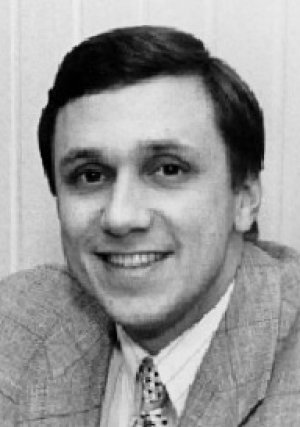
Vyacheslav Kredisov in his youth
To this end, Vyacheslav Kredisov, his wife Svetlana Zorina, and his army friend Vyacheslav Melnik founded the company "Mezokred" (Melnik, Zorina, Kredisov) in 1991, which quickly grew into a holding company. Its subsidiaries were opened in Donetsk (EDRPOU 30075672), Kharkiv (EDRPOU 24269913), Odessa (24760572), Sumy (30608104), and other cities (a total of about 30). By now, almost all of them have closed; some remain in the Kredisov family's ownership. The fate of Mezokred Holding LLC is curious: it is now owned by Estonian businessman Hillar Teder, known to Ukrainians for his scandalous involvement in the SkyMall shopping center case.
Kredisov's business would have been worthy of praise, had it not been shady, corrupt, and even criminal from the very beginning. Specifically, one of his "roofs" was Vitaly Yarema , who even installed a relative in Mezocred's management. But police protection wasn't enough: according to Skelet.Org sources , Kyiv organized crime groups conducted their commercial activities through Mezocred. Specifically, sources named the "brigade" of Valeriy Pryshchik (Pryshch), who served as the second, gangster "roof" of this firm. More precisely, it was practically one "roof," but, as they say, a double-pitched one. As the media has repeatedly reported, Vitaly Yarema and his colleague Alexey Savchenko were formally "developing" Pryshchik's organized crime group, but in reality, they provided him with protection for several years, receiving their "cut" (which is how Yarema came into contact with Mezokred), until a major falling out between them in the second half of the 90s led to Pryshchik's downfall. Pryshchik was subsequently killed, and part of his money went to the "UBOP mafia" (Yarema, Savchenko, and Heletey ), who used it to open their own bank, Avant.

Vitaly Yarema
Furthermore, the media reported on Svetlana Zorina's personal criminal connections, as a relative of hers in Donetsk was serving time. It was also reported that the Kredisov family business was connected to Leonid Chernovetsky , who worked as a lecturer at Taras Shevchenko Kyiv State University in the late 80s before moving into commerce.
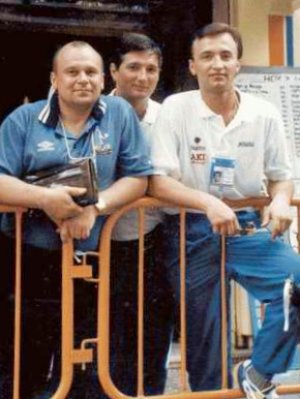
Valery Pryshchik (left)
In the mid-90s, Mezocred employed several hundred people, and its annual turnover amounted to tens of millions of dollars. Kredisov spent money like a crime boss: he bought apartments in central Kyiv, drove sports cars, and developed a habit of dining at expensive restaurants. This period of easy money came to an abrupt end in 1997 with the arrest of Vyacheslav Kredisov and his wife, Svetlana Zorina, on charges first of drug and arms trafficking, then of alcohol smuggling. Kredisov himself was also accused of assault. They spent time in pretrial detention while their business was literally torn apart, and then fled Ukraine for a time.
Neither Kredisov nor Zorina ever admitted to the true reasons for their arrest, nor did they name a single person. Kredisov later assured journalists that certain "werewolves in uniform" were simply extorting "sponsorship" from him, while being confused about which agency they were from—the Ministry of Internal Affairs or the Security Service of Ukraine. His wife later wrote a crime novel, "The Raid," "based on her experiences." Yarema, the curator of Mezocred, could have revealed a wealth of interesting information about this, but he categorically denies any connection to the enterprise or any accusations against him. The other witnesses to this case have long since been buried under granite tombstones. Only fragmentary rumors remain that the "raid" on Mezocred was allegedly connected to the then-erupting war between the "UBOP mafia" and Pryshchik's organized crime group.
On different paths
After this incident, Kredisov and Zorina separated for the first time—though briefly; their second divorce took place in the 2000s. Then, in the late 1990s, having lost their highly profitable distribution business, they started a new one—rumor has it, with the assistance of crime boss Cherep, through whom they became closely acquainted with Vitali Klitschko.
In the late 90s, Zorina immersed herself in a series of books, "Divorce," "Shooting," and "Repartition," demonstrating her extensive knowledge of the life of the then "brotherhood." Whether she wrote them herself or hired some hungry philology graduates for a couple hundred bucks is unknown. But by 2002, Zorina had transitioned from writing to selling books, opening a bookstore called "Bukva," which three years later had grown into two bookstore chains. Then, after her second divorce from Kredysov, accompanied by the division of property and business, she ran for the Kyiv City Council in 2006. Her old acquaintance Leonid Chernovetskyi became the new mayor, and his team included another old acquaintance and friend of Zorina's, Irena Kilchytska, whose father also taught at Kyiv State University. Thanks to them, Zorina received a position at the Kyiv City State Administration, heading its Department of Culture. Zorina's name was later implicated in numerous scandals: attempts to illegally privatize movie theaters, a "cash scam" by the Kapranov brothers' publishing house "Green Dog," direct involvement in organizing the so-called "bloody Christmas tree ," and then she was put on the wanted list for embezzlement and theft of budget funds during the organization of the May 9th celebration.
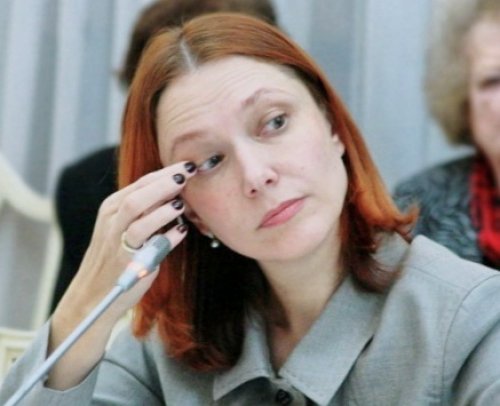
Svetlana Zorina
Vyacheslav Kredisov began his self-rehabilitation in 1997 by becoming a public figure: he joined the presidium of the then-founded public organization of entrepreneurs, "New Formation." He developed new and significant connections in government, and in 1998, Kredisov was included in the list for the honorary title of "Honored Economist of Ukraine."
In 2001, he received personal gratitude from President Kuchma with the wording “For his outstanding work, significant special contributions to developments and the value of the Ukrainian state,” and at the same time he became an adviser to Prime Minister Anatoly Kinakh.
From his business career in the 90s, which were wild in every sense, Kredisov retained the Mezocred companies, some "savings," and an apartment in a historic building on Bohdan Khmelnytsky Street, known to Kyiv residents as "Bradtman's Lace House," where Kredisov is still registered. However, the building has long been in need of restoration, so Kredisov is simply registered there and simultaneously holds onto the property (the second-floor apartment) as a good real estate investment.
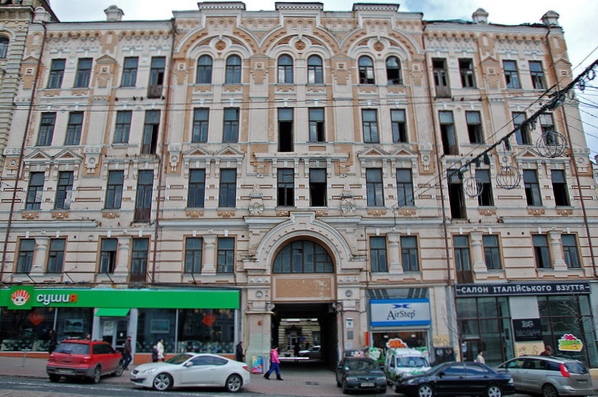
Bradtman's "Lace" House
His younger brother, Alexey (born in 1972), was registered with his parents for a long time in a high-rise building on Mayakovsky Avenue, near Desnyansky Park. This is astonishing modesty for a man who made a successful career as a "Soros boy"! After graduating from his father's Institute of International Relations, he didn't follow his brother into business, but took advantage of Soros programs and went to the United States for additional training (for six months). He then returned to Kyiv and, from the mid-90s, worked for the audit firm Arthur Andersen. After its merger with Ernst & Young in 2004, Alexey Kredisov became managing partner of its Ukrainian branch, Ernst & Young LLC. He is now Ernst & Young's Chief Operating Officer for Eastern Europe and West Africa. And it seems his position reflects the attitude of Western economies toward our country. Incidentally, Alexey Kredisov is a strong supporter of cooperation between Ukraine and the IMF, advocating for strict compliance with all of the Fund's "recommendations."
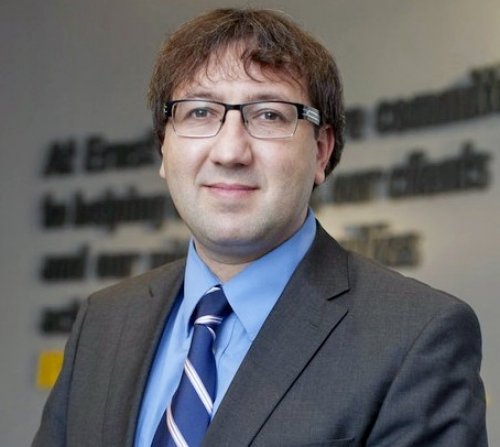
Alexey Kredisov
But the apple, even one carefully selected and polished by Soros himself, didn't roll far from the family tree. It turned out that the prosperity of Ernst & Young LLC depended largely on lucrative contracts for all sorts of audits that Oleksiy Kredisov's firm received from the Kyiv City State Administration, and previously from government agencies (including the Ministry of Defense during Vyacheslav Kredisov's tenure there). One of these scandalous contracts was the financial audit of Kyivenergo , which Ernst & Young conducted at the request of the Kyiv City State Administration, receiving a fee of 2,45 million hryvnias from the capital's budget. It's worth noting that this sum, at the time, was equivalent to the monthly salaries of two hundred highly qualified Kyiv accountants. Clearly, Ernst & Young was overpaid for its services many times over. Who was so generously squandering the capital's budget? There are many "friends" of the Kredisovs and Zorina (and perhaps even their business partners) in the Kyiv City State Administration and the Kyiv City Council, and the NABU and the Prosecutor General's Office will probably one day identify the specific names.
Vyacheslav Kredisov: Straight from the bunk - to deputy minister!
After the second Maidan, Ukrainians had come to regard it as commonplace that "prisoners of the regime" freed from prison by the "revolution" not only walked free but also received parliamentary mandates or even government positions. But in 2005, this was still a novelty and a surprise. Therefore, the fact that Ukraine's new deputy defense minister was just yesterday slurping gruel in the Lukyanivske pretrial detention center was kept under wraps.
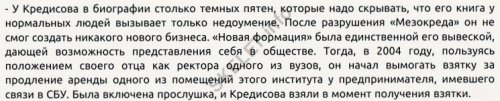
How did Vyacheslav Kredisov end up behind bars again? He later lied about it, repeatedly. He lied in interviews , telling a tale about how businessman Kalatsky, who had joined his "New Formation" and paid a "membership fee" of $10, accused the poor fellow Kredisov of extorting a bribe out of sheer meanness. He lied in his book, "The Peaks and Abysses of Vyacheslav Kredisov," which he published in 2007 (apparently imitating his ex-wife), where he claimed he suffered for political reasons: the provocateur Kalatsky was an opponent of Viktor Yushchenko! This was a direct assertion that Kredisov not only suffered during the "Kuchma regime," but suffered for Yushchenko. However, Svetlana Zorina immediately demolished her ex-husband's fantasies, exposing his lies and revealing the true reason for Kredisov's "second stint":
Vyacheslav Kredisov: Doctor of Fraudulent Sciences. Part 1
Details of this criminal scandal can be found in leaked materials from criminal case No. 50-3662, opened in 2004, as well as information from other sources. It turns out that at the time, father and son Kredisov were "moonlighting" by renting out premises at the Intersectoral Institute of Management (MIU), where Anatoly Kredisov had served as rector since the late 90s. But even here, the Kredisovs couldn't avoid scams. Since the leased premises were state-owned, not the Kredisovs' private property, they accepted bribes for the mere approval of the lease (the consent of the institute's management and the approval of the State Property Fund). However, since the approval was a one-time thing, unlike monthly rent, the Kredisovs tried to arrange things so that the leases were renewed as frequently as possible—which meant they pocketed the "fees" more frequently. Their tandem worked like this: first, Kridisov Sr. would promise to "assist" (without mentioning money) and refer the client to his son, saying, "Discuss all the details with him." Then, Kridisov Jr. would negotiate the bribe with the client: "You pay me, and daddy will do everything!" A rather sophisticated scheme, one might wonder if its mastermind was not the flighty son, but his experienced father.
But his insatiable greed for easy money failed him again. Businessman Kalatsky, who had leased the institute's premises at 10-v and 10-e Vetrenye Gory Streets for his companies, Kvadrat LLC and TD Yaroslavl, turned out to be a seasoned veteran, not to mention one with family ties to the SBU.
This remained outside the scope of the criminal case, as did the fact that Kalatsky needed the premises and was willing to pay for them, but Kredisov began openly ripping him off. Kalatsky then decided to rip Kredisov off in turn, complaining to a relative. On August 10 and 17, 2007, Kalatsky recorded conversations with Kredisov on a voice recorder, and on August 25, he filed an official complaint with the SBU. And on August 27, Vyacheslav Kredisov was caught "hot" in the courtyard of the Ministry of Internal Affairs with 10 marked dollars in his pocket (Kalatsky was supposed to give him another 8 after signing the permits).
During interrogation, Kredisov Sr. immediately shrugged his shoulders: "I know nothing about any money, I don't take bribes, and if my son orchestrated some kind of scam, then hold him responsible!" Essentially, the case was immediately narrowed to the charge of extortion of $18 (an especially large sum) by Vyacheslav Kredisov himself in exchange for a promise to "resolve the rental issue." But since Kredisov Sr. immediately disclaimed the case, and his son had no formal connection to the Ministry of Internal Affairs, he was also charged with fraud (Article 190-4).
Thus, Vyacheslav Kredisov ended up in the Lukyanivske pretrial detention center, where he languished until the end of December 2004. However, his father didn't disown his unsuccessful son, but rather involved all his connections in his case. And when the "Orange Revolution" occurred, when the third round of elections was scheduled and Yushchenko's victory became certain, when Viktor Andreevich's allies began to march through the offices of the outgoing government, kicking doors open and shouting, "Tomorrow I'll be sitting in this chair!", Vyacheslav Kredisov's case was quickly overlooked, and he was released home on his own recognizance. A month and a half later, according to Skelet.Org , his father helped his son again by arranging for him to serve as deputy to the new Defense Minister , Anatoly Gritsenko , with whom Anatoly Kredisov had a long-standing acquaintance. No sooner had the new President, Viktor Yushchenko, signed the decree appointing him (No. 287/2005, dated February 10, 2005) than the criminal case against Vyacheslav Kredisov was immediately closed on March 14 by a ruling of the Solomensky Court "due to the changed situation and the fact that the act he committed had ceased to be a public danger." The reasoning is, of course, shocking: how can fraud and bribery cease to be a public danger?! But regarding the changed situation, the court was right—much had changed then. And the scandalous fact that the "people's president" had appointed a bribe-taker and fraudster facing criminal charges as a deputy minister needed to be urgently rectified!
Later, of course, after all the scandals, Gritsenko insisted he had never heard of Kredisov, that this deputy had been foisted on him "from above." But numerous Skelet.Org sources claim Gritsenko lied, attempting not only to conceal his involvement in Kredisov's appointment as his deputy but also to blame him alone for all the corruption and fraud scandals that rocked the Ministry of Defense in 2005-2006.
Sergey Varis, for Skelet.Org
CONTINUED: Vyacheslav Kredisov: Doctor of Fraudulent Sciences. PART 2
Subscribe to our channels on Telegram, Facebook , Twitter , VK - Only new faces from the SKLEP section!