
There was a time when Nikolai Azarov was considered the main enemy of business and the middle class.
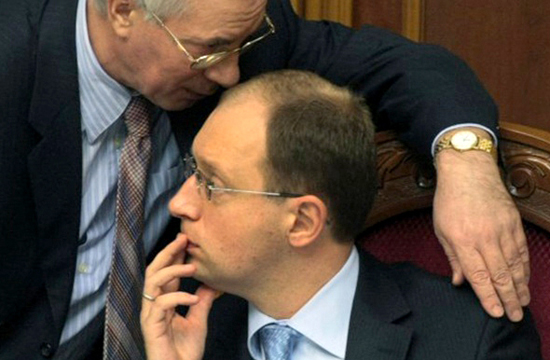
Mykola Azarov and Arseniy Yatsenyuk
The ex-prime minister tried every now and then to pick the pockets of both the first and the second.
Arseniy Yatsenyuk has always respected Nikolai Yanovych.
Apparently, on this note, he decided to use the methods of the founder of the tax service.
According to sources at Economic Truth, the new 30% personal tax will be introduced to parliament this week.
They will try to push it through using an accelerated procedure, after first hitting the deputies' huge ears with slogans like "we need to save the country."
This worked with the previous, far more experienced parliament, and it will work even more so with the current, naively impetuous one. If this is what is needed for the country and the front, former Maidan activists will press the green button without a second thought.
Perhaps you should wean yourself off revolutionary impulses, gentlemen deputies. Even the "anti-market" Azarov didn't allow himself to do so.
The government's proposal is far from fresh. Yatsenyuk has decided to revive Bill No. 5079, "On Amendments to the Tax Code and Other Laws," submitted to the previous Verkhovna Rada.
The act has been slightly cleaned up, and the Cabinet is ready to demand its adoption this week. The Prime Minister is probably already preparing a speech that will make history.
In the previous Verkhovna Rada, this bill failed under the guise of "tax reform." It was obvious to deputies who had seen Azarov's work: there was no reform involved. New taxes, indeed.
The updated draft hasn't changed anything fundamentally. Again, it doesn't mention any tax reform. It will increase fiscal pressure on legal businesses and ordinary citizens.
Legal businesses, for example, will receive a new tax regime for commercial real estate. The list of excisable goods will be expanded, additional excise taxes will be introduced for retailers, and excise rates will be increased.
Yatsenyuk also proposes increasing the powers and corruption potential of senior officials of the State Fiscal Service.
Companies will once again face unconditional write-offs from their current accounts based on a decision by the head of the fiscal authority. The last time such a measure was observed in Ukraine was in 2001, when it was abolished amid scandal.
The state has other gifts in store for individuals. They will be introduced a progressive income tax scale—from 15% to 25%—increasing rates, and complicating taxation procedures on passive income. Interestingly, the tax on dividends will not be affected.
Firstly, many members of the Cabinet of Ministers own shares – they wouldn’t want to offend themselves.
Secondly, Rinat Akhmetov owns shares in SCM and is unlikely to be thrilled about having to pay the state. This applies to Yatsenyuk's friendly ties.
The public will also likely be pleased to learn of the expansion of the residential property tax base and the inclusion of non-residential premises. This has happened, as the skeptics predicted.
At first, the property tax was pushed through, with the public convinced that only extremely large properties would be subject to it. But now the tax base is gradually expanding, and everyone in the country is beginning to wonder: maybe this was the original plan?
A key feature for individuals will undoubtedly be the introduction of indirect income taxation methods. This is worth discussing in more detail.
At first glance, this seems to be a transition to a more civilized method of monitoring individuals' actual income—the kind used in the West. An inspector came, saw a new car, and asked to see the receipts.
However, the devil is in the details.
Firstly, no one is proposing to legislate the procedure for applying the control method. It will be approved by the Ministry of Finance. This means that officials will write exactly what they need, and even parliamentarians won't be able to stop the fiscal authorities' creativity.
State Fiscal Service Head Igor Bilous is surely beaming with joy. After all, he wasn't fired for chronic failures; on the contrary, he'll soon be rewarded with new opportunities.
It's completely unclear how the background check will work for an individual. And if it's not described, it's not prohibited. This means they can come into someone's home, peek through binoculars, and film with a hidden camera.
According to a procedure approved by a Ministry of Finance order, a cohort of Ukrainian Red Guards will be established. They will be authorized to use batons to break into the homes and apartments of citizens suspected of tax evasion. Don't mention later that Yatsenyuk wanted to feed the country.
As for tax authorities, there are still a number of unpleasant aspects. The authority to order audits of individual non-entrepreneurs will be given to the heads of regulatory agencies. These could be officials of any level—from the current head of the State Fiscal Service to local fiscal lords.
They will have more than enough reasons to order such an inspection. I quote the draft law.
“The control body has the right to conduct a documented, scheduled verification of the appropriate method of control over expenditures and income, if one of the circumstances is evident:
392.2.1. The authority of the tax payer has assets for which the tax payer does not have documentary evidence of the exchange of funds or mines that are available for the acquisition of such assets.
392.2.2. The tax payer has made expenditures for which the tax payer does not have documentary evidence of the transfer of assets required for the purpose of making such expenditures.
392.2.3. The control body revealed the fact that the data provided by the tax payer was unreliable for the exchange of funds, mines or other assets.
392.2.4. Detection of undeclared assets and income from the tax payer.
392.2.5. Availability to the control body of information, excluded from the procedure established by law, so that the amount of expenses incurred in connection with the addition of assets to the tax payer - a special physical person in the current period, is transferred over the amount income, deducted by such a tax payer from this world period, in an amount that exceeds the amount of forty minimum wages established by law for 1 day of the world.”
That is, instead of blocking kickbacks for VAT refunds, tax authorities will dispossess citizens and businesses.
The main danger of ordering such an audit is its selectivity. The head of the fiscal authority may or may not order it. The bill does not provide for a procedure, meaning it remains the Cabinet's prerogative.
The presumption of innocence is being abolished in the country. Completely. Tax authorities can not only order an audit of an individual, but also make decisions based on its results, without bothering to go to court.
The act grants officials the right to demand payment to the budget of 30% of the excess of expenses over revenue. The tax authority will also determine this amount itself, with the help of its experts. The taxpayer merely has the right to prove in court that the assessment is erroneous. This is called the presumption of guilt.
What has been described indicates several things.
1. The senior staff of fiscal authorities become full-fledged owners of their fellow citizens.
2. Any opposition, for example, negative statements about the work of the State Fiscal Service or specific officials, can be nipped in the bud with the help of the proposed know-how. "Criticizing? Show me where you got your TV."
3. All public figures and prominent businessmen become seriously dependent on the tax authorities. Incidentally, the businesses of parliament members are not immune, unlike the parliament members themselves.
We are witnessing the creation of an authoritarian vertical power structure built on the personal opinion of a fiscal authority employee. Something similar existed in the USSR, called the Extraordinary Commission, which evolved into the NKVD.
What are the population's chances? Not great. To implement indirect taxation methods, it is proposed to introduce a one-time voluntary-mandatory asset declaration for taxpayers.
For those who do not do this, assets will be considered at a conditional level of 200 thousand hryvnias or 12 thousand dollars. In 2015, this amount may fall below 10 thousand dollars.
It would seem, why not declare assets? After all, there are no plans to tax anything acquired through hard labor until the mandatory declaration is made. There are several answers to this question.
Just recently, the government asked its citizens to declare their residential property. It vowed that it would only tax residential space and only beyond the established non-taxable minimum. Many believed it.
However, the bill under consideration proposes changing the real estate tax system. Taxing it based on the first square meter, not just on residential space, but on the total area. And not just residential space, but non-residential space as well.
This is a wonderful lesson for overly trusting citizens. Who would believe that the same thing won't happen to previously declared property?
Who guarantees that tomorrow another "Caesar" won't want to take 0,1% off asset values? For example, to help orphans. And again, on a selective, individual basis. Or are you against orphans?
Besides, where is the guarantee that data from the databases won't surface at Petrovka, and that the day after tomorrow, "lustrators" won't come to the person with batons?
Finally, Yatsenyuk and his brilliant advisers came up with the following rule: individuals must deposit any funds in excess of UAH 200 declared in a one-time declaration into Ukrainian bank accounts.
This is happening in a context where temporary administrations are being brought in at several banks every week, and deposits over 200 hryvnias are not guaranteed by the Deposit Guarantee Fund. Is this expropriation, food tax appropriation, confiscation, or confiscation? None of these terms are sufficient.
This is called "Yatsenyuk invited himself to a personal Maidan." The first group of people to lose money as a result of this regulation will have to give the prime minister a ride in a trash bin.
The question inevitably arises: why is Yatsenyuk's attack aimed specifically at the middle class? After all, there are so many corruption schemes out there—all it takes is shutting them down, and the budget will automatically fill with the required amount.
No, oligarchs and other serious businessmen have long had all their assets registered in Cyprus or the Virgin Islands. Politicians, in addition to the opportunity to register their assets offshore, also have political protection, but the middle class will be completely and utterly destroyed.
Andrey Vyshinsky, Economic Truth
Subscribe to our channels on Telegram, Facebook , Twitter , VK - Only new faces from the SKLEP section!