
We will see Speaker Groysman only on December 9, so there is time to analyze his successes and failures as the head of the Verkhovna Rada of the eighth convocation.
The first plenary week of the eighth Rada has concluded. We won't see Speaker Groysman again until December 9, which means we have time to analyze not only his successes and failures as Speaker of the eighth Rada, but also to understand how he ended up in the presidium in the first place.
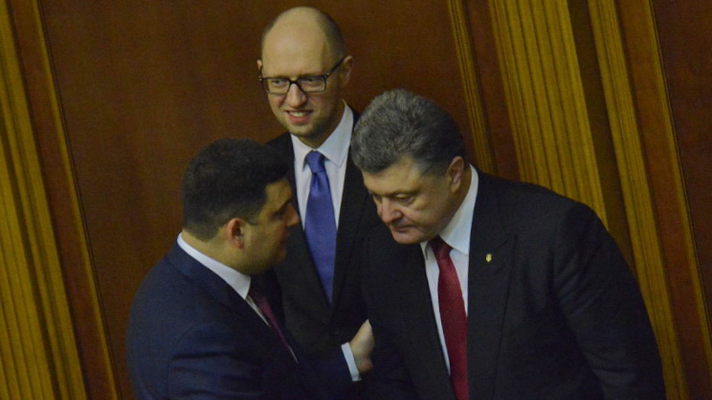
Volodymyr Groysman, Arseniy Yatsenyuk, Petro Poroshenko
After all, before Groysman, politicians with extensive experience in public and political affairs weren't the first or second. Tkachenko, Plyushch, Moroz, Lytvyn, Rybak... Each of them, before "leading" parliament, had risen through the ranks of government, with at least parliamentary experience, and at most (Moroz and Lytvyn) leadership of previous Verkhovna Radas. But the 36-year-old mayor of Vinnytsia rose to the parliamentary "leader" seat in a matter of months: like Poroshenko himself, he was swept to the top by the turbid revolutionary wave. And there's a reasonable assumption that Groysman will quickly disappear along with the Maidan's foam: virtually all experts don't give the current Verkhovna Rada a chance of a full five-year term, assuring that this parliament will last no more than a year. So, Groysman, under whose leadership the Rada has become known as the "Ukrainian Knesset," doesn't have much of a cushion. Nevertheless, it will fall to him to preserve and strengthen the pro-presidential majority, wage a silent war against Yatsenyuk and his team, and adopt a new Constitution, the need for which has already been hinted at by both the PACE and the Venice Commission. The new Constitution must become the final building block in the final legitimization of the coup d'état in Ukraine staged last February.
And all this time, we will be witnessing the standoff between Poroshenko and Yatsenyuk, as Ukraine now effectively has two presidents. Both will fight to maintain their influence domestically and secure international (primarily American) support abroad. In this struggle, Groysman is becoming Poroshenko's most important ally, and it must be said that Petro Oleksiyovych doesn't have many such allies. One only needs to look at the BPP list, which includes Lyovochkin's representatives and Kolomoisky's men, members of UDAR, and protégés of the Mejlis, to understand that the President can't count on this hodgepodge. Moreover, the most perceptive of them are already running reconnaissance missions to the Opposition Bloc, preparing for the April elections.
In fact, the cautious and reserved Poroshenko doesn't have many trusted confidantes, about 15 people, half of whom are family members (father, wife, son), while the other half are Groysman, Gontareva, and Hryniv. Not a lot, to be honest... Therefore, the President will make maximum use of these "bayonets," promoting them to the highest government positions. The examples of Groysman, Stets, and Gontareva are the most vivid confirmation of this "governance concept." Isn't this what we've been witnessing since 2010? When people with Donetsk registration became everyone and everything...
Volodymyr Groysman hails from Vinnytsia, the Poroshenko family's home region for business. When the 27-year-old, energetic private entrepreneur was elected to the Vinnytsia City Council in 2005, he convinced the region's informal overseer that he could handle the responsibilities of the council's secretary. In 2006, from this position, Groysman won his first mayoral election in Vinnytsia, certainly with organizational and financial support from Petro Poroshenko. Within five years, Poroshenko's protégé had proven his loyalty, and in 2010, he secured a second mayoral victory with 77,8%. Groysman and Poroshenko had excellent rapport during both their first and second terms as mayor, and the Petro Poroshenko Charitable Foundation served as a constant supporter of municipal reforms. The Roshen fountain in Vinnytsia stands as a visible monument to their collaboration. It's no exaggeration to say that Vinnytsia's mayor is Poroshenko's project, not Groysman's independent career and political capital. He would never have risen above the level of a minor provincial official with potential if not for the influence and resources of the Poroshenko family. Likewise, it's impossible to describe Groysman as the most successful mayor in central Ukraine—without the Poroshenko family's wealth, he would be no different from hundreds of similar mayors: after all, Groysman personally hasn't brought about any "revolutions" in the city's governance.
Essentially, Groysman as speaker is like Gontareva at the National Bank. Poroshenko's godmother, whom the President dispatched to "save the hryvnia," not only fueled inflation and squandered the NBU's gold reserves, but also became the subject of a criminal case for currency speculation at the National Bank. True, under her leadership, the income of Poroshenko's bank doubled, but was that the sole reason Gontareva was appointed to the National Bank? It turns out that the woman, who had been a capable chief accountant for Poroshenko's businesses and a personal friend of the President, is ill-suited to manage the national financial system. She lacks experience, connections, and an understanding of the situation and the operating principles of the state "machine": after all, the NBU is not Mykhailovskyi Bank. And they failed to transfer the principles of family management to the National Bank. And what did they succeed in doing? They collapsed the hryvnia, destroyed the banking system, destroyed public trust in banks, and scared off investors. The same goes for Groysman: what worked in Vinnytsia doesn't translate to the capital, where all the levers of state power are concentrated, not just Papa Poroshenko's foundation. Groysman's first misstep occurred at the Cabinet of Ministers level, where Petro Oleksiyovych brought in his protégé to implement local government reform, which Poroshenko saw as a panacea for separatism and was supposed to be an alternative to federalizing Ukraine.
However, developments (the war in Donbas and the economic collapse) forced the President to reconsider Groysman's role in history. As a result, the former mayor of Vinnytsia became a counterweight to Yatsenyuk, first in the Cabinet and now in parliament. Even when Poroshenko replaced Yatsenyuk with his Vinnytsia ally during his summer demarche, it became clear that Groysman's powers could be significantly expanded. He was a genuine contender for the post of the new head of government, and if not for the intervention of the United States, which oversees Ukraine, the mayor would now be sitting in the prime minister's chair. However, Groysman failed to achieve any feats or breakthroughs in developing local self-government at the national level. Not to mention the housing and utilities reform, which he also undertook. Groysman (and all other members of the Cabinet) were saved from failure by early parliamentary elections, when the President named his favorite among the top five "heroes of the Maidan." That is, the whole point is in Pyotr Alekseevich’s personal sympathy for his Vinnytsia friend, and not in the managerial genius of the young official.
Poroshenko wasn't even fazed by the corruption scandals involving the Groysman family (the mayor himself and his father, Borys Isakovich Groysman). This involved a high-profile corruption scandal involving the privatization of the Yunost city market and the construction of the Magigrand shopping mall, for which the Vinnytsia family took out a $10.8 million loan. However, only part of this money went toward the construction of the "wailing wall" (as locals called the project); the rest was cashed and embezzled through currency exchange centers. Naturally, no one even considered paying taxes on particularly large scales, but the Vinnytsia family attempted to "pay off" the debts with land and municipal property. The scandal, which gained momentum in 2012, was hushed up thanks to Poroshenko's influence and connections at the top, but the bitter aftertaste remained. Nevertheless, despite Groysman's deep integration into the executive hierarchy of the "Donetsk regime," Poroshenko managed to infiltrate the Vinnytsia mayor into the ranks of Maidan politicians, a group the current speaker has no connection to. Of course, no one saw Groysman on the Maidan; he was clearly on the wrong side of the tire barricades. But today, it is Volodymyr Borysovych who leads a majority in the Rada, formed exclusively from Maidan parties. Isn't this a stroke of irony? In fact, it has already played its first cruel joke on him. Recall the scandal with Sotnik Parasyuk, whom BPP deputies advised to shut up "because the Verkhovna Rada is not Maidan," while the speaker himself didn't respond at all to the battalion commander's attempts to "block" the rise of former Party of Regions members to committee leadership.
Essentially, Poroshenko is now trying to consolidate power using Yanukovych's methods. And Groysman, as Speaker of the Rada, is akin to former parliamentary speaker Volodymyr Rybak, who became Speaker only thanks to his long-standing friendship with Viktor Fedorovych and his Donetsk roots. Of course, the President's logic is understandable: he wants the parliament, which is tasked with forming the Cabinet of Ministers, passing strategic laws (for example, the abolition of non-aligned status), and approving the new Basic Law, to be under his personal control. This is especially true given that Tymoshenko has already threatened impeachment, and the People's Front is almost openly discussing future presidential elections in the Rada. But whether his Vinnytsia protégé will be up to the daunting task of "reformatting" the Verkhovna Rada to suit Poroshenko's agenda is a big question. After all, similar battles were lost in their time by the much more mature and politically savvy Moroz in 2007 and Rybak in 2013...
Maria Bakushinskaya, Golos.ua
Subscribe to our channels on Telegram, Facebook , Twitter , VK - Only new faces from the SKLEP section!