
Ukraine will not be accepted into the European Union as long as oligarchs seek power for the money. EU politicians have repeatedly expressed this idea in connection with our parliamentary elections.
DS singled out 20 newly elected people's deputies whose motives for fighting for a seat in parliament raise particularly serious doubts.
Ukraine will not be admitted to the European Union as long as oligarchs seek power for the money. EU politicians have repeatedly expressed this idea in connection with our parliamentary elections. For example, on October 30, Czech Foreign Minister Lubomír Zaorálek, speaking to university students in Uzhhorod, emphasized: "The European public will not allow its politicians to accept Ukraine into the European Union as long as public funds in this country end up in the pockets of oligarchs, as long as hundreds of millions are stolen from the state budget."
But not only EU membership—there will be no normal life for the country or its citizens at all as long as parliamentarians are preoccupied with their own enrichment. In this regard, there are many questions for the deputies who entered the Verkhovna Rada on party lists, and even more for those elected by majoritarians.
DS has identified 20 newly elected MPs whose motives for running for parliamentary seats are particularly questionable. This list, of course, is not intended to be exhaustive or definitive. Rather, it presents the most characteristic and eloquent examples of the purely personal interests that motivate wealthy, rich, and very wealthy Ukrainians to spend enormous sums on election campaigns in single-member constituencies. All those included on our list have already proven themselves sufficiently. Undoubtedly, new, unexpected "talents" may emerge in the future.
Clearly, conducting lustration among elected officials is much more difficult than among appointed officials. Nevertheless, steps in this direction are necessary. First and foremost, parliamentary immunity must be abolished. Furthermore, anti-corruption monitoring of parliamentarians' activities is needed. This should be undertaken by the public, journalists, law enforcement agencies, and intelligence agencies. This should begin with an investigation of all reports of vote-buying, bribery of election commission members, election fraud, and other violations during the election campaign. Ukrainians must see that the revolution was not in vain, and parliamentarians must learn a lesson for the future: being a member of parliament is not a business, and that doing business in parliament is a crime.
Why They Go into Power. Part One
Yevgeny Bakulin dreams of immunity
Yevhen Bakulin, a direct protégé of Yuriy Boyko and a group of "gas workers," led Naftogaz Ukrainy (Naftogaz of Ukraine) until March 25, 2014. That is, including during the annexation of Crimea, when Russia de facto seized the multi-billion-dollar assets of Chornomornaftogaz (a subsidiary of Naftogaz Ukrainy) located on the peninsula. Bakulin did nothing to mitigate Ukraine's losses from the invader's actions. No attempt was made to remove the company's assets, such as ships or helicopters, from the occupied territory, nor even Chornomornaftogaz's documentation on the results of offshore geological exploration.
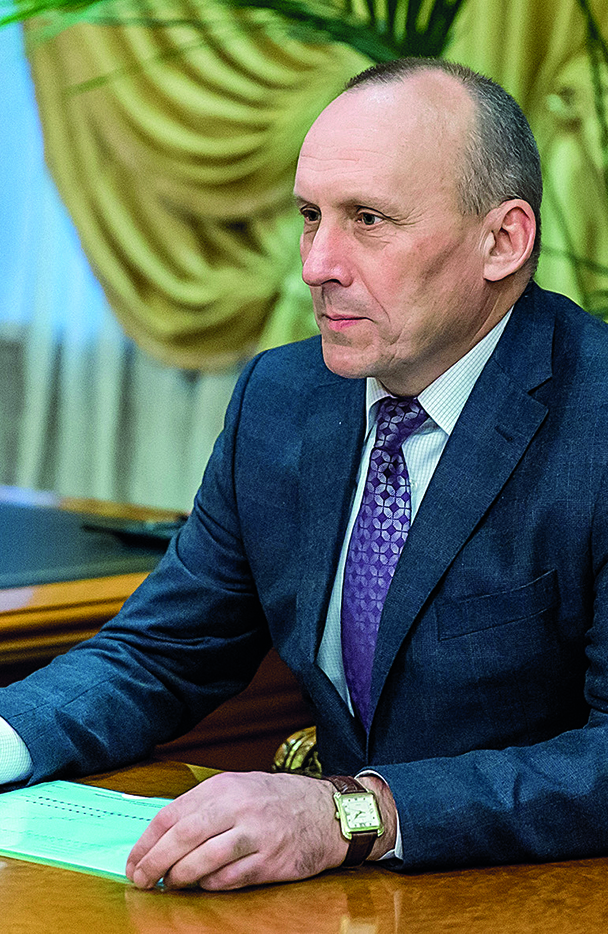
Evgeniy Bakulin
On March 21, Bakulin was arrested as part of an investigation into corruption schemes in the gas industry, with the damage he caused to the state estimated at $4 billion. On April 25, Kyiv's Pechersky District Court released Bakulin on bail of 10 million hryvnias. On October 18, according to Interior Minister Arsen Avakov, two criminal cases were opened against Bakulin, a candidate from the Opposition Bloc in constituency No. 106, for vote bribery. However, the cases stalled at the pre-trial stage, and Bakulin celebrated his victory, receiving 43% of the vote.
If the new parliament does abolish parliamentary immunity, it will signal to society that lustration can finally be applied to members of parliament. And Bakulin's absence from the list of suspects sought by investigators in particularly important cases will likely create a major scandal. Therefore, it's safe to assume that the controversial former head of Naftogaz will no longer be present on the day of the vote.
Evgeny Balitsky: Curator of the Melitopol fifth column
Melitopol District No. 80, as in 2012, was won again by Yevhen Balitsky, son of local bottling oligarch Vitaliy Balitsky. The family controls the Avtogidroagregat plant and brewery, the region's largest motor depot, and retailers selling household and electrical goods. In 2013, the Balitsky family clashed bitterly with Yevhen Anisimov, the family's then-supervisor for the Zaporizhzhia region, who wanted to extend his influence to Melitopol as well. The mayor, Serhiy Valter, a direct protégé of the Balitsky family, fell victim to the infighting; he remains under investigation for creating an organized crime group.
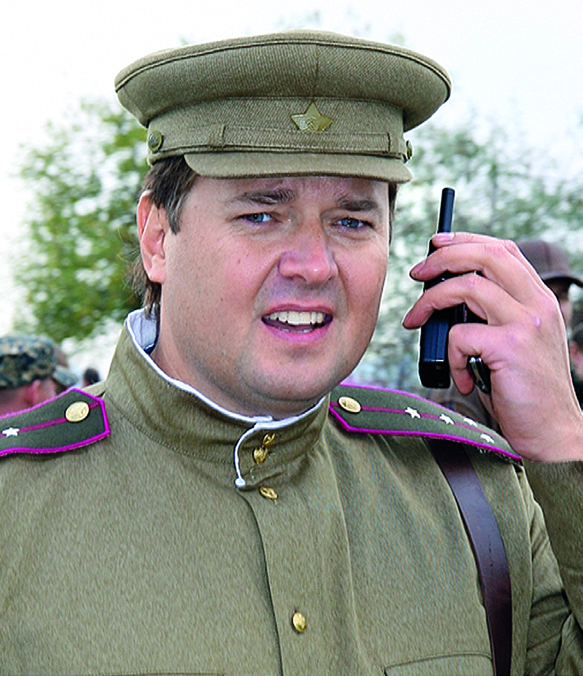
Evgeny Balitsky
Following Anisimov's arrest late last year, a new "family" enforcer, Donetsk businessman Andriy Alesha, arrived in the region. During the revolution, the Zaporizhzhia People's Council accused Zaporizhzhia Mayor Oleksandr Sin of ties to Donetsk criminals led by Alesha. In September, local media reported that the region's first deputy governor, Hryhoriy Samardak, was seen in the new enforcer's office at the Sheraton Hotel. Alesha, unlike Anisimov, established a constructive dialogue with the Balitsky brothers and is rumored to have supported Yevhen Balitsky's election as a member of parliament at the regional level. In the seventh parliament, after Yanukovych's flight, Balitsky joined the pro-Kremlin group "For Peace and Stability." In the new parliament, he will also be a conduit for fifth column interests: Melitopol is an important regional transportation hub, and the Kremlin would be very keen for pro-Ukrainian sentiments not to dominate the city.
Stanislav Berezkin: A Regional Prince Without Inner Complexes
Stanislav Berezkin, the main owner of the Kreativ industrial group (oilseed processing, fat and margarine production, land ownership, and pig farming), first ran for parliament in February 2011 on the BYuT list, and on March 1, he switched to the Party of Regions faction. In 2012, he won constituency #100 in the Kirovohrad region as a Party of Regions candidate. He voted for the dictatorial laws on January 16 and remained a member of the Party of Regions faction until Yanukovych's flight. He won the current election as a non-partisan, despite the fact that there were no candidates from either the Petro Poroshenko Bloc or the People's Front in his constituency.
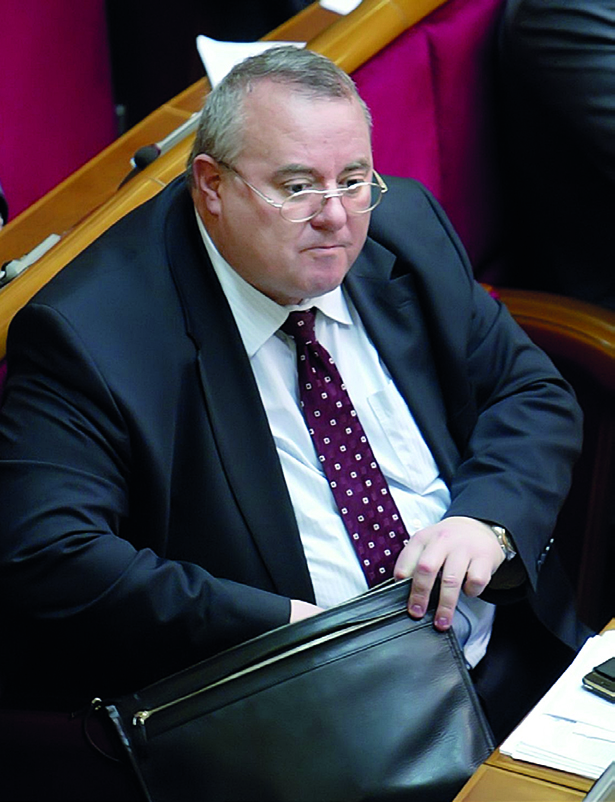
Stanislav Berezkin
Berezkin's involvement in politics has never hindered his business development. One recalls how, in the mid-1990s, Berezkin's company, Sistema SSB, refused to repay a loan provided by the American fund Western NIS for the development of the joint venture Sonola (which later became Kreativ). Or how, in 2012, Kirovohrad-based Gradoliya LLC struggled to launch its sunflower seed processing lines, accusing competitors from Kreativ of inciting tax and judicial authorities against the business.
Berezkin's activities are smaller in scale than those of many of the other figures in this DS report. However, as long as such regional princelings feel fully in control of the Ukrainian provinces, the soil for the idea of a new Koliyivshchyna will remain well-fertilized.
Vyacheslav Boguslayev will oversee contracts
Vyacheslav Boguslayev, General Designer and President of Motor Sich PJSC, was elected from the same Zaporizhzhia city district #77, as in 2012. Prior to that, he had twice entered parliament on the Party of Regions list and served in the Party of Regions faction for the entire seventh convocation (even after Yanukovych's flight). Boguslayev's primary concern is maintaining the profitability of his life's work, regardless of the state of relations between Ukraine and Russia. And this is much more conveniently accomplished from the parliamentary dome than from the general designer's office in Zaporizhzhia. There are indirect indications that the company's products continue to reach Russian consumers, albeit indirectly, through shell companies, contractors, or partners in other countries. Firstly, no one has heard of the Russian Helicopters holding company suing Motor Sich for failure to fulfill a five-year contract signed in November 2011 for $1,2 billion, which provides for the annual supply of 270 engines for helicopters: the multi-role Mi-8 and Mi-17, the attack Mi-28, the transport and combat Mi-24, the radar patrol Ka-31, and the transport Ka-32.

Vyacheslav Boguslaev
Secondly, at a stable enterprise, there are no signs of increased social tension, which would inevitably occur if the plant were deprived of its main source of foreign currency earnings. Thirdly, it's worth recalling Boguslayev's September statement, made during the international Hydroaviasalon in Gelendzhik: "I am very grateful to our President Poroshenko. He's a pragmatist. His decree prohibits the supply of products if they will be used by the Russian Ministry of Defense... We had only 3,2% of the plant's turnover supplied not to the Russian Ministry of Defense, but for products that could be lethal. We no longer supply that. But if, say, our aircraft engines are supplied to Russian enterprises, and not to the Russian Ministry of Defense, there are no restrictions."
Alexander Gerega: Big money and little wealth
"Do I need a mandate as a people's deputy of Ukraine in the current circumstances of Ukraine? This is the number one question for me today," philosophizing Oleksandr Gerega, a member of the Party of Regions faction, wrote on Facebook (since deleted) on February 20, when the authorities were shooting at peaceful protesters in central Kyiv. It turns out, yes, he does. Moreover, the owner of the Epicenter retail chain, in the rural 192nd district of Khmelnytskyi Oblast, with its center in Dunaivtsi, which he's been "favoured" since 2012, actually scored higher than two years ago—73,9% versus 58%.
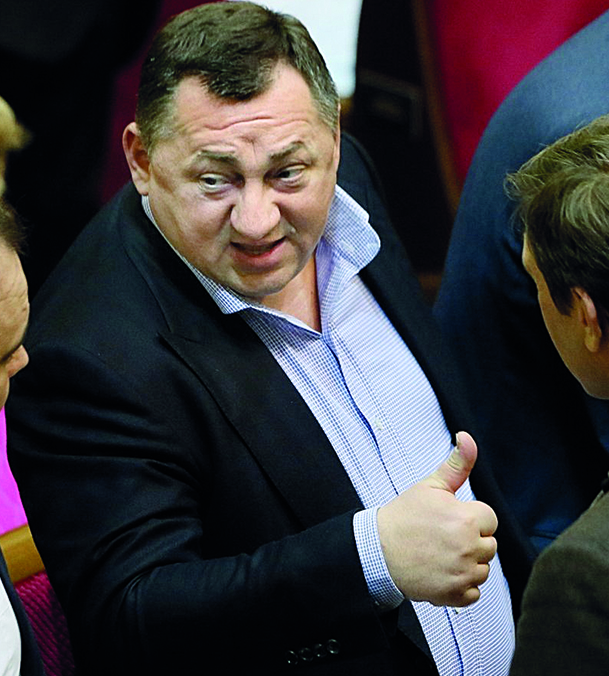
Alexander Gerega
Renovations of social facilities, gifts for Independence Day and other holidays, organizing children's recreation in Koblevo and Odessa, and tourist excursions to Kyiv... The "For Concrete Deeds" charitable foundation financed the entry into parliament not only of Gerega but also of his hired manager, Andrey Shinkovich, deputy head of Epicenter K LLC (for constituency No. 189, centered in Krasilov).
There's another point worth remembering. In early October, the Kyiv Commercial Court granted Epicenter K LLC permission to demolish a bus depot in the capital's Obolonskyi district to build a new hypermarket. The corresponding ban by the Kyiv prosecutor's office was withdrawn, and the city administration reassured the public, explaining that the terms of the investment agreement stipulate the construction of a bus depot in Troyeshchyna and its transfer to Kyiv municipal ownership. There's no doubt that the Gereg family has many more exciting projects ahead.
Yuri Vishnevsky, Evgeny Pivnev, "Business Capital"
Subscribe to our channels on Telegram, Facebook , Twitter , VK - Only new faces from the SKLEP section!